On this page
IB commission sounds complicated, but it comes down to one multiplication and a few deductions. This guide gives you enough to work the number out yourself before you sign, and tells you in advance which parts make the amount you actually receive smaller than the figure in your head.
Source for the clause numbers: CXM Direct’s published IB agreement (PDF © 2018 on cxmtrading.com, read Sep 15, 2026) and CXM’s Introducing Brokers page (read Sep 14, 2026). Every money figure in this guide is a made-up example, not CXM’s rebate; the real rate is negotiated when you sign.
The formula
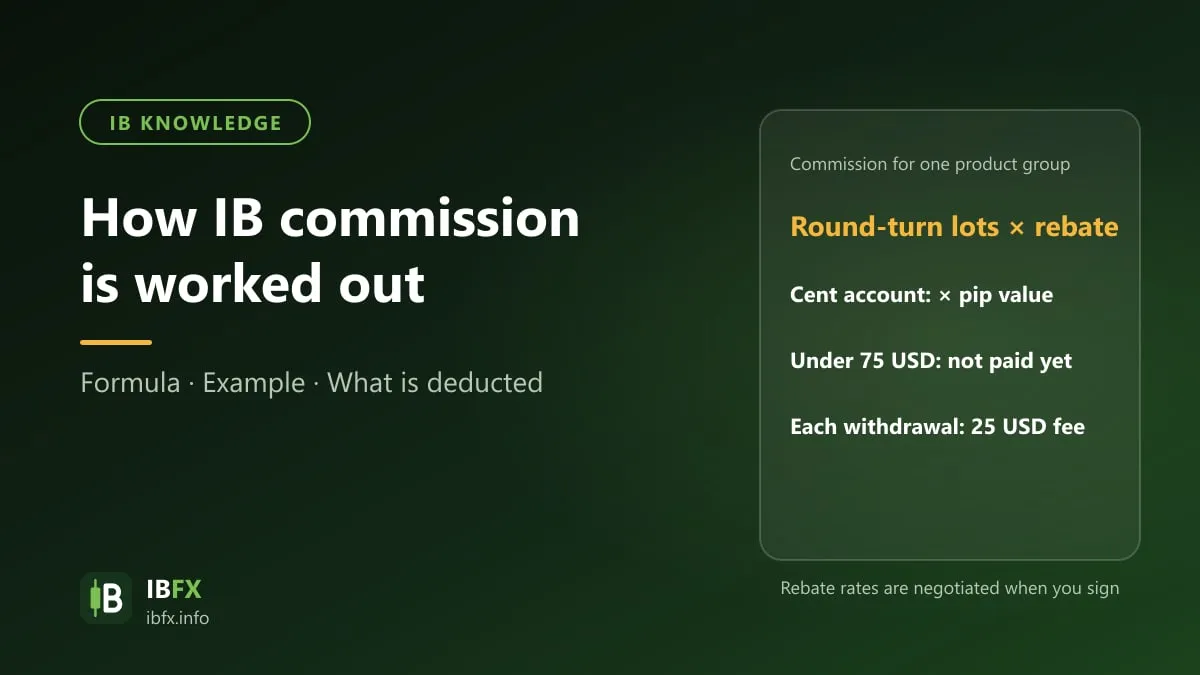
Commission for one product group = round-turn lots × the rebate per lot for that group
Add the groups together and you have the total commission for the period. Three terms in that formula need to be understood correctly:
Round-turn lot. A 1 lot trade opened and then closed counts as 1 round-turn lot. A 0.5 lot trade counts as 0.5. Only closed trades count, so an open trade has not generated commission yet.
Product group. CXM’s rebate schedule splits products into four groups: FX and energies, metals, crypto, indices. Each group has its own rate, so you work each group out separately and then add them up; you do not multiply the total lots by a single rate.
Rebate per lot. Usually quoted in USD per lot. For Cent accounts it is quoted in pips, and then it has to be converted.
An example for one payment period
Suppose that during the period your clients trade as follows, at the made-up rebate rates below:
| Product group | Round-turn lots | Rebate per lot | Commission |
|---|---|---|---|
| FX and energies | 40 | 7.0 USD | 280.0 USD |
| Metals | 5 | 9.0 USD | 45.0 USD |
| Indices | 2 | 4.0 USD | 8.0 USD |
| Total | 333.0 USD |
Put the same set of figures into the IB commission estimate tool and you get the same result. The tool calculates in your browser and does not send what you type to a server.
When the rebate is counted in pips
For a Cent account the rebate is quoted in pips. The formula becomes:
Commission = round-turn lots × the rebate in pips × the pip value of 1 lot
For example: 12 round-turn lots, a rebate of 0.8 pips, and a pip value of 10 USD for 1 lot.
12 × 0.8 × 10 = 96 USD
The pip value differs by currency pair and by account currency, so when you are working across several pairs, work each pair out separately. The Pip value tool handles that part for you.
Two things that make the amount you actually receive smaller
Under clause 6 of CXM’s IB agreement:
- A payment period with a rebate under 75 USD is not paid out. The agreement says only that much; it does not say whether the small amount carries over to the next period or is dropped, so ask the broker exactly when your account is set up.
- Each withdrawal carries a 25 USD bank transfer fee. Withdrawing in small pieces lets the fee eat into the difference: 4 withdrawals in a month cost 100 USD in fees.
Take the 333 USD above: withdraw once and you actually receive 308 USD. The same amount split into three withdrawals leaves 258 USD.
“Instant” and “reconciled quarterly”: two sources that do not agree
This is the point to ask about in writing before you sign:
- CXM’s Introducing Brokers page says “Instant IB rebate” and “Withdraw IB commission immediately”.
- The template IB agreement (clause 34) says the share of the spread markup and the commission are reconciled quarterly.
Those two statements are not the same thing about when you actually have the money in hand. IBFX records both on the IB partner page exactly as the published documents put them, and advises you to ask exactly how it is recorded for your own account when it is set up, instead of guessing.
How it works out across IB levels
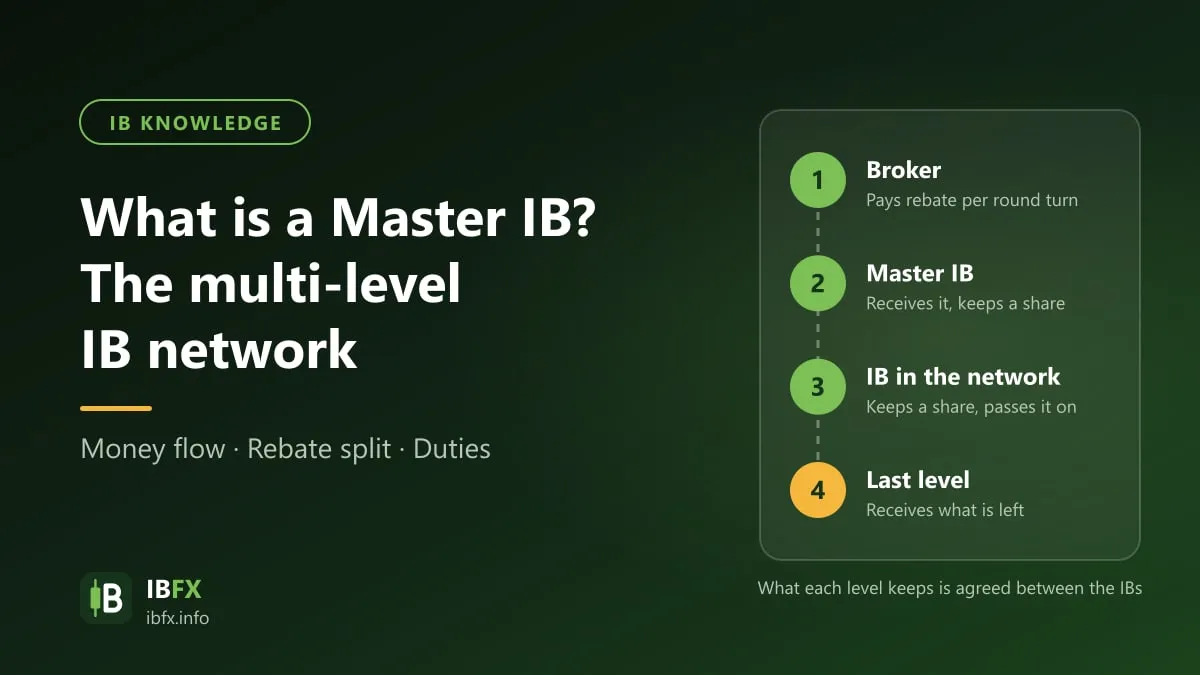
If you are inside a multi-level network, the rebate you multiply by is your share after the levels above have kept theirs, not the rate the broker pays the top level. The split is covered in detail in What is a Master IB? How a multi-level IB network works, and you can try the numbers with the Rebate split across IB levels tool.
What this number does not tell you
The multiplication above only tells you what the commission is for that number of lots at that rebate. It does not predict how many lots your clients will trade, and that volume changes from month to month, and with whether a client still has capital left.
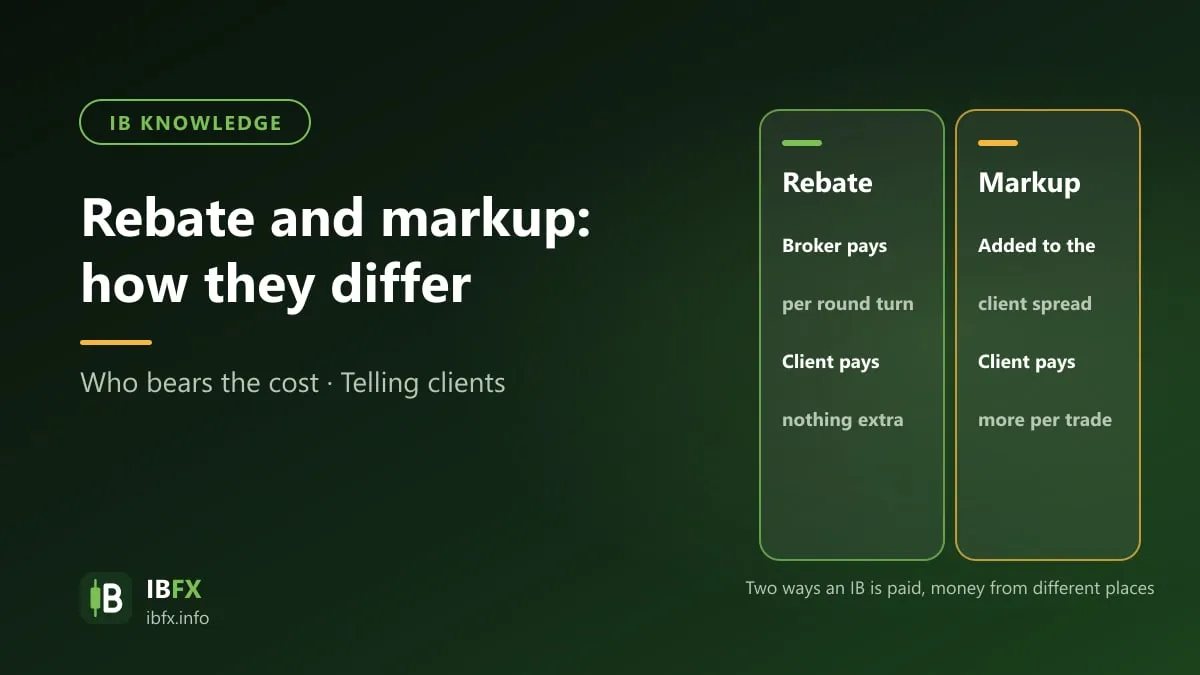
So do not read a steady rate into one good month, and do not promise anyone a figure. The IB agreement also forbids promising to shield a client from losses, and forbids any side agreement with a client about profit (clauses 4.13, 19). The more durable approach is to make sure a client understands the risk before they deposit: see Rebate and markup for the amount a client pays on top.
The legal risk is worth weighing first as well: in Vietnam, foreign forex brokers are not licensed by the State Bank of Vietnam to provide foreign exchange services to individuals, and introducing clients in return for commission may be treated as unlicensed foreign exchange brokerage. See Is forex trading legal in Vietnam?. IBFX does not give legal advice.
Summary
- Commission = round-turn lots × the rebate per lot, worked out for each product group separately and then added up.
- A Cent account is counted in pips, so you multiply by the pip value of one lot as well.
- A period under 75 USD is not paid out; each withdrawal costs 25 USD, so withdraw in one go rather than in small pieces.
- CXM’s page says the rebate is paid instantly, the template agreement says it is reconciled quarterly; ask in writing when your account is set up.
- Inside a multi-level network, multiply by your share after the levels above have kept theirs.
- For the rates that apply to IBs in the IBFX network, contact IBFX.