On this page
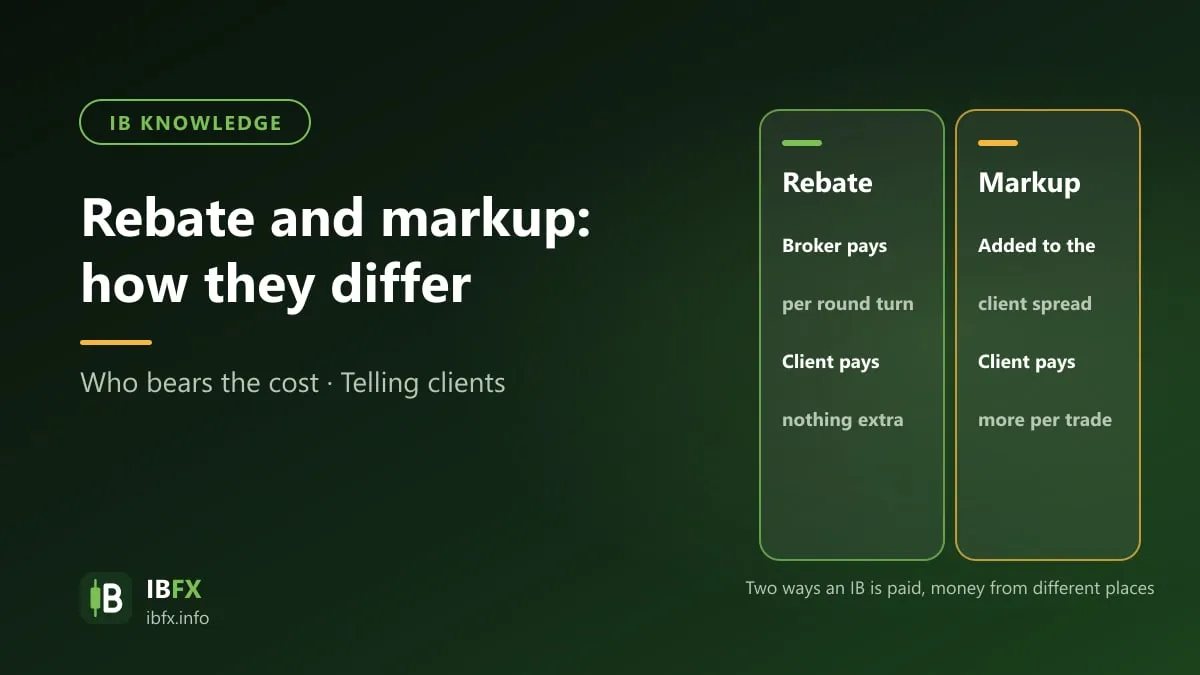
When you look into a forex broker’s IB program, two words turn up together: rebate and markup. Both are ways the broker pays an IB, but the money comes from different places, and only one of the two costs your client anything extra. Understanding that difference is the first thing to do, because it decides what you tell a client.
This guide uses CXM Direct’s IB agreement as its example, because IBFX is a Master IB of CXM Direct. The clause numbers come from the published IB agreement (PDF © 2018 on cxmtrading.com, read Sep 15, 2026) and from CXM’s Introducing Brokers page (read Sep 14, 2026). The actual amounts are negotiated when you sign, so this guide quotes nobody’s figures.
Rebate: the broker pays on the volume your client trades
A rebate is the amount the broker pays an IB based on the trading volume of the clients that IB introduced. Three points to hold on to:
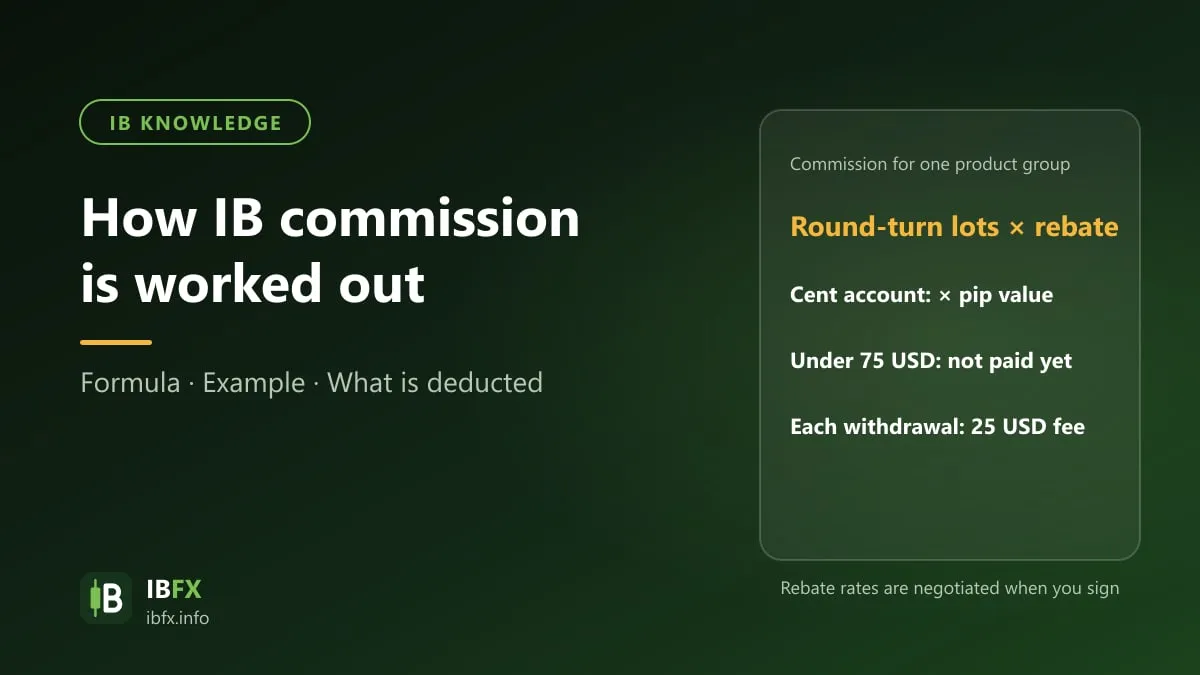
- Counted per round-turn lot. A 1 lot trade opened and then closed counts as 1 round-turn lot. A client entering 0.5 lots and closing counts as 0.5.
- It differs by product group. CXM’s rebate schedule splits products into four groups: FX and energies, metals, crypto, indices. For the same number of lots, a client trading gold and a client trading a currency pair generate different rebates.
- Cent accounts are counted in pips. For that account type the rebate is quoted in pips rather than in USD per lot, so to turn it into money you multiply by the pip value of one lot.
The rebate money comes out of the broker’s revenue on that trading. The client pays the spread and the fees set by the account type they are using, and nothing is added because there is an IB.
To see a figure, put your lots and your rebate rate into the IB commission estimate tool. It runs in your browser, and needs no sign-up.
Markup: added to your client’s spread
A markup is an amount added to the spread the client pays. An account with markup carries a higher spread than the same account type without markup, so every trade the client makes costs more. The broker collects that amount from the client and pays it over to the IB (clause 34 of CXM’s IB agreement).
CXM’s Introducing Brokers page calls this “flexible markup”, meaning the IB gets to choose the rate. This is exactly where to be careful: the higher the markup, the more your client pays, and that cost turns up on every trade, including losing ones.
The difference in one line: who bears the cost
| Rebate | Markup | |
|---|---|---|
| Where the money comes from | The broker’s revenue on the client’s trading | An amount added to the spread the client pays |
| Does the client pay more | No | Yes, on every trade |
| Counted by | Round-turn lots, by product group | The amount added to the spread |
| Does the IB choose the rate | Negotiated when you sign | Yes, by agreement with the broker |
So the two do not replace each other, they add up: one account can generate a rebate and carry a markup at the same time.
Will your client know you are paid?
Yes, and this is something to say up front rather than leave a client to find out. Under clause 33 of the IB agreement, CXM notifies the client in writing that CXM pays the IB; if the client asks, they are told the amount and which IB receives it.
IBFX discloses this on every page too: when you open an account through a referral link on this site, IBFX may receive commission from the broker.
If a client’s account carries markup, say plainly that their spread is higher than on the same account type without markup. Clients comparing trading conditions between one place and another is perfectly normal, and knowing in advance means they do not feel anything was hidden from them.
What an IB is not allowed to do
The IB agreement sets out several limits that bear directly on money:
- Do not charge a client anything extra beyond the commission the agreement allows (clause 8). You cannot set up an “advisory fee” or a “signal fee” charged on a client’s trading with the broker.
- Do not take a client’s money (clause 4.6). The client deposits straight into their own account at the broker.
- Do not trade for a client without written authority (clause 5).
- Do not let a client trade more than they should simply to generate commission. That is churning; the broker can act on an account flagged for it to protect the client.
- Do not promise to shield a client from losses, and make no side agreement with a client about profit or about capping a loss (clauses 4.13, 19).
The fuller list is under what an IB is responsible for on the IB partner page.
Before you sign: four things to ask about
- The rebate for each product group, and how it is recorded for your account.
- The default markup for new clients, and whether you are allowed to change it.
- When the money is paid. CXM’s page says the rebate is instant and can be withdrawn straight away; the template IB agreement says the markup share and the commission are reconciled quarterly, that a period with a rebate under 75 USD is not paid out, and that each withdrawal carries a 25 USD bank transfer fee (clause 6). The two sources do not agree, so ask again in writing when your account is set up.
- Promotional material. Articles, websites, ads and the messages you send clients have to be approved by the broker before you publish them (clauses 4.1–4.3).
The legal risk to know about first
In Vietnam, foreign forex brokers are not licensed by the State Bank of Vietnam to provide foreign exchange services to individuals. Introducing clients to trade at a foreign broker in return for commission may be treated as unlicensed foreign exchange brokerage, and in a dispute with the broker neither you nor your client is protected by Vietnamese law. This is covered in more detail in Is forex trading legal in Vietnam? and in the legal section of the IB partner page.
IBFX does not give legal advice. Before you work as an IB, read the rules in force or ask a lawyer.
Summary
- A rebate comes out of the broker’s revenue and costs the client nothing extra; a markup is added to the spread, so the client pays more on every trade.
- A rebate is counted per round-turn lot and differs by product group; Cent accounts are counted in pips.
- The broker tells the client that it pays the IB, so say it first yourself, above all when the account carries markup.
- An IB may not charge a client anything extra, take a client’s money, or trade for a client without authority.
- To talk through the rebate and markup rates for IBs in the IBFX network, contact IBFX.