On this page
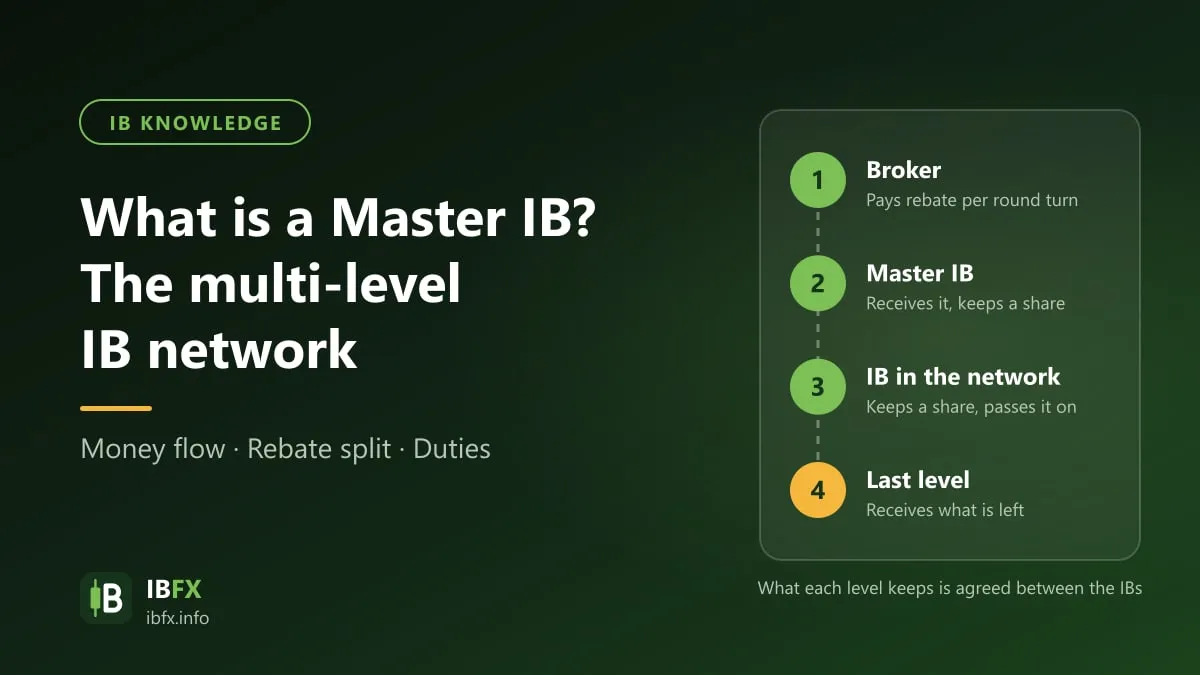
An IB can bring in IBs of their own, and that is when several levels appear. The IB that runs the whole group is called a Master IB. CXM Direct’s Introducing Brokers page states there is “no limit on IB levels”, which means an IB in the network can have IBs of their own as well.
IBFX is a Master IB of CXM Direct. When you become an IB with IBFX, your IB account sits inside the IBFX network at CXM Direct, and IBFX receives commission on the trading volume of clients across the whole network, including the clients of IBs in the IBFX network. This guide sets that mechanism out plainly so you know what you are stepping into.
Sources: CXM’s published IB agreement (PDF © 2018 on cxmtrading.com, read Sep 15, 2026) and CXM’s Introducing Brokers page (read Sep 14, 2026).
The money flows in one direction
The broker pays the rebate only to the top level of the network, and the levels then share it out:
- The client trades, and the broker works out the rebate from the round-turn lots and the product group.
- The broker pays the rebate to the top level, that is, the Master IB.
- The Master IB keeps a share and passes the rest on to the next level.
- And so on down to the last level, the one that introduced the client directly. The last level receives what is left after every level above has taken its share.
What each level keeps is agreed between the IBs themselves; it is not a rate the broker sets. That is why, when you talk to a Master IB, the most important question is: for every lot my client trades, how much do I receive?
An example of splitting the rebate per lot
Suppose the broker pays 7 USD per lot to the top level. This figure is made up to illustrate the arithmetic; it is not CXM’s rebate, and the real rate is negotiated when you sign.
| Level | Role | Keeps per lot | Share |
|---|---|---|---|
| Level 1 | Master IB, receives the rebate from the broker | 3.0 USD | 42.9% |
| Level 2 | IB in the network, has IBs of their own | 1.5 USD | 21.4% |
| Level 3 | The last level, introduces the client | 2.5 USD | 35.7% |
If the clients of the last level trade 20 lots in a month, that level receives 20 × 2.5 = 50 USD, level 2 receives 30 USD, and level 1 receives 60 USD from those same 20 lots.
To try it with your own figures, use the Rebate split across IB levels tool: enter the rebate per lot and what each level above keeps, and the tool gives you what is left for the last level, with the percentage.
Two things the example shows:
- The deeper the level, the thinner the share per lot, because every level above keeps part of it. There is no way around that other than renegotiating.
- The shares never add up to more than the rebate the broker pays. If someone promises you a share larger than what the broker pays for the whole network, that number cannot stay true for long.
Do more levels mean less responsibility?
No. The IB agreement binds each IB to the broker, so at any level you carry the same duties:
- Your promotional material has to be approved by the broker before you publish it (clauses 4.1–4.3). A Master IB reviewing it first saves you a step of preparation, but the content of your website and your messages is your responsibility.
- Do not take a client’s money (clause 4.6), do not trade for a client without written authority (clause 5), and do not charge a client anything extra (clause 8).
- Do not promise a client that they will be kept from losses, and make no private arrangement with a client about profit or about capping a loss (clauses 4.13 and 19).
- Do not let a client trade more than they should simply to generate commission. That is churning, and the broker can act on an account flagged for it.
- Follow the law where you operate, including licenses and tax (clauses 4.4, 4.5).
One more point few people notice: liquidity limits are counted together across the group. When one IB or money manager controls several accounts, the limits on lots per trade, on the waiting time and on open lots apply to the whole group of accounts, not to each account separately. A breach can mean commission is refused and trades are cancelled. Check a list of trades first with the CXM liquidity limits tool.
Who a multi-level network suits
This model fits when you already have a community, a group or students who trust you, and you want to do it for the long run: teaching clients, having them practice on a demo account before they deposit, and saying plainly that capital can be lost.
It does not fit if you only want a steady sum of money without looking after clients, or if you want to take clients’ money and trade on their behalf. Those last two breach the IB agreement.
There is legal risk to keep in mind too: in Vietnam, foreign forex brokers are not licensed by the State Bank of Vietnam to provide foreign exchange services to individuals, and introducing clients in return for commission may be treated as unlicensed foreign exchange brokerage. See Is forex trading legal in Vietnam? and the legal section on the IB partner page. IBFX does not give legal advice.
Summary
- A Master IB is an IB that runs a network of several IBs; the broker pays the rebate only to the top level.
- Each level keeps a share and the last level receives the rest; what is kept is agreed between the IBs themselves.
- The deeper the level, the thinner the share per lot, and the shares never add up to more than the rebate the broker pays.
- Responsibility under the IB agreement does not shrink when there are more levels, and that includes liquidity limits being counted together.
- To find out the rates inside the IBFX network, contact IBFX. The account-opening links on this site are for clients who want to trade; they are not IB sign-up links.