On this page
Forex is an online investment channel that many people look into, and both the number of participants and the number of brokers advertising keep growing. With stocks, an investor does not have to worry about the legal risk of the activity, because the stock market is protected by the state and Vietnamese law both allows stock investors to trade and protects their rights. With Forex it is exactly the opposite.
The easiest thing to notice is that news about the stock market, about stock investors, shares and derivatives is broadcast regularly on mainstream news programs, while news about Forex is not. Stocks are traded through state-run exchanges, whereas Forex is traded through brokers abroad, with no sign of the Ministry of Finance or of the Vietnamese government anywhere. Doubts about the legal standing of this investment channel are therefore well founded.
In this article we answer the question “Is Forex trading against the law in Vietnam?” head-on, so that you can think it through carefully before deciding whether to take part in this market.
How the Forex market operates in Vietnam
The foreign exchange (Forex) market in its modern form, with floating exchange rates, took shape after the collapse of the Bretton Woods system in the early 1970s. It is a global decentralized market, where the banks of different countries exchange currencies with one another. The participants include central banks, commercial banks, investment funds, credit institutions, other financial institutions and retail investors.
As technology has developed, the Forex market now lets individuals take part in this global trading network through an intermediary: the broker, or Forex broker.
Forex is the largest financial market today, with trading volume running into trillions of dollars a day; it attracts a lot of people, but the risk is very high. To trade Forex, an investor needs to open an account at a broker and trade currency pairs by placing buy orders (if they expect the price to rise) or sell orders (if they expect the price to fall), and the profit or loss is worked out from the difference between the price when the order was placed and the price when it was closed. This is precisely margin trading through an online account, where the net result is revalued continuously as prices on the market move.
Unlike stocks, Forex offers an investor a far more convenient trading environment: the market runs 24/5, so a trader can trade at any hour of the day; liquidity is high, so positions are easy to open and close; leverage means you can invest with a small amount of capital; and a phone with an internet connection is all you need to trade Forex…
Forex arrived in the Vietnamese market more than 10 years ago and has drawn in many individual investors. It is, however, a specialized form of financial investment that requires a certain level of knowledge of technology and of international finance, so the Vietnamese government allows only credit institutions and organizations approved by the State Bank of Vietnam to deal in and supply foreign exchange services.
Elsewhere in the world, Forex brokers are approved and governed by national law and supervised by reputable foreign exchange regulators, and individuals are allowed to take part in the market as investors and traders. In Vietnam, all of this is restricted.
The rules of Vietnamese law on Forex
Foreign exchange business in Vietnam is currently governed by the following legal documents:
- The Ordinance on Foreign Exchange.
- Decree 88/2019/ND-CP on administrative penalties in the monetary and banking sector (this Decree replaced Decree 96/2014, took effect on Dec 31, 2019, and has been amended and supplemented by Decree 143/2021/ND-CP).
- The Law on Credit Institutions (currently Law 32/2024/QH15, in effect from Jul 1, 2024).
- Circular 20/2011/TT-NHNN of the State Bank of Vietnam: rules on the purchase and sale of foreign currency in cash between individuals and authorized credit institutions.
- The Law on Handling of Administrative Violations.
The passages below are quoted from the Vietnamese originals and rendered in English by IBFX for reading only. They are not official translations, and only the Vietnamese text has legal force.
Of these, Article 36 of the Ordinance on Foreign Exchange, on the principles for dealing in and supplying foreign exchange services, reads:
- Credit institutions, branches of foreign banks and other organizations may deal in and supply foreign exchange services domestically and abroad after obtaining written approval from the State Bank of Vietnam.
- The State Bank of Vietnam prescribes the scope of dealing in and supplying foreign exchange services domestically and abroad, and the conditions, order and procedures for approving the dealing in and supply of foreign exchange services by credit institutions, branches of foreign banks and other organizations.
Read the full Ordinance on Foreign Exchange here
Article 23, Section 7, Chapter II of Decree 88/2019/ND-CP, on penalties for breaches of the rules on foreign exchange activity (quoted from the original 2019 text; some penalty amounts have since been amended, so check the latest consolidated text when it matters):
- A warning shall be imposed for any of the following violations:
- a) Buying or selling foreign currency between individuals where the currency bought or sold is worth less than 1,000 US dollars (or an equivalent amount in another foreign currency);
- b) Buying or selling foreign currency at an organization not licensed to exchange foreign currency where the currency bought or sold is worth less than 1,000 US dollars (or an equivalent amount in another foreign currency);
- c) Paying for goods or services in foreign currency worth less than 1,000 US dollars (or an equivalent amount in another foreign currency) contrary to the law.
- A fine of VND 10,000,000 to VND 20,000,000 shall be imposed for any of the following violations:
- a) Buying or selling foreign currency between individuals where the currency bought or sold is worth from 1,000 US dollars to less than 10,000 US dollars (or an equivalent amount in another foreign currency); buying or selling foreign currency between individuals where the currency bought or sold is worth less than 1,000 US dollars (or an equivalent amount in another foreign currency), in the case of a repeated violation or of violating several times;
- b) Buying or selling foreign currency at an organization not licensed to exchange foreign currency where the currency bought or sold is worth from 1,000 US dollars to less than 10,000 US dollars (or an equivalent amount in another foreign currency); buying or selling foreign currency at an organization not licensed to exchange foreign currency where the currency bought or sold is worth less than 1,000 US dollars (or an equivalent amount in another foreign currency), in the case of a repeated violation or of violating several times;
- c) Paying for goods or services in foreign currency worth less than 1,000 US dollars (or an equivalent amount in another foreign currency) contrary to the law, in the case of a repeated violation or of violating several times; paying for goods or services in foreign currency worth from 1,000 US dollars to less than 10,000 US dollars (or an equivalent amount in another foreign currency) contrary to the law.
And penalty brackets from VND 20,000,000 to VND 250,000,000, plus other additional penalties, for more serious breaches of the rules on foreign exchange activity.
Read the full text here
Article 2 of Circular 20/2011/TT-NHNN, on who may buy, sell and exchange foreign currency:
- An individual who is a Vietnamese citizen may buy foreign currency in cash at an authorized credit institution to cover their own spending needs and those of a child sharing a passport with their father or mother, including food, pocket money and travel costs abroad, for the following purposes:
- a) Study or medical treatment abroad;
- b) Business trips, tourism or visits abroad.
- For the other lawful purposes set out in Clause 2, Article 8 of the Government’s Decree 160/2006/ND-CP of Dec 28, 2006 detailing the implementation of the Ordinance on Foreign Exchange, an individual may buy foreign currency in cash at an authorized credit institution depending on that institution’s ability to balance its supply of foreign currency in cash.
- An individual who is a foreigner with lawful income in Vietnamese dong may buy foreign currency in cash at an authorized credit institution in accordance with the foreign exchange management rules in force.
- An individual sells foreign currency in cash at an authorized credit institution, or at a foreign currency exchange agent of an authorized credit institution, in accordance with the foreign exchange management rules in force.
Read the full Circular here
So, is Forex trading against the law in Vietnam?
First, for brokers based in Vietnam
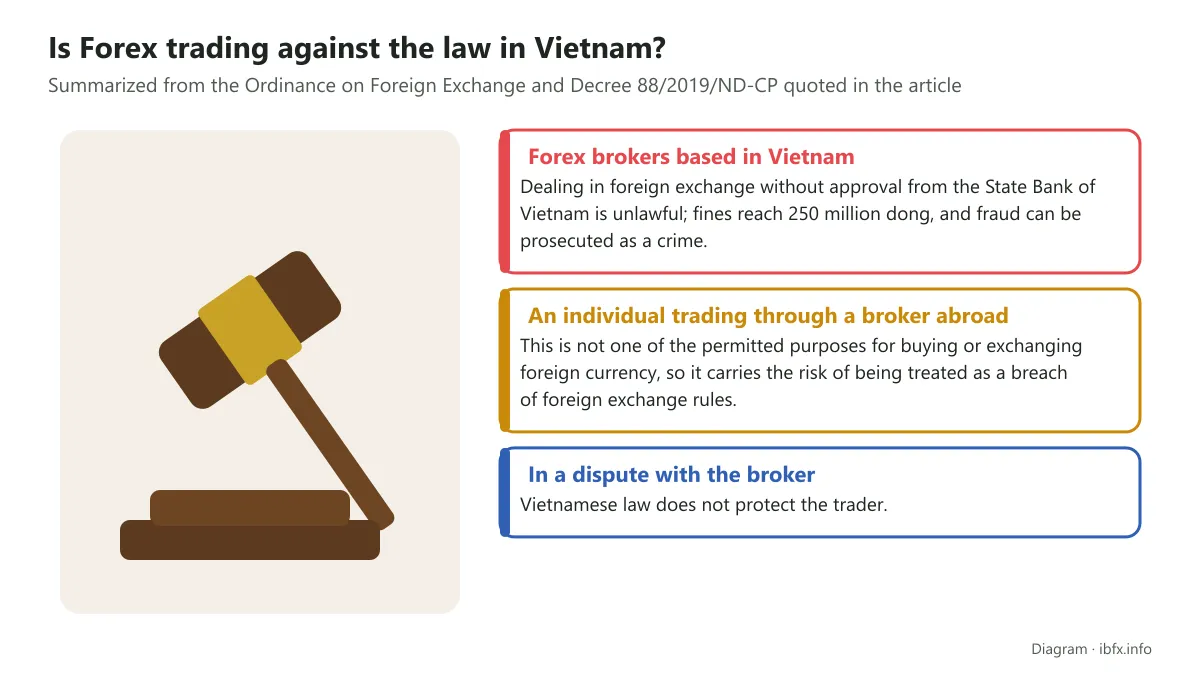
Under the Ordinance on Foreign Exchange quoted above, any organization dealing in foreign exchange without written approval from the State Bank of Vietnam is acting unlawfully. Forex brokers based in Vietnam are therefore all unlicensed operations, running against the law.
If one of these unlicensed brokers is caught, it faces heavy administrative penalties of up to VND 250 million. A broker that defrauds investors and misappropriates their money may be dealt with under the Criminal Code, usually as fraudulent misappropriation of property (article 174) or abuse of trust to misappropriate property (article 175); the charge and the sentencing range in any given case are set by the prosecuting authorities.
Second, for traders and individual investors
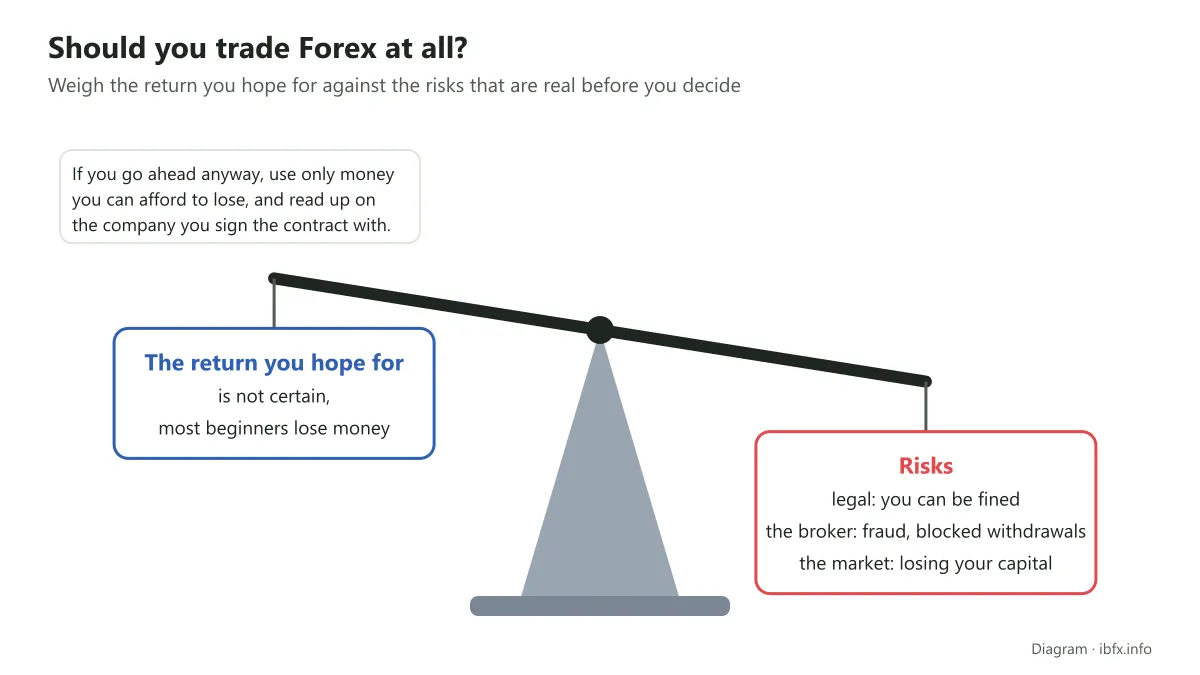
Also under the Ordinance on Foreign Exchange, dealing in and exchanging foreign currency may only be carried out by credit institutions and other organizations designated by the State Bank of Vietnam. An individual buying, selling or exchanging foreign currency has to stay within the purposes spelled out in Circular 20/2011/TT-NHNN set out above. Forex investing by an individual investor falls outside those purposes, so trading Forex through a broker abroad carries the risk of being treated as a breach of the foreign exchange management rules. What is certain is that an individual investor is not protected by Vietnamese law in a dispute with the broker.
Even so, because the market is easy to get into and the returns look attractive, a great many investors have taken the risk and started trading Forex.
Beyond the legal risk, a trader also faces risks that come from the broker and from the market.
There are hundreds of Forex brokers out there, and plenty of them hold no license from any reputable regulator; an investor who opens an account at one of these runs the risk of being defrauded, of having withdrawals refused, and of losing their money.
If you still decide to take part, pick a broker in a group licensed by a reputable regulator, and read carefully the name of the company that signs the contract with you. Understand that the protection a licensing authority provides (such as the compensation funds in the UK and the EU) applies only to clients of that exact licensed company; international clients are usually given an account at a subsidiary registered somewhere else, and so get almost no protection. See how to check a broker.
The Forex market moves constantly and is pushed around by many different economic and financial factors; without trading knowledge and an understanding of international finance, an investor will lose money quickly. According to the warning that brokers in Europe are required to publish, most retail investor accounts lose money when trading CFDs.
Given the legal risk in Vietnam, anyone thinking of entering this market should look at it very carefully before deciding whether to trade Forex at all. Weigh your reasons for trading Forex against the risks you will be facing, and make the decision that fits you best.