On this page
D Prime’s payments page has one genuinely useful feature: local bank transfer rails in a long list of countries, so no international card is needed. It also has one thing to be careful about, which this article will point out.
Every figure was read on dooprime.com on Sep 24, 2026.
Quick summary:
- Four groups: credit cards, cryptocurrencies, e-wallets, and local bank transfers (the largest group, around 26 country-specific rails).
- Every deposit method in the table shows no deposit fee and instant processing.
- Minimums vary by rail: crypto from 10 USD, e-wallets from 5 USD, cards from 15 USD.
- D Prime charges no withdrawal fee on most methods; third-party or bank fees may still apply.
- The withdrawal table on the site reuses the deposit labels. Read that part carefully.
The four groups
From the payments page as read on Sep 24, 2026:
| Group | Figures read from the table |
|---|---|
| Credit and debit cards | One rail, limits 15–5,000 USD, no deposit fee, instant |
| Cryptocurrencies | Four rails, minimum 10 USD; BTC, ETH, TRC, BEP and ERC supported |
| E-wallets | Three rails; one at 5–10,000 USD, one at 10–25,000 USD |
| Local bank transfers | Around 26 country rails, covering THB, JPY, ZAR, IDR, INR, PHP, BRL and VND among others |
Every rail in the deposit table states no deposit fee and instant processing.
Local currency rails
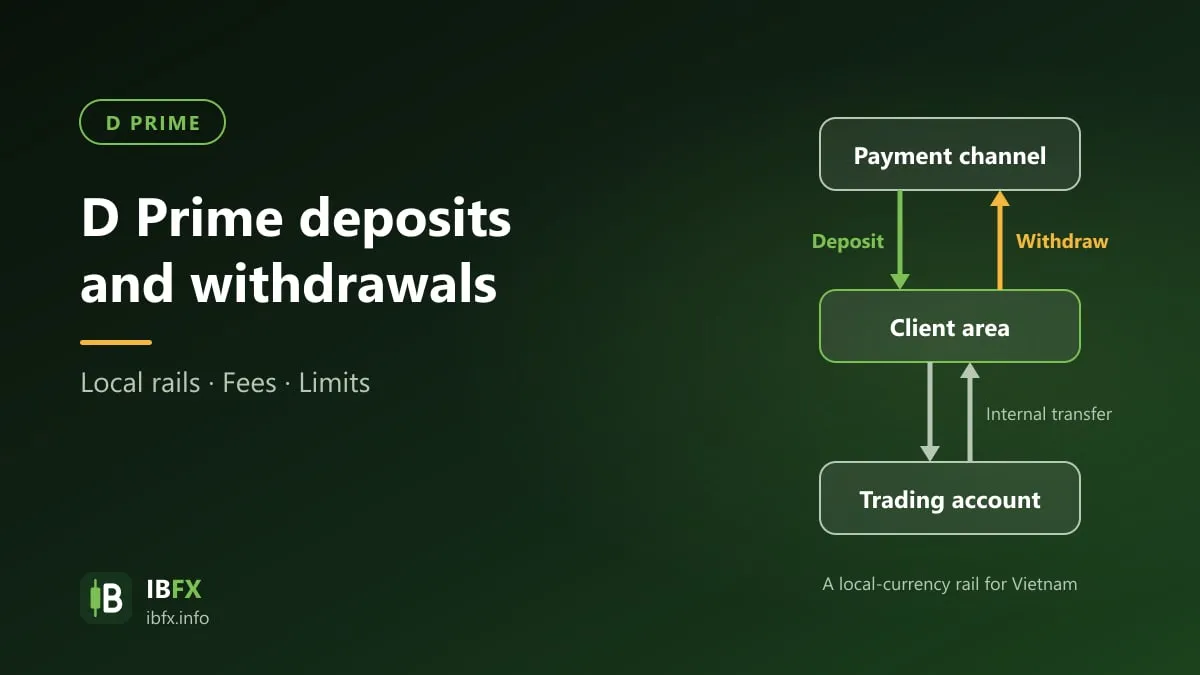
This is the part worth knowing if your bank is outside the usual card networks. Rather than requiring an international card or a crypto detour, D Prime runs bank rails denominated in local currencies, each with its own limits — for example one rail covering VND with a 10–4,000 USD range per transaction, no deposit fee, processed instantly.
Two things to weigh up even though these rails are convenient:
- The conversion rate is a hidden cost. Your D Prime account is denominated in USD while you send local currency, so a rate sits in between. Compare the USD actually credited against the market rate at that moment; 1–2% on a 1,000 USD transfer is 10–20 USD, usually more than every trading fee you pay in a month.
- The limits are per transaction. A larger sum has to be split, and it is better to know that in advance than to discover it when you need the money moved.
Fees
The FAQ on the pricing page answers briefly: D Prime charges no withdrawal fee on most payment methods. However, “third-party fees or bank fees may apply depending on the payment service provider or the withdrawal method selected”.
In other words, as at most brokers: the cost sits with the channel, not the broker. Before picking a withdrawal channel, ask two questions:
- What does that intermediary charge per withdrawal?
- How far is its conversion rate from the market rate?
The second usually costs more than the first.
A labelling bug on the payments page
This has to be said plainly, because it can make you read the wrong number.
The payments page has two tabs: Deposit and Withdrawal. Switching to Withdrawal does change the list — different rails appear. But the labels inside each card keep the deposit wording: every card still reads “no fee when depositing” and “Deposit limit”, even in the withdrawal table.
This is a translation or display bug on the page, not anything sinister. But the practical consequence is that you should not treat the limits in the withdrawal table as reliable, because it is unclear which is wrong — the label or the number.
So this article quotes figures from the deposit side only, where the labels match the content. For the real withdrawal limits and fees, check inside your own account at the point of creating a withdrawal, or ask support.
What holds a withdrawal up
None of this is specific to D Prime; it is the common pattern at every broker, and the usual reason people conclude that “the broker won’t let me withdraw”:
- Names that do not match. The bank account or wallet receiving the money must be in the broker account holder’s own name. No broker pays a third party.
- Verification not approved. Verify your documents before you deposit. See how to open a D Prime account.
- Withdrawing to a different channel than you deposited from. Most brokers require withdrawals back through the funding channel, at least up to the amount deposited, under anti-money-laundering rules. IBFX could not read D Prime’s Client Agreement (a PDF), so the specific rule is unverified — ask support before funding through a channel you do not intend to withdraw through.
- Open positions. Money used as margin cannot be withdrawn.
- A long-dormant account. Many brokers charge a maintenance fee on unused accounts. That is another section worth finding in the agreement.
What to do the first time
The safe order, at any broker:
- Get your documents verified first.
- Deposit a small amount through the channel you intend to keep using. If you do not have an account yet, sign up with D Prime here.
- Place a few trades at the smallest size.
- Withdraw part of it as a test and time how long it takes, what it costs, and what rate you end up with.
- Only once that round trip runs smoothly should you consider a larger amount.
One successful test withdrawal tells you more than any table of figures — including the ones in this article. And remember the part that matters more than payments: which entity signs the agreement with you, in the D Prime review; for picking an account, see D Prime account types.
In Vietnam, offshore Forex brokers are unlicensed and trading through them is not protected by law. See is Forex trading legal in Vietnam.