On this page
Deriv splits its accounts by platform rather than by deposit size. This article focuses on the five Deriv MT5 account types, because that is where you trade Forex CFDs, then covers the rest.
Every figure was read on deriv.com on Sep 24, 2026.
Quick summary:
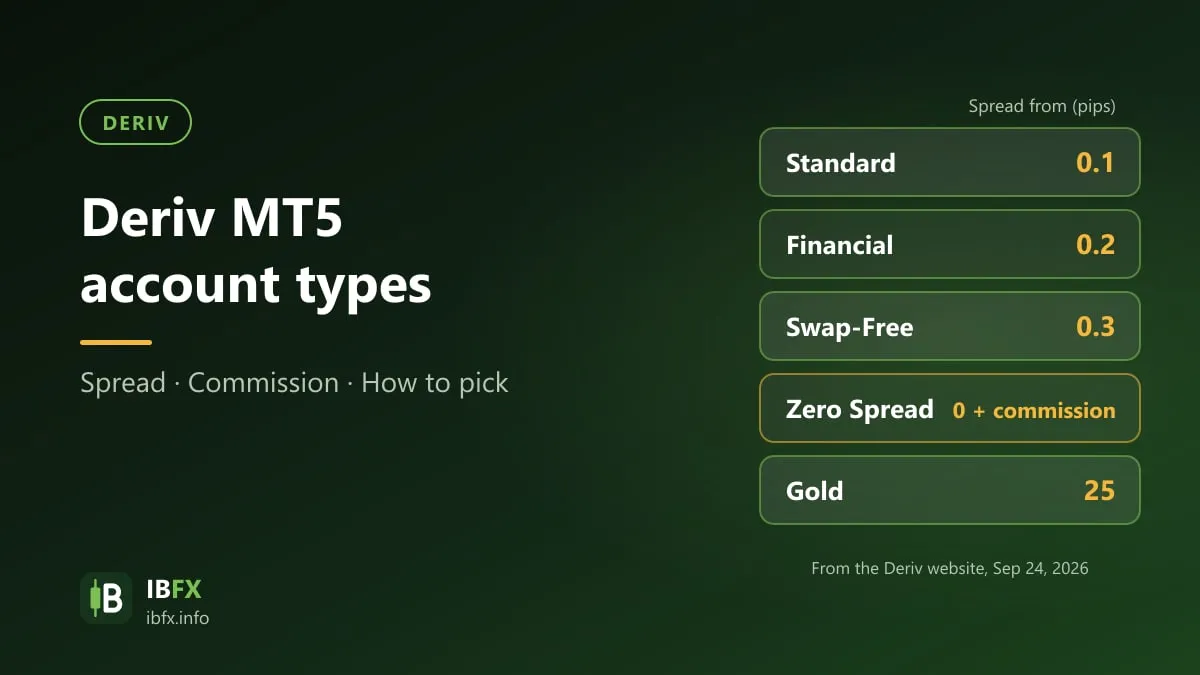
- Five MT5 account types: Standard, Financial, Swap-Free, Zero Spread, Gold.
- None of them has a minimum deposit.
- Four charge no commission; Zero Spread has spreads from 0 pips but does charge commission.
- Gold is a separate precious-metals account with spreads from 25 pips — a figure quoted in the pricing convention of the gold symbol, not directly comparable with a currency pair’s spread.
The five MT5 accounts compared
| Account | Spread from | Commission | Min. deposit | Assets |
|---|---|---|---|---|
| Standard | 0.1 pips | No | None | Financial assets, Derived indices |
| Financial | 0.2 pips | No | None | Financial assets, Derived indices |
| Swap-Free | 0.3 pips | No | None | Financial assets, Derived indices |
| Zero Spread | 0 pips | Yes | None | Financial assets, Derived indices |
| Gold | 25 pips | No | None | Commodities |
Deriv describes each one as follows:
- Standard — “trade Derived and financial assets in optimal conditions, with competitive spreads and swap charges”. This is the default.
- Financial — “trade financial markets with the tightest spreads, for fast and frequent trades”.
- Swap-Free — “trade without worrying about overnight swap charges”.
- Zero Spread — “spreads from 0 pips to enter and exit the market at low cost”.
- Gold — “trade gold and precious metals in a dedicated account”.
How to choose
Standard or Financial
On paper these two barely differ: 0.1 pips against 0.2 pips, both commission-free, the same asset classes. Deriv positions Financial as the account for “fast and frequent trades”, so it is aimed at high-frequency traders.
Do not pick on the advertised spread alone. Both numbers are the minimum in ideal conditions, not what you meet all the time. The right way to check is to open both accounts (Deriv lets you hold several MT5 accounts), run a few dozen trades of the same strategy in the hours you actually trade, and compare the realised cost in your journal. See what spread is for how to convert spread into money.
Zero Spread: cheaper or not
Zero-pip spreads sound very attractive, but the cost does not disappear — it moves into commission. This is a familiar model, the same as Tickmill’s Raw account or an ECN account elsewhere.
The only correct comparison converts both to a total round-turn cost:
- Spread account, no commission: cost = spread × pip value × lots.
- Zero Spread account: cost = the actual spread (still above zero outside peak hours) × pip value × lots + commission both ways.
The Deriv MT5 page as read on Sep 24, 2026 says Zero Spread “has commission” but does not state the rate there, and this article did not open a live account to verify it. Ask Deriv support what the commission is per lot per side, and which product groups it applies to, before choosing this account. Without that figure you cannot work out whether it is cheaper or dearer than Standard.
Who Swap-Free is for
Swap-Free removes the overnight charge in exchange for a higher starting spread (0.3 pips against Standard’s 0.1). The arithmetic is simple: if you hold positions over several nights, the swap you save may outweigh the extra spread; if you close inside the day, you are paying more spread for nothing.
Note that swap-free accounts at any broker usually come with conditions — a cap on how long a position may be held, or an administration fee that replaces swap after a certain number of days. The Deriv MT5 page does not list those conditions, so read the terms attached to this specific account type when you open it. See also what swap is.
Gold
This is a dedicated precious-metals account, and its asset class is Commodities rather than the financial assets of the other four. A spread “from 25 pips” looks enormous next to 0.1 pips, but the two figures are not in the same unit: a pip of gold and a pip of a currency pair are worth very different amounts. See how to work out gold lots and what one XAU/USD pip is worth before comparing.
Standard and micro symbols
Beyond the account type, Deriv also splits symbols by contract size. The Trading specifications table as read on Sep 24, 2026 shows most currency pairs listed twice:
| Standard symbol | Micro symbol | |
|---|---|---|
| Example | AUDCAD | AUDCADmicro |
| Contract size | 100,000 units | 1,000 units |
| Minimum lot | 0.01 | 0.1 |
| Volume limit | 15 | 100 |
This matters on a small account. A 0.1-lot trade on a micro symbol is 100 units of the base currency — far smaller than 0.01 lots on the standard symbol, which is 1,000 units. With a few tens of dollars of capital, micro symbols are how you keep the risk per trade sensible without raising leverage. See the 2% money management rule for sizing against your stop distance.
Accounts outside MT5
- Deriv cTrader — a separate CFD account for the cTrader platform, with copy trading built in.
- Deriv Trader — the account for Options (Digital Options, Accumulators, Vanillas, Turbos, Multipliers). Contracts from 1 USD, with 5 USD needed in the account.
- Demo account — Deriv offers free demo accounts with virtual funds on every platform. This is where to start: you can sign up with Deriv here and create a demo before depositing anything.
Money for all of these sits in one Deriv Wallet and moves between accounts inside the client area, so you do not fund each account separately.
Before you choose
The sensible order: open a Deriv account through our referral link, run a demo on the account type you intend to use, record the realised cost of a few dozen trades, and only then decide. The figures on a marketing page are minimums in ideal conditions — your journal holds the real number.
And remember the part that matters more than the account type: which entity signs the agreement with you. See the Deriv review for which companies make up Deriv and which of them hold a license.