On this page
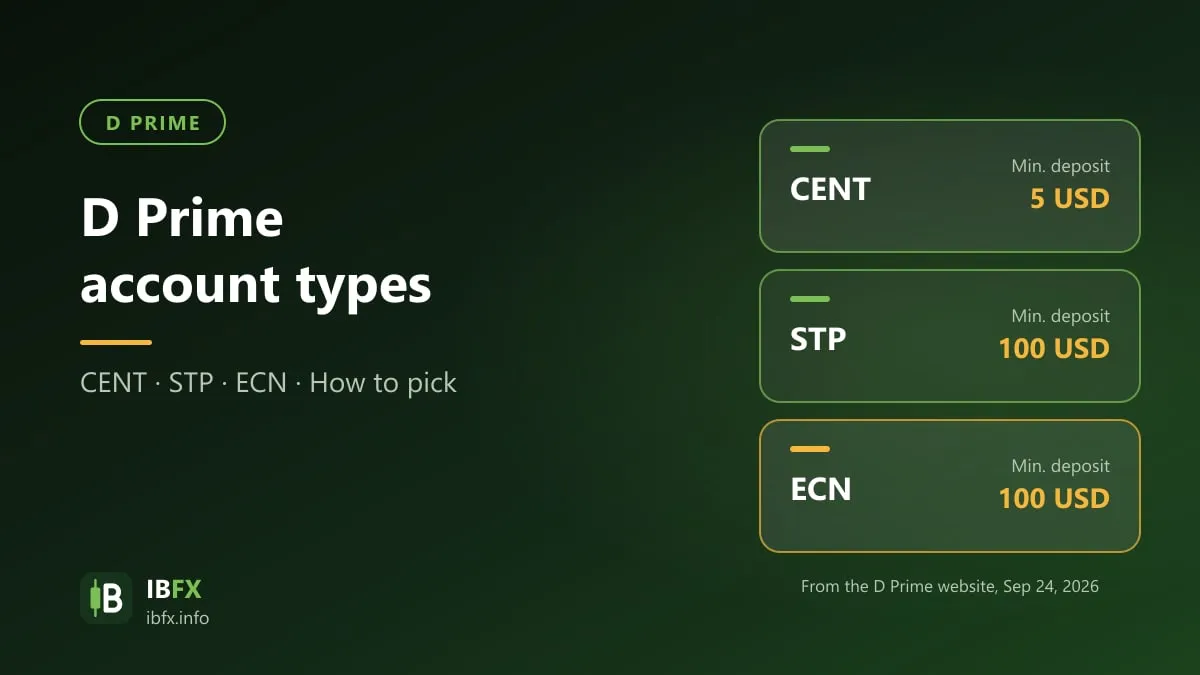
D Prime has three trading accounts: CENT, STP and ECN. Unlike brokers that split accounts by deposit size, the difference here is in two things: which markets you can trade, and how you pay the cost.
Every figure was read on dooprime.com on Sep 24, 2026.
Quick summary:
- CENT — from 5 USD, spreads from 1 pip, no commission, forex, precious metals and energies only.
- STP — from 100 USD, spreads from 1 pip, no commission, all six market groups.
- ECN — from 100 USD, spreads from 0.0 pips, commission from 1 USD, all six market groups.
- All three are USD-only.
- The “0.0 pips” figure on the marketing page belongs to ECN alone.
The three accounts compared
| CENT | STP | ECN | |
|---|---|---|---|
| Minimum deposit | 5 USD | 100 USD | 100 USD |
| Spread from | 1 pip | 1 pip | 0.0 pips |
| Commission | No | No | Yes, from 1 USD |
| Currency | USD | USD | USD |
| Forex | Yes | Yes | Yes |
| Precious metals | Yes | Yes | Yes |
| Energies | Yes | Yes | Yes |
| Stocks | No | Yes | Yes |
| Stock indices | No | Yes | Yes |
| Cryptocurrencies | No | Yes | Yes |
How to choose
CENT: for beginners, and only for a while
CENT’s strength is the 5 USD figure. That is the lowest minimum deposit among the IBFX-reviewed brokers that set one at all — Deriv sets no minimum on any of its five MT5 accounts. Either way, 5 USD solves a real problem: practising with real money, for the real feeling, while the amount lost if you are wrong stays trivial.
Two limits to know first:
- Three market groups only. No stocks, indices or crypto. Fine if you intend to trade currencies and gold; anything wider means switching accounts.
- Spreads from 1 pip. That is not the most competitive number on the market. Acceptable for a practice account, but do not judge a cost-sensitive strategy on results produced there.
Practical advice: use CENT to build habits and discipline, not to optimise cost. See the 2% money management rule for what a sensible position size looks like on 5 or 50 USD.
STP or ECN: the real cost question
These two share the 100 USD minimum and the same six market groups. They differ purely in how the cost is packaged:
- STP: spreads from 1 pip, no commission.
- ECN: spreads from 0.0 pips, commission from 1 USD.
These are two ways of wrapping the same cost, and the only correct comparison converts both into a total round-turn cost.
Take one standard lot of EURUSD (100,000 units, where 1 pip ≈ 10 USD):
- STP: 1 pip × 10 USD = 10 USD a round turn, no commission.
- ECN: say the actual spread is 0.2 pips = 2 USD, plus commission. If commission is 1 USD per lot per side, the total is 2 + 2 = 4 USD.
On that assumption ECN is clearly cheaper. But the word “say” is the problem:
- The commission rate is not stated. The page only says “trading fees from $1” and does not say whether that is per lot per side or per round turn, nor how it applies across product groups. This article did not open a live account to verify it.
- 0.0 pips is a best-case minimum, not what you meet on a news release or outside peak hours.
- STP’s 1 pip is also a “from” figure, the best case rather than the average.
The thing to do before choosing: ask D Prime support one question — what is the ECN commission per lot per side, and which product groups does it apply to? With that number you can work out the break-even between the two yourself. Without it, every comparison is guesswork.
The break-even in short: ECN is cheaper than STP as long as ECN’s actual spread in money plus commission both ways stays below STP’s spread in money. See what spread is for converting pips into money on the pair you actually trade.
Who should pick what
- Under 100 USD of capital, trading only currencies and gold → CENT, treat it as cheap tuition.
- Trading rarely, holding longer, no wish to track commission → STP, where the cost sits entirely in the spread and is easy to calculate.
- Trading many positions at size, sensitive to cost per round turn → ECN, provided you have asked about the commission first.
The Islamic account: where it charges
D Prime offers a swap-free Islamic account. But its own page shows that the removed swap is replaced by something called an Administration Fee, with its own per-pair table.
Comparing four common pairs, both read on Sep 24, 2026:
| Pair | Long swap → long admin fee | Short swap → short admin fee |
|---|---|---|
| AUDUSD | −3.263 → −3.589 | −4.939 → −5.433 |
| EURUSD | −8.776 → −9.654 | +0.915 → −0.742 |
| GBPUSD | −5.424 → −5.966 | −3.694 → −4.063 |
| USDJPY | +4.047 → −2.075 | −18.284 → −12.733 |
On the first three pairs the new charge is larger than the swap it replaces, by roughly 8 to 10%. The short side of EURUSD even flips from a credit to a charge. USDJPY goes the other way, lighter on both sides.
So if you choose the Islamic account for religious reasons, it does its job. If you choose it expecting to save on overnight costs, look up the pair you trade first — on most common pairs the result is the opposite. See what swap is.
Specifications shared by all three
From the Forex page table as read on Sep 24, 2026, these figures are identical across every pair displayed:
- Contract size 100,000 units.
- Maximum leverage 1:1000.
- Margin a minimum of 100 units of the base currency per lot.
Leverage being the same on every pair is a convenience: you do not have to look up each symbol as you do at some brokers. But 1:1000 is still very high — see leverage and how much to use before your first order.
Before you choose
The sensible order: open a D Prime account through our referral link, run a demo on the account type you intend to use, record the realised cost of a few dozen trades, and only then decide. The figures on a marketing page are best-case minimums — your journal holds the real number.
And remember the part that matters more than the account type: which entity signs the agreement with you, and which licence covers that account. See the D Prime review.