On this page
When you open a forex trade, you do not have to put up the full value of the trade. The broker only holds part of the money in your account as margin. That is how a few hundred USD can open a trade worth tens of thousands of USD, but profit and loss are still calculated on the full position value. Understanding margin, margin level, margin call and stop out tells you in advance how much your account can take before the broker closes your trades for you.
This guide follows on from the IBFX guides on what leverage is and on what a lot is. The numbers in it are examples picked to keep the arithmetic easy; the margin rate, margin call and stop out that apply to your own account are in your broker’s terms.
What is margin?
Margin is the money the broker holds in your account so you can open and keep a trade open. Three things to remember:
- Margin is not a fee. The money is still yours; it is only locked while the trade is open, and it is given back when the trade is closed. Your trading costs are the spread, commission and swap.
- The loss does not stop at the margin. A 0.1 lot EUR/USD trade needs only about 23 USD of margin at leverage of 1:500, but each pip is still 1 USD. If price runs 100 pips against you the loss is 100 USD, more than four times the margin.
- The higher the leverage, the lower the margin. Leverage of 1:500 means the margin is 1/500 of the position value, that is 0.2%. Leverage does not make each pip dearer or cheaper; the position size is what decides that.
How to calculate margin
Required margin = Position size (lots) × Contract size × Price × Rate to convert into the account currency ÷ Leverage
The contract size of a currency pair is usually 100,000 units of the currency that comes first, and for gold it is usually 100 ounces. For example, with a USD account and leverage of 1:500:
| Trade | Position value | Required margin |
|---|---|---|
| 0.1 lot EUR/USD, price 1.17 | 0.1 × 100,000 × 1.17 = 11,700 USD | 11,700 ÷ 500 = 23.40 USD |
| 0.1 lot USD/JPY | 0.1 × 100,000 = 10,000 USD (USD comes first, so no conversion is needed) | 10,000 ÷ 500 = 20 USD |
| 0.01 lot XAU/USD, assuming a price of 3,000 USD an ounce | 0.01 × 100 × 3,000 = 3,000 USD | 3,000 ÷ 500 = 6 USD |
On a cross pair such as EUR/GBP, the position value works out in GBP, then you multiply it by the GBP/USD rate to convert it into USD. You can enter the currency pair, position size, price and leverage into the IBFX Margin calculator to work it out quickly, cross pairs included.
Two things to watch when you calculate:
- Every broker and every product can differ. Contract sizes for indices, oil and cryptocurrencies differ from broker to broker, and many brokers set their own margin rate per product instead of using the account leverage. On MT4 and MT5, right-click the symbol in Market Watch and choose Specification to see it.
- Leverage can be cut temporarily. Some brokers lower leverage around important news, over the weekend, or as equity grows, which raises the margin on trades that are already open. See for example the guide on CXM Direct’s unlimited leverage.
Balance, equity, free margin and margin level
The Trade tab on MT4 and MT5 shows five numbers related to margin:
| Figure | What it means |
|---|---|
| Balance | The money in the account, before the profit and loss of open trades |
| Equity | Balance plus the profit, or minus the loss, of open trades |
| Margin | The total margin of the open trades |
| Free Margin | Equity − Margin: what is left to open new trades or to absorb losses |
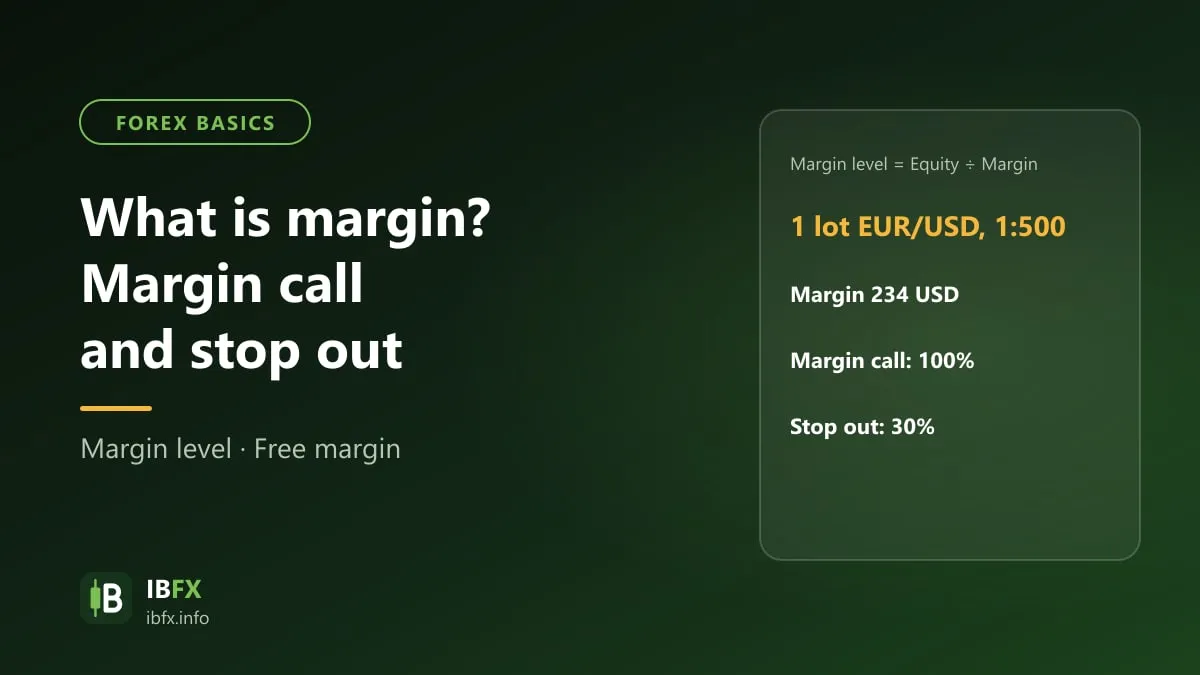
| Margin Level | Equity ÷ Margin × 100% |
For example: a balance of 1,000 USD, and opening 0.1 lot EUR/USD needs 23.40 USD of margin. The moment the trade is open (ignoring the spread), equity is 1,000 USD, free margin is 976.60 USD, and margin level is 1,000 ÷ 23.40 × 100% ≈ 4,274%.
When the trade is losing, equity falls, so margin level falls with it. Margin level is the measure the broker uses to decide when to warn you and when to close your trades.
What are margin call and stop out?
- Margin call is the warning threshold. When margin level drops to it, the platform raises an alarm and you usually cannot open new trades. The broker has not closed anything yet; you need to deposit more money, close some trades, or accept the risk of being closed out later.
- Stop out is the threshold at which the broker closes trades itself. When margin level falls this far, the system starts closing trades, usually beginning with the one losing the most, until margin level is back above the threshold.
Every broker sets its own thresholds, and they sometimes differ by account type. From the summaries on IBFX, checked against the brokers’ own account pages on Sep 14, 2026:
| Broker | Margin call | Stop out |
|---|---|---|
| CXM Direct | 120% | 30% |
| Tickmill (Classic, Raw) | 100% | 30% |
| HFM | 50% | 20% |
For the detail, see CXM Direct account types, the Tickmill Classic and Raw accounts and HFM account types. Brokers can change these thresholds, so check them again before you trade.
Stop out is not a safety net. Trades are closed at the next price that can be filled; when the market gaps on news or at the start of the week, that closing price can be a long way off and equity can go below 0. Whether a broker writes off a negative balance is a matter of each broker’s own policy.
Example: how far does price move before margin call and stop out?
Suppose a balance of 1,000 USD and a EUR/USD trade opened at a price of 1.17 with leverage of 1:500, with the broker setting margin call at 100% and stop out at 30%. Spread, commission and swap are left out to keep the arithmetic easy. On EUR/USD, 1 lot is worth about 10 USD per pip, as the IBFX guide on what a pip is explains.
| 1 lot trade | 0.1 lot trade | |
|---|---|---|
| Required margin | 234 USD | 23.40 USD |
| Value per pip | 10 USD | 1 USD |
| Margin call when equity is down to | 234 USD, that is a loss of 766 USD | 23.40 USD, that is a loss of 976.60 USD |
| Price running against you to reach margin call | about 77 pips | about 977 pips |
| Stop out when equity is down to 30% of the margin | 70.20 USD, that is a loss of 929.80 USD | 7.02 USD, that is a loss of 992.98 USD |
| Price running against you to reach stop out | about 93 pips | about 993 pips |
Two things come out of the table:
- The position size decides how many pips the account can take. A 1 lot trade on a 1,000 USD account only needs price to run about 93 pips against it — a move that is not rare on EUR/USD over a few days — to lose almost all the money.
- By the time stop out arrives, the account has already lost almost everything. In both cases you are left with under 8% of the starting balance when the trades are closed. High leverage makes the margin small, so stop out comes later, which means the account loses more before the broker closes the trades.
Do not use margin call as your stop loss
Margin call and stop out are the broker’s limits, not a risk management plan. Before you open a trade, check these yourself:
- Set your stop loss from price structure and work out the loss if price reaches it.
- Keep that loss within about 1–2% of your capital under the 2% money management rule. The Position size calculator works out the number of lots from your capital, your risk percentage and your stop loss distance.
- Look at your margin level once the trade is open. With 1–2% risk per trade, margin level is usually still very high; if it is down to a few hundred percent, the position size is too large for your capital.
- Add up trades in the same direction. Several trades on pairs that tend to move together, such as EUR/USD and GBP/USD, share one pool of free margin and can lose at the same time; see the Currency correlation tool.
- Keep an eye on the news calendar and the weekend, when the broker may raise margin and price gaps more easily.
If your account keeps reaching margin call, that is a sign the position size is too large. The IBFX guide on what blowing up an account means says more about the common causes, and the guide on the R:R ratio helps you set your stop loss and take profit within one plan.
Summary
- Required margin = position size × contract size × price (converted into the account currency) ÷ leverage. This is money held for the time being, not a fee.
- Margin level = equity ÷ margin used × 100%. Margin call is the warning, stop out is when the broker closes trades itself; the thresholds differ from broker to broker.
- Profit and loss are calculated on the full position value. The position size, not the leverage, decides how much money each pip costs.
- Manage risk with a stop loss and a position size set to 1–2% of your capital; do not wait for margin call.
Trading leveraged forex and CFDs carries a high level of risk; you can lose all of the money you have deposited.