On this page
Dollar-cost averaging (DCA) is an investment strategy in which an investor puts a fixed amount of money into an asset at regular intervals (every month, for example), whether the price is high or low at the time, instead of putting the whole amount in at once. The strategy is not the same as trying to catch the bottom, where you time the purchase to get the best possible price. DCA suits long-term accumulation and cuts the risk of committing all your money at one unlucky moment to buy, but it does not remove the risk that the asset loses value.
What is DCA, or the dollar-cost averaging strategy?
Dollar-cost averaging is a way of investing that fits spare cash that arrives steadily, such as part of a monthly income. Instead of investing all your capital at once, you split the amount into equal parts and buy on a fixed schedule over a period of time. It is used most often with index funds, ETFs and stocks held for the long term; many people also apply it to cryptocurrencies.
The aim of dollar-cost averaging is to reduce the effect that price swings have on your average purchase price. Because you buy at several points in time at different prices, your average purchase price does not depend on a single moment, and that lowers the risk compared with buying all at once just as the price is high.
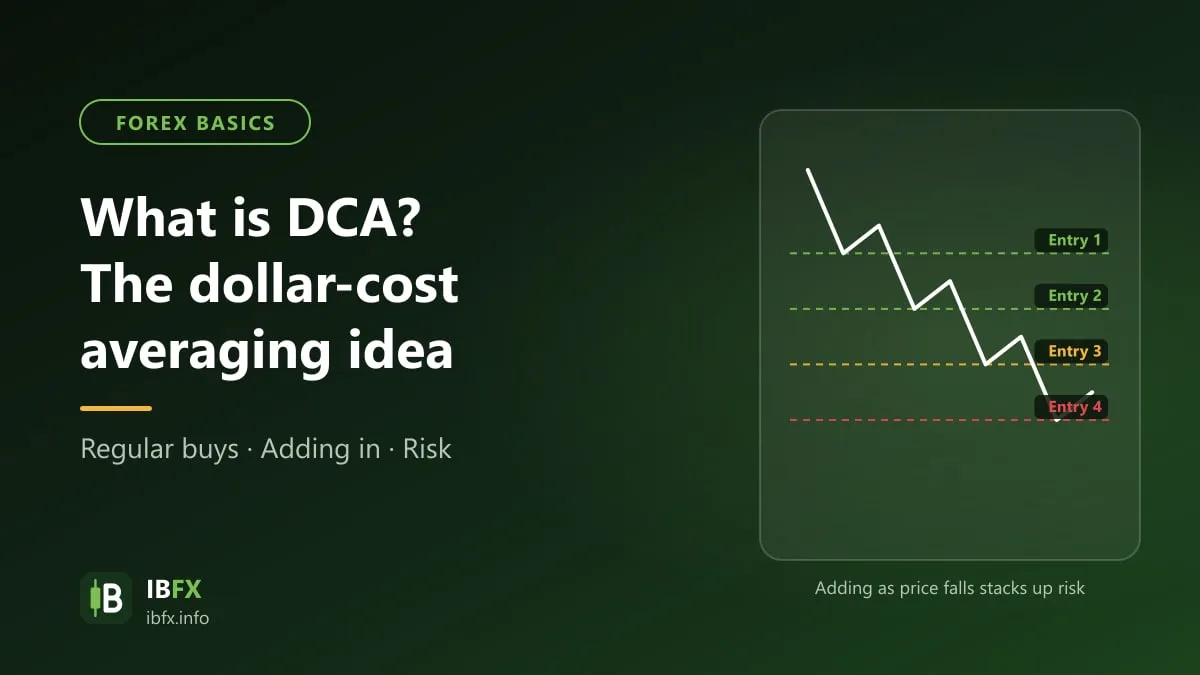
Note: in many trading communities, “DCA” is sometimes used for buying more while the price is falling in order to pull the break-even price down (adding to a losing position). That is not DCA in the proper sense, and with leverage it is especially dangerous (see the notes further down).

For example: instead of investing 6,000 USD in one transaction, you could invest 1,000 USD a month for six months in a row. The value of the asset you buy may rise and fall over that time, but the amount you invest never changes: it is only 1,000 USD a month. When the price falls, the same money buys more of the asset; when the price rises, you buy less. The method does not remove risk, but it helps you avoid committing all your money at one unlucky moment to buy, and it is less stressful than investing a large sum all at once.
How the dollar-cost averaging (DCA) strategy works
Suppose you are going to invest in some stock X with a total of 6,000 dollars over the next 6 months, but at the moment you decide to buy, the share price is swinging hard. So you decide to use DCA over a six-month period at 1,000 dollars a month, whatever the share price does. This is the result after 6 months of investing:
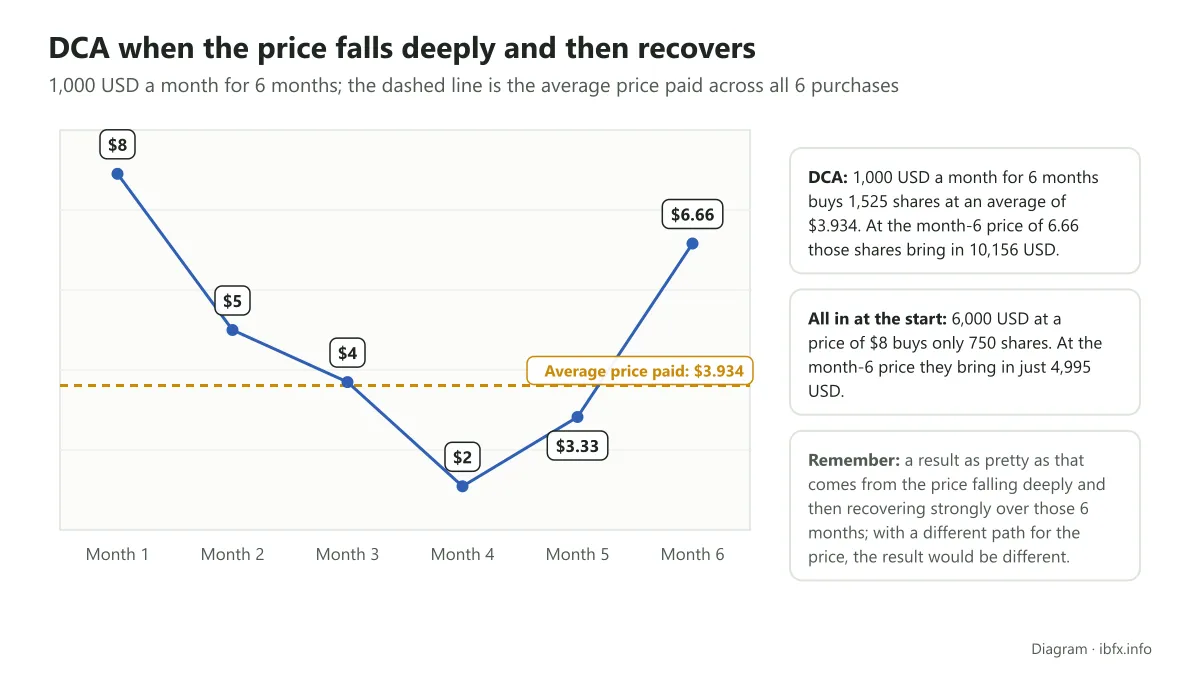
| Month | Amount invested | Share price (in $) | Shares bought |
|---|---|---|---|
| 1 | $1,000 | 8 | 125 |
| 2 | $1,000 | 5 | 200 |
| 3 | $1,000 | 4 | 250 |
| 4 | $1,000 | 2 | 500 |
| 5 | $1,000 | 3.33 | 300 |
| 6 | $1,000 | 6.66 | 150 |
| $6,000 | Average value of 1 share: $3.934 | Total shares bought: 1,525 |
Looking at the table above you will see that if you had instead invested the whole 6,000 dollars in the first month, the number of shares you bought would be only 750. Thanks to averaging in, after 6 months the total number of shares you have bought has doubled, to 1,525 shares. That came about because the share price rose and fell over those 6 months, at its extreme falling to only 2 USD a share, so that 1,000 USD bought you 500 shares. And by month 6 the share price had risen to 6.66 USD, so the 1,525 shares you hold would bring in 10,156 USD if you sold them all, against the 6,000 USD you invested at the start, a gain of more than 4,000 USD. The other way round, if you had gone all in with the whole 6,000 USD from the start, the 750 shares in your hands would bring in only 4,995 USD, which means a loss of more than 1,000 USD.
So in this example, by investing steadily through dollar-cost averaging, the investor takes in more than 4,000 USD of profit. Remember that a result as pretty as that comes from the price falling deeply and then recovering strongly over those 6 months; with a different path for the price, the result would be different. This is also why some investors see dollar-cost averaging as a way of reducing timing risk by spreading capital over a set period of time.
However, remember that every form of investment is full of risk, and dollar-cost averaging is no exception. DCA still loses money if the price keeps falling and never recovers, and when the price rises steadily DCA usually gives a poorer result than buying all at once, as the example below shows.
Anyone who invests wants to “buy low, sell high”, but in many cases the dollar-cost averaging strategy does not give the best result. Look at the example below to understand this more clearly:
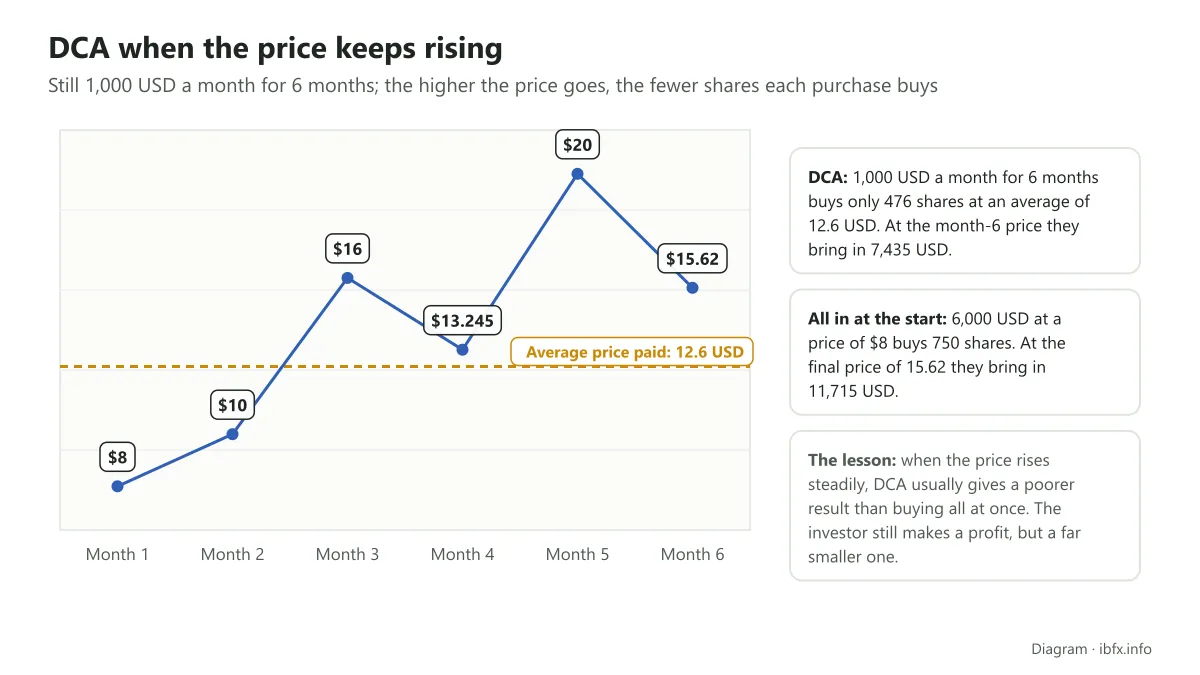
| Month | Amount invested | Share price (in $) | Shares bought |
|---|---|---|---|
| 1 | $1,000 | 8 | 125 |
| 2 | $1,000 | 10 | 100 |
| 3 | $1,000 | 16 | 62 |
| 4 | $1,000 | 13.245 | 75 |
| 5 | $1,000 | 20 | 50 |
| 6 | $1,000 | 15.62 | 64 |
| $6,000 | Average value: 12.6 USD a share | Total: 476 shares |
We are still using the assumption of 6,000 USD to invest. But because the price keeps rising, the investor ends up buying only 476 shares. If instead of DCA the investor had gone all in with the whole 6,000 USD at once at the start, the number of shares he holds would be 750, and at the final price of 15.62 a share the value of those shares would be 11,715 USD. But because he used DCA, the amount he has from 476 shares is only 7,435 USD. He still makes a profit, but it is far smaller than buying all the shares at the start.
A few notes on using the dollar-cost averaging (DCA) strategy
DCA is for assets you buy to hold for a long time, and without leverage. In forex and CFDs, “averaging down” by adding more positions while you are losing is one of the most common reasons accounts are blown up.
Dollar-cost averaging is used a great deal in buying and selling cryptocurrencies. For forex trading, DCA carries extremely high risk because leverage is involved, so when the market swings very hard, blowing up the account is very easy to do. That is why you should think twice before using dollar-cost averaging with forex investment.
With cryptocurrencies, if you apply dollar-cost averaging you should pick only large, long-established coins and use only spare money; even the large coins have fallen 70-80% in value before now. Small coins with little value are best not invested in at all, because the risk of losing nearly all their value or of being delisted by an exchange is very high.
Beyond that, DCA does not require you to guess the bottom or the trend correctly, but it does require you to pick the right asset: DCA into an asset with long-term value (an index fund of a major market, for instance) is completely different from DCA into a stock or a coin that is falling because the business or the project is weak; the second case only makes you lose more. Knowledge of fundamental analysis will help you a great deal at this step.
And one point you should not forget: with individual stocks or cryptocurrencies, set a loss limit or a condition for stopping in advance (for example, the business or the project is no longer what you judged it to be at the start), instead of simply going on buying steadily whatever happens. Decide clearly how much goes in each period, how long you will invest for and what your goal is before you begin.