On this page
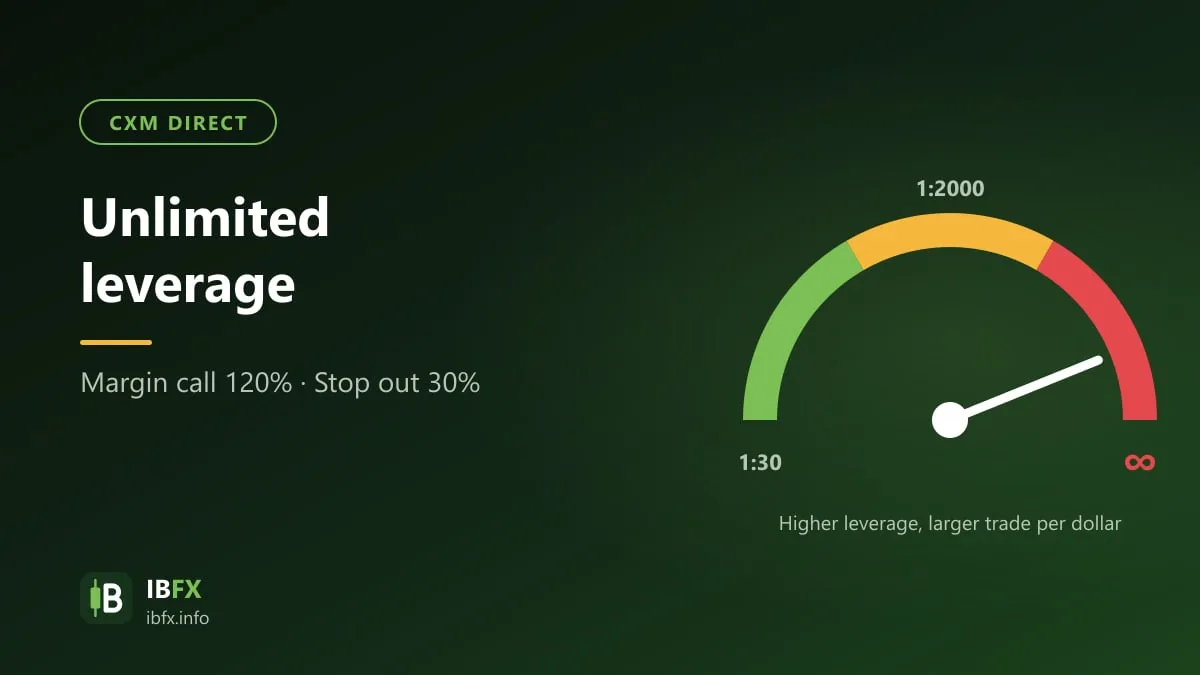
CXM Direct advertises leverage of up to 1:2000, and even “infinite” (unlimited) leverage on some accounts. It sounds attractive, because it takes very little margin to open a large position, but that is exactly why so many accounts blow up so quickly. This article explains the CXM leverage policy as set out on the Leverage Policy page of the CXM website (cxmvn.net), as of Sep 14, 2026, and the arithmetic that keeps leverage from pushing you into more risk than you meant to take.
If you are not yet clear on what leverage is, start with the IBFX guide on what leverage is and how much of it to use.
Standard leverage by account equity
The maximum leverage steps down as the equity in the account grows:
| Account equity (USD) | Forex, gold, silver | Indices, energies | Crypto | Base metals |
|---|---|---|---|---|
| Up to 10,000 | 1:2000 | 1:200 | 1:10 | 1:10 |
| 10,001 – 30,000 | 1:1000 | 1:200 | 1:10 | 1:10 |
| 30,001 – 100,000 | 1:500 | 1:200 | 1:10 | 1:10 |
| Over 100,000 | 1:100 | 1:200 | 1:10 | 1:10 |
Each account type also has a ceiling of its own: the Cent account caps at 1:2000, ZERO at 1:1000 and FIX API at 1:300 (see the CXM Direct account types).
How “infinite” leverage works
Under the CXM policy:
- It only applies to Standard and ECN accounts. It does not apply to the CXM Trader, Standard Bonus, Cent, Zero and Gold accounts.
- An account only qualifies once it has made at least two trades.
- It does not apply to every product: most exotic currency pairs, crypto, energies, base metals, index baskets and shares are excluded.
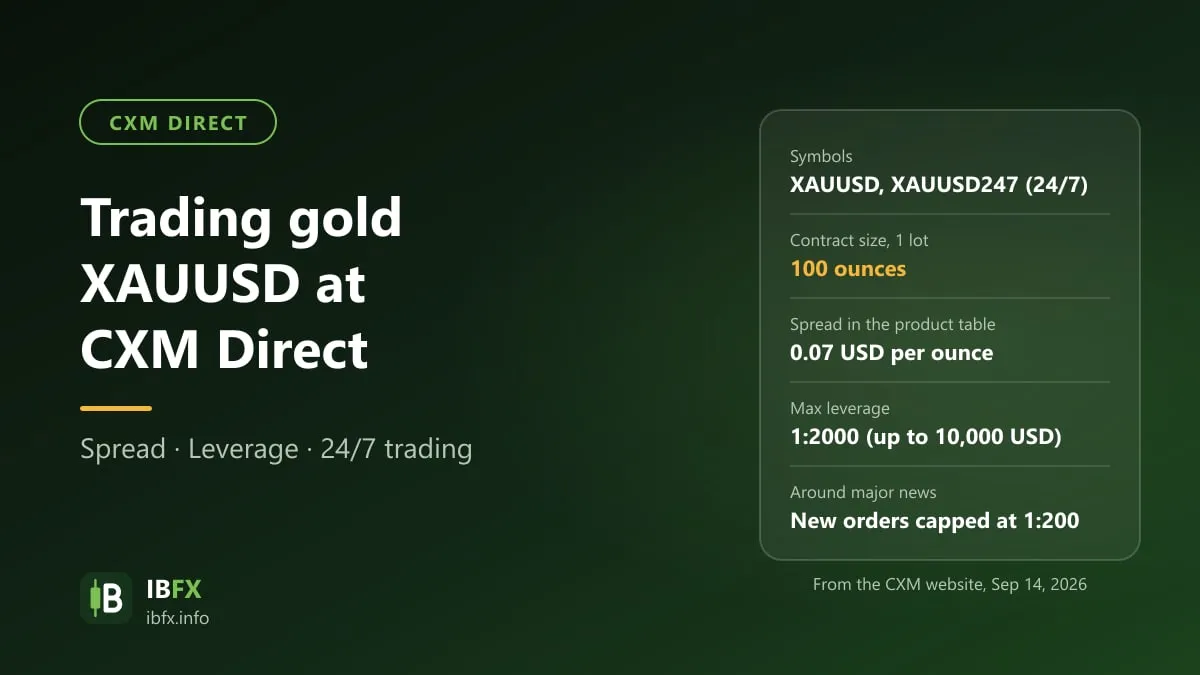
The CXM product pages also give a ceiling per symbol, and those match the exclusions above. Figures as of Sep 16, 2026: 1:2000 on the major pairs and on gold and silver; 1:500 on 33 exotic pairs (USDTRY, USDZAR, EURPLN, USDCNH and others); 1:200 on most indices, with some indices at only 1:50 or 1:20; 1:10 on base metals (aluminum, copper, nickel, lead, zinc) and on platinum and palladium. In other words, the 1:2000 advertised on the home page only holds for the narrowest group of products.
The leverage table for an account using infinite leverage is keyed to balance, unlike the standard table above, which is keyed to equity. The two only coincide when no position is open; once a trade is running at a profit or a loss, equity and balance diverge, so the leverage you are actually granted may differ from the table you are reading. Check it against CXM’s own policy when your account is set up:
| Balance (USD) | Forex, gold, silver | Indices, energies | Crypto |
|---|---|---|---|
| 0 – 500 | 2M:1 (2 million times) | 1:200 | 1:10 |
| 501 – 1,000 | 50K:1 (50 thousand times) | 1:200 | 1:10 |
| 1,001 – 10,000 | 1:2000 | 1:200 | 1:10 |
| 10,001 – 30,000 | 1:1000 | 1:200 | 1:10 |
| 30,001 – 100,000 | 1:500 | 1:200 | 1:10 |
| Over 100,000 | 1:100 | 1:200 | 1:10 |
So “infinite” really means extremely high leverage while the account is still small (under 1,000 USD). As the equity grows, the leverage returns to the ordinary levels.
When leverage is cut
CXM caps the leverage on a new position in three risky windows:
| When | Maximum leverage on a new position |
|---|---|
| Roughly 3–5 minutes before and 1 minute after a major news release | 1:200 |
| Roughly 10 minutes before the end of the daily trading session | 1:100 |
| The last hour before the market closes on Friday | 1:100 |
If you are used to opening large positions on high leverage, a position opened in one of those windows needs considerably more margin, and may not open at all. Check the economic calendar before you trade.
Margin, margin call and stop out
On every account type, CXM sets the margin call at 120% and the stop out at 30%.
- Required margin = position value ÷ leverage.
- Margin level = equity ÷ the margin in use × 100%.
- Below 120%: a margin call warning. At 30%: the system closes positions for you.
Example: a 200 USD account buying 1 lot of EUR/USD
Say EUR/USD is at 1.1000. One lot is 100,000 EUR, which is 110,000 USD. Each pip on 1 lot is worth about 10 USD.
| Leverage | Required margin | Can you open it? |
|---|---|---|
| 1:500 | 220 USD | No, the account only holds 200 USD |
| 1:2000 | 55 USD | Yes |
| Infinite (2M:1) | Close to 0 | Yes |
On 1:2000, if the price moves 15 pips against you, you lose 150 USD, your equity is down to 50 USD and your margin level is about 91%: already below the margin call. By a loss of about 18 pips (equity of 16.5 USD, which is 30% of 55 USD) the position is closed out. Just 18 pips, an ordinary move over a few minutes, has taken more than 90% of the account.
On infinite leverage the required margin is close to 0, so the margin level is enormous; the position is barely ever stopped out early and can run until the equity is nearly gone, around 20 pips. The negative balance protection policy keeps the account from going below zero, but you still lose almost the whole 200 USD.
The same account, but a position size of 0.02 lots
Open 0.02 lots of EUR/USD with a 20 pip stop loss. Each pip is about 0.2 USD, so if the stop loss is hit you lose 4 USD, which is 2% of the account. The required margin on 1:2000 is only about 1.1 USD, and whether the leverage is 1:100 or infinite, the amount you lose is still 4 USD.
Leverage does not decide how much you lose per pip; your position size does. High leverage only lets you open a larger position relative to your capital, which is to say it lets you take on more risk.
Why high leverage is dangerous for a beginner
- It lets you open a position that is far too large. On low leverage the broker blocks an oversized position by itself, because there is not enough margin; on infinite leverage that barrier is gone.
- The stop out comes late. When the required margin is close to 0, positions tend to be closed when the money is nearly gone, rather than while part of it is still there.
- Gaps and slippage. On strong news, or at the open at the start of the week, the price can jump straight past your stop loss.
- The urge to win it back. A small margin requirement makes opening another position to “win it back” look very easy.
For comparison: regulators such as ESMA (Europe), the FCA (UK) and ASIC (Australia) cap leverage for retail clients at 1:30 on the major currency pairs, precisely because of the risks above.
Using leverage more safely
- Work out your position size from your stop loss and the amount you are willing to lose, not from the leverage. The formula: position size (lots) = amount at risk ÷ (stop loss in pips × the pip value of 1 lot). See the IBFX guide on the 2% money management rule.
- If you get to choose the leverage when you open the account, choose a low level. Low leverage acts as an automatic brake against opening a position that is too large.
- Always set a stop loss as you enter the position. See the IBFX guide on what a stop loss is and how to place one.
- Avoid opening a position right around a major news release, at the end of the day and at the end of the week: that is when CXM cuts the leverage and when the price tends to move hardest.
- Watch your margin level, and do not let the account get close to 120%.
- Practice on a demo account or a Cent account until working out your position size is second nature.
For more on why accounts blow up, see the IBFX guide on blowing up an account.
If the arithmetic above is clear to you and you want to trade at CXM, you can open a CXM Direct account through our referral link and then follow the account opening guide. Start with a small amount and low leverage.