On this page
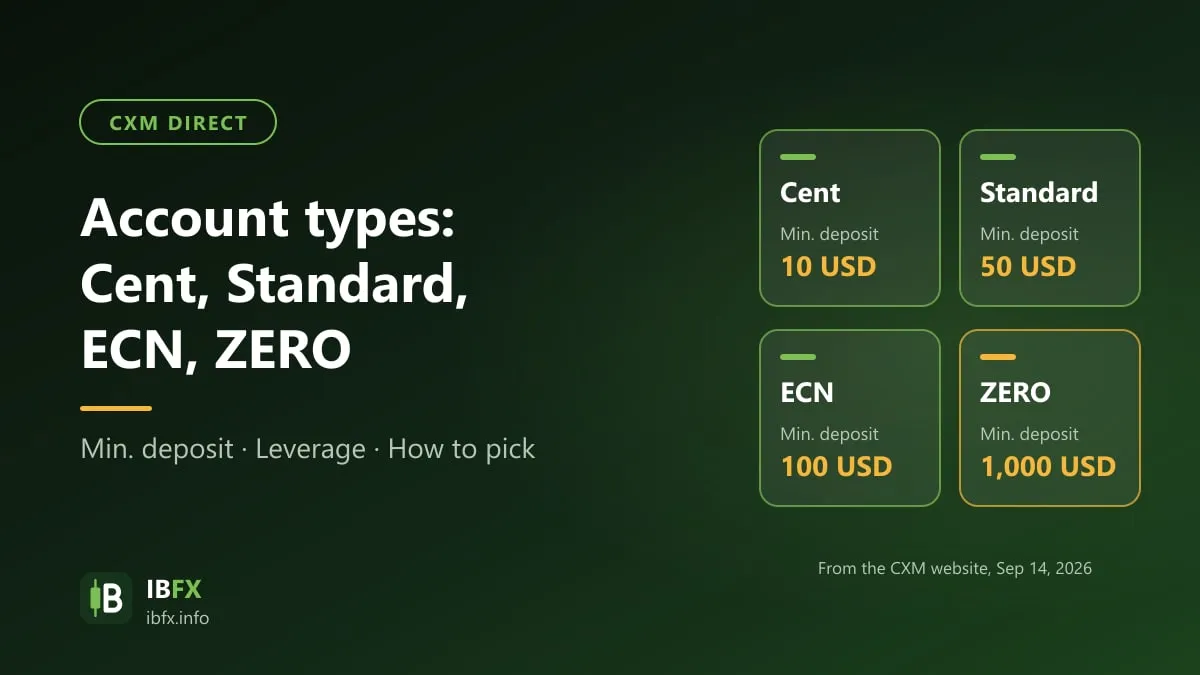
CXM Direct has several account types for different kinds of trader: from a Cent account you can fund with 10 USD to practice trading with real money, to a FIX API account for institutions. This article collects the specifications from the Account Types page on the CXM website (cxmvn.net), as of Sep 14, 2026. The broker can change the conditions at any time, so check them again in the client area before you open an account.
A quick comparison table
| Account type | Minimum deposit | Maximum leverage (per the account page) | Products | Copy trading |
|---|---|---|---|---|
| Cent | 10 USD | 1:2000 | Forex, metals, CFDs | Yes |
| Standard | 50 USD | Unlimited (conditions apply) | Forex, metals, CFDs, cryptocurrencies, shares | Yes |
| ECN | 100 USD | Unlimited (conditions apply) | Forex, metals, CFDs, cryptocurrencies, shares | Yes |
| ZERO | 1,000 USD | 1:1000 | Forex, metals, CFDs, cryptocurrencies, shares | Yes |
| FIX API | 50,000 USD | 1:300 (Forex, gold, silver) | Forex, metals, CFDs, cryptocurrencies, shares | No |
Common to all of them, per the account page: minimum position size 0.01 lots on Forex; margin call at 120%, stop out at 30%; EAs (robots) and scalping allowed; the page states that no swap is charged. CXM also has an Islamic account (swap-free) for Muslim clients, but the page publishes no detailed conditions.
The leverage you actually get also depends on the equity in the account, on the product, and on the time (around news, at the end of the day, over the weekend). “Unlimited” applies only when you qualify, and only to some products. For the detail, see Unlimited leverage at CXM Direct.
The spread has a table per symbol, the commission does not
The Account Types page gives neither the spread nor the commission for each account type. The product pages of CXM, though, do carry a spread table per symbol; the figures below were copied on Sep 16, 2026 from the Forex, Precious Metals and Indices pages on cxmvn.net:
| Symbol | Spread in the table | In pips | Size of 1 lot | Maximum leverage in the table |
|---|---|---|---|---|
| NZDUSD | 0.00003 | 0.3 pip | 100,000 | 1:2000 |
| EURUSD | 0.00004 | 0.4 pip | 100,000 | 1:2000 |
| AUDUSD | 0.00006 | 0.6 pip | 100,000 | 1:2000 |
| GBPUSD | 0.00009 | 0.9 pip | 100,000 | 1:2000 |
| USDCHF | 0.00010 | 1.0 pip | 100,000 | 1:2000 |
| USDCAD | 0.00011 | 1.1 pip | 100,000 | 1:2000 |
| USDJPY | 0.00500 | 0.5 pip | 100,000 | 1:2000 |
| XAUUSD (gold) | 0.07 USD per ounce | 7 pips, about 7 USD per lot | 100 ounces | 1:2000 |
| GER30 | 1.9 points | — | 10 | 1:200 |
| SPX500 | 0.81 points | — | 100 | 1:200 |
The full tables hold 63 currency pairs, 10 metals and 18 indices (figures read on Sep 14, 2026; CXM changes its product range over time, so check the table on the website). Exotic pairs (USDTRY, USDZAR, EURPLN…) top out at 1:500 leverage; base metals such as aluminum, copper and nickel only reach 1:10.
Three things those tables do not answer, so do not treat them as your certain cost: they do not say whether a figure is the minimum spread or the typical spread; they do not say which account type it applies to (the name “ZERO” suggests a lower spread than Standard, but the table carries only one figure per symbol); and the commission is still nowhere on the website, not on the product pages, not on the account page, not on the Islamic page. Before you pick an account, check these yourself:
- On a demo account of the same type: open the Market Watch window in MT4/MT5, turn on the Spread column, and watch the spread on the pair you trade most at several times of day, including when news comes out.
- The contract specification (right-click the symbol and choose Specification): contract size, margin rate, overnight swap.
- Email support (support@cxm.com) to ask the commission per lot on the ECN and ZERO accounts, and keep the answer.
The real cost of a trade is the spread plus the commission (if any) plus the swap (if you hold the position overnight). How it is worked out: “What is spread?”.
To give you a benchmark while there is no official figure: across brokers in general, an ECN or raw-spread account usually charges around 5–8 USD per round-turn lot (counting both the opening and the closing of the trade) and offers a very low spread in return; a standard account usually charges no commission but has a wider spread. That is an industry-wide range, not a figure published by CXM, so do not use it to work out the cost of a specific account. It has only one use: comparing brokers on spread alone is not enough, you have to add the commission to get the real cost, and a “zero spread” account is not necessarily cheaper than a 1-pip account with no commission.
The accounts one by one
The Cent account
Minimum deposit 10 USD, maximum leverage 1:2000, and only Forex, metals and CFDs. On a cent account generally, the balance is shown in cents (10 USD appears as 1,000 cents) and each lot is many times smaller than a standard lot, so the profit and loss per pip is very small. Check the contract specification in the MT4/MT5 of CXM for the exact conversion.
Suits: someone who has finished practicing on demo and wants to trade with real money but a very small amount, to feel what it is like when the profit and loss is their own money.
The Standard account
Minimum deposit 50 USD, every product group available, and it qualifies for unlimited leverage after at least two trades. This is usually the everyday account for someone moving up from Cent.
Suits: a few hundred USD of capital, trading small position sizes. Cap your own position size at 1–2% of capital at risk per trade instead of using all the leverage available.
The ECN account
Minimum deposit 100 USD, and it also qualifies for unlimited leverage. At most brokers an ECN account has a lower spread and charges a commission per lot, commonly 5–8 USD per round-turn lot; CXM does not publish its own figure, so check the real cost structure as described above before you choose.
Suits: traders who trade often, scalp or run EAs and need a low cost per trade.
The ZERO account
Minimum deposit 1,000 USD, maximum leverage 1:1000, and not among the accounts eligible for unlimited leverage. The name suggests a very low spread, but the page publishes no cost structure; ask exactly what the commission is before you choose.
Suits: traders with more capital who have already compared the real total cost of ZERO against ECN.
The Islamic account
A swap-free account for Muslim clients. The Islamic page of CXM (read again on Sep 16, 2026) carries an introduction only: no sign-up conditions, no replacement fee, no limit on how long a position may be held.
That is deliberate on the part of the broker, not an oversight on the page. CXM support answered our question on Sep 16, 2026: a client has to send proof that they are Muslim before they are advised and a separate account is opened, and the specific conditions are not published. So the way to go about it is to contact support first, then ask them to put in writing what takes the place of the swap (an administration fee, a daily holding fee, or no fee at all) before you deposit.
One more thing that is easy to get wrong: the Account Types table says no swap is charged on all five of the ordinary accounts, so if all you need is to hold a position overnight without paying swap, the ordinary account already says as much; the Islamic account is a matter of religious compliance, not a better fee.
The FIX API account
Minimum deposit 50,000 USD, maximum leverage 1:300 on Forex, gold and silver, and no copy trading. It is for institutions, or for traders who write their own system connecting directly over the FIX protocol, and not for beginners.
How to read “no swap fee”
The account page states that no swap (overnight fee) is charged. That is a favorable condition if you hold positions overnight, but:
- The policy can change, or it can apply differently to each product; check the swap column in the contract specification in MT4/MT5.
- No swap does not make holding a position for a long time safer: the risk of the price moving against you, and of a gap at the start of the week, is exactly the same.
Read more: “What is swap?”.
What margin call 120% and stop out 30% mean
The margin level is worked out as: equity ÷ the margin currently in use × 100%.
- When the margin level falls below 120%, you get a margin call warning: the account is running short of margin.
- When it reaches 30%, the system starts closing positions automatically (stop out), usually starting with the biggest loser, to keep the account from going negative.
An example: an account has 200 USD and is using 50 USD of margin. The margin level starts at 400%. Lose 140 USD and equity is 60 USD, a margin level of 120%: a margin call. Lose further, until equity is 15 USD (30% of 50 USD), and the position is closed automatically. For a full example with high leverage, see Unlimited leverage at CXM Direct.
Which account to choose
| Your situation | Suggestion |
|---|---|
| You have never traded | A demo account, then Cent with a very small amount |
| Under 500 USD of capital, a few trades a week | Standard, with your own 1–2% risk limit per trade |
| Many trades a day, running an EA | ECN or ZERO, after comparing total cost on demo |
| An institution with its own trading system | FIX API |
Do not pick an account because it has the highest leverage. The right account is the one with the lowest total cost for the way you trade, and one that lets you keep your position size small relative to your capital. See also the 2% money management rule, and the steps for opening a CXM Direct account.
Once you have chosen an account type, you can sign up through the CXM Direct account opening link. Read Is CXM Direct safe? as well, to find out which legal entity will hold your account.