On this page
A position, and Long and Short, are basic terms an investor or a trader needs a firm grip on when taking part in any financial market. Although they are not especially important and not especially hard to take in, if you do not understand them precisely and properly you will not have a firm grip on what a buying or selling trade in the market really is.
All 3 concepts, a position and Long and Short, always go together, and they relate to other basic ideas such as Buy, Sell and Order.
If you already understand these ideas thoroughly you can skip the article below, but if you only understand them the way you take in a new definition in the old style — what it is, where it turns up in a trade and so on — or if you are a new trader who has never come across those ideas, do not skip this article.
What is a position?
A position is a standing, and the definition you will come across in a great many places is “the state of holding or owning one or more kinds of security on the part of an investor under particular market conditions, usually in relation to movements in the price of the security”.
That definition is of course not wrong; it is both broad and detailed. It is detailed in that it names the idea of a position in the stock market precisely, and it is general in that it defines particular market conditions loosely (what kind of conditions, relating to what factors?).
It is because of a definition like this that a good many people are left with the mistaken impression that the term applies only to the stock market, and because it goes no deeper into those particular market conditions, the term still cannot be understood all the way through.
A position is understood as the standing, or the state of holding, owning or using a particular asset on the part of the parties to a financial contract, and the interest they have in movements in the price of that asset in the market.
- A particular asset: in the stock market it will be shares, bonds, derivatives and so on; in the forex market it will be currency pairs, indices, commodities, shares and so on; in the cryptocurrency market it will be coins and tokens; in the property market it will be houses and land.
- The state of holding, owning or using: in the stock market it will be holding or owning; in the forex market it will be “not really owning”; in the rental property market it will be holding, owning and using (depending on the rights of each party)
- The parties: understood as the buyer and the seller.
- A financial contract: in the stock market or in forex, when you place an order to buy or sell an asset you are entering a financial contract, which is standardized by the rules and has elements such as the price of the asset, the date of the trade, the quantity traded and so on.
- Movements in price: the rule for making a profit in financial markets always depends on movement (up or down) in the price of the asset in the market.
Examples of a position in the financial markets:
- The stock market
In the stock market, and in forex, the way you buy and sell an asset is by placing an order. There are 2 orders: Buy or Sell.
When you place an order to Buy 1,000 shares of ABC at a price of 25.00 USD, your position is that of the buying side, a buying position. When the order is filled, or triggered, you have formally entered a contract to buy and sell shares with a selling party (someone in the selling position), some investor in the market who has agreed to sell you those 1,000 ABC shares at the price you asked for.
Once the trade is complete, the shares move from the seller into your account and your money moves the other way into the seller’s account. That means you have formally become the new owner of those 1,000 ABC shares and you really are holding them in your own account.
- In the forex market
When you place an order to Buy 1 lot of the XAU/USD pair (gold) at a rate of 1880.34, your position is a buying position. When the order is filled, you have formally entered a contract for difference (a CFD) with a counterparty, either the broker or the liquidity provider the broker passes the order to. What sets forex apart from the stock market is how relative the ideas of buying and selling are. Placing an order to Buy XAU/USD means you are buying gold with US dollars, and the party in the selling position agrees to sell to you, but here the seller does not deliver any real gold to the buyer; the two sides only settle the difference that follows from the movement in the price of gold. You are predicting that the price of gold will rise while the party in the selling position is predicting the opposite, and whoever predicts correctly has the money moved from the loser’s account into the winner’s.
What are Long and Short?
What is a Long position?
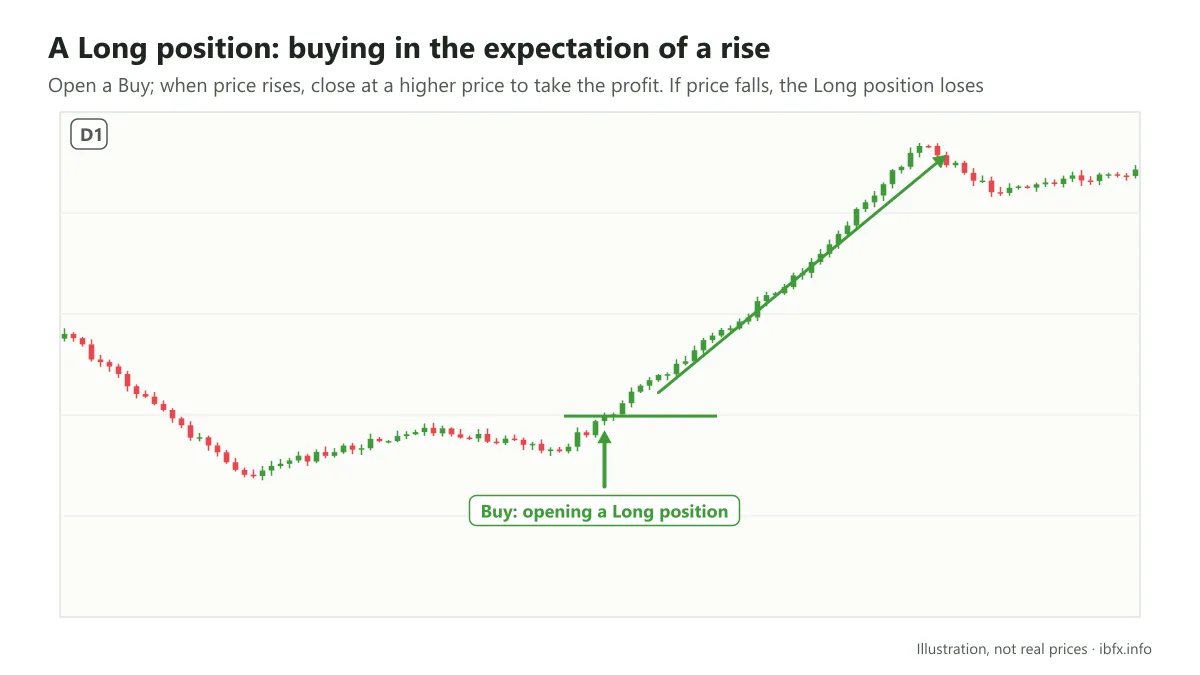
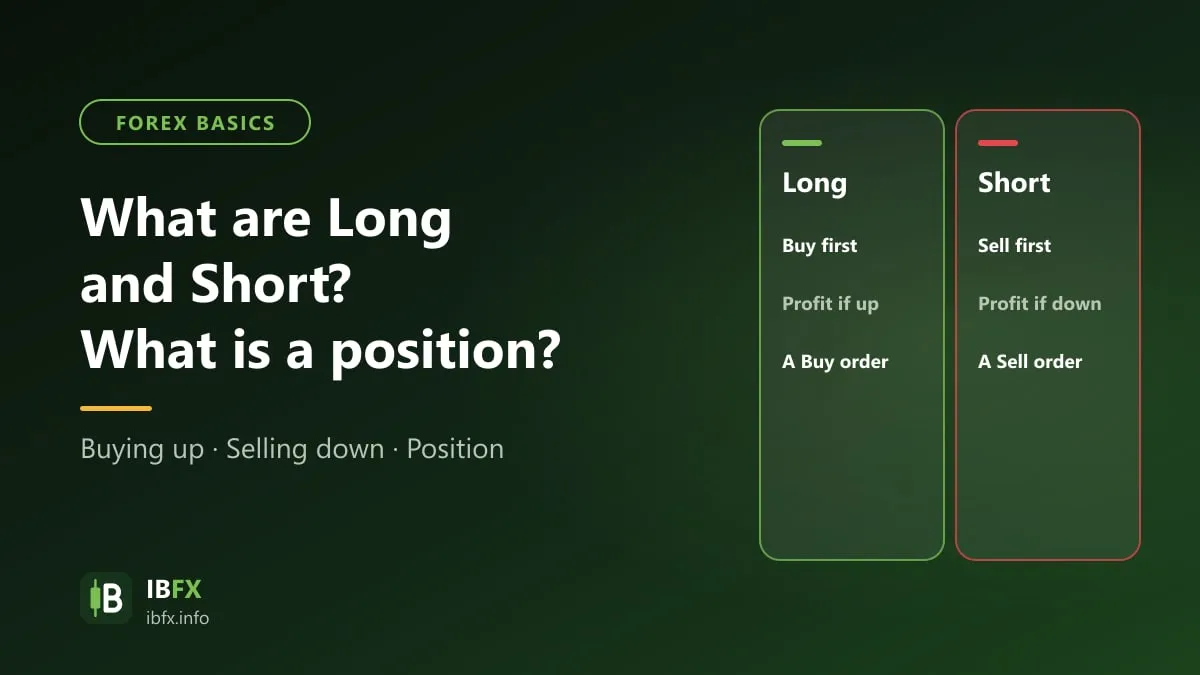
Long, or a Long position, is a buying position. In the financial contract you are the buying party, but because the idea of buying differs from one kind of market to another (as set out in the examples above), people define this idea by the investor’s motive.
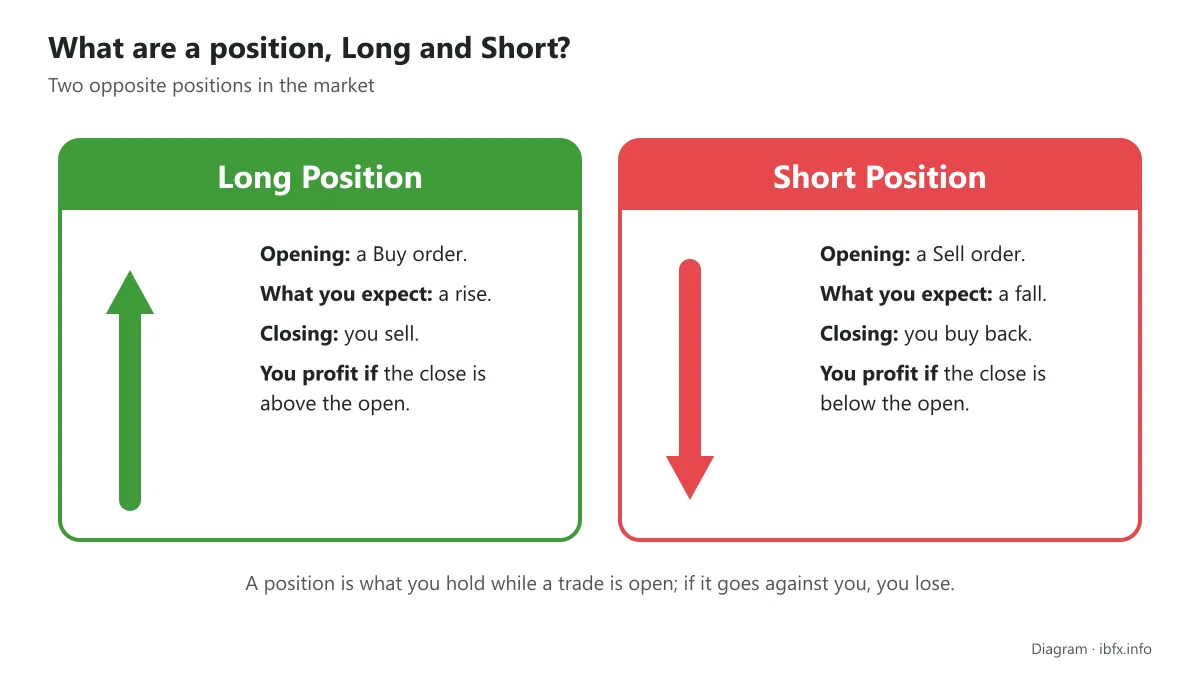
A Long position is the position of a party entering the market in the expectation that the price of the asset will rise.
Someone in a Long position believes the price of the share will rise in future, so they decide to buy the share now at a low price and then sell it at the higher price they expect. The difference in price between the buying and the selling (leaving trading costs aside) is their profit.
Or in the forex market, someone opening a Long position expects the price of a currency to rise in future, and places a buying order (opening the trade) in the market as a bet on their own prediction. When price really does rise, they close the trade, which amounts to selling the currency at a higher price to take the profit, but there is no real buying and selling the way there is in the stock market.
What is a Short position?
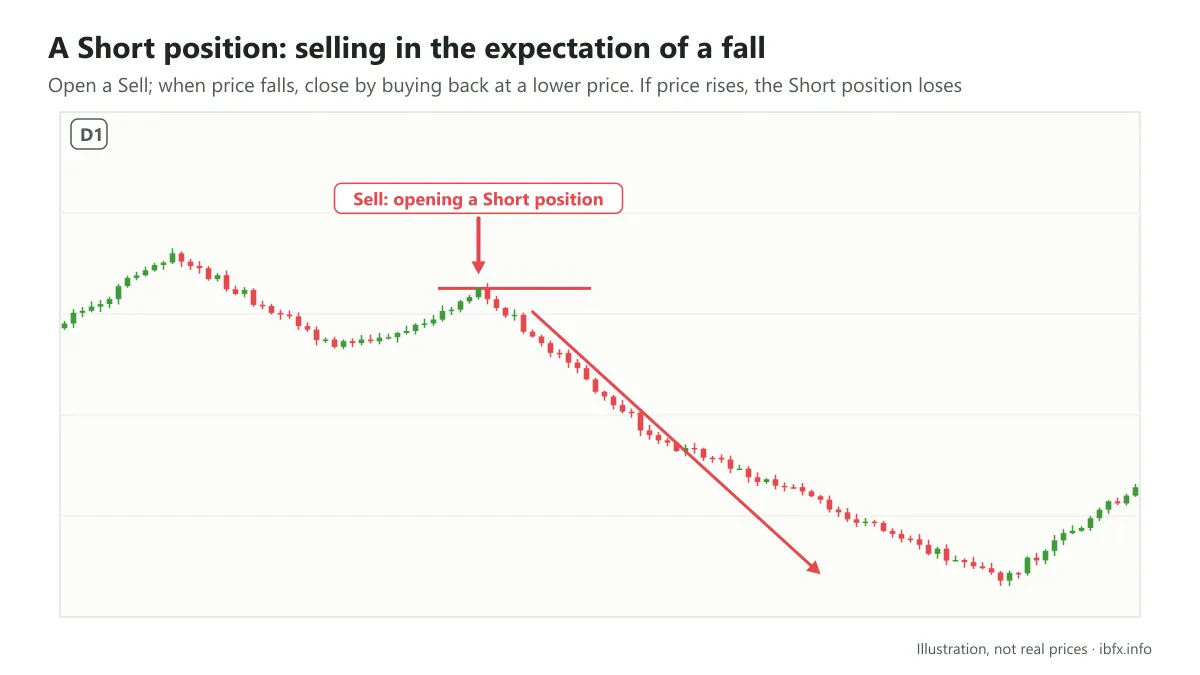
Short, or a Short position, is the position of a party entering the market in the expectation that the price of the asset will fall.
In the stock market, opening a Short position is selling short: the investor borrows shares (usually through a securities company) to sell in the expectation that price will fall, and then buys them back to return them. If price falls as expected, the difference between the price sold first and the price bought back later is the profit; if price rises, the loss in theory has no limit. Vietnam does not at present allow short selling of underlying shares.
Note that selling shares you already own and buying them back at a lower price is only closing a Long position and opening it again; it is not a Short position. In forex, opening a Short position is simply placing a Sell order.
The relationship between a Long position and a Short position
They are 2 opposing positions in one financial contract.
In the stock market, when person A buys shares, A is in a Long position. Seller B may simply be selling shares they already hold (closing B’s Long position), or selling short (opening a Short position) in markets that allow it. When price rises as expected and A places a Sell order to sell the shares they bought and take the profit, A closes the Long position and no longer has a position at all, rather than becoming Short; the new buyer can be any investor.
In the forex market, when A wants to take the profit on a Buy order, A closes the trade, that is A carries out an opposite trade to settle the position with the counterparty, the broker (or the liquidity provider). That is not the same as opening a separate Sell order on an account that allows hedging.
Long and Short positions in option contracts
An option contract gives the buyer the right (not the obligation) to buy or sell the underlying asset at a price set in advance, within a particular period; the seller of the option receives a premium and has the obligation to perform if the buyer asks.
When an investor uses an option contract to exercise the right to buy or sell the underlying asset, the meaning of a Long position and a Short position changes. The profit or loss from using an option contract is also based on movement in the price of the underlying asset, but the investor’s expectation about that price in the 2 positions, Long and Short, is more complicated: a Long position no longer simply means expecting a rise and a Short position expecting a fall.
When you Buy a Call Option or a Put Option, you are in a Long position. But the expectation about the price of the underlying asset when deciding to hold a Call Option and a Put Option is different. A Long position in a Call Option expects the price of the underlying asset to rise, because you will have the right to buy the underlying asset from whoever holds the Short position at the price set in advance, while a Long position in a Put Option expects the price of the underlying asset to fall, because you have the right to sell the asset to whoever holds the Short position at the price set in advance.
The other way round, when you Sell a Call Option or a Put Option you are in a Short position. A Short position in a Call Option expects the price of the underlying asset to fall, because they have the obligation to sell the asset to whoever holds the Long position at the price set in advance, while a Short position in a Put Option expects the price of the underlying asset to rise, because they have the obligation to buy the underlying asset back from whoever holds the Long position at the price set in advance.
Strategies that use a Long and a Short position at the same time
In the financial markets, investors and traders often use both a buying position (a Long position) and a selling position (a Short position) at the same time for various purposes, such as hedging risk, speculating on a price difference, adding to the profit and so on. And the most common purpose is hedging risk. Speculating on a price difference or adding to the profit takes a good deal of trading technique and a high level of understanding of the market.
In the forex market, some traders open a Buy order and a Sell order on the same currency pair at the same time to “hedge the risk”, and then, once price has moved clearly in one direction, close one order and keep the other.
Understand this properly: two opposite trades of the same size only lock in the current profit or loss, and the total does not change wherever price runs, while you go on paying the spread twice and the overnight fee. The decision about which trade to close afterwards is in fact guessing the direction all over again; many new traders use this method to dodge cutting a loss and end up losing more heavily.
Many forex brokers allow opposite trades on MT4 or MT5 (accounts in hedging mode), but some places, such as the United States, do not allow it.
In the stock market, combining the two has various purposes, among which hedging risk and speculating on a price difference are the 2 investors carry out most often. Combining the 2 positions, Long and Short, at the same time is a great deal more complicated, and the tool investors use most is the option contract.
A Long position in the share hedged with a Short position in a Call Option
This is one of the common hedging strategies used by professional investors. Although the strategy does not remove risk altogether, it does reduce the damage of holding the share when the market falls.
The strategy is carried out as follows: buy the share and sell call options on the share, with the number of options sold equal to the number of shares bought.
Where:
- S0: the price at which the share was bought
- X: the strike price of the Call Option
- ST: the price of the share at expiry
- c: the option premium
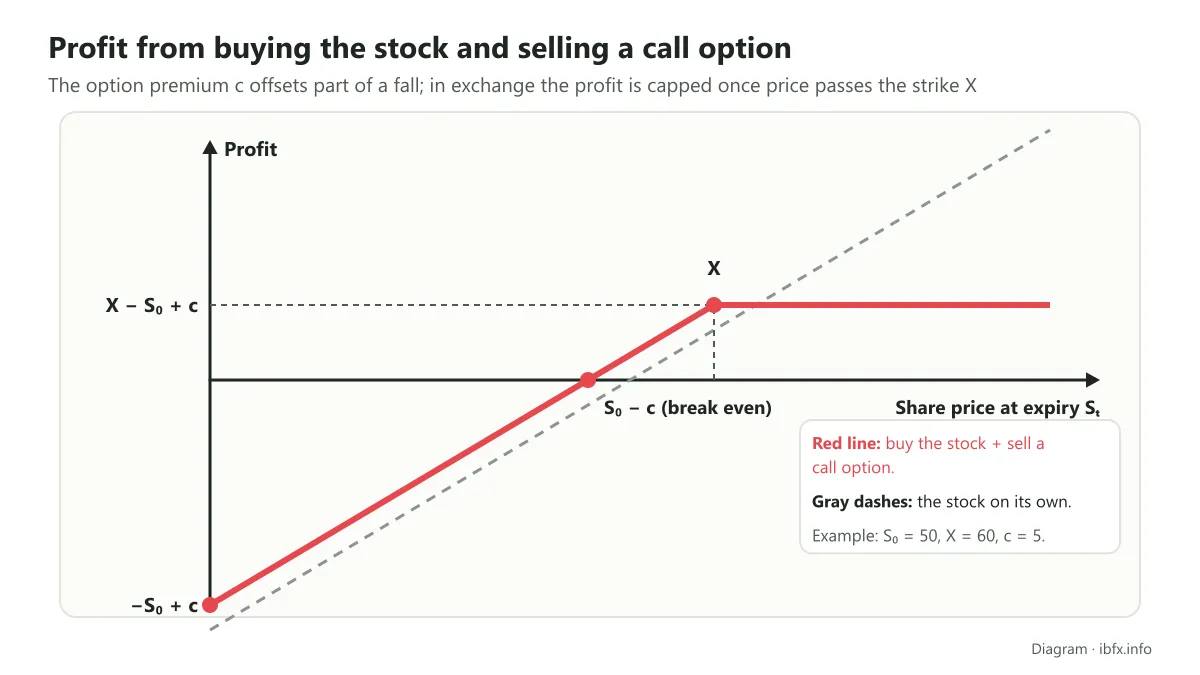
The profit from holding the Long position in the share: P = ST – S0
The profit from holding the Short position in the Call Option: P = c – Max (0, ST – X)
At the expiry of the Call Option, if:
The share price at expiry is below the strike price (ST <= X), whoever holds the Long position, that is the buyer of the option, will not exercise the right, and at that point you have a profit from selling the Call Option, namely the option premium. The total profit from both the Long and the Short position: P = ST – S0 + c.
- If the share price at expiry is above the price at which it was bought (ST > S0), the profit rises with each unit by which ST is above S0.
- If ST < S0, the Long position in the share is at a loss, but the profit from the Short position in the Call Option (c) offsets part of that loss.
If the share price is above the strike price (ST > X), you will have to sell the share as promised in the contract, and at that point the Long position in the share has a profit (with the strike price X no lower than the buying price S0), but that profit is reduced by the loss on the Short position in the Call Option. The profit is then not affected by the share price at expiry. P = ST – S0 – (ST – X) + c = X – S0 + c
A chart illustrating the profit on this strategy:
Buying and selling two call options with different strike prices
This is the strike spread strategy using option contracts.
The strategy comes in 2 kinds: speculating on a rising spread and speculating on a falling spread.
The rising spread strategy (a bull call spread) is used when the speculator expects price to rise moderately in future: open a Long position in Call Option 1 (buy Call Option 1), and at the same time open a Short position in Call Option 2 (sell Call Option 2). These 2 Call Options have the same underlying asset and the same expiry date, but the strike price of Call Option 2 is higher than the strike price of Call Option 1.
With this strategy the speculator only puts up a small amount of capital at the start, namely (c1 – c2). If price rises as expected the speculator has a profit; the other way round, the loss is the capital put up at the start.
The falling spread strategy (a bear call spread) is used when the speculator expects price to fall moderately in future: open a Long position in Call Option 1, and at the same time open a Short position in Call Option 2, with the same underlying asset and the same expiry date, but with the strike price of Call Option 2 lower than the strike price of Call Option 1.
The speculator has a profit from the very start, namely (c2 – c1). If price falls as expected, the speculator’s profit is exactly that initial amount; the other way round, the loss is limited.
With both of these strategies the speculator does not have to own the share in the account at all and can still make a profit from an initial amount of capital, as long as the direction of the market is predicted correctly.
Conclusion
Without looking into them deeply, you will find the ideas of a position, and of Long and Short, very simple, but having a firm grip on what they really are and what they mean is not easy. With a firm grip on the substance, you will be able to understand and apply them in any kind of market and on any kind of asset. That helps make your investing and your business more effective.
Not only with a position and Long and Short, but with every other term in the stock and forex markets, you need to look into them deeply in order to see them as precisely as possible; that way you will discover a great many interesting things in what seem to be simple matters.