On this page
A lot is the unit that measures position size in forex trading. In everyday life we have units such as the meter, the kilogram and the liter; each kind of product has a unit of its own, depending on what the product is like — rice is sold by the kilo, cloth by the meter, petrol and oil by the liter. The foreign exchange market also has many different products and assets, but they all share a single unit of measurement, the lot. For each type of asset, though, the lot is worked out differently, so the value of a lot differs as well. That is why, even though it is only a unit of size, the term lot in forex trading is far more involved, both in how it is calculated and in everything around it, and it bears directly on a trader’s profit and loss in this market.
So, what is a lot? How do you work out lots in forex? And why does a trader need to understand lots thoroughly? Let’s go through it in this article.
What is a lot? Examples of lots in forex
A lot is the unit that measures the size of a trade in forex trading: when you place an order, you have to decide how many lots of an asset or a currency pair you will buy or sell.
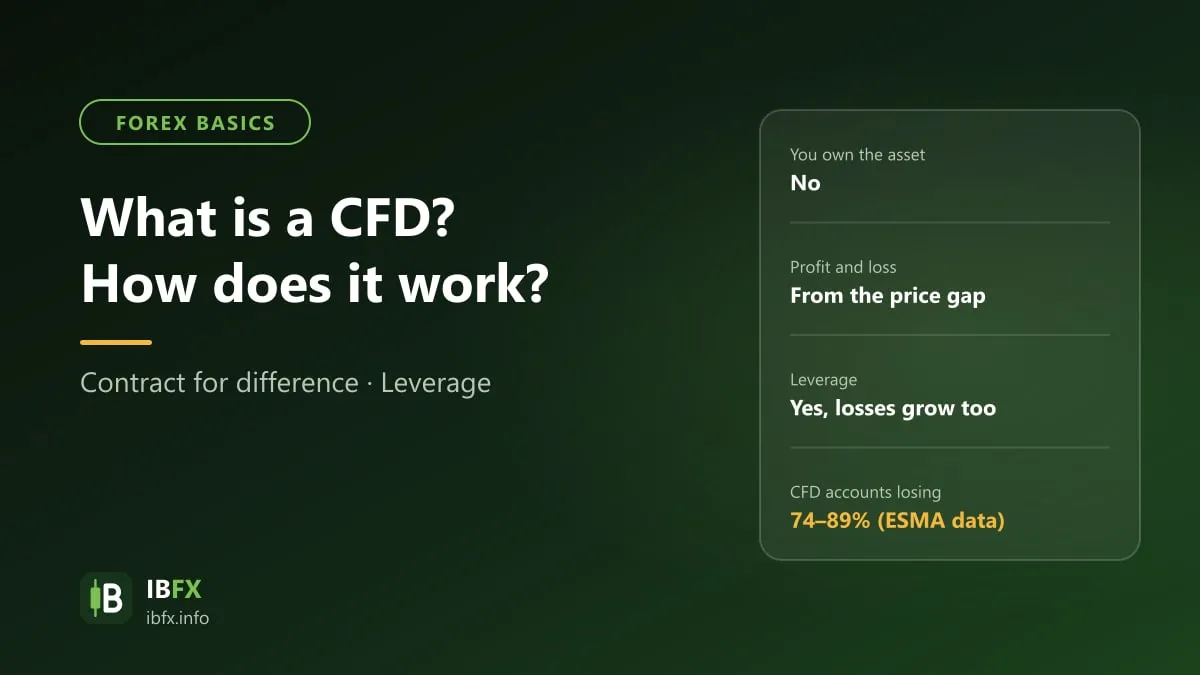
Along with margin and leverage, the lot is one of the features of contracts for difference (CFDs): every financial instrument traded on the forex market through a CFD has its position size measured in lots.
For example:
- Trader A places a Buy order on EUR/USD with a position size of 0.5 lots.
- Trader B trades 0.1 lots of gold (XAU/USD) in a long position
- Trader C sells 2 lots of GBP/USD
- …
Every one of those sentences shows what a lot means in forex trading.
How lots are worked out in forex trading
Say you go to the market and buy 1 kilogram of oranges; the seller puts them on the scales and 5 oranges make a kilo. We say 1 kilogram of oranges is 5 oranges. In the same way:
- 1 kilogram of guavas is 6 guavas
- 1 kilogram of persimmons is 5 persimmons
- 1 meter of cloth is one piece of cloth measuring 1x1 m.
- 1 liter of cooking oil is 2 bottles of cooking oil, each holding 500 ml.
Oranges, guavas, persimmons, cloth and cooking oil are each a particular kind of good, while the kilogram, the meter and the liter are the units that measure them. What we need to settle is how much of the good one unit of measurement contains. That is what working out the unit means. And it is no different for the lot in forex trading. Working out lots in forex means settling how much of a particular asset 1 lot contains, or in other words working out the lot size.
For example:
- how much currency 1 lot of a currency pair is
- how many ounces of gold 1 lot of gold is
- how much of an index 1 lot of an index is
- how many shares 1 lot of a share is
- how many barrels 1 lot of crude oil is
- …
Now let’s work out the lot for each type of asset commonly traded on the forex market.
How much currency is 1 lot of a currency pair?
Currencies in forex trading are shown as a pair of two currencies, for example EUR/USD. The one that comes first (EUR) is the base currency and the one that comes second (USD) is the quote currency.
So, 1 lot of a currency pair = 100,000 units of the base currency.
For example:
- 1 lot of EUR/USD = 100,000 EUR
- 1 lot of USD/CHF = 100,000 USD
- 1 lot of GBP/USD = 100,000 GBP
Some material says 1 lot of a currency pair, or 1 forex lot, is 100,000 USD, and that is simply wrong. 1 forex lot is 100,000 USD only when the pair has USD first.
How much gold is 1 lot of gold?
Gold on the international market is measured in ounces, and 1 ounce of gold is about 0.83 luong (the unit for gold on the Vietnamese market).
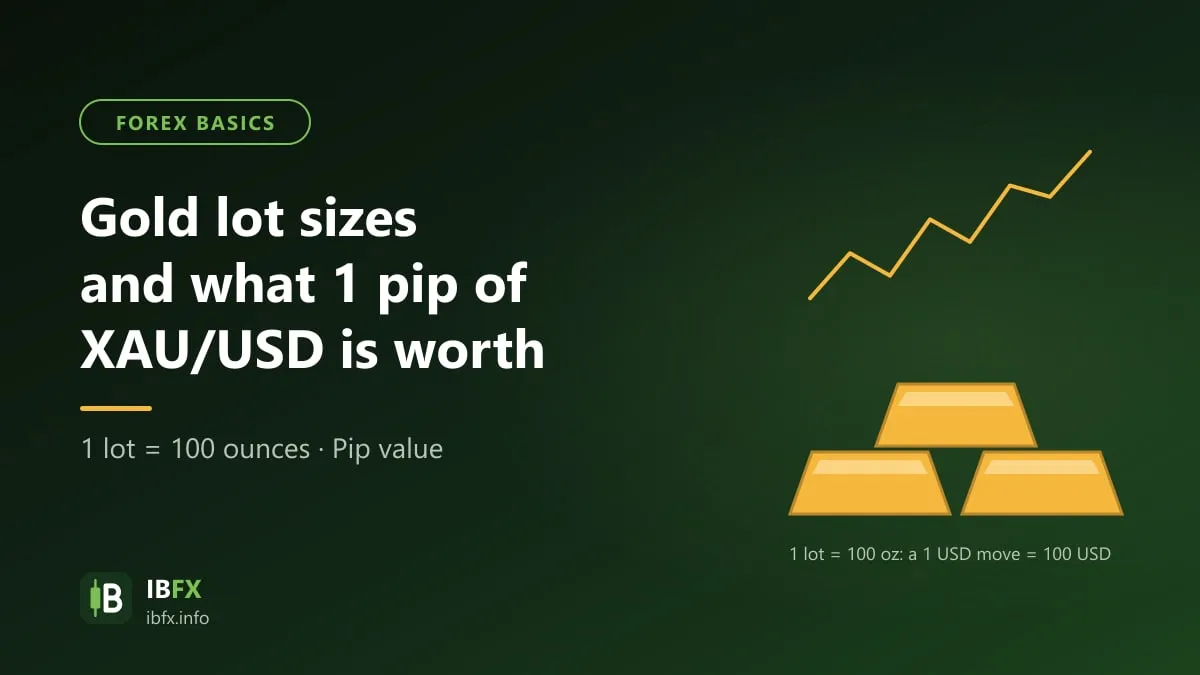
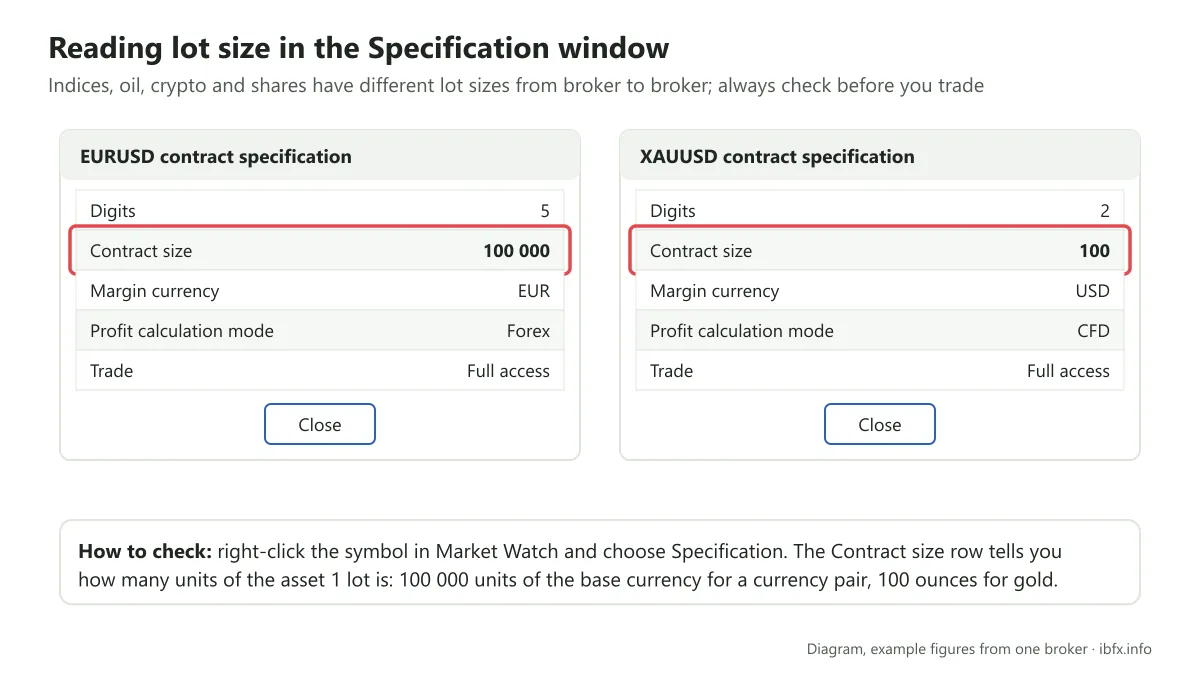
At most brokers, 1 lot of gold = 100 ounces of gold (some brokers use a different size, so read the contract specifications).
How much of an index is 1 lot of an index?
An index is a special kind of asset; it is not measured in a concrete quantity the way other assets are.
At many brokers, 1 lot of an index = 1 CFD on the index worth 1 currency unit per point (1 USD per point on US500, for instance). Trade 1 lot, the index moves 20 points, and you make or lose 20 USD; trade 2 lots and the profit or loss doubles. Some brokers set 1 lot at 10 or 100 times that, so you have to read the contract specifications before you place an order.
How many barrels is 1 lot of crude oil?
On the international spot market, crude oil is traded in barrels of 42 gallons (a gallon is a unit of liquid measure), or about 159 liters.
In forex trading, 1 lot of crude oil is worked out in several different ways depending on the broker: 100 barrels at one broker, 1,000 barrels at another…
And the crude oil price quoted on this market is the price of one 42-gallon barrel in US dollars. Buying 1 lot of WTI crude on the forex market does not mean buying 1,000 barrels; it means buying one contract for difference on 1,000 barrels of WTI crude. The crude oil is only the underlying asset of the CFD.
How many shares is 1 lot of a share?
As a rule, most brokers treat 1 lot of a share as 1 share. A few brokers, though, set 1 lot of a share at 10 shares.
How much crypto is 1 lot of crypto?
At many brokers, 1 lot of crypto = 1 unit of that crypto, so 1 lot of BTC = 1 BTC and 1 lot of ETH = 1 ETH. Some brokers use a smaller size.
How many bonds is 1 lot of a bond?
The lot size of bond CFDs differs a great deal from broker to broker, so read the contract specifications for each symbol.
How many fund units is 1 lot of an ETF?
Usually 1 lot of an ETF = 1 fund unit, depending on the broker.
How much of a commodity is 1 lot of a commodity?
For commodities it depends on the individual commodity, for example:
- 1 lot of Arabica coffee = 1,000 pounds of coffee
- 1 lot of sugar (raw sugar) = 10,000 pounds of sugar
- 1 lot of cocoa = 1 metric ton of cocoa, with 1 metric ton = 1,000 kg, or one tonne
Those figures are only an example from one broker.
As a rule, the lot size of currency pairs (100,000 units) and gold (100 ounces) is fairly consistent across brokers, while indices, oil, crypto, shares, bonds and commodities differ a great deal. So before you trade any type of asset, look at the contract specifications for that asset.
In MT4, to see the lot size of a currency pair, right-click the pair, choose Specification, and look at the lot size (contract size).
How much is 1 lot worth in USD?
In practice, when you place an order you do not care how many units of the asset 1 lot is, but how much money 1 lot is. Put another way, a trader wants to know the value of the lot rather than the lot size.
When you trade, the value of a lot depends on the currency of your account. If the account currency is USD, the lot value is figured in USD; if it is EUR, you need to know how many euros 1 lot comes to. Since USD is the most common account currency, we will work out the value of a lot in USD, that is, how much 1 lot in forex trading comes to in USD.
If the lot size tells you how many units of the asset 1 lot is, the lot value tells you how much those units are worth in USD.
For example: 1 lot of crude oil = 100 barrels, so to work out how much 1 lot of crude oil is in USD we have to know the price of one barrel in USD.
And the rate on the forex market (the Bid price and the Ask price) is exactly the price of one unit of the asset in the quote currency (the one that comes second), so all we have to do is convert that rate into USD.
How much is 1 lot of a currency pair in USD?
1 forex lot = 100,000 units of the base currency, so to work out how much 1 forex lot is in USD, all we have to do is convert the base currency into USD.
Pairs with USD first, for example USD/CHF
This case is extremely simple: 1 lot of USD/CHF is exactly 100,000 USD.
Pairs with USD second, for example EUR/USD
1 lot of EUR/USD = 100,000 EUR. Here we use the EUR/USD rate to convert 100,000 EUR into USD. Suppose the current rate on EUR/USD is 1.23450/1.23451.
- For a Buy order the rate applied is the Ask, 1.23451, so 100,000 EUR = 123,451 USD. So 1 lot of EUR/USD in a Buy position is worth 123,451 USD at this moment.
- For a Sell order the rate applied is the Bid, 1.23450, so 1 lot of EUR/USD in a Sell position is worth 123,450 USD at this moment.
Pairs with no USD in them, for example EUR/GBP
1 lot of EUR/GBP = 100,000 EUR. There are two ways to convert that into USD: convert the 100,000 EUR straight over at the EUR/USD rate, or convert it into GBP at the EUR/GBP rate and then GBP into USD at the GBP/USD rate. The two give nearly the same result, differing only because of the spread. The example below uses the second way, on a Buy position.
Suppose the current Ask on EUR/GBP is 0.85920; then 1 lot of EUR/GBP = 100,000 EUR = 85,920 GBP. What we have to do now is turn 85,920 GBP into USD. On GBP/USD, swapping GBP for USD means you are selling GBP to get USD, that is, opening a Sell position on GBP/USD, so the rate applied is the Bid — say the current Bid on this pair is 1.22950. That gives 85,920 GBP = 105,638 USD. So 1 lot of EUR/GBP in a Buy position is worth 105,638 USD.
How much is 1 lot of gold in USD?
Suppose gold is quoted at this moment as 1798.54/60.
That quote is the price of one ounce of gold in USD, so 1 ounce of gold = 1798.54/60 USD. Since 1 lot of gold = 100 ounces of gold, to work out the value of 1 lot of gold you simply multiply the rate by 100.
In this case, the value of 1 lot of gold is 179,860 USD in a Buy position and 179,854 USD in a Sell position.
How much is 1 lot of an index in USD?
The price of an index is its number of points, worked out from the prices of the shares in the basket using each index’s own weighting (the S&P 500, for example, weights by market capitalization); it is not the average price of the shares.
For example: the US500 index is quoted at this moment at 4055.50/4056.54.
At a broker where 1 lot of US500 is 1 USD per point, the value of 1 lot of the US500 index is 4056.54 USD if you open a Buy position and 4055.50 USD for a Sell position.
For example: the UK100 index is quoted at this moment at 7759.20/7760.20.
Because the shares in the UK100 basket are priced in GBP, we also have to bring in the GBP/USD rate to work out the value of 1 lot of the UK100 index in USD.
How much is 1 lot of a share in USD?
With shares it is extremely simple: the value of 1 lot of a share is the lot size times the price of one share. If the lot size is 1, the value of 1 lot of a share is the price of one share; if the lot size is 10, the value of 1 lot of a share is the price of 10 shares.
For a share on a market outside the United States, add one more step and convert the share price into USD.
Note: in every example above, working out the value of a lot always comes with two important qualifiers, the position and the present moment. The value of a lot depends on the rate, and the rate applied depends on whether the position is a buy or a sell and on the exact moment, because the rate changes all the time.
Lots and leverage in forex trading
In all the examples above, taking positions of 1 lot makes the value of the trade (which is also the value of the lot in USD) very large. On forex pairs the value of 1 lot is around 100,000 USD, more or less depending on the base currency (1 lot of AUD/USD, for instance, is only about 65,000-70,000 USD). That figure is of course out of reach for most traders. Even if you place an order at the smallest position size of 0.01 lots, the money you would need is still around $1,000, which is not a small amount for a single trade. At trade values like that, the forex market really is not for small retail traders like us.
And yet, as you can see, all of us can take part in this market today, and that is thanks to leverage. Leverage lets a trader take a position worth many times the money actually in the account.
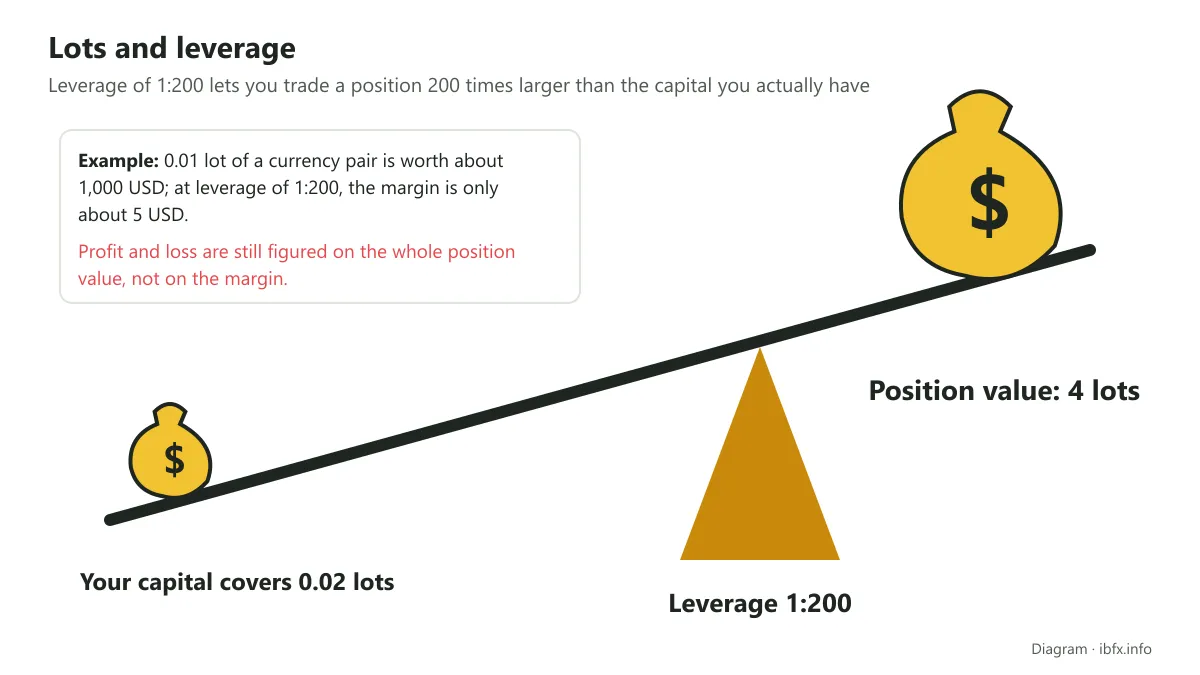
For example, without leverage a trader would need at least about 1,000 USD to trade 0.01 lots of forex, while with leverage of 1:200 the trader needs only $5.
Leverage is another feature of contracts for difference; almost every asset traded through a CFD comes with leverage.
The maximum leverage you are allowed to use differs from broker to broker.
The types of lot size
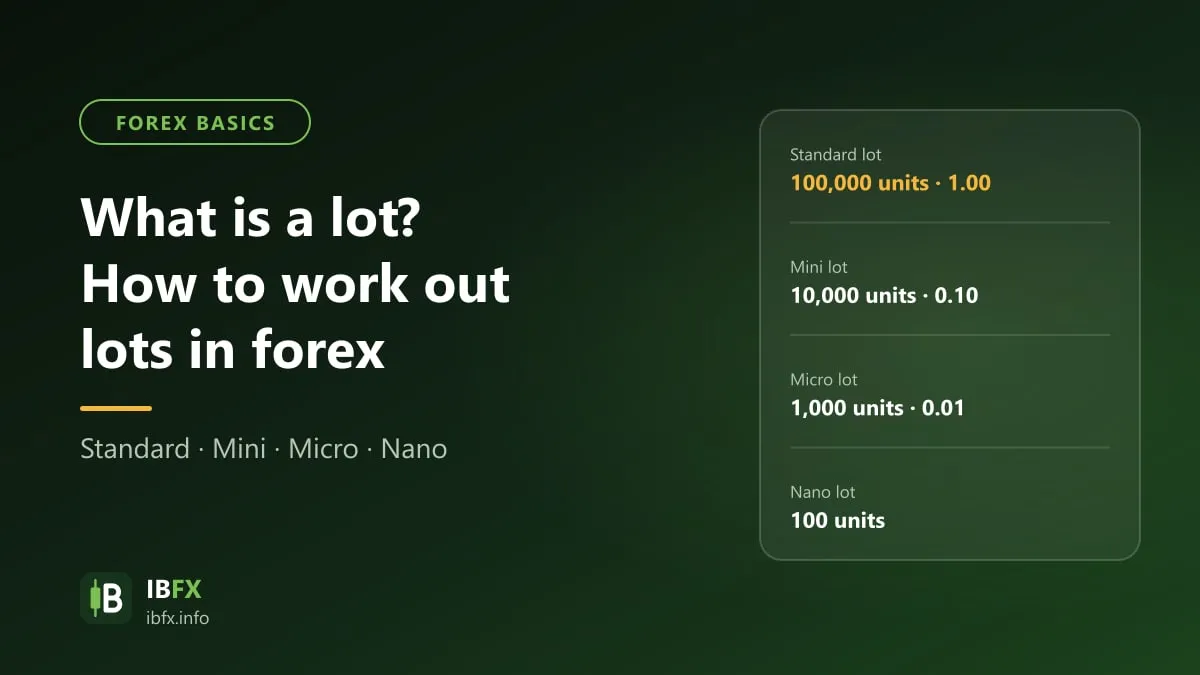
The lot we have been talking about since the start of this article is called 1 standard lot. Forex trading also has other lot sizes, smaller than a lot: the mini lot, the micro lot and the nano lot. They are:
1 mini lot = 0.1 standard lot
1 micro lot = 0.01 standard lot
1 nano lot = 0.001 standard lot
So if 1 standard lot on forex pairs = 100,000 units of the base currency, then:
- 1 mini lot = 10,000 units of the base currency
- 1 micro lot = 1,000 units of the base currency
- 1 nano lot = 100 units of the base currency
Plenty of brokers on the market today offer traders a Cent account or a Micro account whose lot size is the micro lot, so 1 lot on that account equals 0.01 standard lot. And since brokers also let a trader trade a smallest position size of 0.01 lots, trading 0.01 lots on a Cent (Micro) account comes to only 0.0001 standard lot, which is very small indeed.
That makes the Cent or Micro account well suited to new traders with little capital who want to experience a real trading environment with the smallest possible risk.
Forex trading also requires a position size step of 0.01 lots, meaning the smallest order you can place is 0.01 lots and, if you want more, you can go up in steps of 0.01 lots.
Why does a trader need to understand lots thoroughly?
It is not only the idea of the lot: spread, pip, swap, leverage and every other important term in forex trading have to be understood thoroughly as well.
Because the lot measures position size, it naturally bears directly on the value of the trade and on the margin each trade ties up. Understanding lots clearly helps you settle on a sensible, workable position size.
The larger the position size in lots, the larger the profit it can bring, but the loss grows to match. And trading a large number of lots without balancing it against your account balance will bring a margin call if you read the market trend wrong.
On top of that, as the sections above set out, each type of asset has its own way of working out lots, so understanding lots thoroughly helps a trader place orders more accurately and more effectively.
How many lots should a new trader trade?
Nobody can tell you exactly how many lots to trade. The decision depends on a great many things: your account balance, how much risk you accept, the success rate of your strategy, your profit target… and above all your trading style.
For a complete beginner, what matters first is preserving your capital until you have built a trading system that works. Trading a large position size will blow up your account in a handful of trades, given how green and untested you still are. So unless you want to keep putting more money into the account, or to be pushed out of this market quickly, trade only small position sizes with low leverage.
Here are some trading rules for a new trader that you can look at:
- Spend some time on a Demo account
- Choose a Cent or Micro account (if there is one) to start trading for real
- Choose an account type with a low minimum deposit, no more than $200
- Use low leverage, no more than 1:100 on forex, and better still 1:50 or lower
- Focus on just 1 or 2 major currency pairs.
- Work out your position size from your risk: never lose more than 1-2% of the account on a trade. On a 500 USD account, for example, 2% is 10 USD; with a 30-pip stop loss on EUR/USD, 1 lot would lose 300 USD, so the largest position size is 10 / 300 ≈ 0.033 lots, rounding down to 0.03 lots. See the 2% money management rule.
Conclusion
I hope this article leaves you with a firm and thorough grasp of what a lot means in forex trading, so that you can settle on a sensible position size in lots for each trade.