On this page
In forex trading, alongside analysis skills, money management is a skill no trader can do without. Good money management skills help a trader maximize profit and hold risk down as far as possible. There are a great many reasons why a trader fails quickly on the forex market, and among them, having no knowledge of money management, or treating it lightly, is one of the reasons present in most of those failed traders.
“10 top tips for effective money management in forex”
Alongside the Kelly formula, a well known money management principle in financial investing, this article introduces a tool that is simpler and easier for an individual trader to apply: the 2% money management rule.
The 2% money management rule is one of the money management and risk management principles many traders use on the financial markets, and on forex in particular. To be clear from the start: 2% is the ceiling of this rule, not the figure the article recommends — the sections below show why many long-standing traders keep the risk on each trade at 1% or less.
If you have already grasped how important money management and risk management are in forex, you cannot skip what follows: the 2% rule gives you one more tool for managing your money effectively in this market.
What is the 2% money management rule?
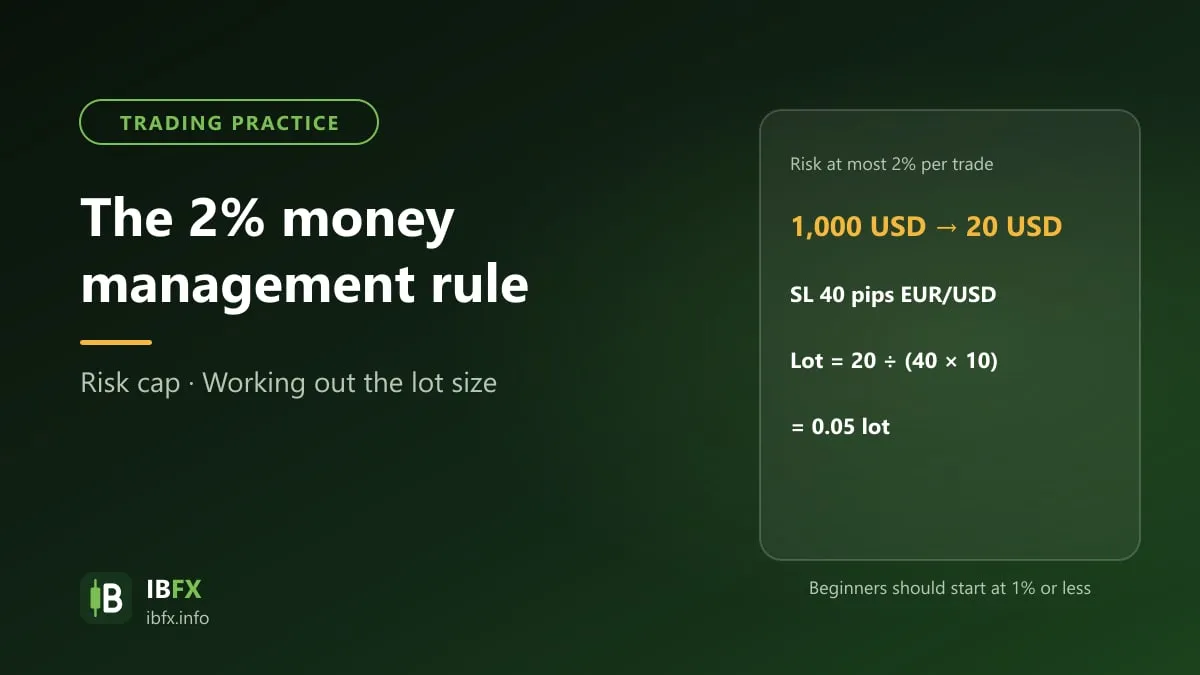
The 2% money management rule is a trading principle under which an investor allows themselves to lose at most 2% of the account balance on each trade.
Where the Kelly formula tells you how much capital to invest in each trade in order to maximize profit over the long run, the 2% money management rule also helps you work out how much capital to put up, but in order to hold the amount you can lose at a fixed level, in this case 2% of the account balance.
Say your trading account currently has a balance of 1,000 USD and you are planning to place a Buy order on EUR/USD. Under the 2% money management rule, the maximum risk you accept on this trade is 1,000 USD x 2% = 20 USD. That 20 USD is the most you will lose if the trade fails; it is not the capital you will put into this trade.
Once the maximum allowable loss is settled, the trader can work out the position size of the trade, and from there the initial capital, or the margin, based on the leverage of the account. The exact calculation is set out below.
Why the number 2%?
You will have heard investing principles such as “survive first, and only then think about becoming wealthy” or “while you still have money you are still alive”. The 2% money management rule works the same way: you have to have money in the account before you can make a profit. But having money in the account does not mean losing over and over and topping the account up; it means keeping the account at a low level of risk at all times.
Why is the number 2% sensible?
Suppose you are unlucky and lose 10 trades in a row. Under the 2% money management rule the loss across those 10 trades is 20%, so you still have 80% of the balance left to carry on trading, a proportion that keeps a losing run from feeling too much like pressure.
Try a higher number, 3%: lose 10 trades in a row and you are down 30%, a proportion that easily brings on the negative thought that you have lost almost 1/3 of the account, and the pressure will certainly weigh on your trading psychology. For a scalper or a day trader, 10 trades in one day is perfectly normal, and if that day is a dark one for them (all 10 of those trades fail), you can picture how serious a loss of 30% of the account would be. That is exactly why a great many professional traders, scalpers and day traders never even let a loss go above 1%.
Applying the 2% money management rule to forex trading
Some points to note when you use the 2% money management rule
The ultimate aim of the 2% money management rule is to cap the maximum loss on each trade at 2% of the account balance, and what the trader has to do is settle the position size of each trade so that if the market moves against the forecast and the trade reaches the stop loss, the trader loses exactly that amount.
Before we get to the specific steps for applying the 2% money management rule, you should note the following points:
First, commission and swap can be counted inside the maximum loss of the 2% money management rule.
In forex, if a trade fails, the trader takes a loss because the position went against the direction of the market, and on top of that the trader’s account is also charged other costs such as commission and swap. So, depending on how much risk they will carry, each trader uses the 2% money management rule in a different way. Some will not count commission or swap (which only applies to positions held overnight) inside that 2%, while others will.
As a rule, professional traders trading large position sizes count these 2 costs in, while small traders with little capital usually leave them out, because these costs make up a very small proportion when the position size is small.
Because working out swap is somewhat complicated, within the scope of this article we will leave it aside and present only 2 cases: with commission counted in and without commission counted in.
Second, there are 2 ways of approaching the 2% money management rule
Maximum loss = account balance * 2%
There are 2 ways a trader can approach this 2% money management rule:
- The maximum loss is worked out on the initial account balance (the amount deposited into the account the first time)
- The maximum loss is worked out on the current account balance.
Suppose the trader’s account has an initial balance of 1,000 USD. Under the first approach, the maximum loss on one trade is always fixed at 20 USD, at any point in time. Under the second, suppose that after a period of trading the account balance is down to 800 USD; the maximum loss on one trade is then 2% * 800 USD = 16 USD.
What if you place several trades at once?
When a trader opens several positions at the same time, a total risk limit can be applied across all the open positions; many traders keep this between 5% and 10% of the account balance, depending on how far those positions are correlated with each other.
Each trader can choose a different approach, depending on their preference and how much risk they will carry. Note that the first approach makes the real risk percentage creep up while the account is down (20 USD on a balance of 800 USD is already 2.5%), while the second cuts the amount at risk automatically as the account falls, so it is safer. The examples below use a current balance equal to the initial balance, so the two approaches give the same result.
Third, the knowledge you need before you use the 2% money management rule.
The most important thing you need to grasp in order to use this principle is how to count pips and how to work out pip value in forex. Pip value feeds directly into the formula for profit and loss in forex trading. Traders who do not use money management or risk management principles usually pay no attention to this, because their profit or loss has already been worked out for them by the trading software.
However, to use this 2% rule, you need a firm grasp of how to count pips and work out pip value.
First comes the size of one pip on 1 unit of the base currency:
- For an XXX/USD pair, 1 pip = 0.0001 USD
- For a USD/XXX pair, 1 pip = 0.0001 XXX = (0.0001 / the exchange rate) USD
- For USD/JPY, 1 pip = 0.01 JPY = (0.01 / the exchange rate) USD
- For an XXX/JPY pair, 1 pip = 0.01 JPY, which in XXX is (0.01 / the exchange rate) XXX — this line gives a figure in XXX rather than in USD as the three above do, so it still has to be converted into the currency of your account.
That is not yet the pip value of a trade. To get the pip value on 1 lot, multiply by the number of units in 1 lot, that is by 100,000. Take GBP/USD: 1 pip = 0.0001 USD per unit, times 100,000 units, which gives 10 USD a pip on 1 lot — and that is the 10 USD used in Step 3 below.
To understand these formulas better, you can read the article “What is a pip? How to work out pip value in forex trading.”
The 5 steps for applying the 2% money management rule
Example 1: your trading account has a balance of 1,000 USD. Your trading strategy gives you the following entry details:
- A Buy order on GBP/USD
- Entry at a price of 1.29100
- Stop loss at 1.28800
- Take profit at 1.30000
Your task is to settle the position size of the trade so that it satisfies the 2% money management rule.
- Case 1: commission not counted in
- Case 2: commission counted in, assuming a charge of 7 USD per lot round turn
Step 1: Settle the maximum loss corresponding to 2% of the account balance
- Case 1: maximum loss = 2% * 1,000 USD = 20 USD
- Case 2: maximum loss = 2% * 1,000 USD = 20 USD.
Step 2: Count the pips of loss
The pips of loss are counted as the distance from the entry to the stop loss.
With the entry details above, the maximum loss is 30 pips and the profit is 90 pips. The risk:reward ratio of this trade is 1:3
Step 3: Work out the money value of those pips of loss
The value of 1 pip on 1 lot of GBP/USD is 10 USD. It follows that the value of 30 pips, trading 1 lot of GBP/USD, is 300 USD.
Step 4: Work out the position size
Call the position size to be settled A. It follows that the value of the 30 pips of loss when trading A lots will be 300*A (USD), and the commission on A lots is 7*A (USD).
- Case 1: maximum loss = the value of the pips of loss = 20 USD
- Case 2: maximum loss = the value of the pips of loss + commission = 20 USD
So the maximum loss on the trade in the 2 cases works out as follows:
- Case 1: 20 USD = 300*A, so A = 0.0667 lots, rounding down to 0.06 lots.
- Case 2: 20 USD = 300*A + 7*A = 307*A, so A = 0.0651 lots, rounding down to 0.06 lots.
The 2 cases both come out at 0.06 lots. Always round down: rounding up to 0.07 lots would make the loss at the stop loss 21 USD (before costs), over the 2% limit. If you are a trader with little capital, trading a small position size, you can leave commission out when you use this 2% rule to make the arithmetic easier.
Step 5: Place the trade
Once the position size is settled, you can enter a Buy of 0.06 lots of GBP/USD at a price of 1.29100, with the stop loss at 1.28800 and the take profit at 1.30000.
If the trade fails, you lose 18 USD (plus about 0.42 USD of commission in case 2), 1.8% of the account balance in case 1 and 1.84% in case 2, both below the 2% limit because the position size was rounded down in step 4.
Example 2: with the same details as above, but in this example we will apply the 2% rule to an account with a large balance (100,000 USD), so that you can see the difference between the 2 cases.
- Step 1: maximum loss on the trade = 100,000 USD * 2% = 2,000 USD
- Step 2: the maximum pips of loss is 30 pips.
- Step 3: the value of those pips of loss = 300 USD per lot
- Step 4: the position size
Case 1: maximum loss = 2,000 USD = 300*A, so A = 6.6667 lots, rounding down to 6.66 lots
Case 2: maximum loss = 2,000 USD = 307*A, so A = 6.51 lots
A difference of 0.15 lots (equivalent to 45 USD of risk on a 30 pip stop loss) is not a small position size, so on a large account count the commission in as well.
Conclusion
The 2% money management rule is an upper limit, not a level you have to use: for a new trader, many people advise starting at 1% or lower. The rule helps an account survive a losing streak; it does not turn a losing strategy into a profitable one. The rule is very easy to apply, but keeping the discipline is not something everyone manages, unless they truly understand how important money management and risk management are and can see the point of this number 2%. Besides, the 2% rule can be used together with a number of other money management rules to work better still, such as a total risk limit on the open positions (mentioned above), locking in part of the profit, or stopping trading to review your investment strategies once the loss has gone beyond what you expected… Try out several different money management strategies to find the one that suits you best.