On this page
In an earlier guide we went through the term pip; this time we carry on with another basic term in Forex that matters just as much, and that is spread.
If a pip is the unit that measures how far price moves, and also the unit that measures the profit or loss on a trade, then spread is a quantity whose unit of measurement is the pip itself. That is why the two ideas, pip and spread, always go together: as soon as anyone mentions spread, they say how many pips that spread comes to.
In Forex trading, spread is one of the costs you pay your broker, alongside commission and swap (the overnight fee), and for a short-term trader the spread is usually the largest of them.
So, what is spread? How is spread worked out? Why is spread a trading cost?… we will go through all of it in this article. Read on.
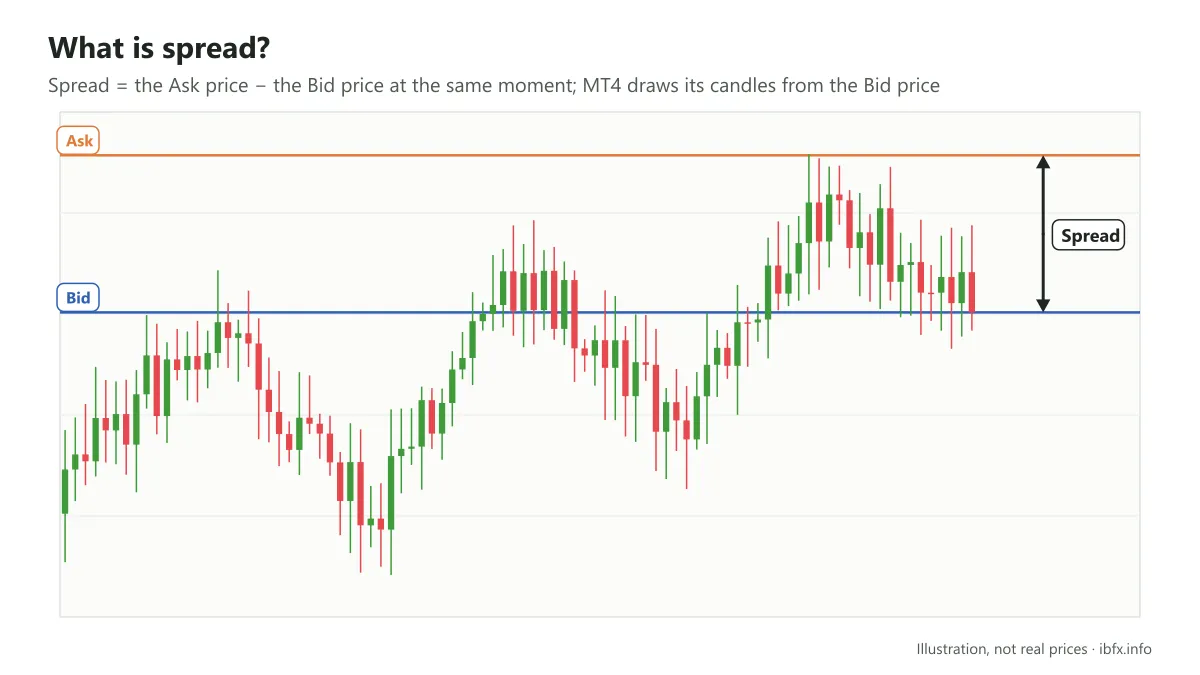
What is spread?
Before we pin down what spread is, let us go back over the two ideas of the Bid price and the Ask price.
In your trading platform you will always see every currency pair, and every other kind of instrument, quoted with two different prices: the Bid price and the Ask price.
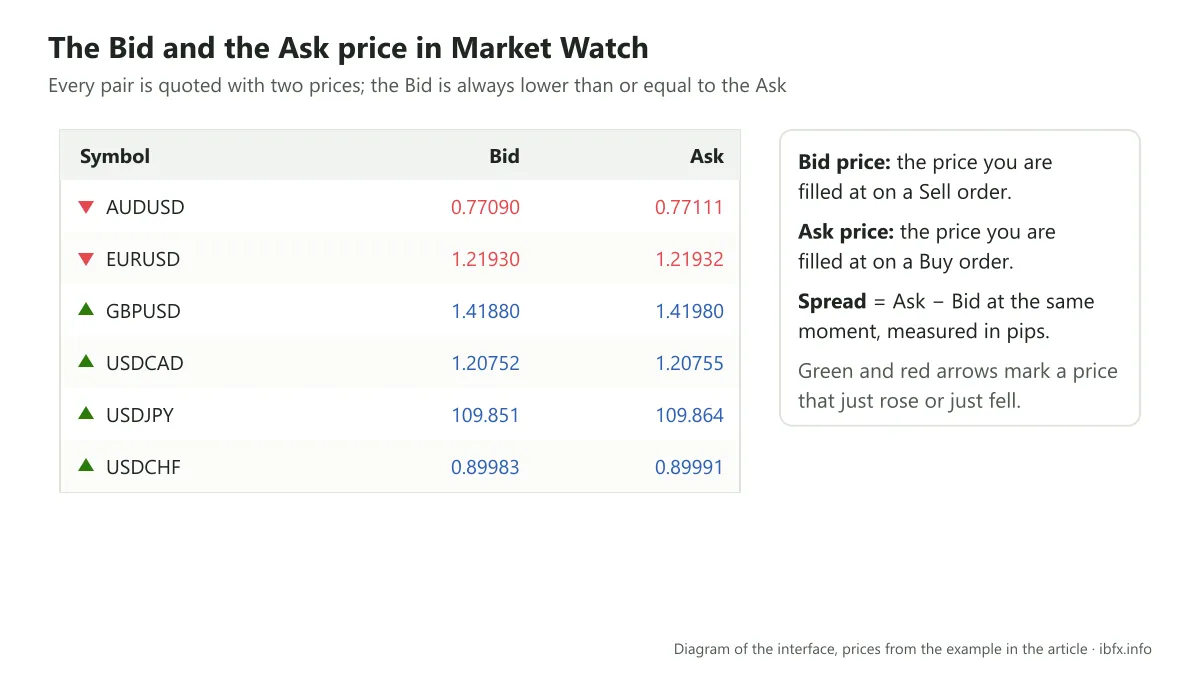
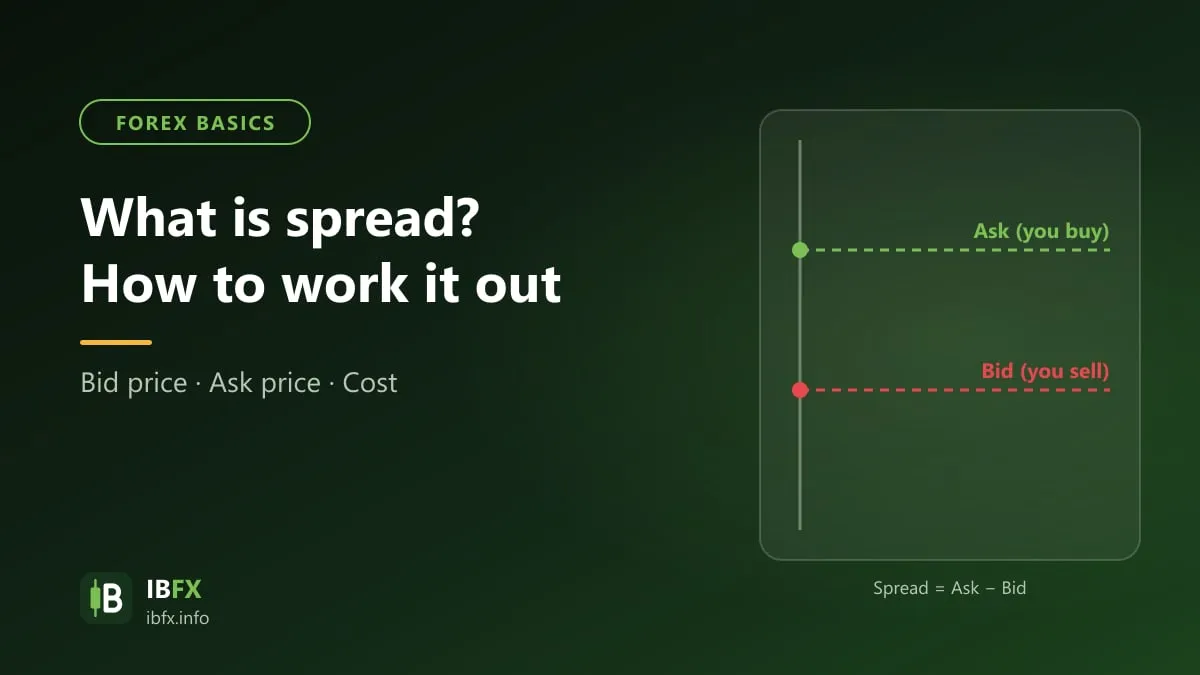
The Bid is the price you are filled at when you place a Sell order, and the Ask is the price you are filled at when you place a Buy order. The Bid is always lower than or equal to the Ask: the price you buy at (the Ask) is always higher than or equal to the price you sell at (the Bid).
An example: banks usually quote an exchange rate in this form: USD/VND: 23,340/56 (an illustrative rate). Read that way, the Bid is 23,340 and the Ask is 23,356. When you go to the bank to buy US dollars, the rate applied is 23,356, and when you take US dollars to the bank to sell them for VND, the rate applied is 23,340. Suppose you buy and sell on the same day: the difference between the buying and the selling rate is the loss you take.
So in Forex trading, the spread is the difference between the buying price and the selling price, that is, the difference between the Ask and the Bid at the same moment.
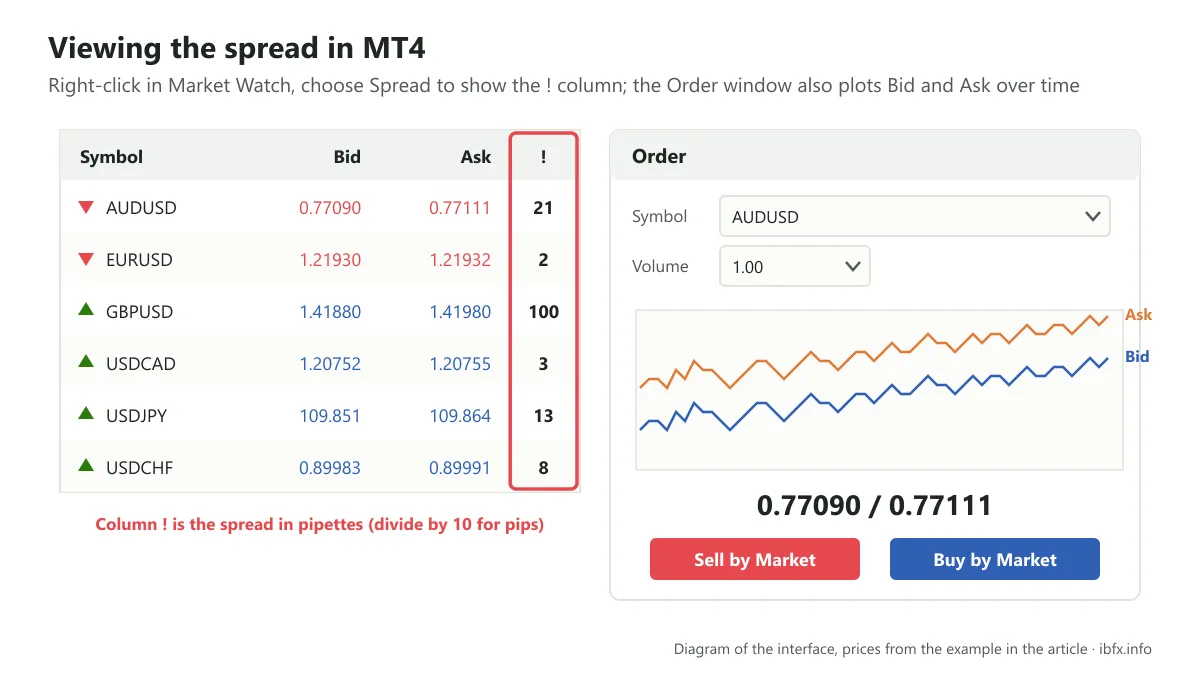
In the MT4 platform, to see the spread on the instruments you trade, go to the Market Watch area, right-click any quote row and choose Spread; the column marked with an exclamation mark (!) is the spread column.
Or, when you open the order dialog for the instrument you want to trade, you can also see the spread as a chart.
How to work out spread in Forex
Spread is the difference between the Ask and the Bid on any instrument at the same moment.
Spread = the Ask price – the Bid price. The unit that measures spread is the pip.
The exclamation mark column above shows the spread in pipettes; to convert it into pips, simply divide by 10.
An example: the current rate on AUD/USD is Bid: 0.77090, Ask: 0.77111. The difference on AUD/USD at this moment = 0.77111 – 0.77090 = 2.1 pips = 21 pipettes.
The words at the same moment cannot be left out of the definition, because the price of an instrument in the market changes all the time. At this moment the spread is 2.1 pips, and a minute later it may drop to 1.1 pips or rise to 3.5 pips.
Why is spread a trading cost?
Go back to the example of buying and selling US dollars at the bank. Suppose you buy USD at the Ask and then sell it the same day at the Bid, and the USD/VND rate does not move during the day: you make no profit and no loss on this short trade, yet the gap between the Ask and the Bid has left you with less cash than you started with, and that gap is the trading cost you pay the bank.
Now look at the Forex market, where the rate on a currency pair changes every second and every minute: it is very rare for you to buy and sell straight away and find the rate unchanged.
Look at the illustration below:
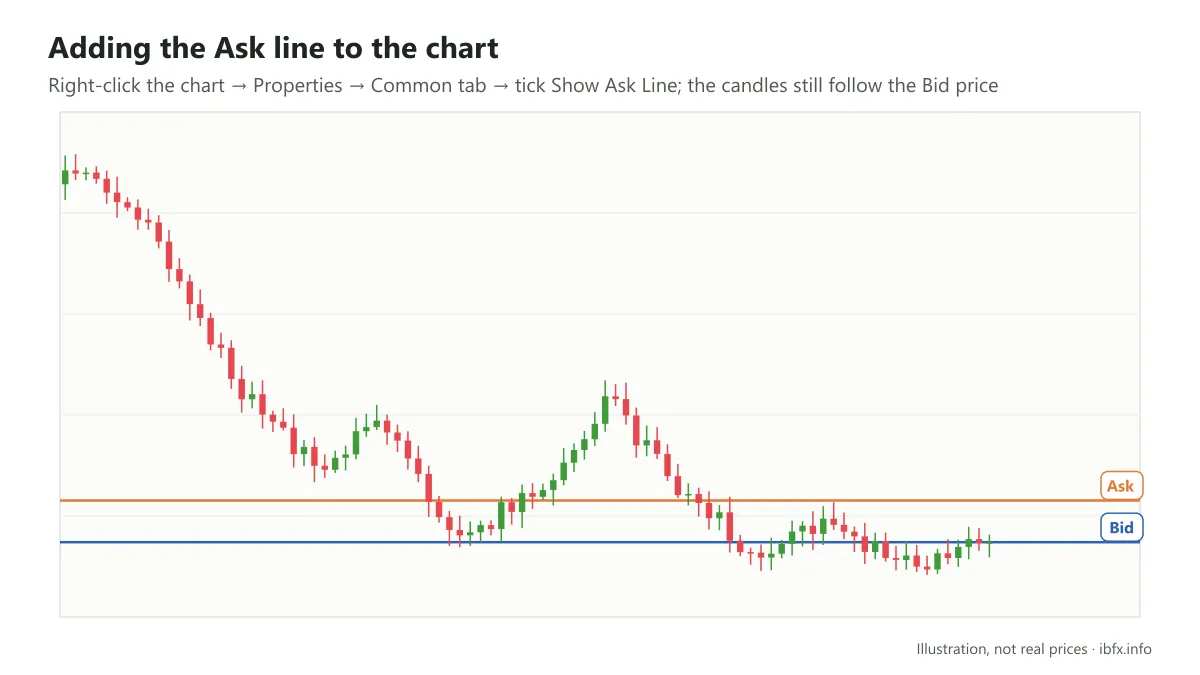
The candles on the price chart move with the Bid price. By default the platform draws only a Bid line; we have added the Ask line to show you how a trade is filled and how the spread is charged as a trading cost. You can add the Ask line yourself in the chart settings of your own platform.
Right-click the price chart, choose Properties, go to the Common tab, then tick the Show Ask Line box and click OK.
- Case 1: placing a Sell order
When you place a Sell order you are filled at the Bid, which means your trade is marked on the chart right on the Bid line at the moment it is filled.
When you close the trade to take your profit, instead of being filled at the Bid price running on the chart, you are filled at the Ask (because closing a trade means opening the opposite position to the one you placed), so at that point your trade is closed on the Ask line.
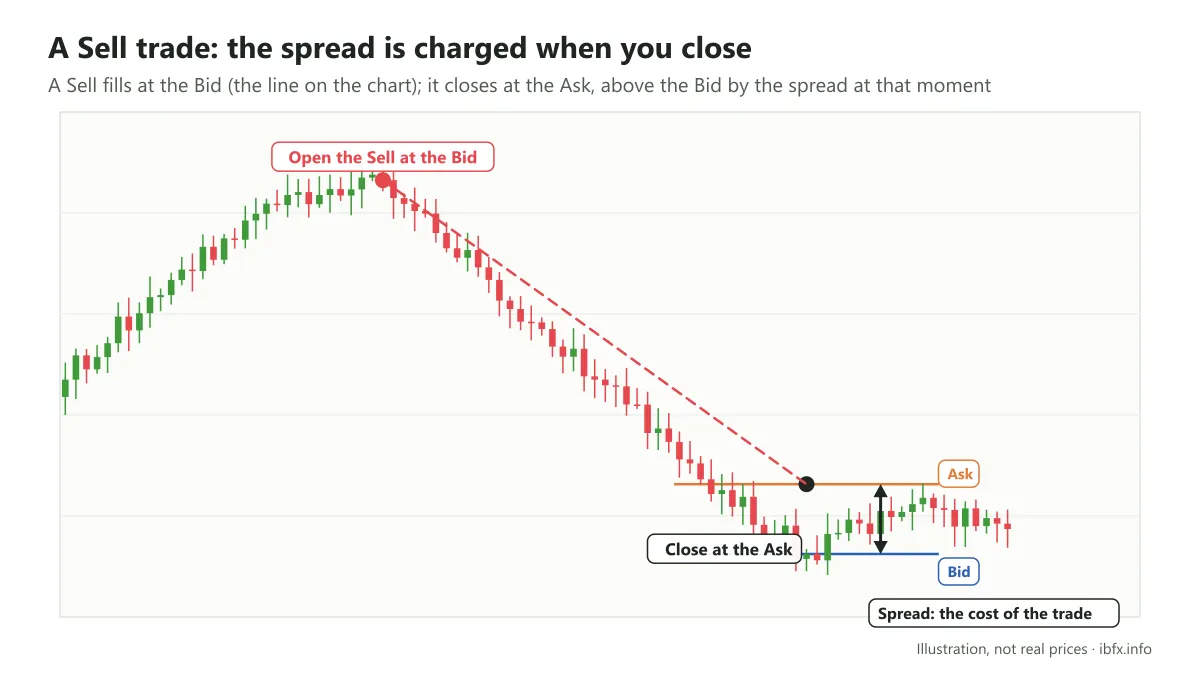
That fill cuts part of your profit away, by exactly the difference between the Ask and the Bid at the moment you close, that is, the spread on the pair at the moment you close. This is the trading cost you pay the broker.
- Case 2: placing a Buy order
When you place a Buy order you are filled at the Ask, while the price running on the chart is the Bid, so your trade is filled on the Ask line, a step above the price running on the chart.
That fill when you open a Buy cuts part of your profit away (if price goes your way) or adds to your loss (if price goes against you), by exactly the spread on the pair at the moment you open. This is the trading cost you pay the broker.
When you close, you are filled at the Bid, right at the price running on the chart, so you pay nothing further.
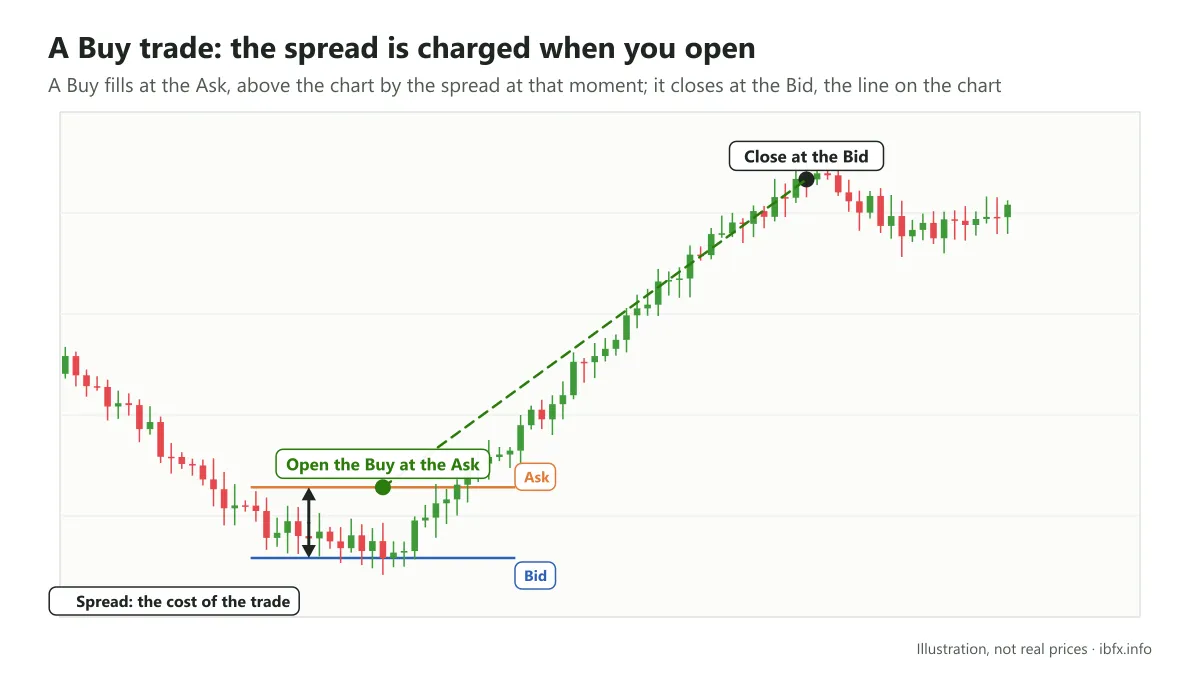
In short:
- On a Sell trade, the spread is charged as a trading cost at the moment you close.
- On a Buy trade, the spread is charged as a trading cost at the moment you open.
The spread at the open and at the close can differ, depending on how the rate moves, so the trading cost you pay on a Buy and on a Sell can differ too.
An example: EUR/USD is currently at 1.21930/1.21932, so the spread at this moment is 0.2 pips.
- On MT4 the chart is drawn from the Bid, so on a Buy the cost is charged at the moment you open, which makes 0.2 pips what you pay on this trade, whether the spread rises or falls by the time you close.
- On a Sell the cost is charged at the moment you close. Suppose that when you close, EUR/USD has moved to 1.21300/1.21303: the spread is then 0.3 pips, and that is what you pay on this trade.
Because spread is measured in pips, you can easily work out the value of a spread in any currency, and from that work out what each trade costs you at the broker (not counting commission and swap).
The formula:
Spread cost per trade = position size * the spread in pips * the value of a pip per unit of currency = the number of lots * the standard size of a lot * the spread in pips * the value of a pip per unit of currency.
Further reading: What is a pip? How to work out the value of a pip in Forex
What is spread widening? What causes it
The types of spread
In the sections above we have always looked at a spread that keeps changing, but in practice a spread can stay the same even as the rate moves, and that is a fixed spread.
- Fixed Spread: the rate changes all the time, but the difference between the Bid and the Ask does not.
- Variable Spread: the rate changes all the time, and the spread changes with it.
With a fixed spread you can work out what each trade will cost you at the broker before you even place it, and the spread cost is the same on a Buy as on a Sell.
Whether a fixed or a variable spread applies depends on the broker and on its policy for each account type. Some brokers apply both a fixed and a variable spread across their trading accounts, while others apply a variable spread only; the second is the more common, because a fixed spread is usually wider than a variable one when the market is normal.
What is spread widening?
Spread widening is when the spread runs far above its usual level. It happens on a variable spread; a broker on a fixed spread may instead requote or turn down the order when the market moves sharply. On EUR/USD, for example, the usual spread ranges from 0.1 to 1.0 pip, and when the spread widens that difference can reach 5 pips or even 10 pips. The wider the spread, the more you pay the broker, which is why traders always avoid trading at times of sharp market movement, when the spread widens easily.
What causes the spread to widen
The spread usually widens sharply at two times:
-
At the handover between trading sessions: in the early morning, just as the market reopens, is when the market is quietest, because few people are trading; thin liquidity makes the spread wide, and it is widest on Monday morning each week, since the Forex market only runs 24/5. The spread also widens at the handover between markets. New York and London are more liquid than the Asian (Tokyo) or Australian (Sydney) markets, so the handover from a busy session to a quieter one is another time when the spread commonly widens.
-
Just before and as important news is released: banks and liquidity providers pull back their quotes for fear of a sharp move, liquidity thins out, and the gap between the buying and the selling price widens. Brokers also commonly widen their spread in those minutes to protect themselves.
To run into sharp spread widening less often: first, avoid trading at the session handover and in the run-up to a news release; second, do not place a stop loss or a pending order too close to price, because a spread that widens at the handover can trigger them even though the price on the chart has not reached them; third, trade with a reputable broker that has a low spread.
How to choose a broker and an account to keep your trading cost down
In this section we look at two trading costs, spread and commission, and leave swap out, because swap can be a cost but can also be interest credited to your account when you hold a trade overnight.
As said above, a broker may offer both accounts with a fixed spread and accounts with a variable spread.
Which type of spread to pick also depends on your own style and strategy. Some scalpers prefer an account with a fixed spread, because it limits the risk of a sudden widening. Most other traders prefer a variable spread.
So, to keep your trading cost down, you have to pick an account with a low spread at a reputable broker.
- Choosing an account type to keep your trading cost down
Accounts with a variable spread fall into two basic types: the Standard account and the ECN account.
A Standard account usually adds the broker’s own fee into the spread, so the spread is wider, while an ECN (or Raw) account has a spread close to the liquidity provider’s price and therefore very low. Even so, the name ECN by itself is no assurance that your order goes out to the market, or that the broker has no conflict of interest with you.
In exchange, to keep their revenue, brokers charge a commission on every trade on an ECN account, while a Standard account is free of commission.
So the question is: total trading cost = spread + commission, and how do you tell which of a Standard account and an ECN account costs less?
At reputable, good-quality brokers, a Standard account carries a spread of 1.0 to 1.5 pips on the major Forex pairs and no commission, while an ECN account carries a spread of only 0.0 to 0.5 pips on the major pairs plus a commission of only 6 to 7 USD per round-turn lot.
The total trading cost on an account with a wide spread and “no commission” is usually higher than on one with a low spread and a competitive commission.
An example: a Standard account has a spread of 1.5 pips on EUR/USD. An ECN account has 0.5 pips and a commission of 7 USD per round-turn lot.
Place a Buy of 1 lot of EUR/USD
- The cost on the Standard account = spread = 100,000 * 1.5 * 0.0001 = 15 USD
- The cost on the ECN account = spread + commission = 100,000 * 0.5 * 0.0001 + 7 = 12 USD
That is why traders tend to prefer an ECN account over a Standard one. Choosing between the two still depends on how much capital the trader has, because an ECN account usually asks for a far larger deposit than a Standard account.
- Choosing a broker to keep your trading cost down
Picking the best ECN or Standard account to keep your trading cost down also has to do with how reputable and how good the broker is.
Reputable, good-quality brokers usually offer a lower spread and a lower commission than poor brokers, or than reputable ones whose trading conditions are not competitive.
Not every broker’s Standard account has a spread of 1.0 to 1.5 pips, and not every ECN account has a spread of 0.0 to 0.5 pips with a commission of 6 to 7 USD per round-turn lot. Those are only the costs commonly seen at large, licensed brokers.
You will come across a great many brokers that offer an ECN account with a far higher spread and commission, 0.8 to 1.2 pips and 8 to 10 USD per round-turn lot, and whose Standard account usually has a spread of 2.0 to 3.0 pips on the major Forex pairs.
In short, to keep your trading cost down, open an account at one of the reputable brokers with good trading conditions and pick the account type that fits your capital and your strategy. On top of that, traders tend to pick the major pairs to trade, because the minor and the exotic pairs have a far wider spread: they are less liquid and less traded in the market.
Conclusion
Understanding what spread is, and what it really amounts to, helps a great deal when you put a trading strategy together and when you limit the risk the market puts on you. It is a basic term, but understanding it thoroughly is not easy, and once you have it clear, everything becomes better and simpler.