On this page
- What is a CFD?
- How does a CFD contract work?
- What does it mean that a CFD is a derivative?
- The features of a CFD contract
- Which assets can be traded as CFDs?
- Who provides CFD contracts?
- The factors that affect a CFD contract
- The platforms used to trade CFDs
- The advantages of the CFD market
- The drawbacks and risks of CFDs
The CFD is probably the most familiar arrangement to anyone who takes part in forex trading, and yet not everyone understands clearly what it is. Getting a firm grip on what a CFD is, and on how to trade a CFD contract as effectively as possible, helps a trader a great deal in working through the financial markets in general and forex in particular. If CFDs interest you, do not skip the article below.
What is a CFD?
As the name says, a CFD, or a contract for difference, is a contract under which the two sides settle between themselves the difference in the price of an asset between the moment the trade opens and the moment it closes, without ever buying or selling the real asset.
Explained that way, a CFD may sound unfamiliar to many people, but in substance a CFD imitates the way ordinary trade works in daily life. That is, there still has to be a price for some product, and the trader makes a profit out of the difference between the opening price and the closing price.
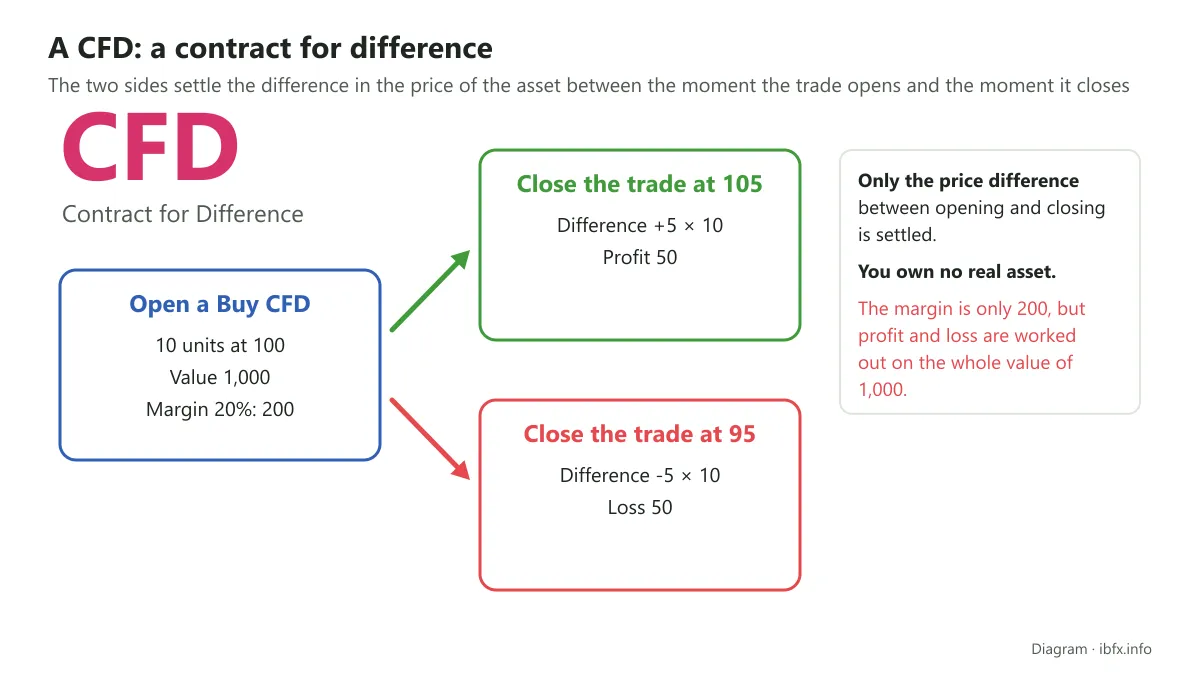
In traditional trading, investors usually look for a field or a product they judge to have potential, or that they think may rise in price after they buy it. And if the price does rise as expected and the investor decides to sell that product, the DIFFERENCE between the buying price and the selling price is the gain (if the product went up in price), or it may be the loss (if the product went down in price).
You can see that traditional trading and CFD trading are both, in essence, about finding a difference in price to produce a profit for the trader. What is different with a CFD is that the trader does not own the product and only has to put up part of the value of the contract as margin, so it is possible to take part with a small amount of capital; but the profit and the loss are still worked out on the whole value of the contract.
How does a CFD contract work?
As we said, a CFD is an agreement between a buyer and a seller about the value of one particular asset. When the contract ends, if the price of the asset has risen compared with the starting point, the buyer makes a profit. The other way round, if the price has fallen compared with the moment the contract began, the buyer loses and the buyer’s money goes to the seller.
Besides this classic buy-and-sell arrangement, a CFD also lets a trader open a selling position first. That is, instead of only being able to Buy products they think will rise in price, a trader can also Sell when they believe a product will fall in price.
This shows the characteristic feature of a CFD: it can be traded in both directions on one product. In theory you can make money both when price rises and when price falls. But that does not mean you will always make money: economic and political events, epidemics and natural disasters can still move price sharply, widening the spread, causing slippage and losses beyond what you had allowed for.
An example of a CFD contract
Suppose a trader wants to invest in gold and the gold price at the moment is 1,670 USD an ounce. He believes gold will rise in price over the next 2 days, so he decides to place a “Buy”, or “Long”, order, and 2 days later gold rises to 1,690 USD an ounce. At that point the trader decides to close the trade and takes a profit of 20 USD an ounce.
If things go badly and gold falls to 1,650 USD an ounce, the trader is afraid gold could fall further and decides to close the trade, so he has lost 20 USD an ounce.
Of course, the trader only loses that 20 USD an ounce once he closes the trade. If he still believes gold will come back up, he can grit his teeth and hold the position until gold rises. At that point two things can happen. Either gold really does come back up, and instead of being down 20 USD an ounce the trader ends up in profit. Or gold keeps falling, and falls to the point where the account can no longer carry the position, in which case he loses not just the 20 USD but blows up the account and is left with nothing at all.
The example above shows that the profit or loss on a CFD is only fixed when the contract is closed. While the trade is open, the software still works out the floating profit or loss continuously and adds it to or subtracts it from your equity; if the floating loss grows too large compared with the margin, the broker will close the trade automatically (a stop out) even though you did not want to close it.
In a great many articles on money management we always encourage you never to “hold a live bomb”, and to build the reflex of placing a stop loss whenever you place an order. Sitting it out is not the best way to last in the financial markets in general and in forex in particular. That said, the example we gave above is the clearest way to explain how a CFD contract works. The difference is settled between you and the other side of the contract (the broker, or the liquidity provider the broker passes the order to): when the trade wins you receive money, and when it loses you pay.
What does it mean that a CFD is a derivative?
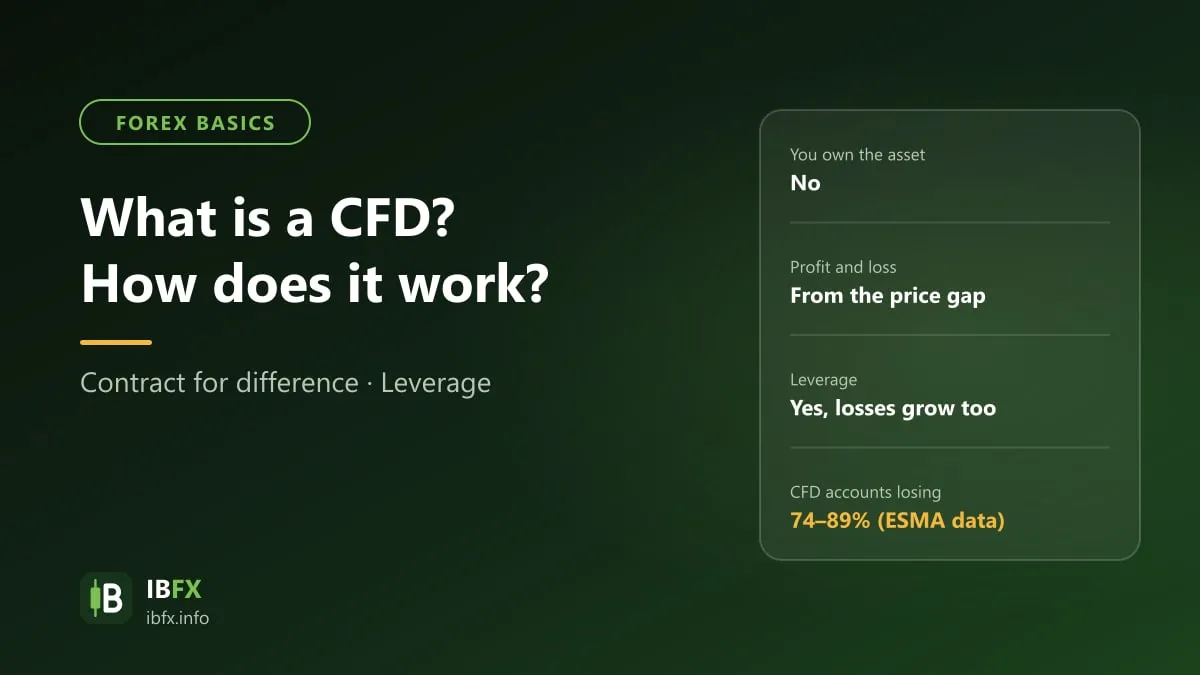
This is a term anyone who takes part in forex trading will hear. It is called a derivative because the trader DOES NOT OWN the product traded at all, and only makes money out of the movement in its price.
If you buy physical gold at a gold shop, once you hand the money to the owner you own that gold and you can carry it home. That is the traditional way of trading that everybody knows.
With gold CFDs (XAU/USD) at a forex broker, you open a position on the world gold price quoted in USD an ounce. You do not own a single piece of gold; you only take, or carry, the difference in price. When you close the trade, you have a profit if price is higher than when you bought, and a loss if it is lower.
When you trade forex through a retail broker, the trader is in fact trading a derivative product of the CFD kind. The trader does not own the asset, but the money lost is real money. That is exactly why you should be careful when you take part in CFD trading.
The features of a CFD contract
- A CFD, or contract for difference, is a derivative product
- The trader does not own the product traded.
- A trader can use leverage when trading a CFD, and leverage magnifies both the profit and the loss.
- Profit or loss is only fixed when the trade closes; before that, the floating profit or loss still affects the margin.
- There are costs: the spread, commission (depending on the account type) and the overnight fee, the swap.
- The other side of the contract is the broker (or the broker’s counterparty), so how safe it is depends on the broker you choose.
Which assets can be traded as CFDs?
A CFD can be built on a great many kinds of asset, such as:
+ Shares: Meta (Facebook), Alphabet (Google), Apple… each broker offers a different number of tickers. When you hold a long CFD position on a share through the ex-dividend date, the broker usually credits your account with an adjustment equivalent to the dividend (and debits that amount if you hold a short position), but you are not a shareholder and you have no vote.
+ Stock indices: SP500, UK100, US30, AUS200, EU50, JP225…
+ Energy: crude oil, gas…
+ Metals: gold, silver (the precious metals), copper, aluminum…
+ Commodities: coffee, rubber, corn, cotton, cocoa…
+ Currencies: EUR/USD, USD/JPY, USD/CHF, GBP/USD, GBP/JPY…
+ Cryptocurrencies: BTC, ETH, XLM, XRP, DASH…
Note: the number of products on offer depends on each forex broker and on each broker’s own policy for what it develops, even for something like cryptocurrency trading. These products can in principle be traded 24/7, but a great many brokers still close over the 2 days of the weekend, which means crypto trading is no different from trading currency pairs, or gold, or copper. That is why, if a particular broker interests you, you should read its product list and trading conditions carefully on its own website.
Who provides CFD contracts?
Forex brokers are the side that issues CFDs to traders. A broker may act directly as the counterparty to your trade, or pass the risk on to liquidity providers.
To make a CFD trade, the first thing to do is open a trading account at a forex broker. While the trade is open, the floating profit or loss is reflected in your equity; when you close the trade, the profit is added to or the loss subtracted from your balance. If the broker acts as the counterparty itself and does not hedge, your loss is the broker’s revenue; this is a conflict of interest that a trader ought to know about.
The most basic CFD trading process for a trader
Trading forex through a retail broker is in substance CFD trading as well, so placing a CFD order on gold, oil or an index works much the same way as on a currency pair. For the process from choosing a broker and opening an account through to your first order, you can read:
The factors that affect a CFD contract
The main factors that affect a CFD contract are: the leverage ratio, margin, the spread, commission and the overnight fee (swap).
The leverage ratio
Leverage means a CFD trade needs less money as margin: without leverage, a trader would need a very large sum to open a single trade. But leverage is not a “gift”: it magnifies profit and loss in the same proportion, and it is the main reason why most individual accounts trading CFDs lose money.
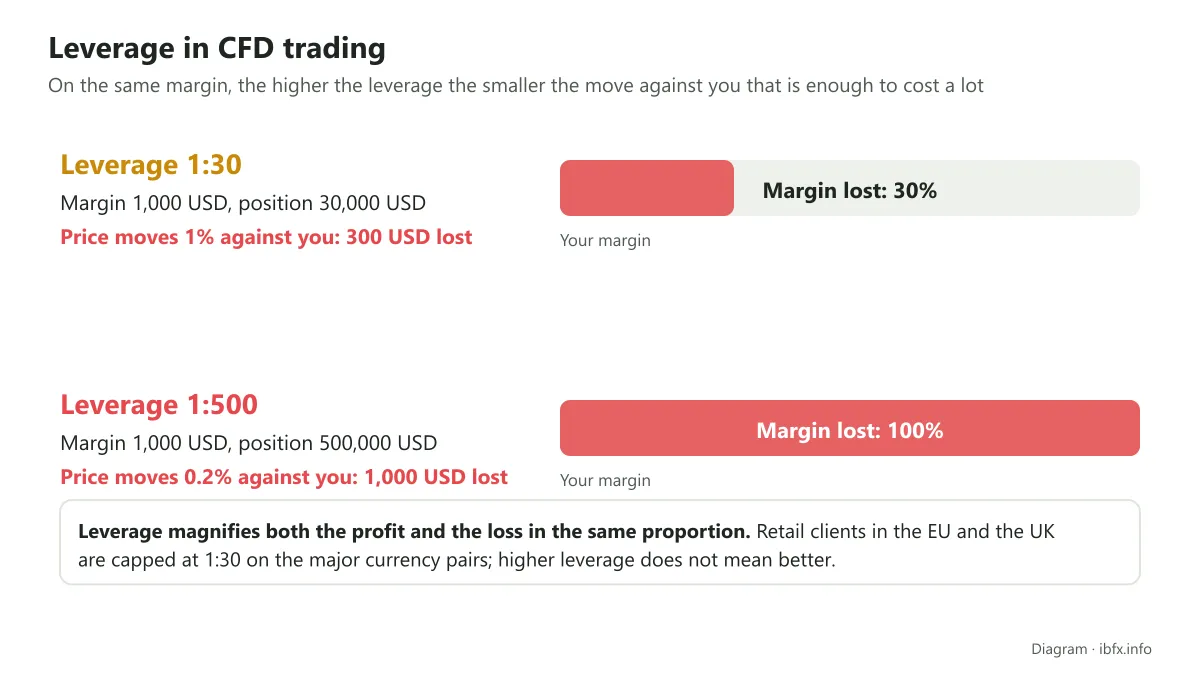
The maximum leverage differs from broker to broker and from one licensing regime to another: retail clients in the EU and the UK, for instance, are capped at 1:30 on the major currency pairs, while companies registered offshore may allow 1:500 or more. Higher leverage does not mean better.
That said, because the leverage ratio is inversely proportional to the margin rate, the more leverage you use the less money goes into margin, and the other way round, if you use low leverage the margin will be higher. But the greater the leverage the greater the risk, and it is also the fastest way to blow up an account.
That is why you need to choose a leverage ratio that suits you when you trade. Leverage is a catalyst that lets a trader place a trade with a small sum, but that does not mean using a very high level of it.
Margin
This is the money used as “collateral” with the broker when you open a trade.
As we said above, this margin changes with leverage: the more leverage you use, the less margin there is, and the other way round, if you use low leverage the trader will have to put up more money as margin for one trade.
And whether you use high or low leverage, it is fair to say the money used for trading is still far lower than in the traditional way. Let us make that clear with the example below:
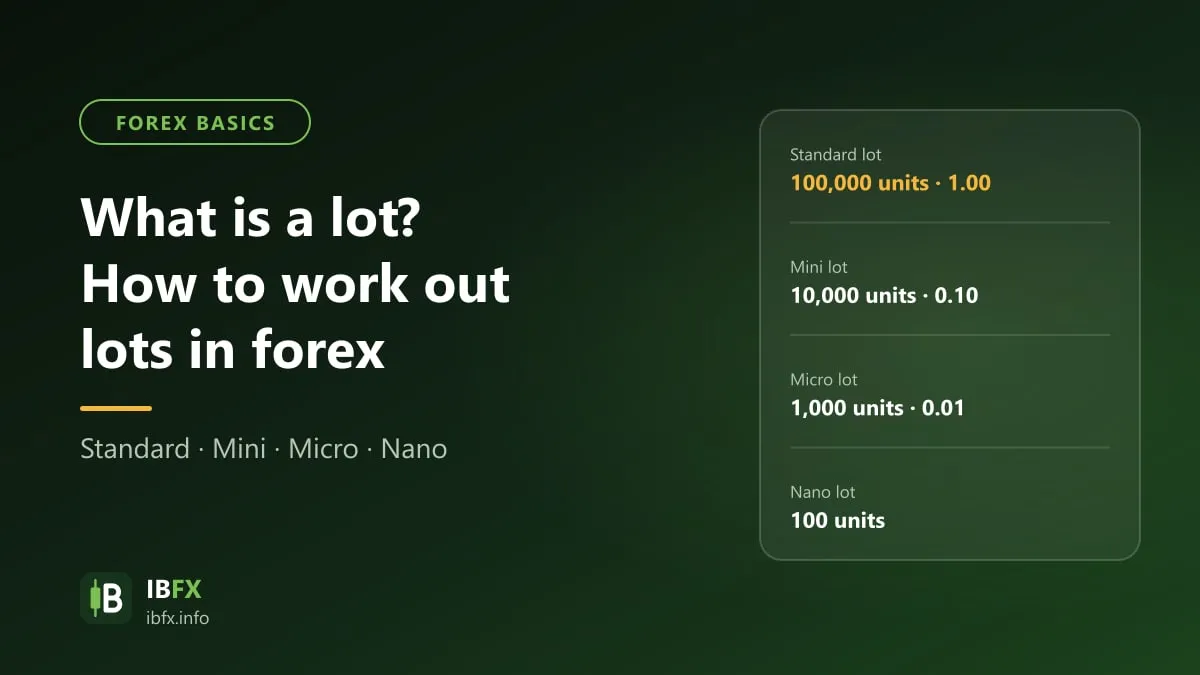
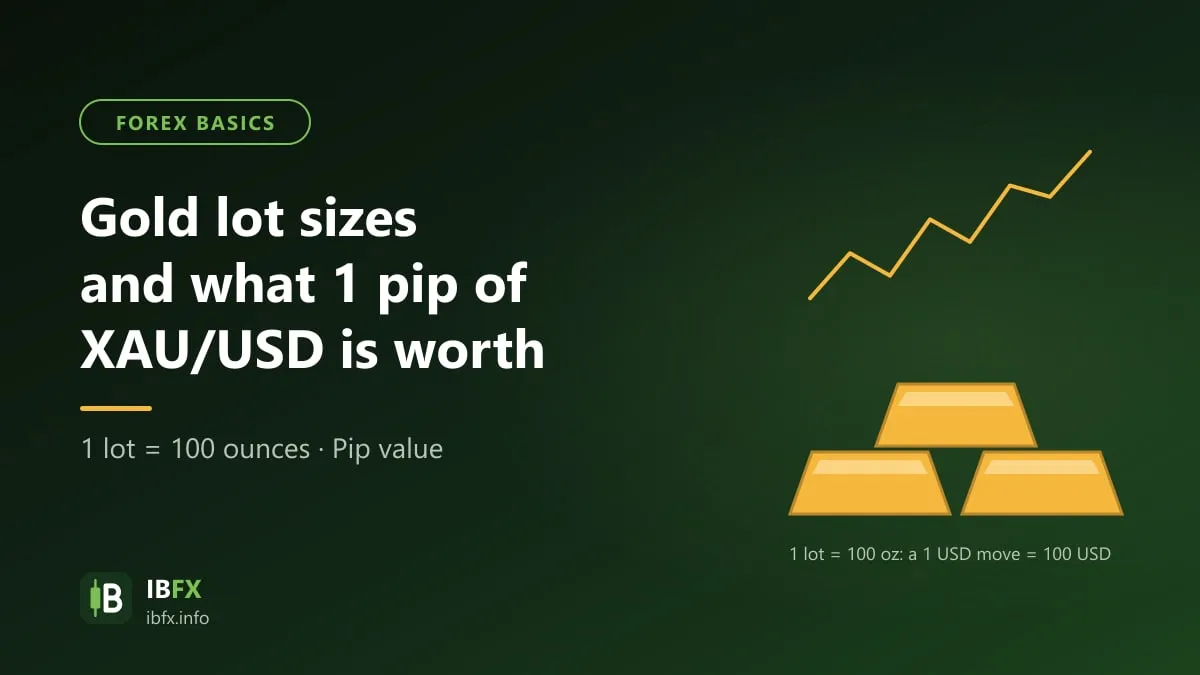
Now, suppose the gold price is 2,000 USD an ounce and you buy 1 lot of gold, that is 100 ounces, a contract worth 200,000 USD. With leverage of 1:50, the margin is 200,000 ÷ 50 = 4,000 USD.
If you use leverage of 1:500, you only need 400 USD of margin for the same trade. But the profit and loss are still worked out on 200,000 USD: a 2 USD fall in the gold price (0.1%) leaves you down 200 USD, half the margin.
And if you were buying 100 ounces of physical gold, you would have to put up the full 200,000 USD, 50 times the margin at 1:50 leverage and 500 times the margin at 1:500.
Spread and commission
Above we explained to you that the forex broker is the intermediary that provides CFD trades to the trader. So to trade CFDs you must open an account at some forex broker before you can trade at all.
The forex broker is the place that holds all the money, so choose a broker you can trust in order not to lose it. Before you choose a broker, read:
Now back to CFD trading: the broker is the party that provides the CFD trade. So through what channels does the broker collect its fees from the trader?
The main sources of fee income the broker takes from the trader are the spread, commission and the overnight fee (swap).
On an account with commission, depending on the broker the fee is charged either entirely at the opening of the trade or split between the opening and the closing; in return the spread is usually lower. On an account without commission, the broker collects its fee through the spread, that is the difference between the buying price and the selling price. If you hold a trade overnight, a swap is also deducted (or occasionally credited). The larger that difference, the more profit the broker makes. And so, whether the trader wins or loses, the spread and the commission are the 2 main sums the broker collects from the trader.
And because they are charged directly on the price, a trader will sometimes have the feeling that the broker is providing its service free of charge. That is not the case at all. For that reason, compare total costs (spread + commission + swap) between brokers.
Besides the factors listed above, your position size directly determines how much you make or lose. Position size should be worked out from the amount you are prepared to lose on each trade (say 1–2% of the account) and the distance to your stop loss, not from the leverage the broker allows. See also: the 2% money management rule.
The platforms used to trade CFDs
If the forex broker is the party that provides CFDs to the trader, the trading platform is the tool that connects the trader to the broker. The most common are MetaTrader 4 (MT4) and MetaTrader 5 (MT5); some brokers also offer cTrader, a TradingView connection, or an app of their own.
The order you place on the platform is sent to the broker’s server to be filled. You can also read:
The advantages of the CFD market
You do not have to own the asset
Not having to own the asset makes trading simpler. As in the gold example above, you do not have to put up 200,000 USD to trade a position of 100 ounces of gold, only a small part of it as margin. But the profit or the loss is still worked out on the whole 100 ounces. On top of that, because you do not own the product, you do not have to spend money building a large warehouse to store tonnes of coffee beans, or worry day and night about how to keep that gold safe from thieves.
You can trade in both directions
As well as doing without a factory or a warehouse, and unlike traditional trade where you can only BUY LOW and then wait for price to rise before the trader sells to take a profit, a CFD lets you open a selling position first at a high price and buy it back later; you make money if price really does fall, and lose if price rises.
You can use leverage
Because you do not have to own anything, and with the rapid growth of brokers, investors can now trade positions tens or hundreds of times their capital thanks to leverage. But as we set out above, leverage comes with risk if you overuse it without a deep knowledge of trading.
Many kinds of asset in one account
From one account a trader can trade currency pairs, gold, oil, indices… With share CFDs, as we said above, many brokers make a dividend adjustment on the position, even though you are not a shareholder.
Long trading hours
CFDs on currency pairs trade almost continuously from Monday morning to Saturday morning (GMT+7); CFDs on indices, shares and commodities follow the hours of the underlying market. Only some brokers have crypto CFDs that trade at the weekend.
The drawbacks and risks of CFDs
- Leverage magnifies the loss: when it brought in leverage limits in 2018, the European Securities and Markets Authority (ESMA) recorded that 74–89% of individual investor accounts lose money trading CFDs. Brokers licensed in Europe and the UK still have to publish that figure on their websites to this day.
- Costs add up: the spread, commission and swap are charged whether the trade wins or loses; the longer you hold a trade, the larger the swap.
- Counterparty risk: the broker is the other side of the contract. If the broker cheats or goes bust, you can lose money; foreign brokers are not licensed in Vietnam, so an investor has little protection.
- You do not own the asset: you have no gold and you are not a shareholder; the price at the broker can widen in spread or slip when the market moves sharply.
- It can feel unreal: because everything is only numbers on a screen, a beginner easily takes cutting a loss too lightly and trades far too large.
For those reasons, our advice is to build up your knowledge, practice on a demo account until you are fluent before you use real money, and only use money you are prepared to lose. Articles to read next: