A pip is short for percentage in point, the unit that measures the price movement of a financial instrument such as a currency pair, a metal, an index or a share…
Pip, along with spread and lot, is one of those very basic terms that is nonetheless extremely important, and a trader is obliged to understand it and grasp what it really means before stepping into the foreign exchange market. Everything you do — placing an order, building a trading strategy, studying the market… — has something to do with these terms.
We will start with the idea of what a pip is. What follows in this article is written for new traders, for people who are just beginning to learn about forex, and also for people who have been trading in the market for some time without really understanding these ideas in any depth.
What is a pip?
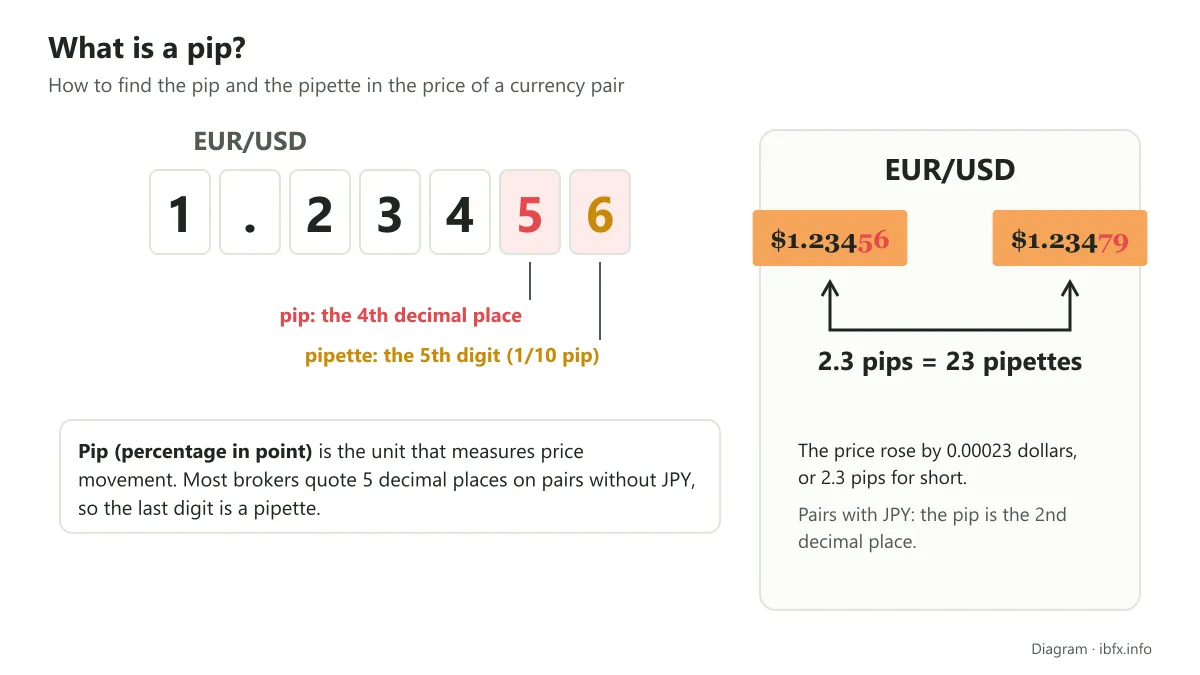
A pip is short for percentage in point, the unit that measures the price movement of a financial instrument. In the forex market that instrument may be a currency pair, a metal, an index, a share…
For currency pairs, the pip measures the movement in the value of 2 currencies, or to put it more precisely, the change in that pair’s exchange rate.
In the past, currency pairs were usually quoted to 4 decimal places: EUR/USD rising from 1.2345 to 1.2346 means a rise of 0.0001 dollars. Today most brokers quote to 5 decimal places: EUR/USD rising from 1.23456 to 1.23457 means a rise of 0.00001 dollars. That is already quite long in writing, and in speech it drags on and on. That is exactly why the pip came about: to boil these very small price movements down.
How to find the pip in forex
In the forex market, pairs that do not contain JPY are quoted to 5 decimal places, pairs that contain JPY have 3 decimal places, and gold (XAU/USD) is usually quoted to 2 decimal places; indices and shares have different numbers of decimal places from broker to broker.
- Finding the pip on pairs that do not contain JPY
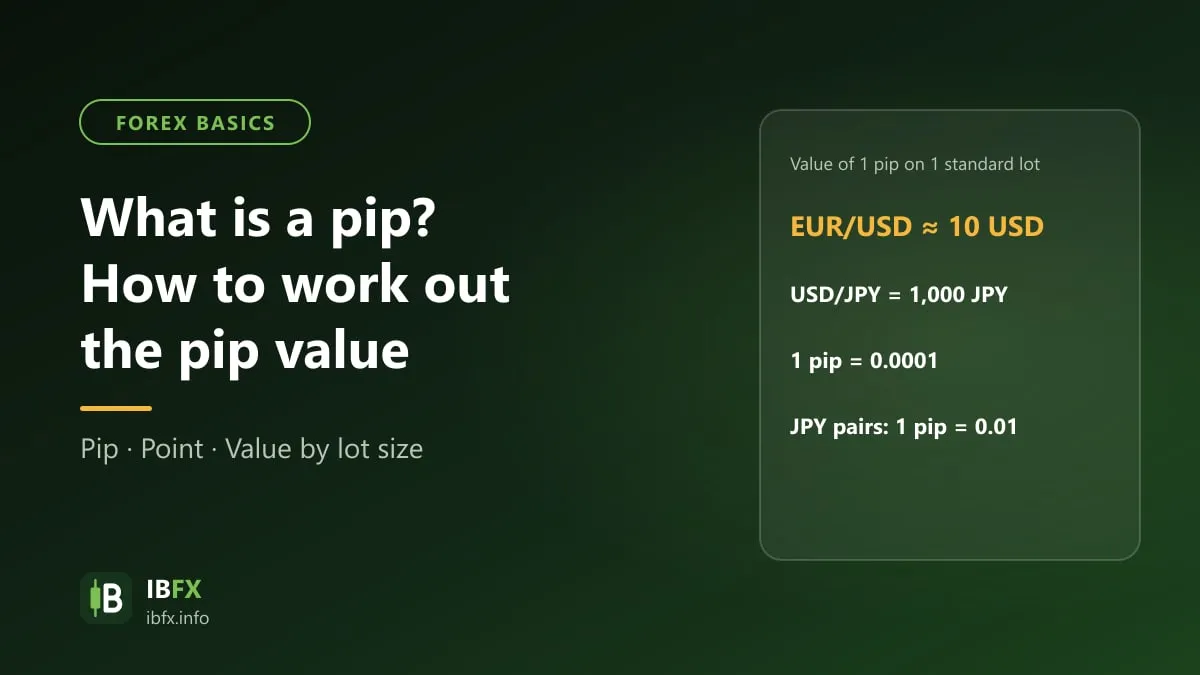
The pip is at the position of the 4th decimal place in the exchange rate.
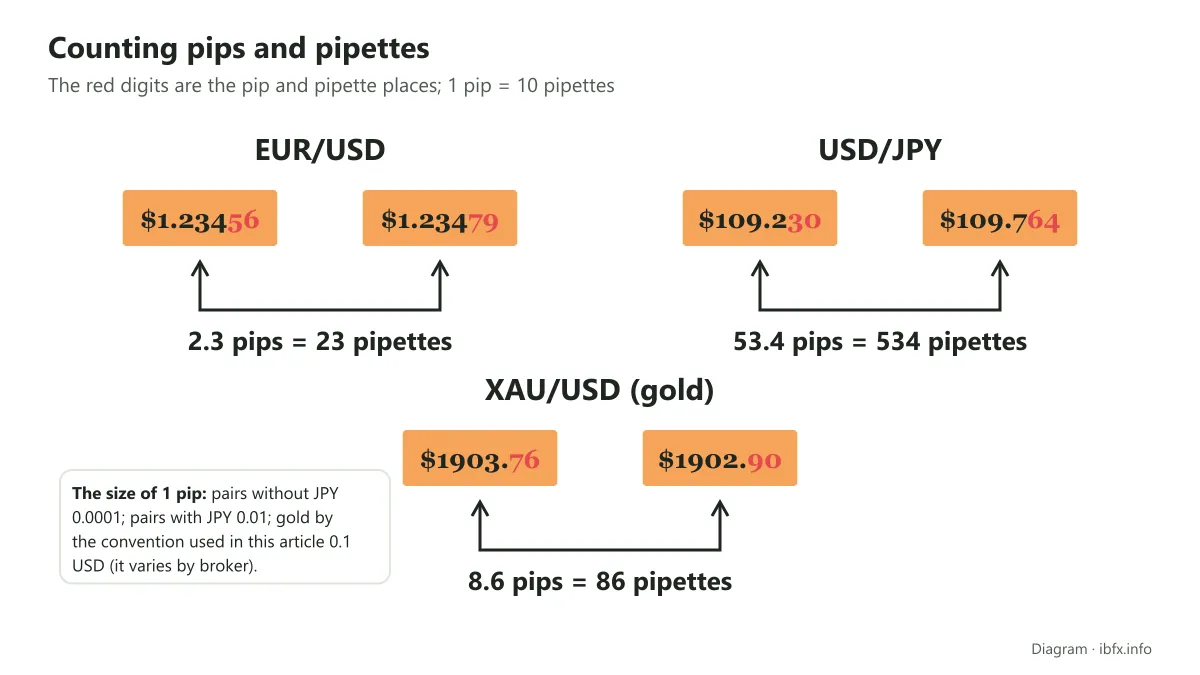
For example: EUR/USD has a rate that rises from 1.23456 to 1.23467, so instead of saying this rate rose by 0.00011 dollars we say this rate rose by 1.1 pips.
- Finding the pip on pairs that contain JPY
The pip is at the position of the 2nd decimal place in the exchange rate.
For example: USD/JPY has a rate that falls from 109.876 to 109.853, so instead of saying this rate fell by 0.023 we say the USD/JPY rate fell 2.3 pips.
- Finding the pip on gold (XAU/USD)
The pip is at the position of the 1st decimal place.
For example: the gold rate moves from 1903.24 to 1903.89, and we say the gold price rose 6.5 pips rather than saying the gold price rose 0.65 dollars an ounce.
Note: the pip convention for gold is not the same at every broker. Some treat 1 pip as 0.01 USD, others as 0.1 USD or 1 USD. This article uses 1 pip = 0.1 USD; before you work out profit and loss, look at the contract Specification at the broker you use.
What are pipettes?
In the past, when forex pairs were quoted to 4 decimal places (without JPY), 2 decimal places (with JPY) or 1 decimal place (gold), the pip was the smallest change in the exchange rate, meaning the pip sat at the last decimal place. Now, though, that smallest change is no longer the pip but the pipette.
The pipette appeared in order to divide the value of a pip into smaller parts, which makes the arithmetic more flexible, and that matters a great deal to traders who trade a large position size. In practice we usually work in pips alone. Remember this: on MT4/MT5, a “point” is the smallest step in the quote, so on an account quoted to 5 decimal places (or 3 decimal places on JPY pairs), 10 points = 1 pip. Setting a stop loss of “50 points” is only 5 pips.
How to calculate the value of a pip in forex
Why do you need to calculate the value of a pip?
In the section above we saw how the idea of the pip is used to simplify the change in the price of financial assets, which matters especially for instruments with a low exchange rate that are quoted to many decimal places.
So calculating the value of a pip, or answering the question how much is 1 pip worth?, really does matter, because the crux of trading, our final goal, is profit, and profit is money. People conclude that they made so many dollars of profit or lost so many dollars; nobody goes around saying they won so many pips or lost so many pips trading forex.
Using pips is simpler while you are doing the arithmetic and building a trading strategy, but in the end it all has to be converted into money. That is exactly why, as a trader, you have to know how much 1 pip is.
Some people also take the view that profit and loss are already worked out for us by the trading software, so why go to the trouble of sitting down and working it out? There is nothing wrong with saying that, but the trading software cannot do the arithmetic for you while you are building your trading strategy.
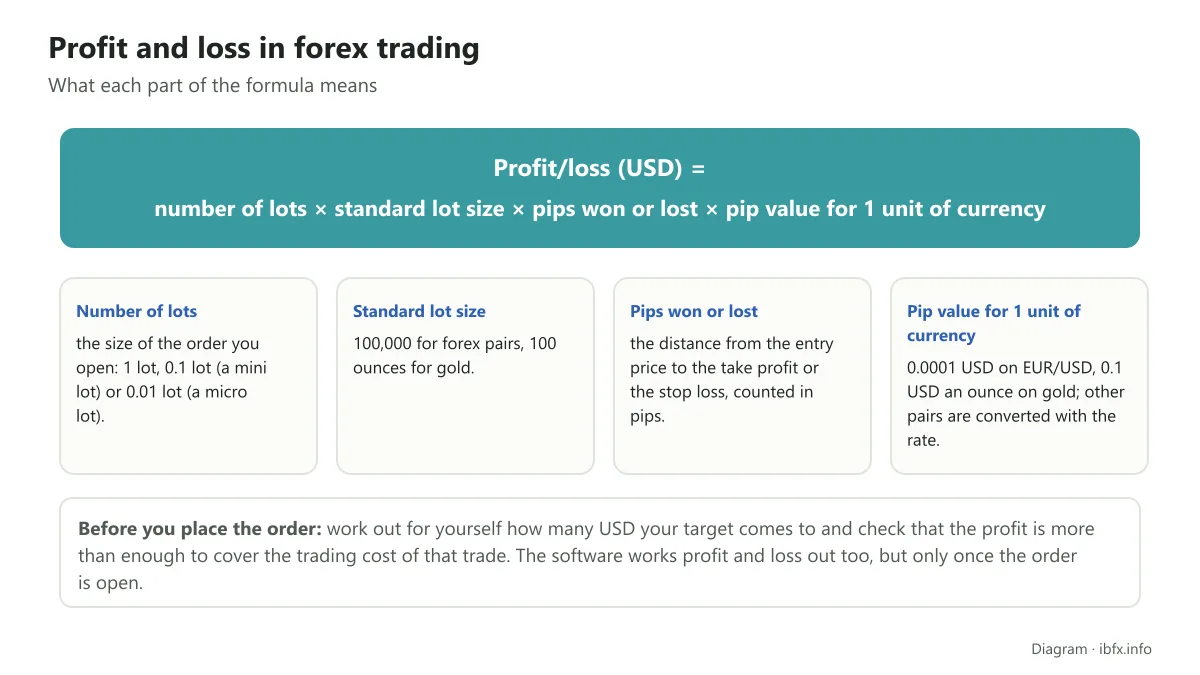
For example: your plan is to enter a Buy on EUR/USD and your take profit target is for price to rise 50 pips. What you need to do is consider whether that 50 pips of profit is more than enough to cover the trading cost of that trade. If it is, open the order; if not, do not trade. That means you have to know how many USD those 50 pips of profit come to, something you should be able to work out yourself before you place the order, even though the software shows profit and loss once the order is open.
This is only the simplest example; in practice, building a trading plan is fairly involved, it takes a number of different steps, and it requires you to be fluent in the arithmetic, so being able to calculate the value of a pip is essential.
How much is 1 pip worth?
Many traders choose USD as the account currency for their trading account. That is why, in this article, we will calculate the value of a pip in USD.
Before we get into calculating the value of a pip, let’s go back over what an exchange rate means for a moment.
EUR/USD at a rate of 1.23456 means 1 EUR = 1.23456 USD. The currency that comes first is the base currency and the currency that comes second is the quote currency.
In the same way, USD/CAD at a rate of 1.20752 means 1 USD = 1.20752 CAD.
With gold, the unit of gold is the ounce, and a XAU/USD rate of 1903.76 means 1 ounce of gold = 1903.76 USD.
- Case 1: pairs with USD second (XXX/USD): 1 pip = 0.0001 USD
Take EUR/USD. Suppose the current rate on EUR/USD is 1.23456; when we say this rate rises 1 pip, the EUR/USD rate becomes 1.23466, that is, 1 EUR that was worth 1.23456 USD is now worth 1.23466 USD, a rise of 1.23466 – 1.23456 = 0.0001 USD. So 1 pip = 0.0001 USD.
- Case 2: pairs with USD first (USD/XXX): 1 pip = (0.0001 / the rate) USD
Take USD/CHF. Explaining it the same way as in case 1, we easily work out that 1 pip = 0.0001 CHF. Our job is to add one more step and convert that 0.0001 CHF into USD.
Suppose the current rate on USD/CHF is 0.89920, that is:
- 1 USD = 0.89920 CHF, and
- 1 pip = 0.0001 CHF, so by the rule of three:
1 pip = 0.0001/0.89920 USD = (0.0001 / the rate) USD
- Case 3: cross pairs (no USD in them)
Take EUR/GBP. Here we have 2 ways of working it out
- Way 1: calculate the pip value in the currency that comes first, then convert into USD
This way needs one more figure, the rate on EUR/USD.
We will call the EUR/GBP rate the main rate and the EUR/USD rate the secondary rate.
From the result in case 2:
- 1 pip = (0.0001 / the main rate) EUR, and
- 1 EUR = the secondary rate in USD, so:
1 pip = [(0.0001 / the main rate)*the secondary rate] USD
But if the secondary pair has USD first:
1 pip = [(0.0001 / the main rate) / the secondary rate] USD
- Way 2: calculate the pip value in the currency that comes second, then convert into USD
This way needs a different extra figure, the GBP/USD rate, and we call this the secondary rate
From the result in case 1:
- 1 pip = 0.0001 GBP, and
- 1 GBP = the secondary rate in USD, so:
1 pip = (0.0001*the secondary rate) USD
But if the secondary pair has USD first:
1 pip = (0.0001 / the secondary rate) USD
- Case 4: pairs that contain JPY (XXX/JPY)
If XXX is USD, this case comes back to the way case 2 is worked out (a pair with USD first), and here 1 pip = ( 0.01 / the rate) USD.
If XXX is not USD (EUR/JPY or GBP/JPY, for example), it comes back to the way case 3 is worked out: 1 pip = 0.01 JPY for each unit of the base currency, after which you turn the JPY into USD by dividing by the USD/JPY rate, that is, 1 pip = (0.01 / the USD/JPY rate) USD.
- Case 5: calculating the value of a pip on gold (XAU/USD)
Here we reason the same way as in case 1. The gold rate is 1903.76, which means 1 ounce of gold = 1903.76 USD. If we say gold rises 1 pip, the rate becomes 1903.86, meaning 1 ounce of gold is now 1903.86 USD. The gold price rose 0.1 USD an ounce, so 1 pip = 0.1 USD.
The value of a pip on a position size of 1 lot
The unit that measures position size in forex trading is the lot, and when people bring up how much 1 pip is, they usually mean the value of a pip when you trade 1 standard lot rather than the value of a pip for 1 unit of currency as calculated above. That said, the latter is the basis that makes it easy for you to work out the value of a pip when you trade 1 standard lot.
Read more: What is a lot?
For currency pairs, 1 standard lot = 100,000 units of the base currency.
For example: 1 lot of EUR/USD = 100,000 EUR
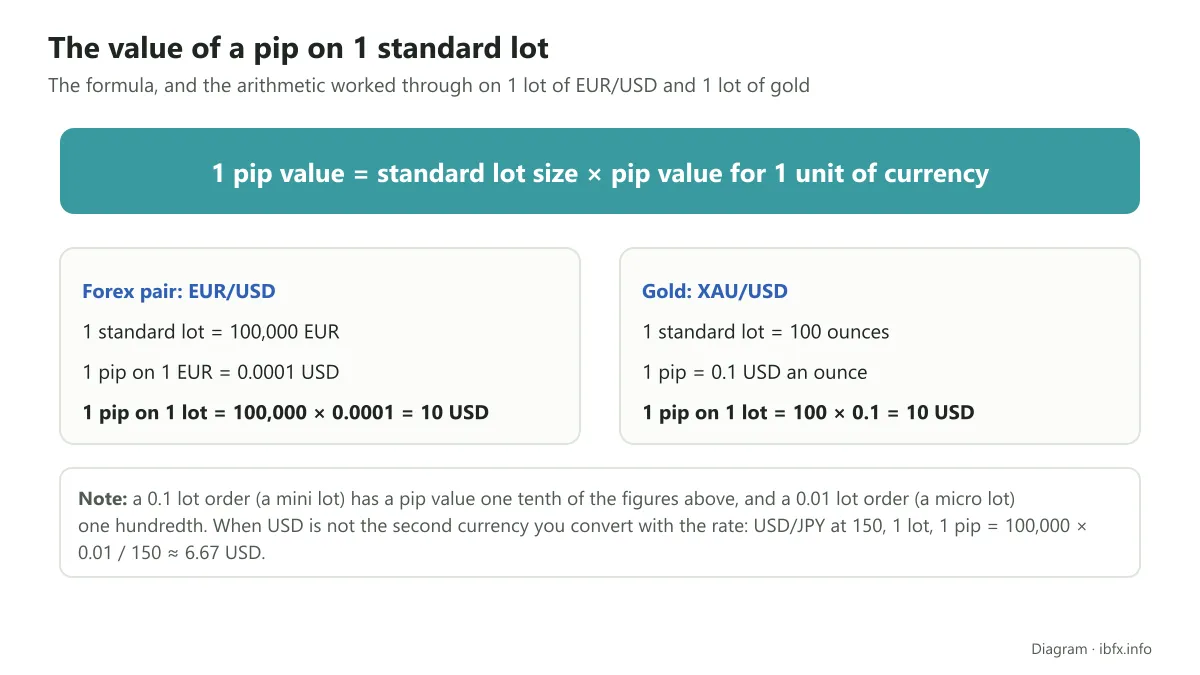
So, 1 pip on 1 EUR = 0.0001 USD, from which 1 pip on 100,000 EUR = 100,000*0.0001 = 10 USD. So the value of 1 pip when you trade 1 lot of EUR/USD is 10 USD.
If you trade n lots, the general formula for the pip value on currency pairs is:
The value of 1 pip = number of lots * 100,000 * the pip value for 1 unit of currency.
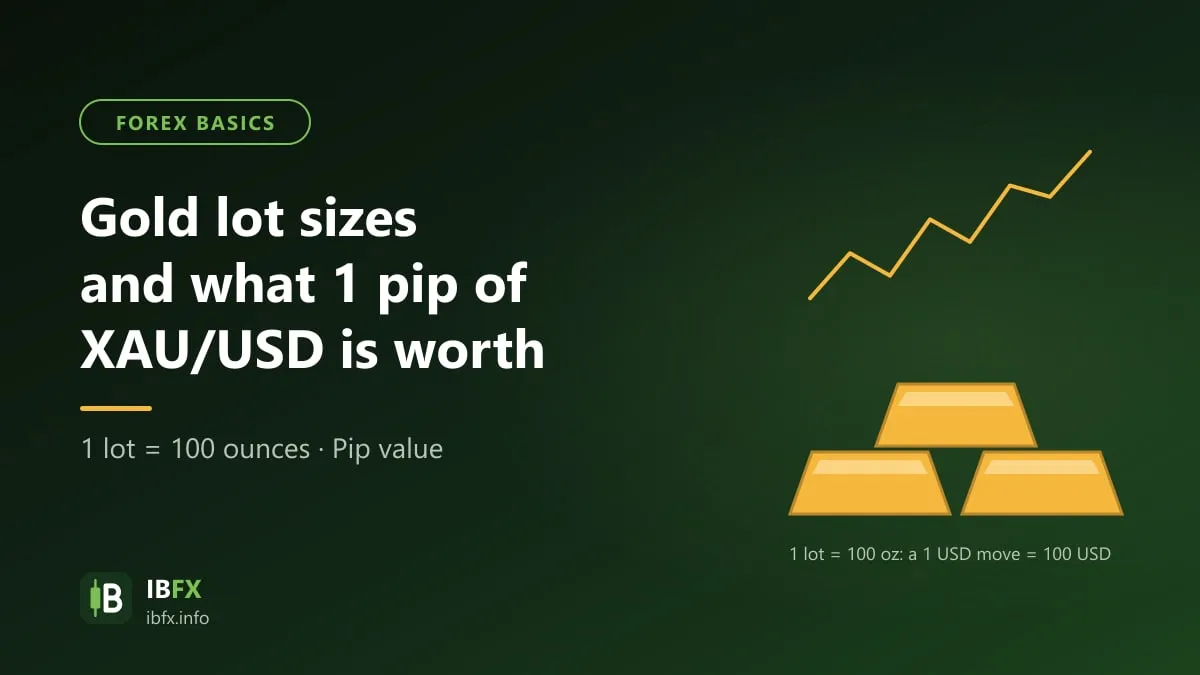
For gold, 1 standard lot = 100 ounces
So the value of a pip when you trade 1 lot of gold is 100*0.1 = 10 USD. The value of a pip when you trade n lots of gold is 10*n USD.
A few examples with 1 lot (the rates are only for illustration and the results are rounded):
- EUR/USD, GBP/USD, AUD/USD (USD second): 1 pip = 10 USD, whatever the rate.
- USD/JPY at 150: 1 pip = 100,000 × 0.01 / 150 ≈ 6.67 USD.
- USD/CHF at 0.8992: 1 pip = 100,000 × 0.0001 / 0.8992 ≈ 11.12 USD.
- A 0.1 lot order (a mini lot) has a pip value one tenth of the figures above, and a 0.01 lot order (a micro lot) one hundredth.
Once you have a very firm grasp of how to calculate the value of a pip, it becomes very easy to work out the profit or loss on each trade. Profit or loss is worked out from the number of pips won or lost. So the general formula for profit and loss in forex trading is:
Profit/loss = number of lots * the standard lot size * the number of pips won or lost * the pip value for 1 unit of currency. (USD)
Here, the standard lot size is 100,000 for forex pairs or 100 for gold…
Conclusion
In this last section we will sum up the formulas for calculating the value of a pip so that you can follow them and use them easily:
The value of a pip in USD for 1 unit of currency
| Currency pair | Value of 1 pip on 1 unit of the base currency, converted into USD |
|---|---|
| XXX/USD (EUR/USD, GBP/USD…) | 0.0001 USD |
| USD/XXX (USD/CHF, USD/CAD…) | 0.0001 / the USD/XXX rate |
| XXX/YYY with no USD (EUR/GBP…) | 0.0001 YYY, converted into USD: multiply by the YYY/USD rate, or divide by the USD/YYY rate |
| USD/JPY | 0.01 / the USD/JPY rate |
| XXX/JPY (EUR/JPY, GBP/JPY…) | 0.01 / the USD/JPY rate |
| XAU/USD (by the convention 1 pip = 0.1 USD) | 0.1 USD an ounce |
The value of a pip in USD on 1 standard lot
The value of 1 pip = the standard lot size * the pip value for 1 unit of currency
Profit and loss in forex trading
Profit/loss = number of lots * the standard lot size * the number of pips won or lost * the pip value for 1 unit of currency.
I hope that after this article you understand what a pip is, how to find the pip and how to calculate the value of a pip as thoroughly as possible. Do not learn any of this in a slapdash way, even the most basic parts of it.