On this page
In forex trading, the economic calendar is the tool many traders open first every day. There are two main schools of analysis: technical analysis, which works from the price chart, and fundamental analysis, which works from economic figures, news and events. Whichever school you follow, you need to know when the important releases come out, because those are the moments when the price can move very sharply.
What is an economic calendar?
An economic calendar is a table that brings together the release times of economic figures, interest rate decisions, central bank meetings and speeches, along with the impact each one is expected to have on a particular currency. It lets a trader know in advance which events are coming, so they can prepare a trading plan or stay out of the way.
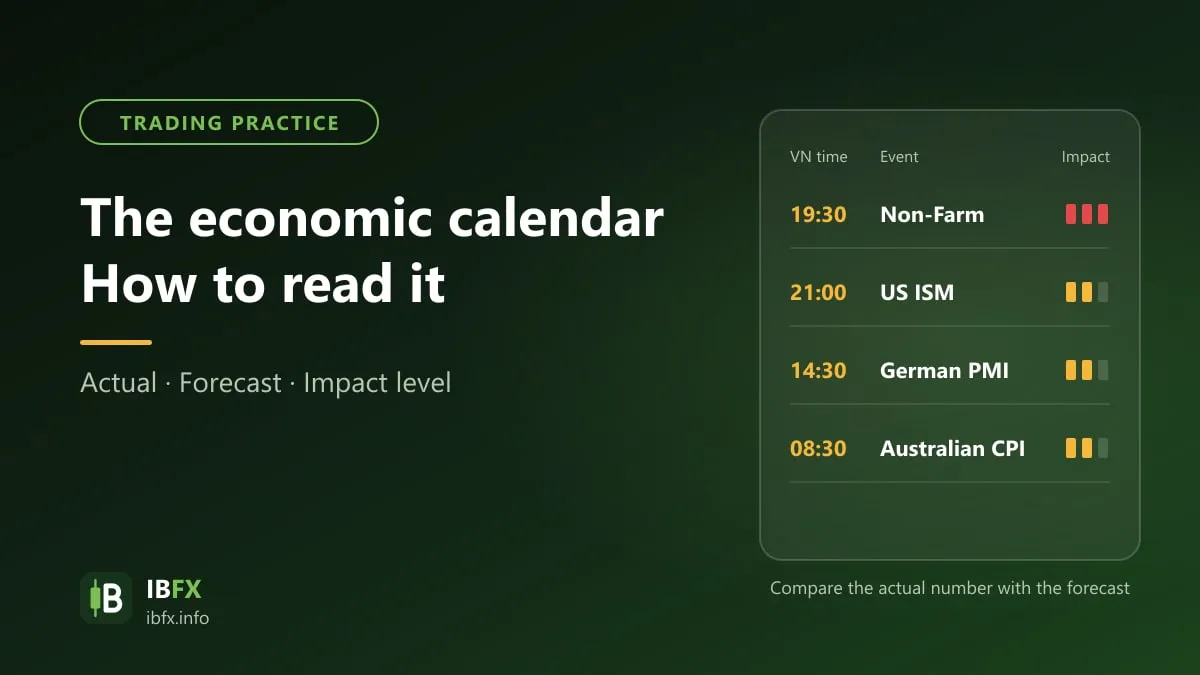
Events are classified by impact: low, medium and high. The more important the event, the greater the chance of a strong price move after the release, especially when the actual figure comes in far from the forecast.
When an important release comes out, the price can rise or fall very sharply in just a few minutes. Some traders choose to trade right around that moment, while many others avoid trading while news is out. You can see an economic calendar for free on sites such as Forex Factory, Investing.com and FXStreet; many trading platforms and broker websites have an economic calendar built in as well.
How to read an economic calendar
An economic calendar is fairly easy to read. The information is laid out as a table, one row per event, with these main columns:
- Time: the release time. Set the time zone in the calendar settings to the zone you live in, so that you do not misread the times.
- Currency, country: the currency directly affected, for example USD, EUR, JPY.
- Impact: low, medium or high. Forex Factory uses yellow, orange and red icons; Investing uses 1 to 3 bull’s head icons.
- Event: the name of the figure or the event. Click it to see a detailed explanation and the history of the figure.
- Actual: the figure as released.
- Forecast: the level that analysts and the market expect.
- Previous: the figure from the previous period; this figure is sometimes revised at the same time the new figure is released.
On many economic calendar sites (Investing, for instance), an actual figure shown in green means it is better than the forecast for that currency, and red means it is worse than the forecast. Note that “better” is not always the larger number: with the unemployment rate, for example, it is a figure lower than the forecast that is good.
The price reacts mainly to the gap between the actual figure and the forecast, not simply to whether the news is “good” or “bad”. If the market was already expecting a very strong figure and the result is only moderately good, the currency can still fall.
The releases with the strongest effect on the market
Releases rated medium and high impact can move exchange rates sharply. The most important groups are:
+ Interest rate decisions and central bank speeches: above all the Fed (United States), the ECB (Europe), the BoE (United Kingdom) and the BoJ (Japan). The Fed’s policy statement is released at 14:00 New York time, that is 18:00 or 19:00 UTC (1:00 or 2:00 the next morning in GMT+7). See also: What is the Fed?
+ Employment and unemployment: the leading example is Non-Farm Payrolls in the United States, usually released on the first Friday of the month at 12:30 UTC (13:30 UTC when the United States is not on summer time).
+ Inflation: the consumer price index (CPI), the personal consumption expenditures price index (PCE)…
+ Economic growth: GDP, retail sales.
+ Business activity indexes: the purchasing managers’ index (PMI) for manufacturing and for services.
Non-Farm Payrolls, for example, reports the number of new jobs in the non-farm part of the US economy. It is one of the most important figures for the US dollar, and after it is released the foreign exchange market usually reacts very strongly, dragging gold and US stocks along with it.
How to use the economic calendar when you trade
- At the start of the week: look at the calendar for the whole week and mark the high-impact releases connected with the currency pairs you trade.
- Every day: check the release times again before you open a new position.
- Before a strong release: consider not opening a new position, reducing your position size or closing part of what you hold, because the spread can widen and a stop loss can be filled with slippage.
- Public holidays: watch for holidays in the United States, the United Kingdom, Japan and elsewhere, because low liquidity can make prices move in unusual ways.
Many experienced traders tell beginners to stay out when a strong release is about to come, because the price runs very fast, jerks both ways and is hard to predict. There are also traders who specialize in trading the news, but that approach calls for experience, a clear plan and the acceptance of very high risk. See also: What to watch out for when you trade forex on the news, Where can you find news about the forex market?