On this page
- What does trading forex mean?
- Who is behind the forex machine?
- Is trading forex legal?
- Who is forex investing for?
- How much money do you need to trade forex?
- A detailed guide to forex investing
- How do you trade forex to a plan?
- Technical analysis, the foundation for success in forex trading
- Money management in forex investing
- Trading psychology
- Should you take a forex course or not?
- Besides foreign exchange trading, are there other forms of forex investing?
- Should you hand your forex investing to someone else?
- Forex investing or investing in shares?
- The forums and websites you must know if you want to invest in forex
- In conclusion: should you invest in forex or not?
Rather than the grander “investing in forex”, a great many traders call this pursuit “having a go at forex”. It reeks of gambling! And fairly so! Because trading forex really is a fickle business and it is not for the many!
Win big and you will be honored like a hero, a trading saint. Lose and, congratulations, you have landed on the gambling square, nothing more than a punter. So what does trading forex mean? And if people know trading forex is so risky, why are they still so keen?
What does trading forex mean?
At present three ideas are confused with one another in Vietnam: foreign exchange trading, forex investing (trading forex) and speculation.
In its nature, investing means putting money into an asset in the expectation that the asset will gain value or produce an income (interest, dividends, rent) over time. That stretch of waiting for the price to rise may run to several weeks, several months, even several years, rather than a few days.
In forex very few people act that way. And the traders who do follow this form are all traders with a long stretch of trading experience, with iron discipline and much else besides.
So foreign exchange trading is in fact closer to speculation. The trader is mainly focused on price movement, seeking a profit from the short-term swings of the market.
That is why forex traders very seldom pay attention to other kinds of value such as interest or dividends. And it is also why, for a long stretch of time, forex has been criticized for creating no real value for society. Instead, forex investing has been seen as a form of gambling, nothing more. Within the scope of this article we only set out to explain how forex is traded and the risks that come with it.
So rather than using the phrase “forex investing”, we can simply understand this as a form of speculation, making money from changes in price, a line of work like a great many other lines of work.
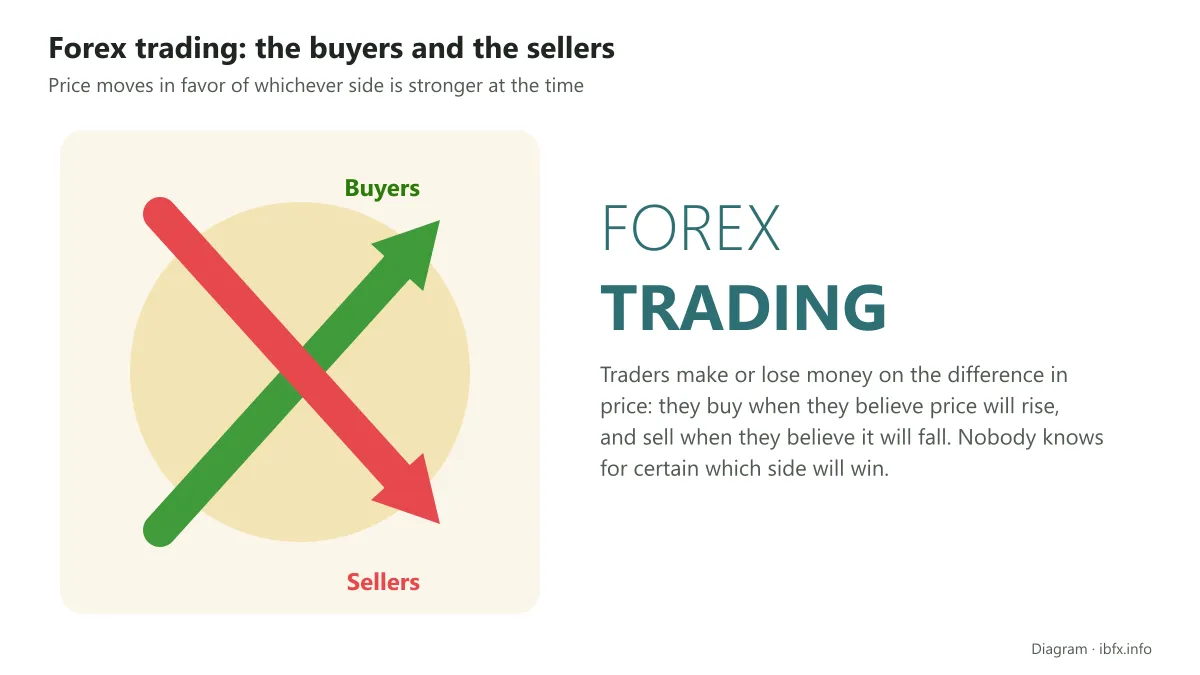
How do these “traders” trade forex?
You see a currency pair about to rise or fall on the strength of technical analysis. Or sometimes you need no technical analysis at all: you only have to hear someone on a Telegram channel, or in any group on Facebook, put out a signal that chimes with your own instinct and agree that this pair will rise or fall in the time to come.
And without knowing whether it is right or wrong, you jump in and Buy or Sell regardless. That done, the next task is to sit and pray that the price will rise or fall the way you want it to. If the train comes off the rails and the price goes entirely the other way, once a minute the trader picks up the phone to check whether the price is going the right way yet. If not, a sigh, and the phone goes back down. Then the price runs further and further the wrong way. As in buying (Buy) and only seeing the price fall, or selling (Sell) and only seeing the price climb higher and higher. The solution on offer here, besides praying, is to go on Facebook and ask the opinion of some nameless “master”, or else to wait until the account blows up. It sounds absurd, and we are not yet arguing about whether this way of buying and selling is right or wrong. But it can fairly be called the most widely used approach to forex investing today.
Who is behind the forex machine?
To take part in forex investing you first have to understand what forex buys and sells, along with the most basic terms and ideas you need to have clear.
To answer the first question, what does forex buy and sell? Or what is the merchandise you buy and sell on the foreign exchange market? It is MONEY. Trading forex means BUYING and SELLING different currency pairs for a profit, such as USD/CAD, EUR/USD, USD/JPY and so on, much like investing in shares.
To buy and sell currency pairs you only have to open a forex account, then use the MT4 or MT5 platform downloaded from the very broker where you opened the account to buy or sell those currency pairs for a profit.
Reading this far, or looking at the way those “traders” buy and sell as described above, you already have a picture of how forex is traded, do you not?
The merchandise you use for forex investing is money, but in fact you only trade the rate of that pair, you never own it. Put that together with what we said earlier and you can see that forex investing is a form of speculation. In it, the trader makes use of the swings in currency pair rates and deposits a certain sum into an account at some forex broker. The trade is then placed by Sell (if you think the price of that pair is going down) or Buy (if you think the price of that pair will rise). Let us look at the example below to make this clearer.
Suppose you are interested in the EUR/USD pair. On the strength of certain data you believe the price will rise, so you open MT4 and place a buy order at 1.1380. EUR/USD then goes the way you predicted and the price rises to 1.1420. You are 40 pips up and decide to close the order. If you traded 1 lot you make about 400 USD, on 0.1 lots 40 USD, and on 0.01 lots only 4 USD (before spread and fees). If the price goes 40 pips the other way, you lose exactly the matching amounts. At the moment you bought EUR/USD you did not hold a single euro in your hand; you only traded the movement of the rate and made or lost money on that movement.
In forex investing, trading currency pairs is the most common form. These days, however, a great many forex brokers have also branched out into other areas, so that traders have more to choose from: metals trading (gold, silver); commodities trading; securities trading; shares and crypto trading.
The foreign exchange market is a decentralized (OTC) market: there is no single exchange, prices are formed out of a network of banks and financial institutions, so the quote can differ slightly from one place to another. The very large liquidity makes the major pairs hard for any one individual to manipulate, but that does not mean the market has never been manipulated: in 2014–2015 a number of large banks were fined billions of USD in total by UK and US regulators for colluding to manipulate benchmark exchange rates. On top of that, when you trade through a broker, the price you see is the price that broker quotes. Forex also allows trading in both directions: not only buying up (Buy) but also selling down (Sell) to gain when the price falls.
Is trading forex legal?
Vietnamese law at present has no mechanism for licensing margined forex trading for individuals, so the “Vietnamese forex brokers” all operate without a license. An individual trading through a foreign broker does not fall within the cases in which buying and selling foreign currency is permitted by law, so there is a risk of it being treated as a breach of foreign exchange management rules. What is certain is that in a dispute, even where a broker has defrauded you, you will have almost no way of calling on Vietnamese law to protect you. See the detailed analysis in Is Forex trading legal in Vietnam?
Who is forex investing for?
Technically, any adult can open a forex trading account. But forex only suits a person with spare money, who accepts losing that money and is ready to put in a good deal of time learning before using real money.
Why are so many people drawn to forex?
Because of money, of course! In practice, any line of work in the end only helps a person create an income to pay for daily life, from simple things such as the electricity bill and the water bill through to a house, a motorbike, a car and so on. All of them need money before they can be bought.
Forex is usually advertised with the “advantages” below, but every one of them has a reverse side:
- The profit can be many times a salary, but the loss can be just as large, and most beginners lose money.
- You are your own master of your time and answer to no superior, but there is no fixed income either, no insurance and nobody to take responsibility in your place.
- You can work anywhere you want; a phone or a laptop with an internet connection is enough.
- The market has very large liquidity and is hard for any one individual to manipulate; even so, the broker you trade with is the one that quotes prices and fills orders, so choosing a tightly regulated broker is a must.
That is why many people see trading as the “dream” job. But every trade has its competition and its weeding out, and on the financial markets the weeding out happens very fast: the money of those who lose flows mostly into trading costs, into the spread and into the pockets of those with the greater advantage.
For that reason forex trading, a very high-risk activity, cannot be for everybody.
So any individual can try trading forex. But whether you can hold your ground in this field and turn it into your meal ticket is an entirely different story.
How much money do you need to trade forex?
Thanks to leverage, you can open an account and trade forex with very little capital; some brokers take deposits of a few USD. But leverage is a double-edged sword: it magnifies both the gain and the loss in the same proportion.
Advertisements of the “put in 1, take out 4” kind tell only half the story. With high leverage, a small move against you is enough to take most of the money in the account.
So a low minimum capital does not mean forex is easy or that it suits everybody.
But the story is never that simple. It is true that with as little as 1 USD you can take part in forex trading.
If you think of forex investing as cooking, as daily spending, then with 1 USD you can buy only a bread roll. Indeed, with prices climbing so fast, 1 USD is not even enough for a bowl of pho. If you want to give your body all the nourishment it needs, you will need richer meals. Which means you will have to spend more money on food, and cannot gnaw on a bread roll every day.
Forex investing is the same: to survive in this market you also need more than the 1 USD mentioned above.
So exactly how much money does it take to trade forex?
Certainly not 1 USD. Quite so! But how much you need depends on each person’s finances; there is no single formula for everybody.
Back to the cooking: if every day you eat nothing but shark fin, Australian beef and salmon roe, that means your work and your salary really have to be very good, enough to pay for that food.
If your salary is only 7 to 8 million VND (as an example) and you eat dishes like these, you will certainly ruin yourself! There will be no money left for anything else.
And because everybody understands that, we all usually set aside only a certain amount for food. Each of us has to spend money on a great many other things too.
In the same way, with forex you should only put in a certain amount of money, one that fits what you can afford. Not all the money you have.
That amount need not be 1,000 USD; 50 USD to 100 USD may be enough. And however much money you put into forex, it has to be spare money. So that in the worst case you can accept losing that much, rather than living buried in debt.
Although every forex broker sets a different minimum deposit, as said earlier you can perfectly well trade forex from 1 USD upwards if you want to.
And this too is seen as a great advantage: a trader can enter this market with a few loose coins, or with tens or hundreds of thousands of USD. Little money, small trades; more money, bigger trades.
In particular that amount is never fixed; you can raise it at any time you wish. All it takes is enough experience to face the forex market, and not to waste the money you worked hard to earn.
At the moment you read this article you (may) put 100 USD into forex. A year later that money may have grown, may have stayed the same, or may be entirely gone; for a beginner the chance of losing money is far higher than the chance of multiplying it.
We say that because it also depends on each person’s strategy, thinking and ability. There are people who take up forex but stay stuck forever at some one stage, so they trade and lose “automatically”, never making a profit.
There are others, though, who through effort, diligence and learning day by day, after losing 100 USD a few times, gradually work it out, learn how to survive in this market, begin to trade at a profit and can then raise the capital they put in.
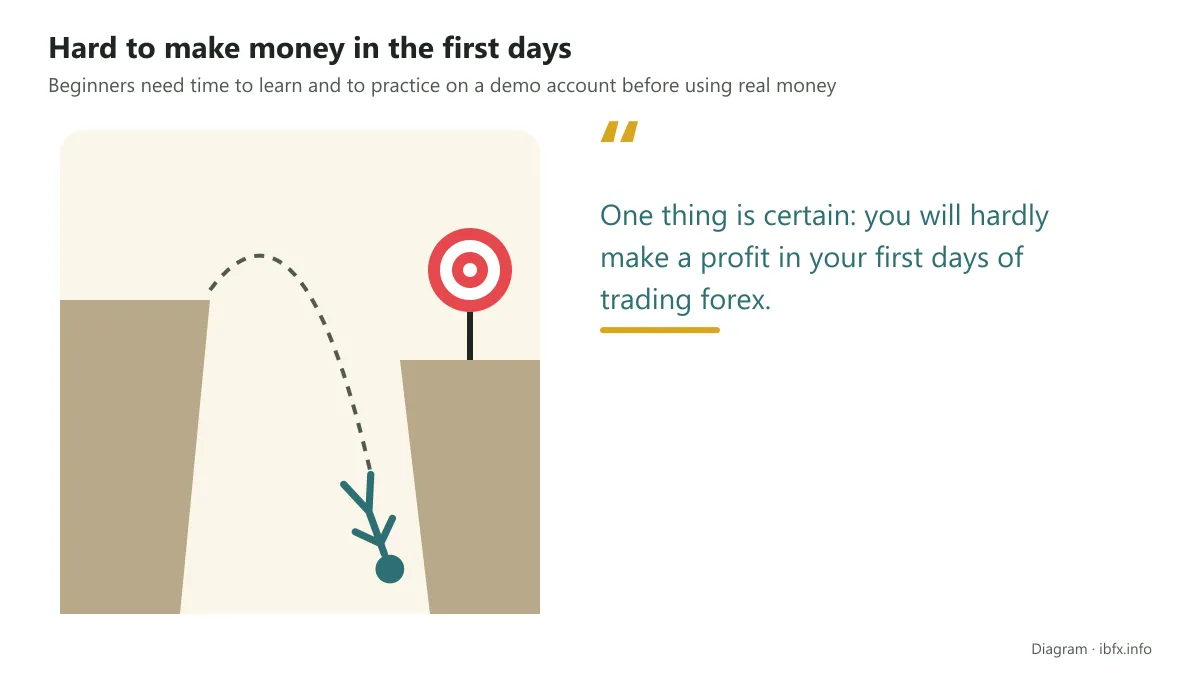
So how much money you put in depends on each person’s finances and circumstances. No two are alike. But one thing is certain: you will hardly win or make a steady profit in your first days of forex trading.
So, to cut the risk, deposit a little money and practice trading until you are really fluent. Once you are no longer a lamb and are beginning to adapt, to survive in this market, it will not be too late to raise the amount you trade with.
With as little as 1 USD you can still take part in forex investing. Although, to be honest, with that much money there is not much you can do in this forex market! But we want you to understand one thing: you can perfectly well invest in forex with a very small sum.
Many forex brokers have several account types with different minimum deposits, some of them only a few USD. A low minimum deposit is not a sign that a broker is trustworthy; check the license and the legal entity that will hold your account first. And if an IB or a sales adviser pushes you to deposit 1,000 USD or more right at the start, you should think again.
A detailed guide to forex investing
Just as the gold prospector needs digging tools and a map, and the person who wants to cook for a living needs a stove, pots and baking tools, trading, speculating or investing in forex is like every other trade in society: to take part you have to have certain tools.
You need a computer with an internet connection in order to open an account at one of the trustworthy forex brokers around the world. Once you have finished opening a forex account, downloaded the MT4 or MT5 platform the broker provides and deposited money into the account, you can start trading.
Opening a forex investment account
To open a forex account you have to go through 2 steps: opening a registration account with the broker, and opening a trading account on the MT4 or MT5 platform.
As a beginner, we advise you to open a demo forex trading account (a practice account) so that you can practice the mechanics, such as placing an order, closing an order and understanding the currency pairs you trade. A demo account almost always sits right beside the live account, and every broker has both kinds, so you can try it out with complete peace of mind. If you feel steady, it will not be too late to set up a live account.
When you open a demo account you only need to give the required information. Many brokers use the phone number you register to call and press you to deposit, so if you are not sure you will use that broker, do not fill in too much personal information; when you open a live account you will have to give everything and verify your identity.
Each broker usually has several different account types. So after you have opened a trading account you have to go on and open the account you want to trade with under one of the 2 platforms, MT4 or MT5. The steps for opening a trading account at a forex broker are all very simple; just follow the instructions.
Read more:
At any broker, the account opening section is usually at the top right or in some other very easy place to spot, under names such as open an account, register or Start, or Open live account, Sign up or Start trading in the English version.
Once you have finished opening the account, you only have to go to the broker’s website, find the Platform section and choose MT4 or MT5 to download. After downloading, choose the broker you registered with. Every forex broker has a great many different servers, so check the email the broker sent you for the server name, the username and the password the broker gave you. Enter all that information, connect successfully and you can start trading forex.
Depositing money to begin forex investing
If you use a live account you have to deposit money into the account before you can trade. With a demo account there is already a certain sum in the account, or many brokers will let you choose how much money you want, so you do not have to deposit anything.
Usually you deposit through the home page of the broker you registered with, finding the deposit section to do it. Brokers usually have a great many different account types, so if you want to deposit into a particular account, choose that account type. These days, though, some platforms built by the broker itself let you deposit inside the platform, without logging in to the home page.
After downloading the MT4 platform you log in by entering the account number and the trading server the broker sent you. Besides the account number, many brokers will also send the password for you to log in, although at some brokers you use the password you created while registering the management account to log in to MT4.
If the forex broker is the treasurer, then the accounts opened with that broker are the treasurer’s heart. So do weigh it up and choose to open a trading account at a trustworthy forex broker, to avoid a great deal of needless trouble later on.
So now you know the basic steps for taking part in forex investing, do you not? But that much knowledge only gets you acquainted with forex. In the part that follows we will go through some more advanced knowledge you need if you want to trade forex with discipline and keep your losses down.
A guide to buying and selling in forex investing
Once you are armed and ready, having completed the steps above, to become a trader taking part in forex trading you need to know how to place a Buy or a Sell order.
As said earlier, forex trading works in both directions, so you do not only Buy, that is wait for a product to be cheap, buy it and wait for it to go high to sell. A trader can also place a Sell order: believing the price will fall, you sell first at the current price, then close the order (buy it back) at a lower price for a profit.
Broadly, forex carries out these 2 kinds of Buy/Sell order in 2 main forms: the order executed at the market price and the pending order.
The order executed at the market price in forex investing (Market Order)
This is the most basic order: whatever the market price is at the time, you place the order and the broker fills it for you right at the market price of that moment (it may be slightly off because of slippage).
The pending order in forex investing (Pending Order)
A pending order is an order in which you set the buy price or the sell price in advance at a particular level. When the market price reaches that level, the broker fills the order for you (when the market is moving hard, the fill price may be off the price you set). There are two groups: Limit orders (Buy Limit, Sell Limit), waiting to buy below or to sell above the current price, and Stop orders (Buy Stop, Sell Stop), waiting to buy when the price climbs through or to sell when the price breaks below a particular level.
Read more:
How do you trade forex to a plan?
In any game or any trade you take up, you have to understand the “rules” of play before you can win. To become a seasoned forex investor who wins in this market, you too need to know 2 things: the rules of play and the discipline of play.
If the rules of forex are the rules of buying and selling, how to use leverage and how to keep your account from blowing up, then the discipline of forex is an investment plan.
Being an investment plan, it will have to carry at least a few basic pieces of information: how much capital goes into the investment, the largest loss you accept on each trade and each month, what the profit target is for the coming month, what it is for the coming 3 months and so on. How will you carry out those trades?
Because you treat them as a trading Plan, it means you have to follow everything you set down before you can reach the target you want.
But by nature nobody who takes up forex trading wants to grow wealthy slowly! Everybody likes growing wealthy fast! Put in 1 and take out 40! And plans for earning small coins one at a time will always be looked down on by many people. So hardly any of the traders who have just stepped into the trade will take the trouble to draw up a proper forex investment plan. Instead they wander on Telegram or Facebook, taking every call they come across, and the more they lose the harder they try to place more orders in the hope of winning it back quickly. That is why losing more than you win is very nearly an everyday affair in forex investing.
As said earlier, a great many people confuse investing with speculating; in forex the trader usually cares only about price movement over a short stretch of time in order to take a profit. That does not mean, though, that every trader trades the same way.
Each trader has a different way of making money, and those ways depend on the timeframe the trader uses for analysis. So there are basic forms of forex investing such as short-term investing and long-term investing.
Short-term forex trading
Short-term investing divides into 2 smaller forms: scalping and day trading.
Scalping is a form of trading on very short timeframes such as M1, M5 or M15. A scalper usually takes profit at a few pips and only holds an order for a few minutes. Because each order earns very little, the spread and the commission make up a large share of the profit, so scalping calls for low trading costs, very high discipline, and it does not suit most beginners.
Read more:
- What is scalping? How a scalping strategy is traded
- What is a time frame? How to choose the timeframe for your trading style
Day trading in forex is the form in which every order is carried out within the day and an order is never held overnight. These days traders often combine scalping and day trading and use them together. When they feel the profit in hand is enough they close the order. To use this approach you therefore need to know what Enough means. And above all, never turn up your nose at a profit of a few odd pips!
Long-term forex investing
A Long term form of trading in which an order is held from several weeks to several months. Oddly enough, a great many traders today who are sitting on losses regard themselves as trading in this form. Not placing stop loss points and simply leaving the account alone day after day is the complete opposite of long-term investing.
Traders really have to have experience before they trade this way. They have to combine fundamental analysis with technical analysis, using daily candles and above, and above all they lay out plans in advance: where to cut the loss, where to take profit, what scenarios the pair may follow, so as to judge whether it is going the way they analyzed.
So of these 2 kinds of forex investing, which suits you best?
Only you can answer that question, because you understand yourself best: the trading experience you have, the capital you put in, even the profit you expect and the loss you can accept in the worst case. So whichever approach you want to invest by, you should learn, and the most important thing to learn is technical analysis.
Technical analysis, the foundation for success in forex trading
Anyone who takes up forex trading will be advised to learn technical analysis, because without knowledge you cannot “read” what the market wants when you trade. Learning technical analysis helps you understand the market so you can go the way the market wants, not the way you think.
In practice, when you take up forex investing you have to put a number of factors together, and technical analysis is not the only factor that will bring you success in this field. But it is like the helmet you wear in traffic. Wearing a helmet you can still have an accident, even a fatal one, but without one the risk of serious injury or death in an accident is far higher. In the same way, knowing technical analysis means you have given yourself a helmet, a suit of armor, for forex investing. Only then can you raise your chance of surviving in this harsh but immensely attractive market.
The body of technical analysis knowledge in forex trading is truly enormous, so even a lifetime of study will not let you grasp all of its essence. On top of that, everyone applies what they learn differently, and each person will equip themselves with the knowledge that suits them. So if you are a beginner, you should study only the following basic material carefully: Dow theory, support, resistance, the trendline, Fibonacci, moving averages (MA), the oscillators and momentum indicators such as MACD, RSI and so on, which you can reach through the links below:
- Reversal candlestick patterns you need to know
- What is Dow theory?
- What are support and resistance?
- What is a fakey?
- What is a Pin Bar candle?
- What is an Inside Bar?
- What is the MA line?
- The candlestick patterns of Price Action
- Ichimoku: what is the Tenkan Sen line?
- What is a Pivot Point?
Every idea listed above has an article of its own in the Forex guides section.
Money management in forex investing
However good you are at technical analysis, if you do not know how to manage money your account will blow up all the same. Years ago, when I had just taken up forex and heard the masters teach this, I used to smirk or skip past it, paying little attention. But later, after the market had trampled and battered me again and again, I understood that to survive you have to know how to manage money in order to avoid risk.
Money management is the practice of managing the size of the position you enter so as to limit the money you can lose on each trade, so that a few losses in a row cannot wipe the account out.
It is a matter of balancing the account against the position size so that the two are in proportion: if your account holds only 100 USD you cannot trade 1 lot, you should only place 0.01 lot orders, which is far safer. Besides managing position size you also need to know the moment to cut a trade to protect your capital, when the market is not going the way you thought. Read more: The 2% money management rule and Effective money management in forex trading.
Trading psychology
This is an extremely important point in deciding whether your forex trading succeeds. As you know, the market is always moving, and every shake of the forex market can eat into your account to a greater or a lesser degree. So if you cannot control your mind you will cut a loss too early and turn a trade that could have made money into a loss, or the other way round, not dare to cut the loss and let a small loss turn into a large one.
Should you take a forex course or not?
To go fishing you need a rod; to go into battle you need a sword, a blade and armor. To go out on the road you need a helmet. In the same way, to trade forex you absolutely have to have knowledge. But a field with as vast an ocean of knowledge as foreign exchange trading is certain to give a great many people trouble. Simply because they do not know where to begin.
That is why online and offline courses have appeared and are advertised heavily on the internet, which brings with it good teachers and hopeless ones alike. People with no real ability still go out to teach “students”. And the students end up not only out of pocket for the course but with a blown-up account all the same.
So, while investing in education is never wasted, you should be careful in choosing a teacher so that you do not lose your money and come out worse off.
If you know nothing yet, start with free material (such as the Forex guides section or Babypips) and practice on a demo account until you clearly understand pips, lots, the spread, leverage, margin and how to read a chart on MT4 or TradingView. After that, if you still want to learn more, it will not be too late to look for a teacher.
First, because you already have the basics you will be less easily dazzled by a teacher; second, the basic knowledge above is taught free in a great many places, and you do not need to pay money to learn it.
Be wary of courses that promise a profit, that show off a high win rate, or that require students to open an account at a particular broker: the teacher in that case is usually taking a commission out of the very volume you trade.
Besides foreign exchange trading, are there other forms of forex investing?
One rather interesting thing: before taking up forex investing, a great many traders already had a settled trade or once worked at something else, and only then moved across to forex trading.
More than that, forex itself is an immensely broad idea, and within forex there are a great many different niches you can perfectly well take part in, not only forex trading. In particular, if the trades we suggest below happen to match what you used to do, or if you once had expertise in these fields, you can work at them to keep daily life going and combine that with forex trading at the same time.
In practice, however, whichever job you choose, you still need a firm grasp and a clear understanding of the basics of forex trading, or at the very least you have to have gone through a stretch as a trader, before you can combine it with some of the trades we suggest below.
Whichever direction you choose, you still need a broker licensed by a reputable regulator to hold your money. See how to pick a safe forex broker and the brokers currently featured on this site, along with the public disclosure about referral links.
Besides choosing a broker carefully, you should also go on gathering knowledge from a range of sources.
Copy trading, the order copying service
This is the most common form and a great many forex brokers provide it. The service is mainly aimed at traders new to the trade, traders who do not have much time for forex investing, or traders without much experience of technical analysis.
So, exactly as the name order copying suggests, you have nothing to do: you only press follow on a service provider, and when those traders enter an order, the order is automatically synchronized and copied across to your account in the capital ratio you set. When that trader closes the order, your order is closed too. The flexible point of this form, though, is that you can still cancel or close all these orders automatically if you no longer want to follow such “calls”.
Broadly, the copy trading service has 2 main kinds of trader: the Follower (the one copying orders) and the Provider (the one providing the service).
The Follower (the one copying orders) is usually a beginner or someone without the time to watch the market. You need to understand that copying orders does not reduce risk: if the person being copied loses money or uses too much leverage, your account loses with them, and past results do not assure the future. Look carefully at the maximum drawdown and how long the provider has been operating, and only use money you accept losing.
The Provider (the copy service provider), on the other hand, is usually a trader with several years of trading behind them, and in providing copied orders to traders they receive a certain share of the profit under the terms agreed beforehand.
Many brokers have an order copying service of their own; the conditions, the fees and the way the profit is split differ from broker to broker, so read carefully before you take part.
PAMM funds and selling signals
Besides order copying there is also the form in which you pool capital into an account traded by somebody else, usually called a PAMM fund (or variants such as MAM and RAMM, depending on the broker).
The manager uses the pooled money to trade; if there is a profit it is split in proportion to the contributions, and if there is a loss everybody bears it, and in not a few cases it ends with the account blowing up. A legal note: in Vietnam, taking other people’s money to trade on their behalf without a license may be a breach of the law, and a number of “forex investment mandate” cases have been investigated by the police. If you take part in a PAMM, you should only use a service run by the licensed broker itself, where you have an account in your own name and can follow the results.
And even if you want to make money this way, you still have to have been a trader with trading experience first.
Besides that, you can also sell your own signals on sites such as Mql5, eToro.com or Zulutrade.com; this is probably the gentlest form, and the one under the least pressure, compared with the PAMM fund or the RAMM fund just described.
Working as an IB
An IB (Introducing Broker) is a person who introduces clients to a broker and receives a commission based on the trading volume of those clients. IBFX itself has referral links to a number of brokers (see the disclaimer). This model easily gives rise to a conflict of interest: the IB gains when the client trades a lot, whether the client wins or loses. It is also the most gossiped-about trade in the forex world, because not a few people have blown up their accounts by following an IB’s “calls”. If you work as an IB, be transparent about the commission and never urge clients into a trade.
Working as a coder
If you are a coder with a grasp of programming, you might look into developing automated robots or coding technical indicators for the MT4 and MT5 platforms. You can sell your products on forex forums or on the MQL5 Market app store, for example. To be able to code a robot, however, you absolutely must have trading experience and a clear understanding of technical analysis. Which means you have to go through a stretch of trading, or at the very least become familiar with all of technical analysis, before setting about writing a trading robot. And that very process of understanding trading will also help you make quality products, which is the only way to attract other traders to buy them.
Should you hand your forex investing to someone else?
Invitations to “hand over your forex investing” appear thick and fast on social media, usually with a promise of a very high fixed monthly return.
Put simply, a mandate is handing your money to somebody else to trade in your place. In Vietnam the law has no mechanism for licensing a service that takes forex trading mandates through a foreign broker; the licensed fund management companies may only invest in the kinds of asset the rules allow.
So when you lose money you have almost no way of getting it back. Any promise of a fixed profit or of “capital protection” in forex trading is a sign of fraud, because nobody controls the gains and losses of the market. Read more: how to spot scams in the Forex market.
Forex investing or investing in shares?
Investing in shares is another channel that draws a good deal of interest, and these days opening an account at a Vietnamese securities firm can be done online. A great many forex brokers also advertise “securities” trading right inside the forex account.
However, the “securities” at a forex broker are in fact contracts for difference (CFDs) on shares: you only trade the price, you do not own the share, you have no voting right, and because leverage is used the risk is higher than buying the real share.
As for dividends, when a share pays a dividend the broker usually adjusts the money in the account: a buy (Buy) position is credited a matching amount, while a sell (Sell) position is debited that amount. Holding a CFD order overnight also incurs an overnight fee (swap). If your aim is long-term share investing, opening an account at a licensed securities firm is usually a better fit.
A great many forex brokers also offer CFDs on Bitcoin and other cryptocurrencies. In the same way, you do not own the Bitcoin, you only trade the price, with very violent moves and an overnight fee that is usually high. An account that can trade many kinds of product is convenient, but it also makes it easy for a beginner to trade too many things at once.
The forums and websites you must know if you want to invest in forex
If you have read this far, you surely know what to do if you want to invest in forex, do you not?
Even so, that is still not enough. One of the best ways to improve your own ability is to consult and learn from the traders who went before you. So you should also know a number of famous forums and boards around the world, such as:
ForexFactory: this is one of the largest forex forums. Here you can not only look through what veteran traders share but also keep up with a great deal of information, the economic calendar and the hottest news about the financial markets. If your English is not strong you can use Google Translate to read up on ForexFactory.
TradingView: no trader can fail to know Tradingview. It not only gives you trading tools much like MT4 but also holds a great deal of other useful information. TradingView supports many languages and has a very large trader community, so you can look through the trading ideas people share (those are personal views, not investment advice). We have a detailed guide to using TradingView below.
Myfxbook: a site that tracks and publishes the results of trading accounts. When you look at someone else’s results, give preference to accounts whose trading history has been verified, because a screenshot of a profit is very easy to fake.
MQL5: a community service of MetaQuotes (the maker of the MT4 and MT5 platforms), regarded as the place that supplies countless trading signals you can look through, in 2 forms, free signals and paid signals. If you are good enough you can even come here and sell signals to other investors.
Investing: this is one of the large financial websites worldwide, giving readers a great deal of news across different fields. It also carries analysis from experts that will help you understand the current financial picture better.
Babypips: a board that provides a great deal of useful forex knowledge; if your English is good you probably do not need to go looking for lessons anywhere else, so make Babypips your “teacher”.
TraderViet: a long-standing forum on investing and trading where you can come to learn and to look through what other experienced traders share.
In conclusion: should you invest in forex or not?
Forex is attractive because it lets you trade any time, anywhere, with small capital. But that very ease of entry is what makes many people rush in before they understand the risk.
You do not have to be a genius to trade, but seriousness and DISCIPLINE are only the minimum condition, not an assurance of profit. Most beginners still lose money however hard they try, so use only spare money that you accept losing.
Learn step by step, practice on a demo account long enough, start with a small sum and always place a stop loss. If after a while you find that forex does not suit you, stopping is a sound decision too.