On this page
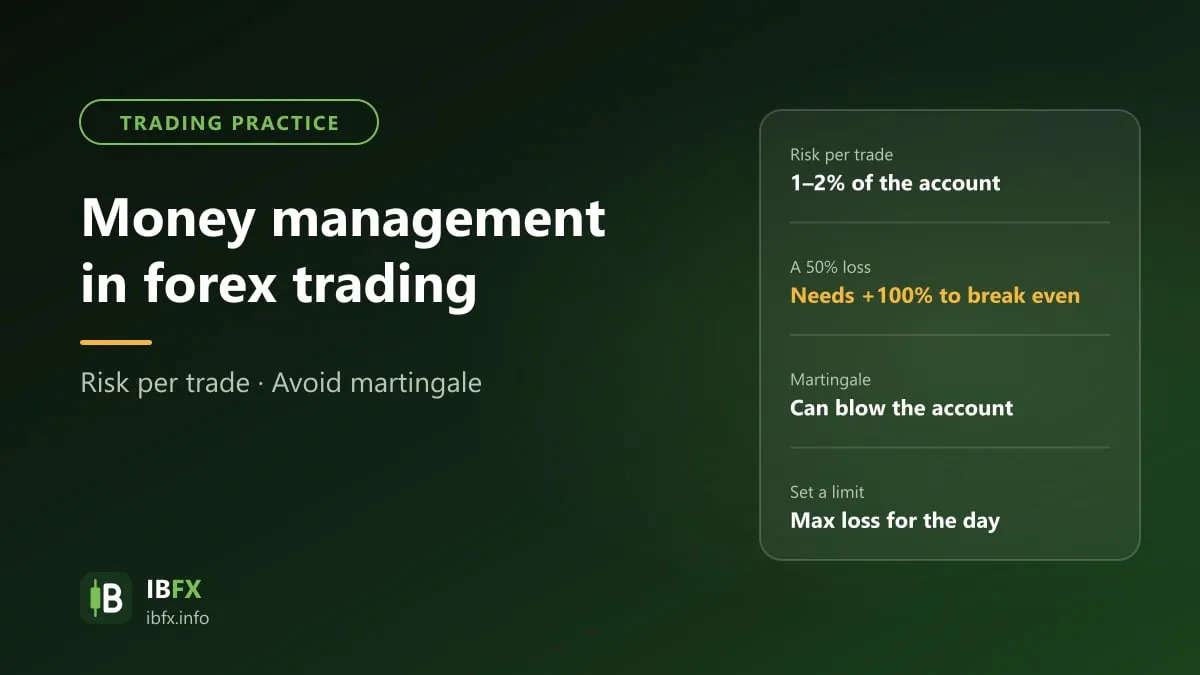
In trading, not knowing how to manage your money is a very big mistake, because once the account has lost most of its capital you have little chance to put it right. This article goes through the basic money management mistakes that many traders, and beginners above all, tend to make. See also: Effective money management in forex trading
Using too much leverage
Leverage is a double-edged sword: when a trade wins, it makes the profit on your capital much larger; but when a trade loses, the loss is correspondingly large and can blow up the account in a moment.
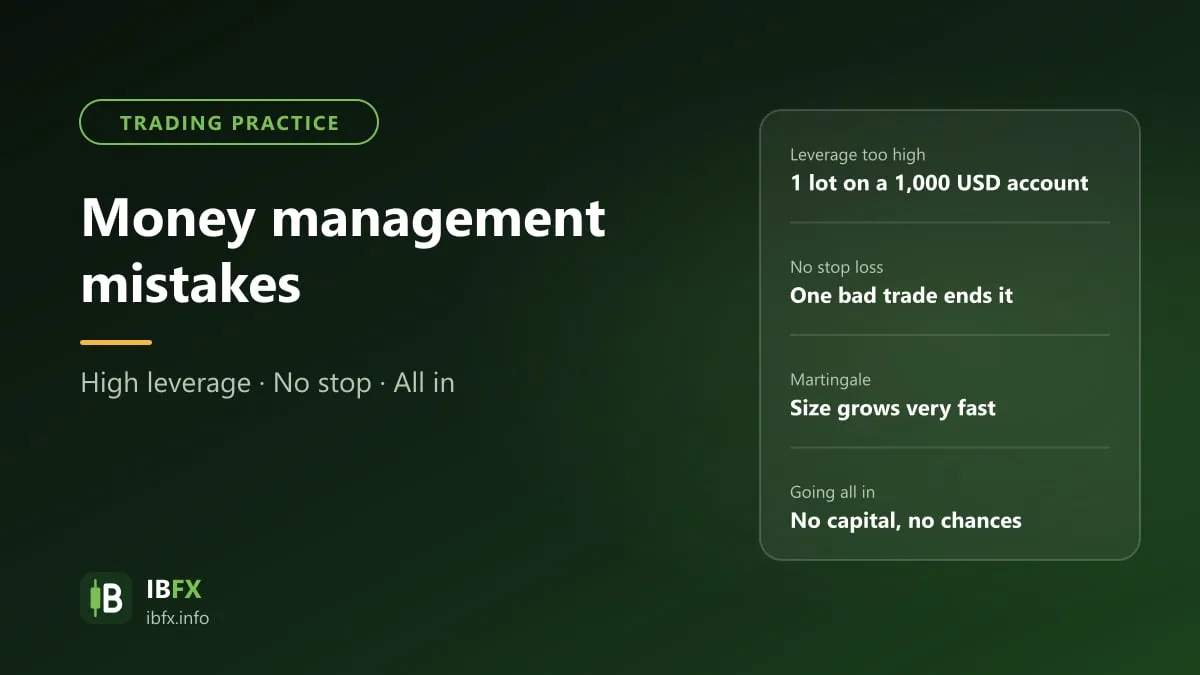
For example, on a 1,000 USD account, open 1 lot of EUR/USD (100,000 EUR, equivalent to more than 100,000 USD, so real leverage above 1:100) and each pip is worth 10 USD. Price only has to move 50 pips against you, a perfectly ordinary move within a day, and you are down about 500 USD, half the account.
Because the proportion of retail traders who lose money is so high, many countries have capped leverage for retail investors: the US has allowed at most 1:50 on the major currency pairs since 2010, while the EU, the UK and Australia cap it at 1:30. See also: “What is leverage? How much leverage should you use?”
Risking too much on each trade
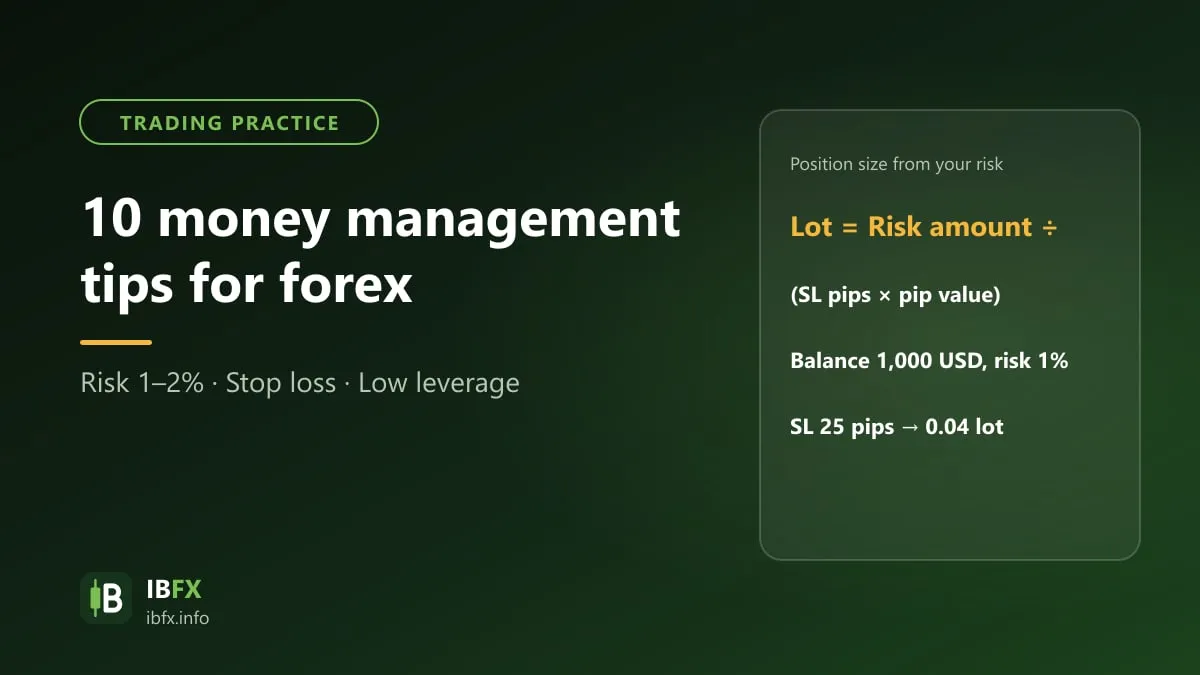
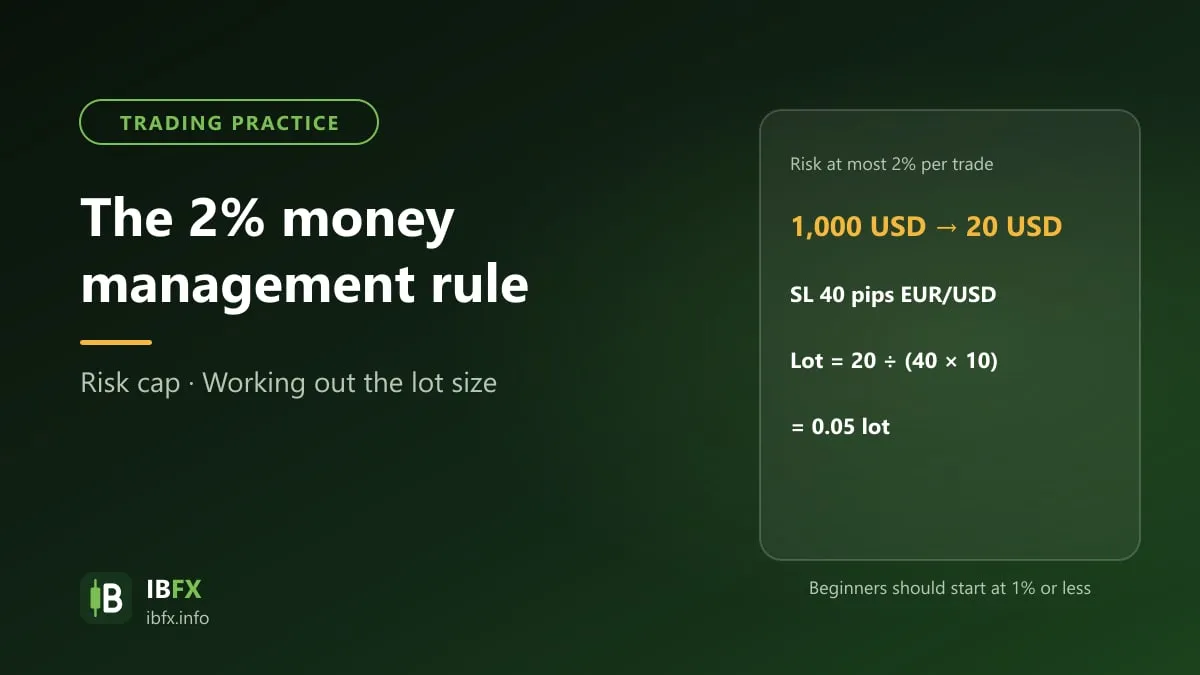
Many traders pick a position size on feel, “if it looks like a certainty, go in big”, instead of working it out from the stop loss distance. The right way is to decide before each trade that you will only risk a small percentage of the account, usually 1-2%, and only then work out the position size:
Position size (lots) = amount at risk ÷ (stop loss in pips × the pip value of 1 lot)
At 1-2% risk per trade, even a run of 10 losing trades in a row leaves most of the account there to carry on with. But at 10-20% risk per trade, a handful of losing trades already leaves the account heavily damaged. See also: the 2% money management rule
Another dangerous variant is stacking up martingale entries: lose, then double the position size on the next trade to win it back. This can “win” several times in a row, but a losing run of any length is enough for the position size to grow very large and the account to be blown up.
Trading against the trend and having no plan of your own
Many new traders like picking tops and bottoms and entering against the trend. Remember that “the trend is a trader’s friend”: trading with the trend means you have to wait, take fewer trades and look less exciting, but the paradox is that it is one of the things that keeps many traders in the market for a long time. Trying to fight a strong trend usually ends badly.
Another mistake is having no view and no trading plan of your own, and entering on someone else’s opinion or on a “signal” in a chat group. When you do not understand why you entered, you also will not know when to cut the loss, and you take no lesson away. Small mistakes repeated over and over, such as not following your strategy, not setting a stop loss and trading on feel, eventually open a large hole in the account.
Lack of patience
Many traders want to enter every time they see the market move, perhaps because of human nature and impatience to make money fast. Meanwhile, patiently waiting for every condition in your plan before you place an order is one of the important factors that keeps you out of poor quality trades.
Few traders understand that steady trading results take a great deal of time. When you hear someone boast of making several hundred percent in a short period, desire is easily kindled and you take on a lot of risk. But large profits always come with large risk; the faster you make money out of the market, the faster you can lose it again.
If you stick with a strategy that suits you, keep it simple and follow your own rules strictly, you have a better chance of trading effectively. That is not easy, and in practice only a small number of people reach profits steady enough to live on from trading.
Keeping no trading journal
See also: Why should you write a forex journal every day?
Without a trading journal, it is hard to know which kind of trade works for you and which trades you should pass on. Writing down your entry history is the best way to learn from past mistakes, and at the same time to look back at good trades and build your confidence. See also: “Why you need to write a forex journal every day”
If you can, save a chart screenshot of each trade along with an Excel file recording the reason for the entry, the entry price, the stop loss, the take profit and the outcome, so that you can look back at any time. Traders with steady results usually treat trading as a business: nothing is certain, but a plan and detailed records help you control risk better in a market as hard as forex.
Overcomplicating your trading method
Many people think that learning every price pattern and candlestick pattern in existence will make them a profit, or that the more indicators they add to the chart, the better they will filter out false signals. Reality is usually the opposite: too many tools produce contradictory signals, which leaves you confused and unwilling to make a decision.
Ichimoku today, Fibonacci tomorrow, then Price Action and Elliott waves to round out the set; the more you learn, the deeper you sink into a pile of knowledge without finding anything that suits you.
Keep everything as simple as you can: learn the basic patterns, but learn them thoroughly; use only a moving average and one oscillator such as Stochastic, RSI or MACD; and concentrate on trend, support, resistance, price channels and trend lines. That is enough for a beginner.
Trading too much
Trading too much (overtrading) is a very common mistake. When a trade is in profit, the brain releases dopamine and you feel elated, you want to make more and you throw yourself into the next trade. Conversely, when price moves against the position, fear rises and your heart races; when the stop loss is hit you are annoyed and want to enter another trade straight away to win it back. Carry on like that and the account can “evaporate” very fast.
See also: How to control your trading psychology effectively
Psychology plays a very large part in trading. Learn to control your emotions so that you do not have to go in and out of the market so often, and do not try to catch every small wave, especially if you are new. You can set yourself a target of only entering a few times a week, or even a few times a month. See also: “How to control your psychology in trading”
For a beginner, medium and long term price moves are usually easier to recognize, and you do not have to keep your eyes glued to the chart all day and take on more stress along with it. Many long standing traders also work toward trading fewer but better trades, for an easier state of mind.
Not setting a stop loss
A stop loss is there to protect the account; setting none means throwing away the most important layer of protection you have. This mistake tends to happen exactly when you are on a winning streak and starting to think you are very good.
Technically, a stop loss is a stop order placed in advance: when price reaches the stop loss level, the position is closed at the market price, so when news comes out or there is a gap it can still suffer slippage. Even so, having a stop loss is far safer than having none. See also: “What is a stop loss?”
Some people dislike setting a stop loss for fear of being “swept out by the sharks”. But letting price run freely with nothing to protect you is far more dangerous; if you are often swept out, look again at where you put the stop loss (outside the support or resistance area rather than right up against it) and cut your position size accordingly.
Putting all your capital into one trade
If your only focus is making a profit fast, you are gambling rather than trading. A very familiar scenario: you do your own analysis and enter a small position, price moves exactly as forecast and the account grows. You regret not having gone in bigger, so on the next trade you put in nearly all your capital in the hope of a large gain. It only takes that trade being wrong for the account to be almost wiped out.
Get used to small gains and be happy with them, and do not bet everything on one single opportunity. The market has plenty of opportunities left, but your capital has to be left too before you can carry on trading; no capital means no opportunity.