On this page
Anyone who starts looking into the financial markets has asked themselves at some point: “Should I invest in forex or in stocks?” There is no single answer that fits everyone: each market has its own strengths and weaknesses, and the interest rate and economic backdrop changes from one period to the next. In this article we will compare the two markets on the nature of the product, the legal position, liquidity, costs, the information you need to follow, trading hours, leverage and risk, so that you can judge for yourself which choice suits you.
A bank savings account keeps your money safe. When the savings rate is lower than inflation, many people turn to other channels such as stocks or forex. But remember that this is not “a savings account with a higher rate”: both can cost you your capital, and forex uses leverage, so it can cost you that capital far faster.
The forex market and the stock market
The forex market is a network for trading currencies among participants all over the world: commercial banks, investment banks, central banks, investment funds, import and export businesses, brokers and individual investors. According to the three-yearly survey by the Bank for International Settlements (BIS), global foreign exchange turnover in 2022 was about 7.5 trillion USD a day and rose further in the 2025 survey, far larger than any stock market.
The stock market is where shares, bonds and other securities are bought and sold. A share represents ownership of part of a business. Some companies are not listed on an exchange, and their shares are traded on the over-the-counter (OTC) market.
The difference in the nature of the product
This is the difference beginners most often overlook:
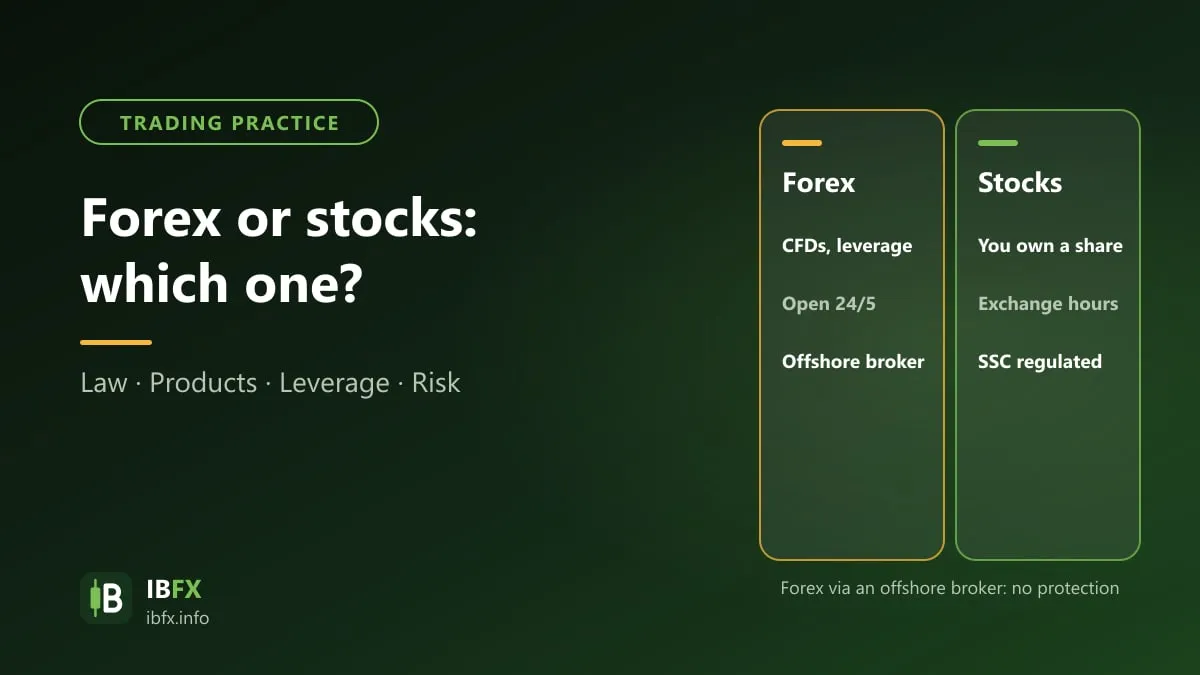
- Shares: when you buy shares with your own money (without borrowing on margin), you own part of a business, you can receive dividends, and you can hold for many years. Over the long run the share price of a good business can rise along with its profits, although nothing is certain and you can still lose heavily.
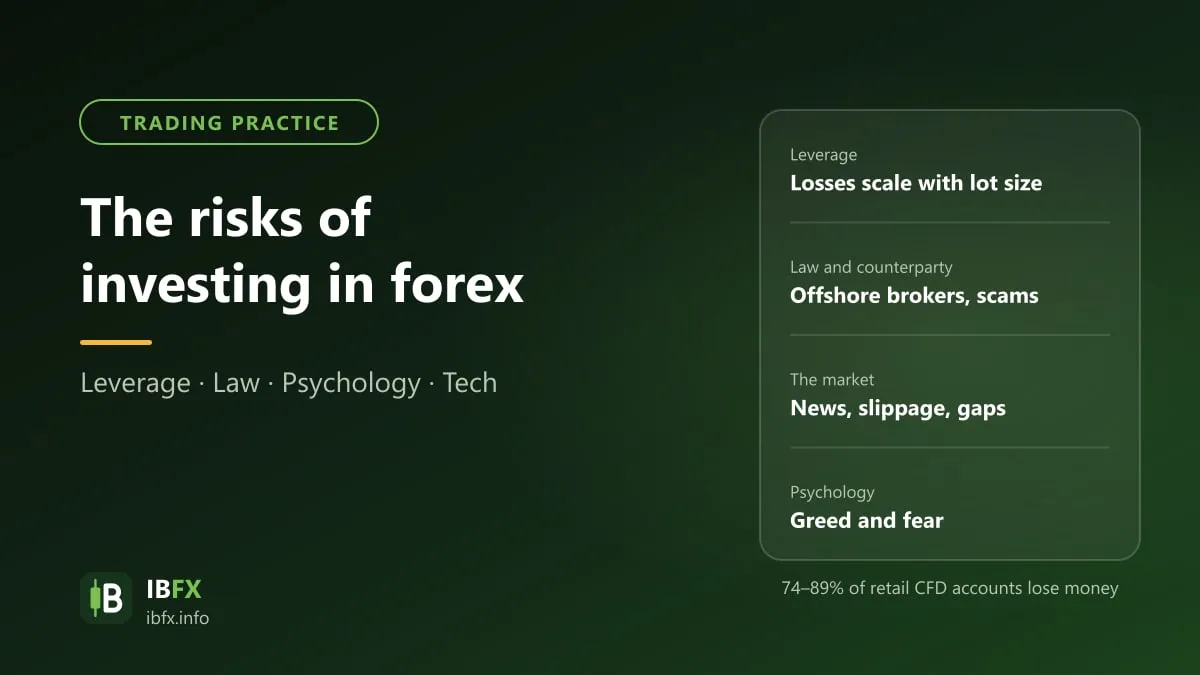
- Forex for the individual investor: this is usually a contract for difference (CFD), or leveraged margin trading through a broker. You own no asset at all, the profit comes entirely from the price difference, you pay a swap if you hold the position overnight, and the price can go against you very fast. According to the disclosures brokers in Europe are required to publish (under the ESMA rules), about 74–89% of retail CFD accounts lose money.
See also: What is a CFD?
The legal position in Vietnam
This is a very important difference. The domestic stock market operates under the Law on Securities, and securities companies are licensed and supervised by the State Securities Commission of Vietnam. Forex trading through a foreign broker in Vietnam, on the other hand, is not at present recognized or protected by law; if a dispute arises, or you run into a fraudulent broker, you have almost no way of getting your money back. See also: Is forex trading legal in Vietnam?
Forex or stocks: liquidity
The forex market is highly liquid, particularly in the major pairs, because there is a very large number of participants at almost every moment of the week. Large, widely held shares such as Microsoft are liquid too, while the shares of small companies are usually thinly traded and hard to buy or sell in size without moving the price.
Note that for an individual investor trading forex through a broker, the execution you actually get also depends on that broker, and liquidity can drop sharply when news comes out, at the start of the week, or on public holidays.
Why do we need liquidity?
Liquidity makes it easy to buy or sell a financial product, and it usually brings the cost of trading down as well. Compare two very common products: the EUR/USD pair and Microsoft shares.
With a large-cap share such as Microsoft, the difference between the buying and the selling price (the spread) in normal conditions is usually only about 1 cent, and many US brokerages now charge no commission on share trades.
With EUR/USD, the most heavily traded pair in the world, the spread on a standard account is about 1 pip. At an EUR/USD rate of 1.1900, with 1 pip = 0.0001, that cost is less than 0.01% of the value of the trade. Measured as a proportion of the value traded, costs in both markets are very low. But forex trading uses leverage, so the cost measured against the capital you actually put up is far larger, and if you hold a position overnight you pay a swap on top of it. You can see the exact costs in the contract specifications on your broker’s trading platform. See also: What is spread?
The information you need to follow
One large difference between the two markets is the kind of information an investor has to analyze. With stocks, information about the business itself comes first: revenue, profit, cash flow, the level of debt, the outlook for the industry.
With forex, the focus is the health of a whole economy and its monetary policy: interest rates, inflation, the unemployment rate, GDP… When you trade forex you always trade a currency pair, that is you buy one currency and sell the other at the same time, so you need to compare the situation of both economies. See also: Fundamental analysis in forex trading
If you enjoy studying businesses, stocks may suit you better; if you are interested in the macroeconomics of countries, forex may appeal to you more.
Forex and stocks: trading hours
Forex is a decentralized market with no single place of trading, so trading goes on almost 24 hours a day, 5 days a week, through the Asian, European and US sessions. Listed shares, on the other hand, trade only during the opening hours of the exchange; some large exchanges abroad have an extended-hours session, but liquidity there is much lower. See also: The forex trading sessions and their hours
Flexible trading hours let someone with a job pick a window that fits. But a market that runs continuously also makes it easy for a beginner to trade too much, to stay up late watching positions, and to damage their health and their work.
Margin and leverage
A large difference between the two markets is the level of leverage. Share trading usually uses no leverage or only a low level of it (margin lending in Vietnam, for instance, is capped at about 50%), while forex brokers usually offer far higher leverage. When you trade shares through a CFD you can use leverage as well; for retail clients in the EU and the United Kingdom, leverage on share CFDs is capped at 1:5, and on the major currency pairs at 1:30.
Leverage lets you trade a large size with a small amount of margin, but the losses grow in the same proportion. Leverage can be a useful tool if you handle it carefully, but it also cuts both ways. See also: What is leverage?
Forex or stocks: the conclusion
So should you invest in forex or in stocks? The key point is which market suits your goals, your knowledge, your time and your ability to bear risk. The market you understand better is usually the one where you will make the better decisions.
For a beginner whose goal is to build wealth over the long run, a channel that is protected by law and does not use leverage, such as the domestic stock market, is usually seen as the less risky place to start. If you still want to look into forex, study the material thoroughly, practice on a demo account, use only spare money you can accept losing, and always manage risk tightly.