On this page
In this article we introduce you to a piece of financial market knowledge that is both familiar and unfamiliar: the bond. Almost everyone has heard of bonds, and yet very few people can understand this kind of business clearly and in detail. If you are interested in bonds, do not miss the article that follows.
What is a bond?
A bond is, in essence, a certificate of a loan with a term (usually from 1 year upwards), issued by a business, a local authority or a government (through its treasury). The buyer of the bond, the bondholder, is the lender. On the maturity date the bondholder gets the principal back at the face value of the bond; the interest is paid at regular intervals, or in a single payment, according to the conditions recorded at issue.
How does a bond work?
Bonds issued by companies raising capital contain the terms of the loan, the timing of the interest payments and the timing of the repayment of principal. The yield is the part of the return that bondholders earn when they lend money to the issuer by buying the bond.
In Vietnam, bonds usually have a face value of 100,000 dong or a multiple of 100,000 dong; on the international market the common face value is 1,000 USD. The issue price of a bond depends on a number of factors, such as the creditworthiness of the issuer, the time to maturity, the periodic interest rate (the coupon) and the market interest rate at the time. The face value of the bond is the amount paid back to the lender, the bondholder, when the bond matures.
If you own a bond you do not necessarily have to hold it to the maturity date; you can sell it to another investor, but the selling price may be below the price you paid, and corporate bonds are sometimes very hard to find a buyer for. With a bond that has an early redemption clause, the issuer usually buys it back when interest rates fall, and can then issue new bonds at a lower cost.
Bond interest rates and bank interest rates
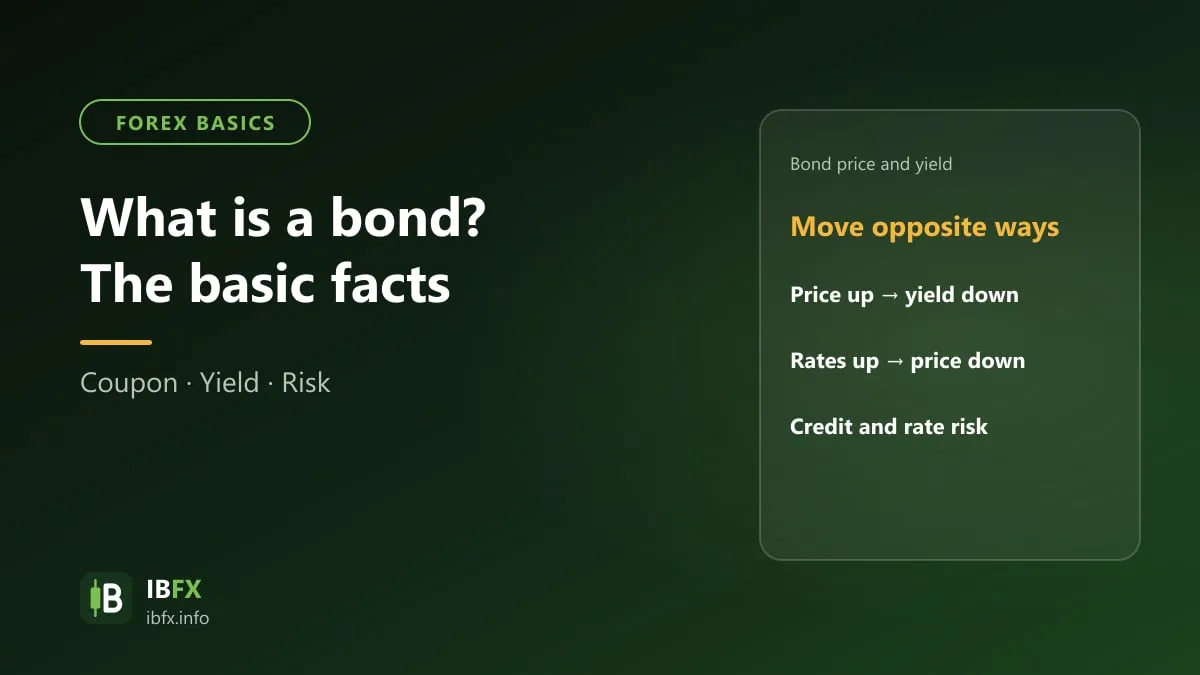
One interesting thing is that bond prices always move against market interest rates: a bond price falls when interest rates rise and rises when interest rates fall.
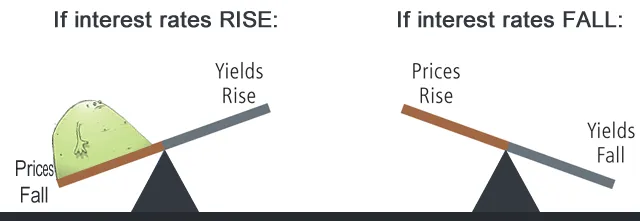
For example, when a bond is issued with a periodic interest rate (coupon) of 5% and a face value of 1,000$. The bondholder will then receive 50$ of interest a year.
However, if the interest rate in the economy falls to 4%, say, the bondholder still receives the periodic interest of 5% as at the start. That makes the bond more attractive, so other people are willing to buy it at more than face value. The other way round, if the market interest rate rises to 6%, the bond’s 5% periodic rate is no longer attractive, and to sell before maturity the bondholder has to accept a price below face value.
The features of a bond
Face value: the amount the bondholder gets back on the maturity date (the purchase price on the market can be above or below face value); it is also the reference amount the bond issuer uses when calculating the interest payments. For example: one investor buys a bond at a price of $1,090, while another investor buys the same bond at only $980. When the bond matures, both investors get back the face value of 1,000$ (the one who paid 1,090$ loses 90$ of principal, the one who paid 980$ gains 20$, before the periodic interest).
Periodic interest rate (coupon): this is the rate the bond issuer pays on the face value of the bond, expressed as a percentage. For example: a coupon of 5% means the bondholder will receive 5% x $1,000 of face value = $50 a year.
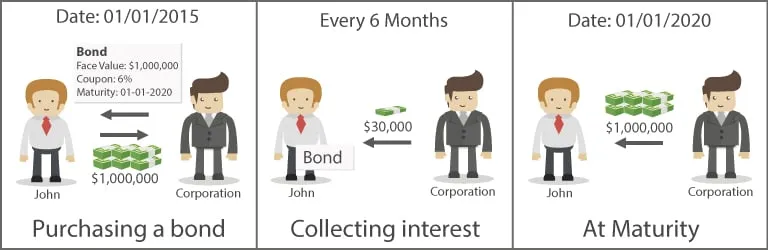
Interest payment period: the date on which the bond issuer makes the interest payment. The payment period is set by the issuer; the common ones are every 6 months (as with US Treasury bonds) or once a year.
Maturity date is the date on which the bond issuer pays the bondholder the face value of the bond.
Issue price is the price at which the issuing organization sells the bond at the time of issue, usually stated as a percentage of face value.
The two main factors that decide a bond’s interest rate
Credit quality and time to maturity. The less reputable the issuer and the higher the risk of default, the higher the interest the bond has to pay to make up for the risk. A bond with a longer time to maturity usually has to pay higher interest, because the lender carries inflation risk and interest rate swings for longer.
The organizations that issue bonds
There are three main kinds of organization that can issue bonds:
Corporate bonds are issued by companies.
Local government bonds (called municipal bonds in the US) are issued by states, cities or provinces.
Government bonds, such as the bonds issued by the US Treasury to cover budget deficits, to fund public works and so on. With a government whose finances are as solid as the United States’, the risk of not being able to repay is very low and liquidity is the highest of the three kinds. But not every government is safe (Greece in 2012, and Argentina several times over, did not repay their debts in full), and the price of government bonds still moves with interest rates.
The kinds of bond
Zero-coupon bonds: they pay no periodic interest and are sold at a price below face value; the difference between the purchase price and the face value you get back at maturity is the interest.
Convertible bonds: they let the bondholder convert the bond into shares in the issuing company at a preset ratio; they are usually worthwhile only if the share price rises high enough.
Callable bonds: they let the issuer buy the bond back before maturity on conditions written in advance.
The risks of investing in bonds
Interest rate risk
As said above, when market interest rates rise, the price of bonds already in issue falls. If you have to sell before maturity you can lose money; the longer the term of the bond, the more sensitive its price is to interest rates.
Reinvestment risk
With a callable bond, the issuer usually buys it back before maturity when interest rates fall. The bondholder gets the principal back (sometimes with a small premium over face value), but cannot reinvest at as high a rate as before. Over the long run, reinvestment risk lowers the return on the investment.
To avoid this, an investor can choose bonds without a call provision, and usually has to accept a slightly lower interest rate.
Inflation risk
When inflation runs higher than the bond’s interest rate, the purchasing power of the interest and of the principal falls, and the investor’s real yield turns negative.
To put it concretely, suppose a bond investor is able to earn an interest rate of 2%; if inflation rises to 4% after they invest, the investor’s yield in real terms is only -2%.
Credit risk
Government bonds are usually considered the safest, because a government can collect taxes or, for debt in its own currency, issue money to pay its debts. A business cannot do that, so corporate bonds are riskier and have to pay investors a higher interest rate.
What do bonds have to do with forex?
The yield on government bonds, such as the US 10-year bond yield, reflects what the market expects for interest rates and inflation. When one country’s bond yield rises relative to another’s, money tends to flow into that currency, so forex traders often watch yield spreads as one of the factors that affect exchange rates. See also: The factors that affect exchange rates in forex.
Conclusion
Investing in bonds can create a fixed stream of income for an investor, and government bonds are usually seen as a safe place to put money. But corporate bonds are a different matter: in Vietnam, over 2022-2023 many businesses were late paying the interest and the principal on their bonds, which showed that high-yield bonds can be no less risky than shares. Look carefully into the financial position of the issuer and into the collateral before you buy.