On this page
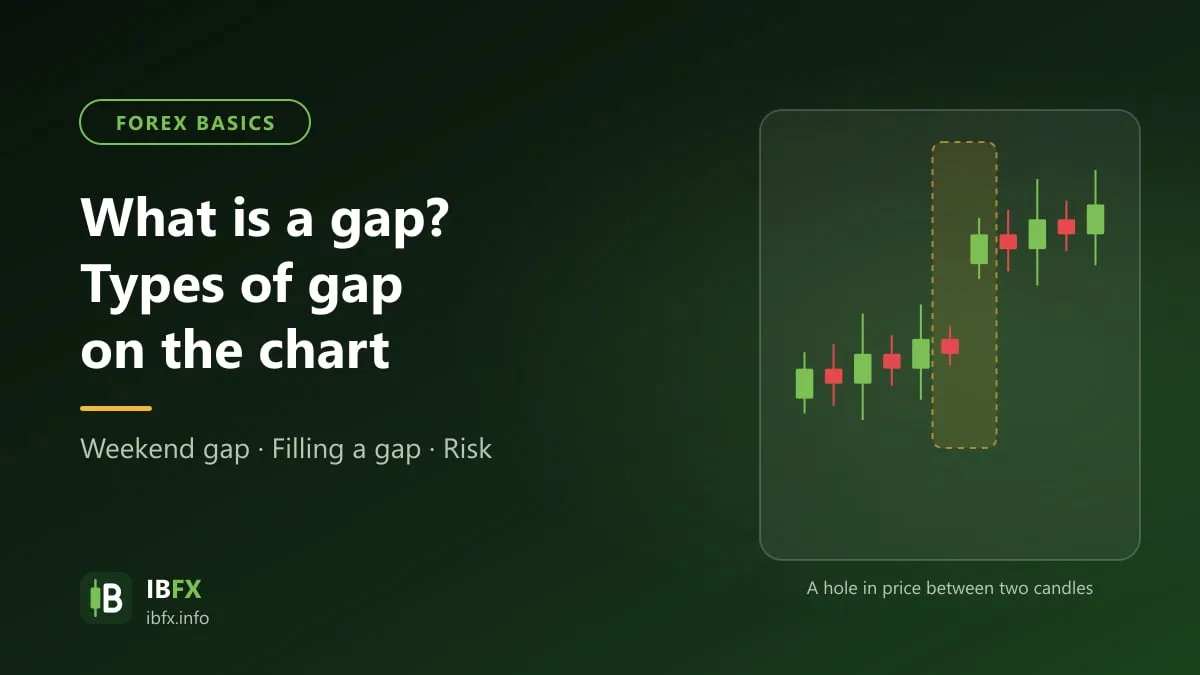
A gap is an empty space in price that shows up on financial charts. If you trade stocks you will see plenty of gaps; in forex this usually happens only when the market opens at the start of the week (Monday morning, GMT+7), or in a few special cases. So what is a gap? And how many types of gap are there in financial trading?
What is a gap?
A gap is simply an empty space: price moves so suddenly, rising too hard or falling too hard, that it jumps up or down to a level above or below the closing price of the previous candle. That leaves a blank space on the price chart, and that space is what we usually call a gap.
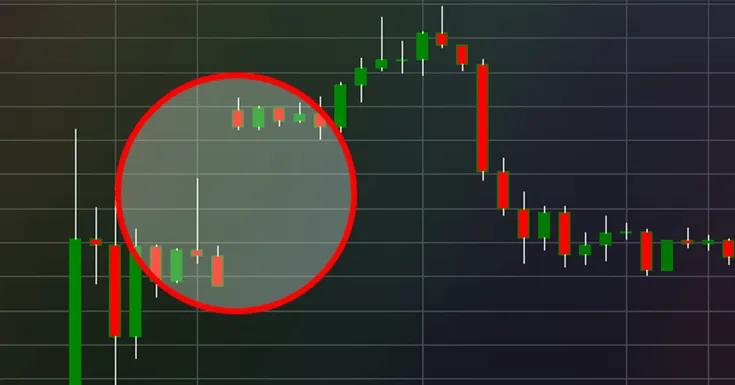
When do gaps usually appear?
Because the forex market trades almost continuously 24 hours a day from Monday to Friday, and because its liquidity is deep, it has fewer gaps than the stock market. Gaps still appear in the following cases:
- At the start of the week: forex does not trade on Saturday and Sunday, but if big news breaks over the weekend (an election, a referendum, a conflict, an unexpected policy decision and so on), the opening price on Monday morning can be far from Friday’s closing price.
- When an extreme event makes liquidity disappear for a moment, as it did when the Swiss National Bank unexpectedly dropped its EUR/CHF floor on Jan 15, 2015: price skipped over many levels with almost nothing filled.
- Around major holidays such as Christmas and the end of the year, when a great many banks around the world are closed, trading is not continuous, which is also a condition in which a gap is created.
The types of gap that appear in the market
There are four different types of gap you need to know:
- Common gap. This is the one you meet most often; in forex it mainly shows up in the opening session at the start of the week, and in stocks it usually shows up while price is moving sideways. A gap like this is usually small, does not say much about the trend and is often filled afterwards, but not always.
- Breakaway gap appears when price jumps out of a consolidation area or a chart pattern, usually alongside unexpected news, and marks the possible start of a new trend. Note that this gap often is not filled: price keeps running hard in the direction of the break.
- Continuation gap (also called a runaway gap) shows up in stocks more often than in forex, in the middle of an uptrend or a downtrend that is already clear, as a sign that the trend is still strong.
- Exhaustion gap. Like the continuation gap, the exhaustion gap mostly shows up in the stock market. It usually sits at a top or a bottom after an uptrend or a downtrend has already been forming for a long time; an exhaustion gap signals the end of a trend, which is exactly why it is called exhaustion.
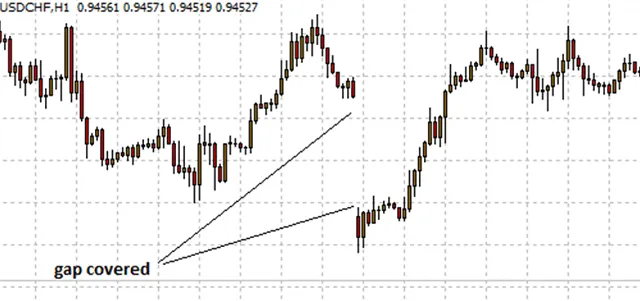
When does a gap get filled?
After a gap appears, price often tends to come back and fill the empty space, and some traders look for ways to trade that fill. Price does not always move up or down to fill the gap, though. And when it does, it can be at some later point rather than straight away. So think it through carefully to avoid the risk that comes with it.
A gap is usually filled in the following cases
- The gap appears at a strong support or resistance area. Price tends to come back to those areas to retest them and to confirm the current price trend once more before it continues up or down.
- The gap appears inside an area where a chart pattern is forming. Those gaps are usually filled, because price is still swinging back and forth within that area.
What is the most sensible way to trade a gap?
There are many ways to make use of a gap in trading, but you can look into a few of the points mentioned above, such as:
Work out whether the gap sits at a resistance level, a support level or a familiar chart pattern. If the gap lines up with those barriers, price often tends to come back to fill the gap and also to retest before it rises or falls with the trend.
Common gaps and exhaustion gaps are usually filled more easily. Breakaway gaps and continuation gaps (runaway gaps), on the other hand, appear inside a strong trend, so they are usually not filled right away, and trading against them while waiting for a fill is very risky.
And as said above, a gap is not always filled, and when it is, it can be at an undefined time rather than the same day. That is why you still have to stick to technical analysis and fundamental analysis when you trade. Do not place a buy or sell order the moment you spot a gap in the hope that it will be filled.
How dangerous is a gap for someone holding a position?
This is something beginners very often overlook: a stop loss order does not stop a gap. When the opening price jumps past your stop loss level, the position is closed at the best price available at that moment, which can be much worse than your stop loss level, and the loss is bigger than planned. A pending order can also be filled at a price different from the one you set.
So if you have to hold a position over the weekend or through major events, consider cutting your position size, closing part of it, and not using very high leverage.