If you are a trader, you need to be able to identify the trend to some degree, because of how much it matters. For a trend trader, the main idea is to try to follow the main trend of the market, whether it is up or down. Remember that the market only trends strongly for part of the time; the rest of it is sideways movement or no clear trend. So the big opportunities in a strongly rising market are not that many.
If you have a grip on the market trend, you get a broader view when you plan your trades.
Understanding it and applying it is not a simple matter, but it is not too complicated either.
The definition of a market trend
A market trend is the tendency of a financial market to move in a particular direction over time.
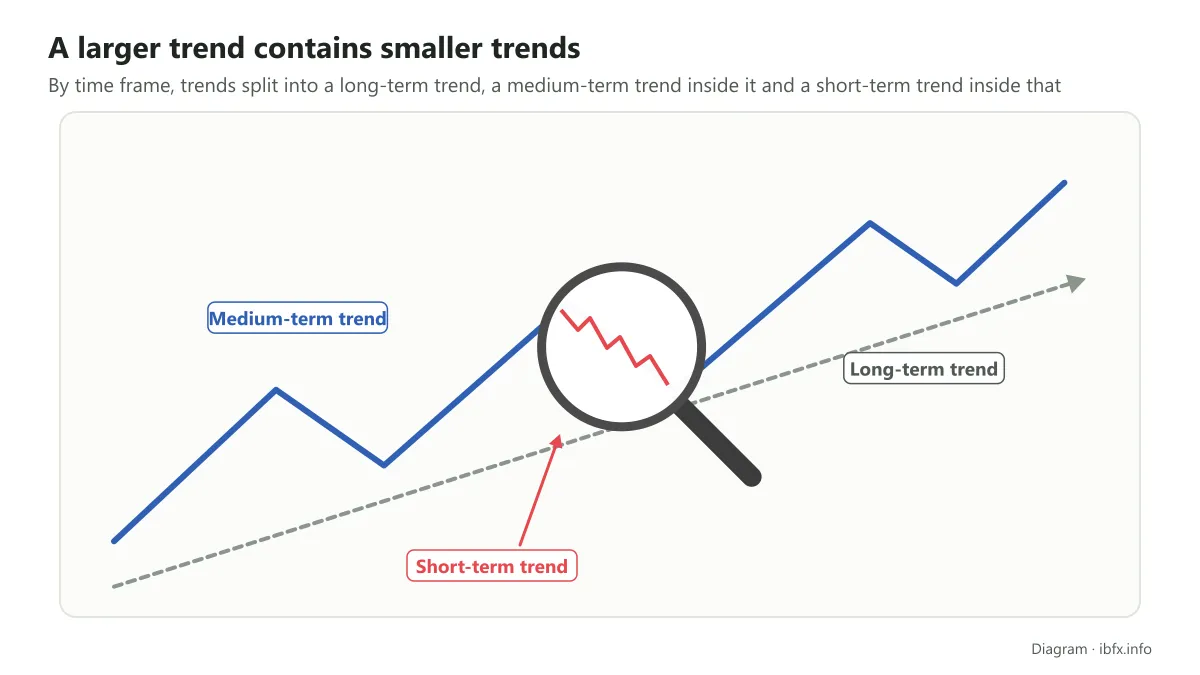
By time, these trends are usually sorted into 3 kinds: a long-term trend, a medium-term trend inside it, and a short-term trend inside that.
The market trend is the factor that many investors care about most.
Sorted instead by whether the market is rising or falling, market trends break down as follows:
+ A rising market describes market trends that go up over time.
+ A falling market describes market trends that go down over time.
+ A sideways market, that is, a market that goes sideways over time.
These trend concepts are used in every market where buying and selling follow supply and demand, not only in the forex market.
The types of market trend
Looked at over a given stretch of time, a market trend splits into the 3 types set out above, a rising market, a falling market and a sideways market:
1. What a rising market is
A rising market is when price goes up over time, which can be short-term or long-term. In stocks, a rising market usually goes with expectations of a brightening economy; with a currency pair, an uptrend means the first currency in the pair is strengthening against the second.
In a rising market, investor confidence usually grows, and buying is more active than selling, which pushes price up.
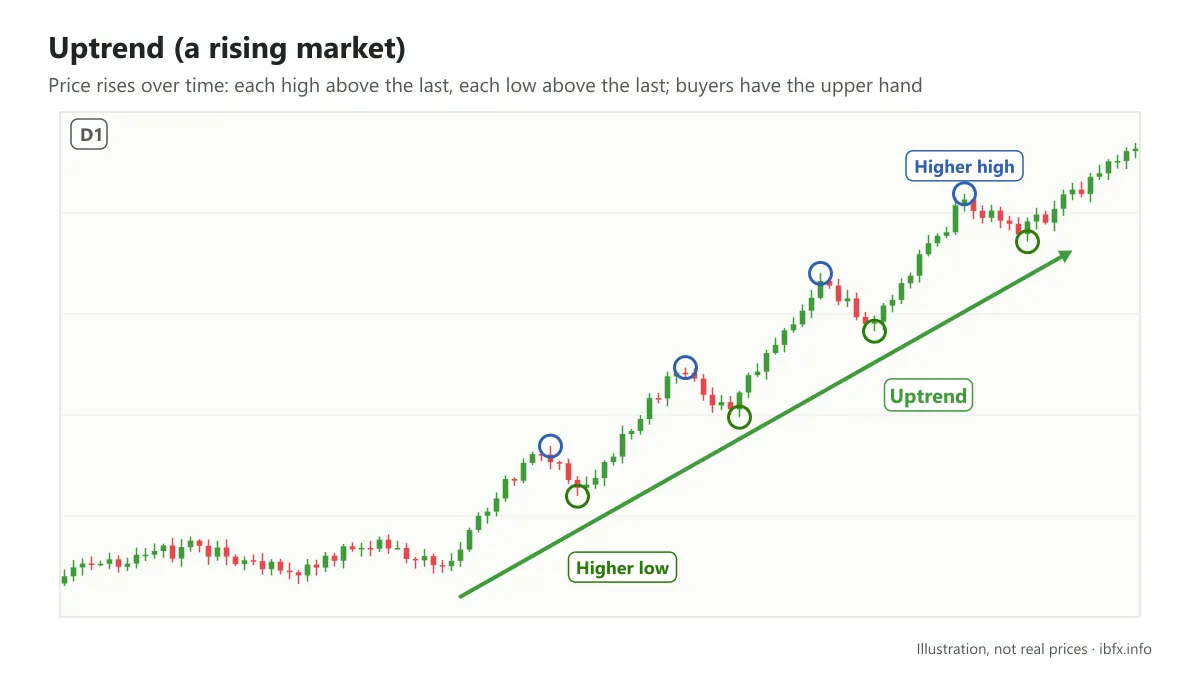
A strong uptrend on the Daily time frame.
In short, in an uptrend buying has the upper hand, which makes price rise over time.
2. A falling market (a bear market)
A falling market is when price goes down over time, which can be short-term or long-term. In stocks, a falling market usually goes with worries about a weakening economy; with a currency pair, a downtrend means the first currency in the pair is weakening against the second.
In a falling market, selling has the upper hand. In stocks, a downtrend usually starts before the economy shows clear signs of weakening, because the market reflects expectations.
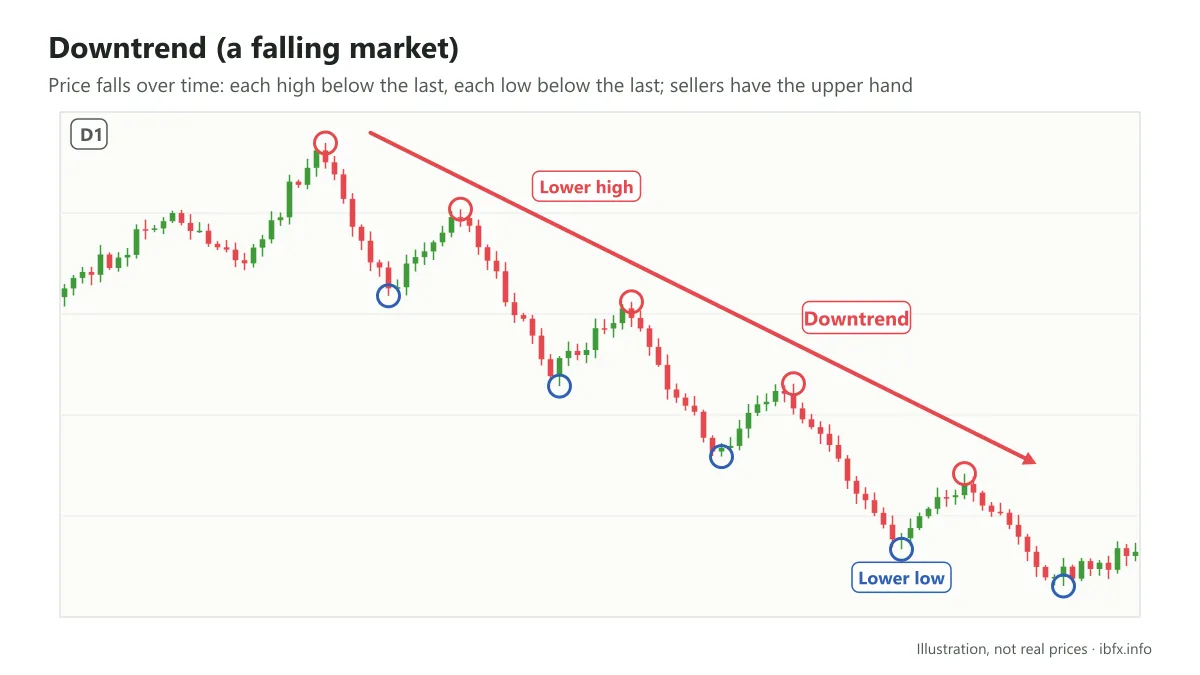
A downtrend on the Daily time frame.
3. A sideways market
Unlike a rising market and a falling market, a sideways market is when price neither rises nor falls clearly and only swings inside a zone, which can be short-term or long-term.
A sideways market shows that buying and selling are close to balanced, and that investors are cautious and waiting for more information.
A sideways stretch usually shows up after a strong rise or a strong fall, as a pause the market cannot avoid.
In a sideways market, price goes up and down between the 2 levels of support and resistance, so some traders buy at support and sell at resistance. The range is usually narrow, though, the profit on each trade is small and false breakouts happen often, so beginners need to be careful. Read more: what a sideways market is.
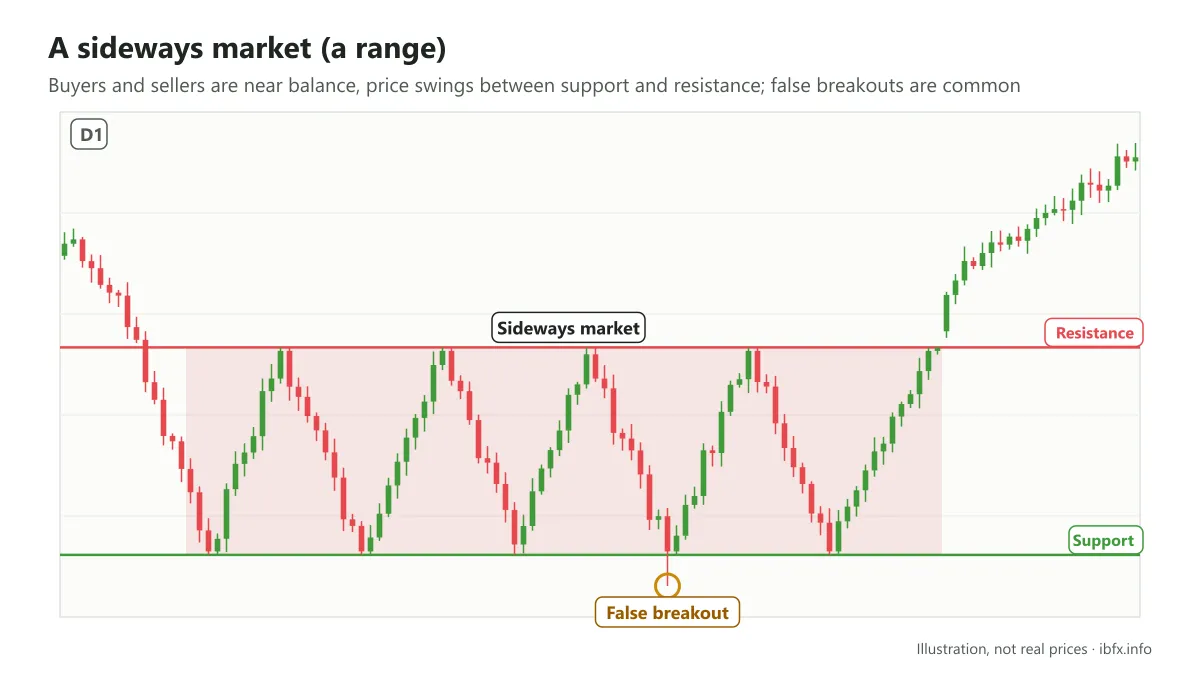
A sideways market is one that moves sideways over time between the 2 zones of support and resistance.
Getting a grip on the market trend helps us trade against the trend less often and be ruled by our emotions less, which matters most for small retail investors. Read more: what a trend is, and how to identify the market trend.
The market trend is also often affected by economic and geopolitical news: whenever important events are announced, price can move sharply and change the short-term trend of the currency market.