On this page
A stop loss, like spread, pip, lot or commission, is one of those basic but very important terms in forex trading. A stop loss is treated as one of the risk management tools you cannot do without, and yet plenty of traders make light of it or “deliberately” leave it off. There is no exact statistic for it, but trading without a stop loss is one of the most common reasons a trader blows up an account.
So, what is a stop loss? How important is it, that it should decide whether you succeed or fail? And how do you set a stop loss well in forex? Let us go through it together in this article.
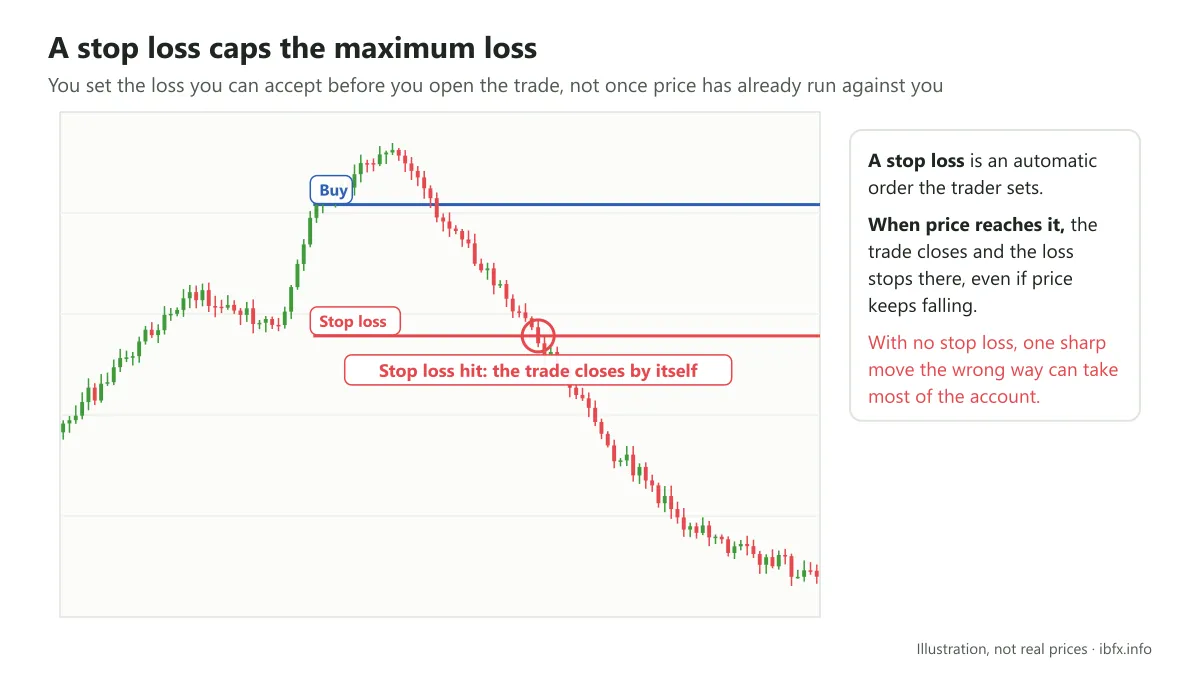
What is a stop loss? Why set one when you trade forex?
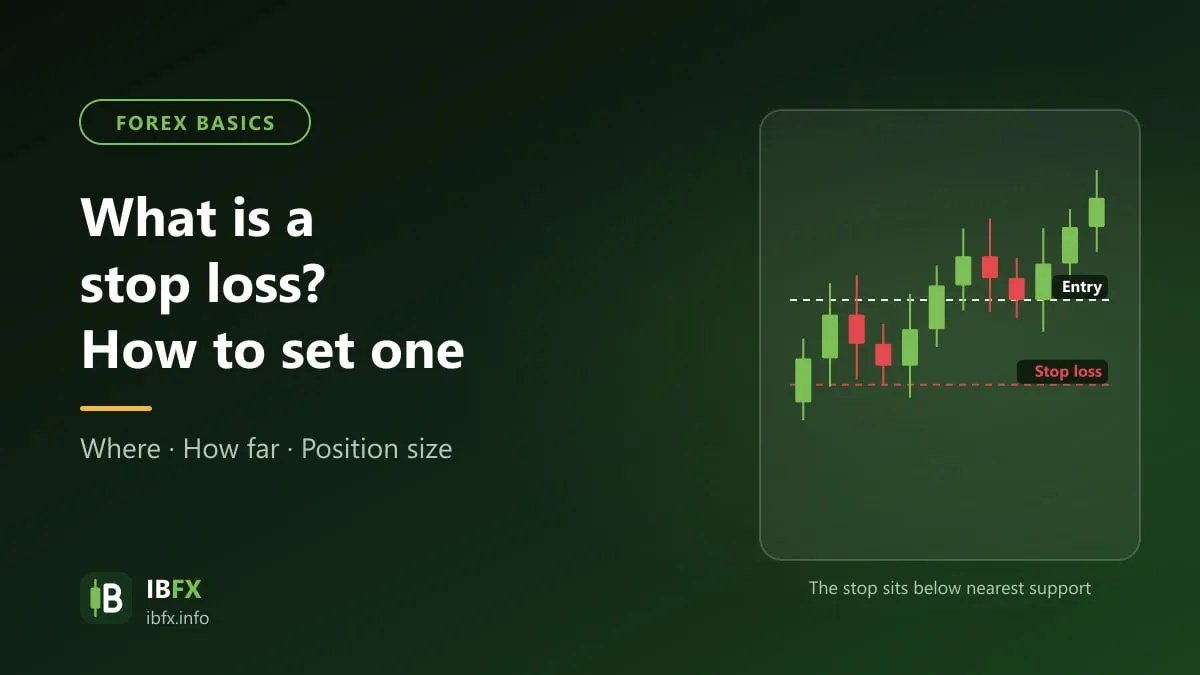
A stop loss is an automatic order to stop or cut a loss, set by the trader (though nothing forces you to set it) on their own trades, in order to cap the loss at a maximum level decided in advance when the market goes the other way from what was expected.
Put more plainly, a stop loss is a specific price, and if the market moves against the trade and reaches it, your trade is closed automatically, the trading software works out the loss, and the money comes straight off your balance.
On a Buy, the stop loss is a price set below (that is, lower than) the fill price. On a Sell, the other way around: the stop loss is set at a price above (higher than) the fill price.
Note: a stop loss does not ensure the trade is closed at exactly the price you set. When price jumps hard (a gap at the start of the week, or a news release), the order is filled at the next price available and the loss can be bigger than you planned. That is called slippage. See What is slippage?
Example: you Buy 1 lot of EUR/USD at a price of 1.22800 and set the stop loss about 50 pips away, at a price of 1.22300. Price goes the other way: instead of rising as expected it falls to 1.22300, and your trade is closed automatically. On this trade you lose 50 pips, that is 500 USD, and the money comes straight off your balance.
What is the real reason for setting a stop loss?
Why do you set a stop loss?
The first reason has to do with how much risk you can take. Trading forex is risky in itself, but we still do not want to lose too much on one trade when we read the direction wrong. When the market moves very hard and there is no stop loss, your account can easily blow up, never mind simply losing more than you meant to. So you set a stop loss to keep the loss around “that much” in normal conditions (when price jumps hard, the loss can be larger because of slippage).
The second reason has to do with your trading system, and that is also what a stop loss really means. When the market goes against your read and reaches a certain price, you decide to stop the trade with a stop loss order at that price. So the question is: why not hold on a little longer, in case price turns around and goes the way you first expected, why not be more patient?
The problem is this: what are you basing it on when you claim price will reverse and go your way right afterwards? Once you have decided to stop when price reaches the stop loss, that means you are convinced it will no longer go the way you predicted, everything you analyzed beforehand was wrong, and your trading system is not working in this case. The stop loss is what tells you that your read was wrong, that you should stop and accept a loss for being wrong.
Why traders do not set a stop loss
Setting a stop loss matters enormously, and yet plenty of traders make light of it and deliberately skip it. So what are the reasons?
- First, they have never heard of the term stop loss.
This is probably the maddest reason of all the reasons a trader does not set a stop loss on their trades. Even if you are a new trader who has never traded before, once you start reading about the market you cannot avoid coming across the stop loss. It is always near the top of the list of basic terms on the foreign exchange market.
- Second, they do not know how to set a stop loss.
This reason only applies to traders who have not seriously read about forex and about how to trade it. Every trading strategy suggested on the market by professional traders and experienced people, the kind you come across on forums and forex websites, sets out the full sequence of steps, including how to set the stop loss and the take profit for that strategy. Of course, we are leaving aside the complicated strategies, where the market makes a trend so obvious that no important price zone appears for you to put a stop loss on. But if you do not have the experience, you can simply not trade, rather than open a position without knowing where the stop loss goes.
- Third, they do not want to be stopped out
You have to answer for yourself why your trades get stopped out. Either you read the direction wrong in the first place, or you picked the wrong stop loss level, so the trade was stopped out before price went the way you expected. Being stopped out once or twice may not frighten you, but if it keeps happening and nearly every trade you open ends that way, you need to look again at your trading system and at your own analysis.
As for the losses that come from being stopped out, that is simply the risk you have to accept when you trade forex. If you do not want to lose money, you have plenty of other choices, such as a bank deposit or buying bonds. Do not waste your time on forex.
- Fourth, they want to close the trade themselves once the loss reaches the level they allow
You can certainly do that, but answer 2 questions for me:
- Are you sure you will close the trade in time to keep the loss within what you allow?
- For you, how much is an acceptable loss?
On the first question, it is almost certain you will struggle to do it. Suppose you open a Buy on EUR/USD, set no stop loss and plan to close the trade when you are 50 pips down. Without a stop loss you have to sit and watch continuously, so that the moment price is 50 pips lower you can close straight away. There are 3 reasons you will not manage it.
One: can you be sure nothing urgent will come up while you are trading, and that after you fetch a glass of water or go to the bathroom price will still be moving normally rather than 100 pips lower the moment you come back? Two: when price is nearly 50 pips down and you are ready to close, a few seconds later price suddenly drops hard and you cannot react in time. The market moves unpredictably and we cannot control it without working things out beforehand. Three: even if you close the trade exactly as price goes 50 pips down, the figure can still come out different because of order latency or a high spread, and that depends very much on your forex broker.
On the second question: how much loss is enough? You plan to lose 50 pips at most on this trade, but when the loss is close to 50 pips, will you have the presence of mind to close it as planned? Or will you tell yourself that if you close now and the market turns back up, what then, so perhaps hold on a little longer, and maybe you can win this loss back. That state of mind makes it easy to hold the trade instead of following your original plan, and if you are lucky price turns back up; if not, you lose more. Then on your next trades you fall into the same situation again, and the loss you consider acceptable keeps going up every time you do not set a stop loss.
One fact that sounds like a paradox: professional traders are extremely strict about setting their stop loss and treat it as an essential part of any trading plan of theirs. New traders, by contrast, make very light of it and break the rule all the time. And that is also one of the main reasons most new traders lose money when they start trading forex.
How to set a stop loss in forex trading
Traders usually have 2 ways of setting a stop loss: setting it after working out the position size, and setting it before working out the position size.
With the first way, traders usually pick the entry point, then work out the position size (it can be based on a percentage of the account balance). Next, the trader decides the maximum amount of money they are prepared to lose on this trade, and from that works out where the stop loss and the take profit go. The last step is to open the trade.
In truth, we do not encourage you to set a stop loss this way. Setting the stop loss after working out the position size means the stop loss no longer carries the meaning it is supposed to have.
Example: you Buy 1 lot of EUR/USD at a price of 1.22800. On this trade you accept a maximum loss of 100 USD, which works out at 10 pips. From that number of pips you conclude that the stop loss goes at a price of 1.22700. However, your trading system says that 1.22500 is a strong support level that price will struggle to break below; if it does break below, price will most likely carry on falling rather than come back up as you expected. Given that analysis, the ideal stop loss should sit at a price of 1.22500, but you put the stop loss at 1.22700 to fit the position size and the loss you decided on beforehand, so your trade is at risk of being stopped out early. At that point the stop loss no longer carries its proper meaning, which is that reaching it shows your trading system was wrong. In this situation your trading system was not wrong, you set the stop loss wrong.
So, to give the stop loss its proper meaning, you have to pick the stop loss level first, from your trading system, and only then work out the position size from that stop loss level and the maximum loss you accept on the trade.
The trading routine goes like this:
- Pick the entry point from your trading system
- Pick where the stop loss and the take profit go, from your trading system
- Decide the maximum loss you can accept on the trade
- Work out the position size
- Open the trade
To describe this routine in detail, we will look at a specific example on AUD/USD on the D1 timeframe.
After a strong rally beforehand, the market starts a downtrend, as shown by price making lower highs and lower lows one after another with no sign yet of turning back up. The plan here is to Sell with the trend to look for a profit.
Step 1: pick the entry point
Use the Fibonacci Retracement to find the entry point. Take the most recent leg down and expect that when price rallies to the FR 0.618 retracement it will turn back down and continue the downtrend.
Wait until price has just reached the FR 0.618 level, then Sell. The entry price is 0.78119.
Step 2: pick the stop loss and the take profit
Where the stop loss goes depends on each trading system and on current market conditions, but as a rule, in a trend with clear legs up and down, the stop loss goes at the nearest high or low, which is also a strong support or resistance level: once price has broken through those levels the trend is broken too, price will most likely carry on in the direction of the break, and at that point everything you predicted was wrong.
Or, if your trading system uses price patterns to enter, each price pattern has its own place for the stop loss.
In this situation you can put the stop loss above the most recent high of the downtrend, because once price goes past that high the downtrend may well be broken. The stop loss is set at a price of 0.79876. That makes the maximum loss on this trade 175.7 pips.
Use the Fibonacci Extension to set the profit target. You can put the take profit at FE 1.0, FE 1.382 or FE 1.5; in this situation we will choose FE 1.382. That take profit sits at a price of 0.74357, and the profit target of the trade is 376.2 pips.
The reason you should pick the likely take profit beforehand is so you can work out the Risk:Reward ratio. The R:R ratio has to be looked at together with the win rate of the system: a system that wins only 40% of its trades needs an R:R greater than 1:1.5 to make money (before costs). For this example we only open a trade when the R:R is 1:2 or better. How to calculate R:R, the win rate you need to break even and the effect of trading costs are covered in What is the R:R ratio?.
The R:R here is 175.7:376.2 = 1:2.14, so you can open the trade.
Step 3: decide the maximum loss on the trade
For this step you use a money management rule, for instance the 2% money management rule, to set the maximum loss for the trade.
Suppose your account has a balance of 15,000 USD and you use the 2% money management rule, so you only allow the account to lose 2% of the balance at most on this trade. That makes the maximum loss on the trade 300 USD.
Step 4: work out the position size
The maximum loss is 300 USD, the stop loss is 175.7 pips, and each pip of 1 lot of AUD/USD is worth 10 USD, so the position size = 300 / (175.7 × 10) ≈ 0.171, rounded down to 0.17 lots.
You can work out the position size from this formula:
Loss = position size (lots) * standard lot unit * number of pips lost * pip value per 1 unit of currency.
Where:
- The loss is the 300 USD
- The standard lot unit for currency pairs is 100,000
- The number of pips lost is 175.7 pips
- The pip value per 1 unit of currency on AUD/USD is 0.0001 USD.
Read again: What is a pip? How to calculate the value of a pip in forex.
Step 5: open the trade
Once every figure is worked out, Sell 0.17 lots of AUD/USD when price reaches the FR 0.618 level, or use a Sell Limit order to be filled more precisely at a price of 0.78119. Stop loss 175.7 pips at a price of 0.79876, take profit 376.2 pips at a price of 0.74357.
Let us look at how this trade turned out.
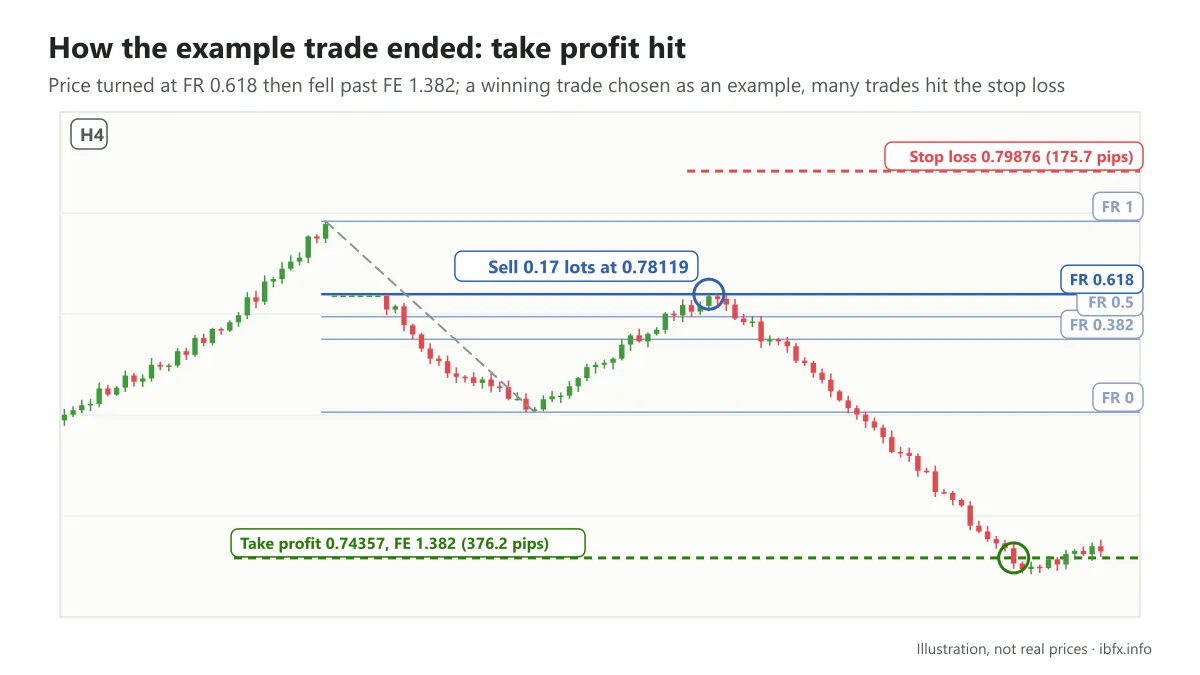
Price did indeed turn around at the FR 0.618 level and fall past the FE 1.382 level. On this trade you have a profit of 376.2 pips = 639.54 USD. This is an example of a winning trade; in practice many trades will reach the stop loss, so the position size on each trade has to be small enough for the account to take a run of losing trades.
Common mistakes when setting a stop loss
- Setting the stop loss too close
If your trading system gives you a place for the stop loss but that place looks too close to the entry, you need to look again or widen the stop loss a little (and work out the position size again so the money at risk does not change), because a stop loss set too close makes it easy for the trade to be stopped out before price properly goes the way you expected, even though a nearer stop loss does mean a smaller loss.
Example: AUD/USD on the H4 timeframe
After the uptrend ends, the market starts a downtrend. At the moment in question a Bearish Reversal Pin Bar appears, signaling a turn down. You Sell as soon as that candle closes, at a price of 0.77445.
Normally you would put the stop loss above the nearest high of the trend, at a price of 0.77903. That stop loss sits 45.8 pips from the entry. In practice that distance looks rather close, and there is a high chance price reaches it before falling as expected.
To check this, look at the same pair on a higher timeframe, D1.
On the D1 chart you can see the distance between the Stop Loss and the Sell Entry more clearly. You are selling at a place fairly close to the high of the downtrend that has just formed, so in this situation the strongest barrier is the price zone at that highest high, while at lower levels price can perfectly well reach them before returning to the main trend. So here you can widen the stop loss above the highest high of the downtrend, at a price of 0.78232, which puts the stop loss 78.7 pips from the entry, a distance that looks safer than the old one.
- Setting the stop loss too far away
Setting the stop loss too far away feels more reassuring, because you think the trade is less likely to be stopped out. However, if your read is wrong or your trading system has a problem, the stop loss will be reached however far away it is. A very distant stop loss combined with a large position size can also get the account stopped out before price reaches the stop loss; see margin, margin call and stop out.
- Moving the stop loss
Once you have a trading system and a promising trade signal, you should stick to it absolutely and not break the rules. A trading system points out the right place for your stop loss, and you have to put the stop loss exactly there to keep its meaning, except when the stop loss is too close to or too far from the entry, in which case you should think again or look for another option that still suits your strategy, rather than change it carelessly and with no basis.
Many traders move the stop loss while the trade is running. When they see price going against them and about to reach the stop loss, they tend to widen it a little in the hope that price will turn, but if price still does not go their way, widening the stop loss only makes the loss bigger. Or when they see price going the way they expected, they often move the stop loss closer to the entry to limit the loss, or even past the entry to lock in part of the profit (a trailing stop order on MT4 does this automatically). There is nothing wrong with that, and it is one way of limiting risk; however, nobody knows for sure whether price will turn, so move the stop loss by a rule already in your plan (below the nearest low that has just formed, for instance) and not by how you feel.
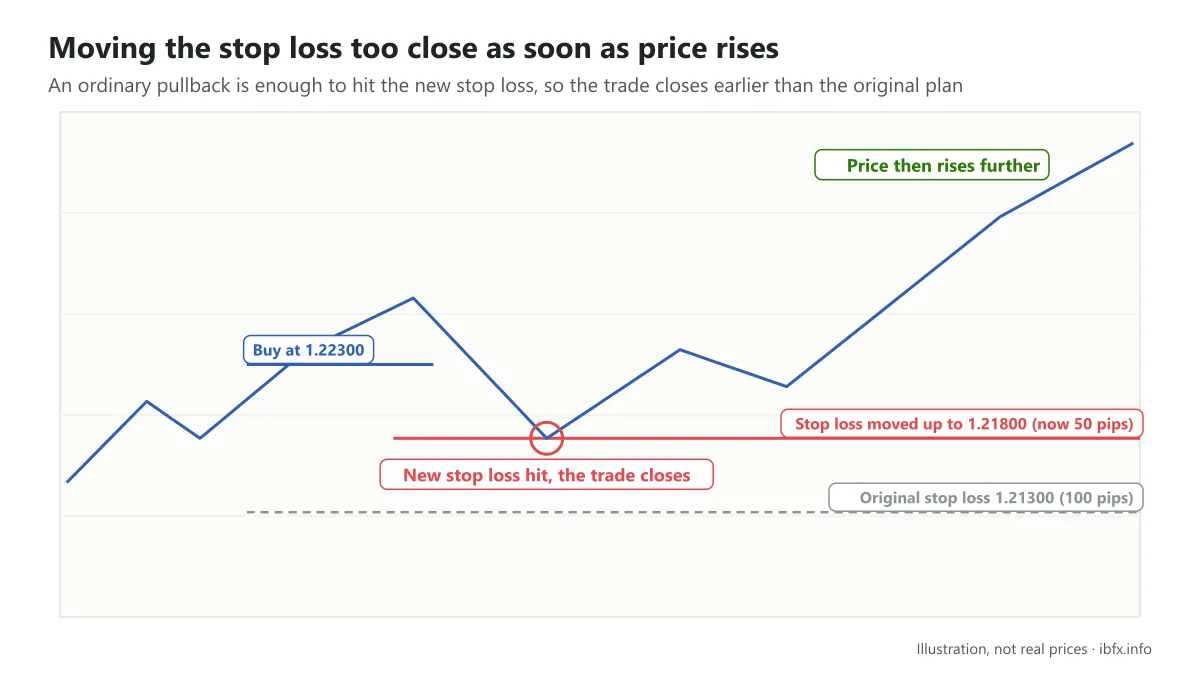
Example: you Buy EUR/USD at a price of 1.22300 with a stop loss 100 pips away, at a price of 1.21300.
- When price rises above 1.22300, you move the stop loss closer, to only 50 pips away, at a price of 1.21800. But if price then turns down, reaches 1.21800 and afterwards goes back up as you expected, your trade has been stopped out earlier than it would have been at the original stop loss.
- When price rises above 1.22300 and gains another 100 pips, you move the stop loss 50 pips above the entry, to a price of 1.22800, to lock in part of the profit. But if price then drops suddenly, reaches the new stop loss, and afterwards turns and rises strongly to a price of 1.32300 (1000 pips above the entry), your trade has been closed and you still have a profit of 50 pips. Had you kept the original stop loss, you could have had a profit of 1000 pips.
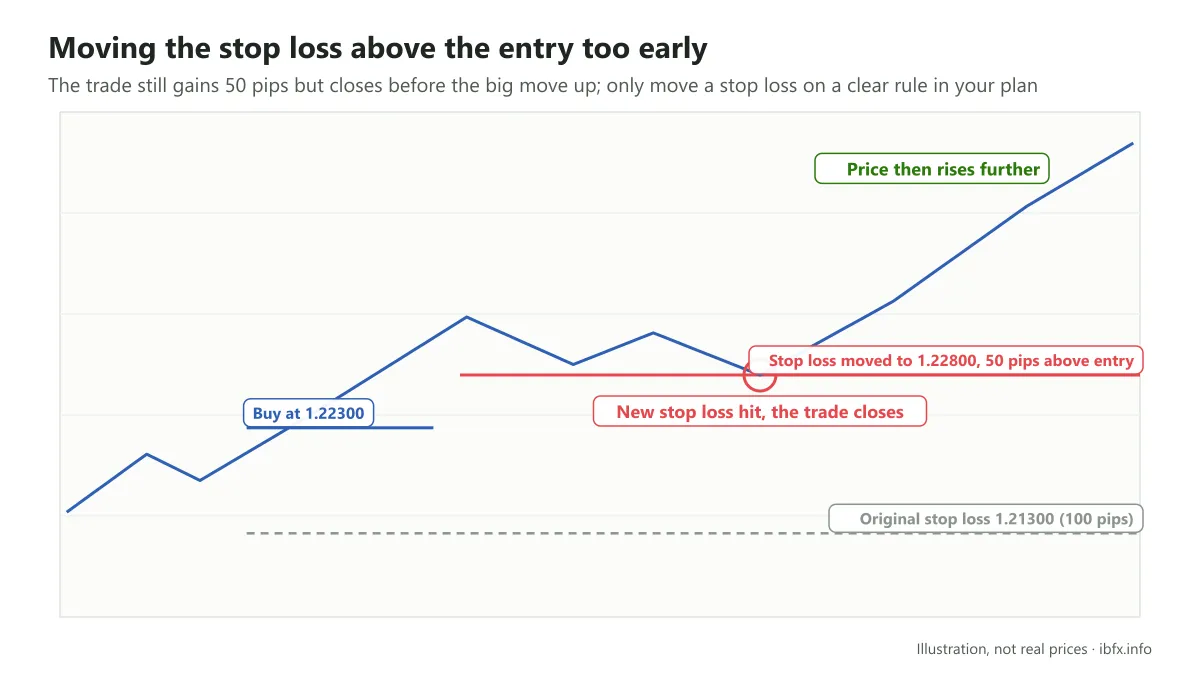
Trust your own trading plan, and only change it when you have a clear basis for it.
If you do not yet know how to set and change a stop loss in the MT4 software, see this article on ibfx.info: A detailed guide to using the MT4 trading platform.
Conclusion
The heart of the matter is still that you have to see for yourself how much setting a stop loss matters in forex trading; as for how to set a stop loss well, you will gradually build up your own experience and your own approach through practice, real trading and study. If you do not, then even once you have learned to set a stop loss well you can still break the rule at any time.
Always remember that professional traders treat setting a stop loss as an unbreakable rule. And you, as a new trader, should you make light of this rule and skip it?