On this page
- What is an ETF (an Exchange Traded Fund)? The features of an ETF
- How the ETF came about
- How does an ETF work? How does it differ from a mutual fund?
- The most common kinds of ETF today
- Should you invest in ETFs? The 10 largest ETFs today
- How do you buy an ETF?
- A summary of the advantages and drawbacks of an ETF
When trading forex, traders usually pay attention mostly to the major currency pairs, shares, metals (gold or silver), energy and cryptocurrencies, and take little notice of another product: the ETF, or exchange traded fund.
The ETF is one of the fastest growing investment products of the past few decades, giving a small investor access to a whole basket of assets at low cost. So what is an ETF? How does an ETF work, and what are the most common kinds of Exchange Traded Fund today?
What is an ETF (an Exchange Traded Fund)? The features of an ETF
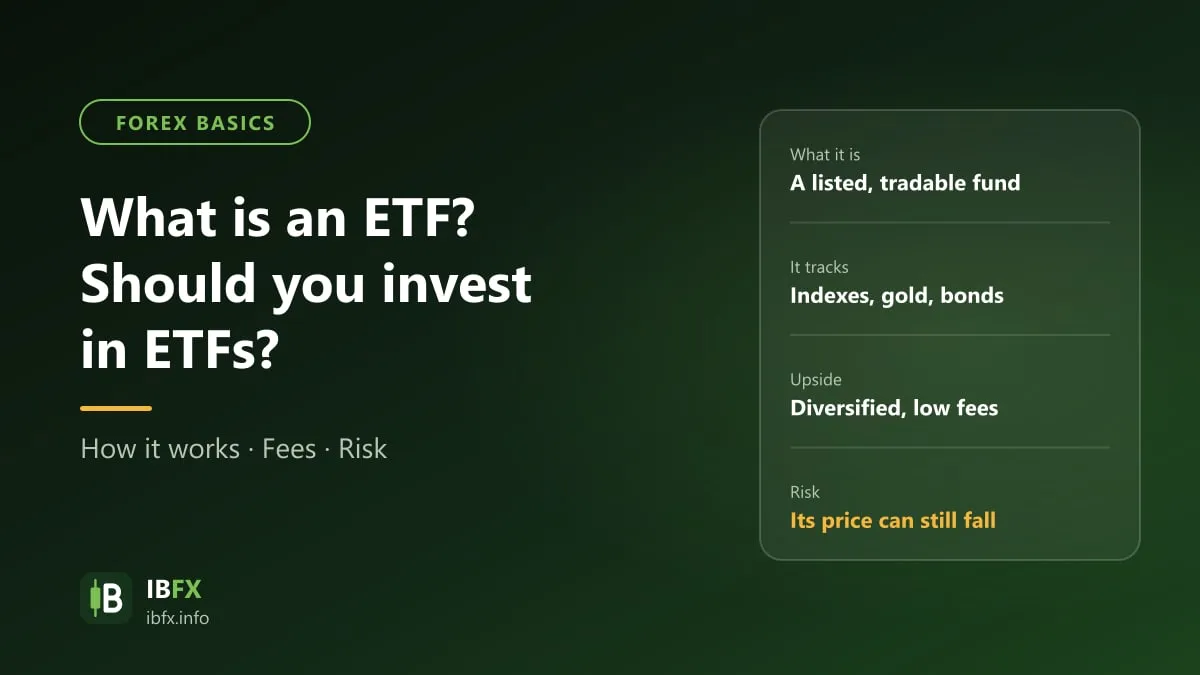
ETF is short for Exchange Traded Fund, a basket of securities used to track an index representing a class of asset, an industry, a sector, a country or one particular region.
An ETF is a combination of an open-ended mutual fund and a security. So instead of buying one individual share, with an ETF a trader buys a whole group of shares in one particular field. You can therefore see an ETF as a combined form of investment that brings variety to the market. And investing in an ETF means you are trading a pooled class of asset, which could be shares from the United Kingdom, or Chinese technology shares, or high-yield bonds, or spot bullion. In particular, with its low cost an ETF really is very easy to buy and sell.
The features of an ETF
- Trading an ETF is similar to trading an individual share, so an ETF is bought and sold at a real-time price during the trading hours of the stock exchange.
- Most of the largest ETFs today are funds that track representative indices such as the S&P 500.
- Who can take part: anyone, including a small retail trader, can take part in trading ETFs
- They can be traded as a CFD: an ETF is a fund unit listed on a stock exchange. Some forex brokers offer CFDs based on the price of an ETF: in that case you do not own the fund units, and the trade has leverage, a spread and an overnight fee like any other CFD.
- Liquidity: because they track the value of an industry, a sector and so on, some ETFs are liquid and some lack liquidity.
How the ETF came about
The ETF grew out of the index funds that appeared in the 1970s. The first product of the ETF kind is taken to be Toronto Index Participation Shares (TIPs), listed in Canada in 1990; it was not until 1993 that the SPDR S&P 500 fund (ticker SPY), developed by Nathan Most and his colleagues at the AMEX exchange, launched in the United States.
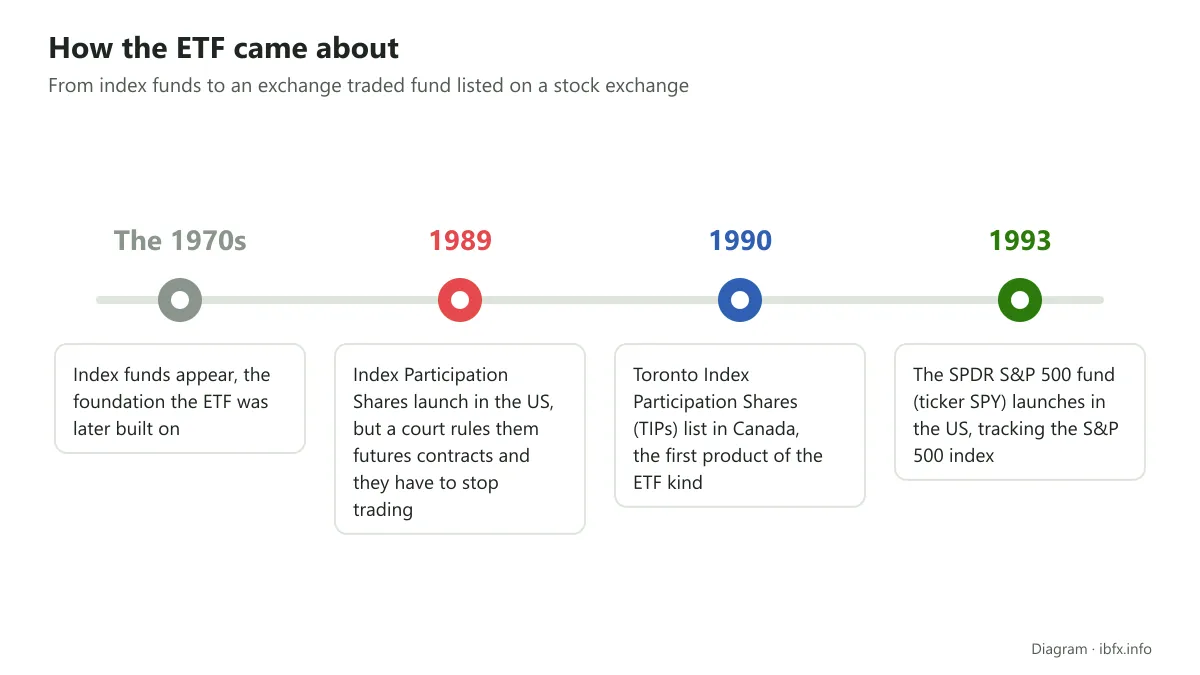
Before that, in 1989, a product called Index Participation Shares had launched in the United States, but a federal court in Chicago ruled it a futures contract and it had to stop trading on the stock exchange. That is why a product of the ETF kind appeared in Canada first.
By 1993: ETFs began to trade officially in the United States, tracking the S&P 500 index.
1996: Morgan Stanley launched WEBS (World Equity Benchmark Shares), tracking the MSCI indices of individual countries, managed by Barclays Global Investors; in 2000 these funds were renamed iShares MSCI. Thanks to WEBS, American investors gained easy access to foreign stock markets.
1998–1999: sector ETFs (the Select Sector SPDRs) launched, along with ETFs on the Dow Jones index (DIA, in 1998) and the Nasdaq-100 (QQQ, in 1999).
2001: beyond the AMEX exchange, the 3 ETFs tracking the S&P 500, Dow Jones and Nasdaq-100 indices began trading on the NYSE.
2002: the first bond ETFs launched in the United States.
2004: the first listed commodity ETF in the United States was created, allowing gold to be traded.
2008: the SEC (the US Securities and Exchange Commission) approved the first actively managed ETFs.
2010: target-maturity bond ETFs launched: funds that hold bonds maturing in the same year and wind themselves up when that date arrives.
2019: ETFs listed in the United States reached 4,000 billion USD, and the assets (AUM) of bond ETFs worldwide passed 1,000 billion USD.
How does an ETF work? How does it differ from a mutual fund?
How an ETF works
An ETF is bought and sold during the day, within particular hours, and has a ticker just like a share.
Unlike a share, the number of ETF units in issue can change daily, because the fund continually issues more units or buys units back in order to keep the ETF price close to the value of the underlying basket of assets.
Although individual investors buy and sell ETFs on the exchange, it is the large institutions (the authorized participants) that play the important role in maintaining liquidity and watching over the integrity of the ETF, through buying and selling in enormous size to make up the underlying basket of securities.
When the price of the ETF drifts away from the value of the assets, institutions use the arbitrage mechanism the creation unit provides to bring the ETF price back in line with the value of the underlying assets.
How does an ETF differ from a mutual fund?
Fundamentally, an ETF works like a mutual fund, a form of collective investment made up of money from many different investors and used to buy securities. A mutual fund is therefore usually seen as a kind of “investment company” where traders can buy or sell fund shares at any time.
For that reason a mutual fund has a good deal in common with an ETF. Even so, they still differ in a number of ways:
Many mutual funds are actively managed: the fund manager picks the shares in an attempt to beat the market. Most ETFs, on the other hand, are passively managed, that is they simply track an index such as the S&P 500 or a US bond index. That said, there are still mutual funds that track an index and ETFs that are actively managed.
Unlike a mutual fund, which is usually priced once a day, an ETF can be bought and sold all day long just like an individual share. You can buy at 10 in the morning, sell at 11 and buy back after lunch if you want.
Because it is listed on an exchange like a share (Exchange Traded Fund means a fund traded on an exchange), an ETF can use the same kinds of order as a share: limit orders and stop loss orders; in some markets, such as the United States, it can also be sold short or bought on margin. A mutual fund cannot do any of that. In Vietnam, individual investors are not at present allowed to sell short.
On top of that, many analysts hold that an ETF usually has the advantage of lower management costs than a traditional mutual fund.
So if you want to invest in a whole industry or a whole market but have only a small amount of capital, not enough to buy many individual shares, an ETF is worth considering. If that industry does well, the ETF rises with it; the other way round, if the whole industry slumps then the ETF falls too, and there is nothing to guarantee you a profit.
The most common kinds of ETF today
As we said earlier, an ETF can be traded much like an individual share, but with demand and development ETFs have widened more and more, and have been created to add income, to speculate, to gain from a rise and to hedge or offset part of the risk in a portfolio. Some of the most typical kinds of ETF today are:
- Bond ETFs: covering government bonds, corporate bonds and municipal bonds
- Industry ETFs: tracking one particular industry, such as technology, banking or the oil and gas sector.
- Commodity ETFs: designed to track the price of a commodity, such as gold, oil, corn, soybeans or coffee.
- Currency ETFs: investing in foreign currencies such as the euro or the Canadian dollar.
- Market ETFs: designed to track one particular index such as the S&P 500 or the NASDAQ
- Foreign market ETFs: used to track markets outside the United States, such as Japan’s Nikkei index or Hong Kong’s Hang Seng index
- Inverse ETFs and leveraged ETFs: these rise when the index falls, or move 2–3 times as much as the index over one day. These funds are designed to be held for a short time; held for long, the result can drift a long way from what you expected.
- Alternative investment ETFs: an inventive kind of ETF that gives a trader access to one particular investment strategy.
Should you invest in ETFs? The 10 largest ETFs today
You can see that ETFs really are attractive to many people: compared with mutual funds, the large index ETFs have very low expense ratios — usually only a few USD to a few tens of USD a year for every 10,000 dollars invested.
Most ETFs are passive funds: the portfolio is set by an existing index, rather than paying a manager to go looking for the best shares. The aim of a passive ETF is to follow the performance of the index closely, not to beat it.
Another benefit is that many stock brokerages in the United States have stopped charging commission on ETF trades. Note: a CFD based on the price of an ETF at a forex broker is not a real ETF, and still carries a spread and an overnight fee.
Perhaps because they are flexible and cheap, ETFs have grown a great deal stronger over the 20 years they have been developing. Look at the chart below to see clearly how ETFs have grown year by year.
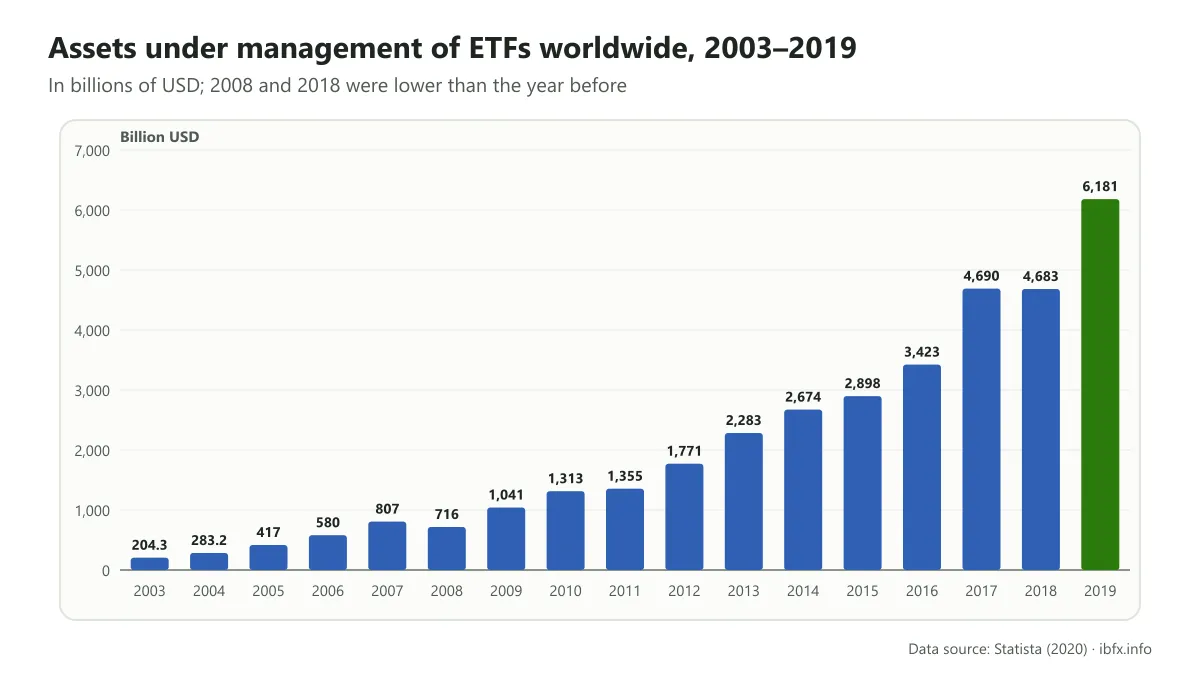
From 2003 to 2019, ETFs grew from 204 billion USD to 6,181 billion USD. As at June 2019 there were 7,850 ETFs worldwide, listed on 71 exchanges across 58 countries, according to figures from ETFGI. Those are 2019 figures; the scale of ETFs worldwide is a great deal larger by now.
From this you can see that the ETF is a very fast growing product. However, because the number of ETFs worldwide has reached nearly 8,000 different funds, it makes things difficult for a trader, who will not know which ETF to invest in to have a good chance of a profit, and as we said earlier, some ETFs are liquid and some are not. Finding good quality ETFs therefore helps a trader a great deal in investing.
For reference, the 10 largest ETFs by total assets at the time of writing (old figures; the ranking has changed: in 2025, VOO passed SPY to become the largest ETF):
| Ticker | Name | Total assets under management (AUM), in thousands of USD | Average trading volume (fund units a day) |
|---|---|---|---|
| SPY | SPDR S&P 500 ETF | $290,672,951.77 | 67,241,656 |
| IVV | iShares Core S&P 500 ETF | $212,989,665.34 | 3,326,965 |
| VTI | Vanguard Total Stock Market ETF | $161,857,601.69 | 2,930,856 |
| VOO | Vanguard S&P 500 ETF | $159,939,700.93 | 3,046,171 |
| QQQ | Invesco QQQ | $133,481,264.46 | 46,526,891 |
| AGG | iShares Core U.S. Aggregate Bond ETF | $80,921,313.21 | 6,095,491 |
| GLD | SPDR Gold Trust | $76,833,043.80 | 13,807,788 |
| VEA | Vanguard FTSE Developed Markets ETF | $74,867,419.42 | 8,644,967 |
| IEFA | iShares Core MSCI EAFE ETF | $71,611,410.90 | 7,631,567 |
| BND | Vanguard Total Bond Market ETF | $62,499,019.72 | 4,853,790 |
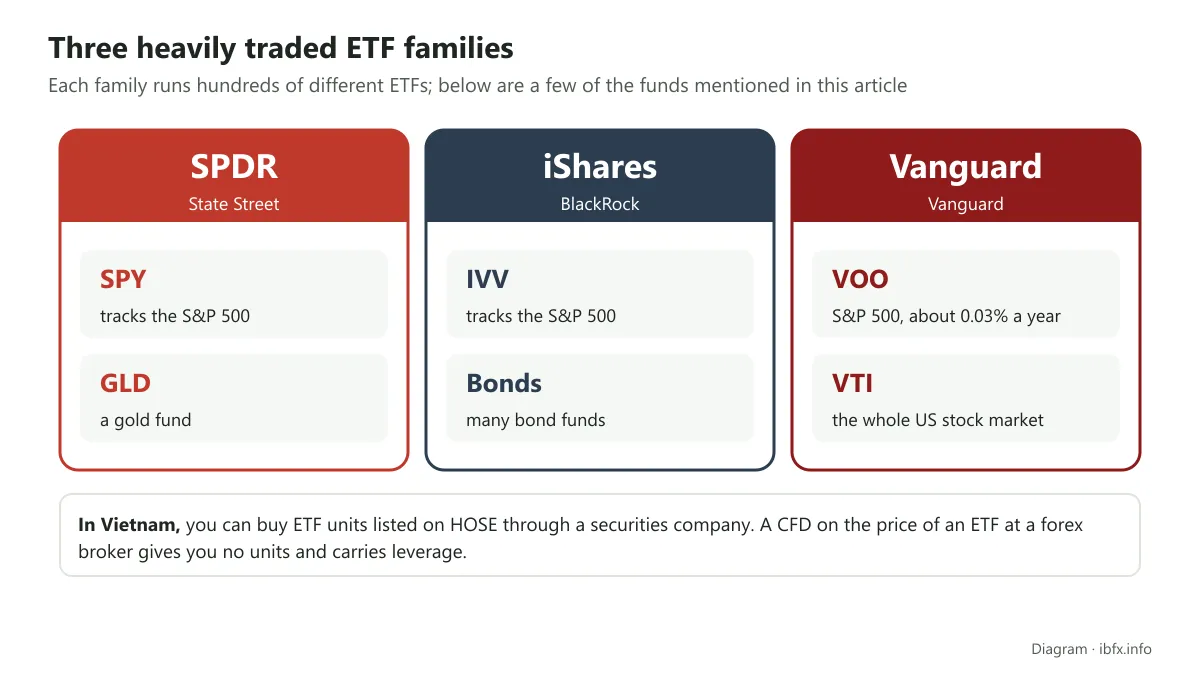
It is no surprise that the most heavily traded ETFs belong to the three fund families SPDR (State Street), iShares (BlackRock) and Vanguard. Each family has hundreds of different ETFs: SPDR has the SPY fund tracking the S&P 500 and the GLD gold fund, iShares has IVV tracking the S&P 500 along with many bond funds, and Vanguard has VOO tracking the S&P 500 and VTI tracking the whole US stock market.
Many gold traders follow the gold holdings of the SPDR Gold Trust (GLD), because that fund holds hundreds of tonnes of gold and changes in its holdings reflect the flow of investor money. Even so, this is only a piece of background information about market sentiment, not a short-term trading signal.
Vanguard is one of the two largest fund management companies in the world (along with BlackRock), and has been mentioned by the billionaire Warren Buffett himself.
Specifically, in his 2013 letter to shareholders (published early in 2014) he said that 10% of the money left to his wife should be invested in short-term government bonds and 90% in a low-cost S&P 500 index fund, and he suggested a Vanguard fund. Vanguard’s VOO ETF has an expense ratio of about 0.03% a year. An extremely low figure. Perhaps that is why Vanguard is always a name that draws attention from people who want to invest in exchange traded funds.
How do you buy an ETF?
As we said above, an ETF works much like an individual share: an individual investor buys and sells ETFs on the stock exchange through an account at a stock brokerage.
For example, some fund houses such as Vanguard have a brokerage of their own so that clients can buy their ETFs. Opening a securities account abroad, however, may not be easy, because of legal questions, money transfers and tax.
In Vietnam you can buy the units of ETFs listed on the HOSE exchange (funds tracking the VN30 or VNDiamond indices, for instance) through an account at a securities company, just as you would buy shares, and you are protected by law. Foreign forex brokers only provide CFDs based on the price of an ETF: you do not own the fund units, the trade has leverage, and it is not protected by Vietnamese law.
A summary of the advantages and drawbacks of an ETF
| Advantages | Drawbacks |
|---|---|
| Easy to trade — you can buy and sell at any time during trading hours, unlike a mutual fund, which trades at the end of the day. | The price of an ETF still falls when the market falls; an industry ETF concentrates on one industry, so if that whole industry runs into trouble the ETF is affected with it. |
| Expense ratios and commission — low, or zero, for the exchange and the broker. | A lack of liquidity gets in the way of trading. Some thinly traded ETFs have a large difference between the buying and the selling price, which means you buy at the high side of the spread and sell at the low side of it |
| Transparency — many ETFs track indices that are published daily. | Tracking error: although an ETF usually follows its index fairly well, costs and technical issues can still create a gap. |
| In the United States, ETFs usually have a tax advantage, because they distribute less in capital gains than mutual funds do. | Leveraged and inverse ETFs are easily misunderstood and are not suitable to hold for long. |
| Buying and selling works like a share — an investor can use various kinds of order (a limit order or a stop loss order, for instance), which is not possible with a mutual fund. |