On this page
- What is leverage? How margin and leverage are related
- How leverage works in forex trading
- Maximum leverage on the forex market
- The advantages and disadvantages of trading with leverage in forex
- How much leverage should you use in forex trading?
- How to avoid blowing up an account when trading with leverage
Leverage is a very familiar idea in corporate finance, where it is about using borrowed money in the running of a business in order to get the most profit out of it. In financial investing leverage matters just as much: this tool can help an investor make more money than the capital they put up, and in a short space of time, but it can also make all that capital disappear just as quickly. That is the two-sided nature of leverage.
In this article we will go through with you all the most basic points about leverage and about trading with leverage on the foreign exchange market.
What is leverage? How margin and leverage are related
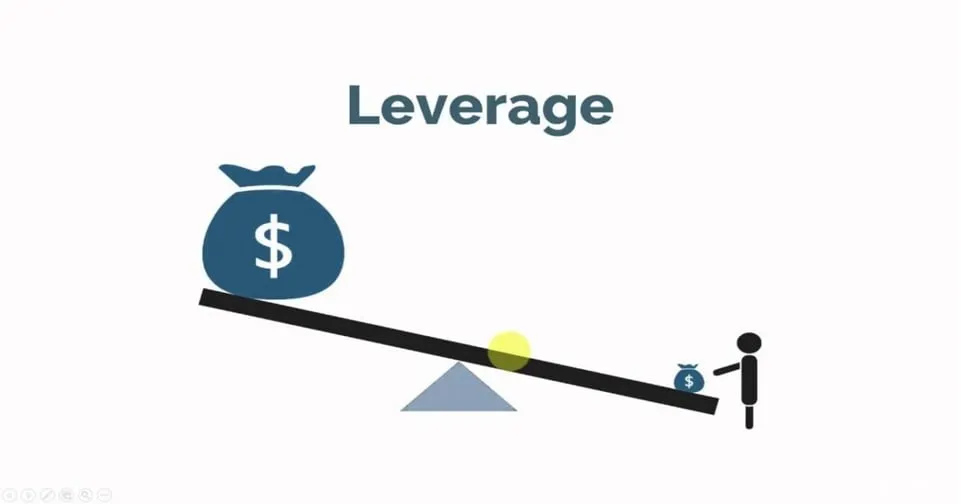
Leverage started out as a basic idea in physics, and when leverage comes up we think straight away of the famous line from Archimedes, the great mathematician and physicist: “Give me a place to stand and I will move the Earth”. In financial investing leverage keeps essentially the same nature: it lets a trader buy or sell financial assets with a trade value many times larger than the money in their account.
Example: with only 100 USD you can make trades worth as much as 200 USD, 500 USD, 1,000 USD and so on.
Leverage is also directly tied to another idea in financial investing: margin.
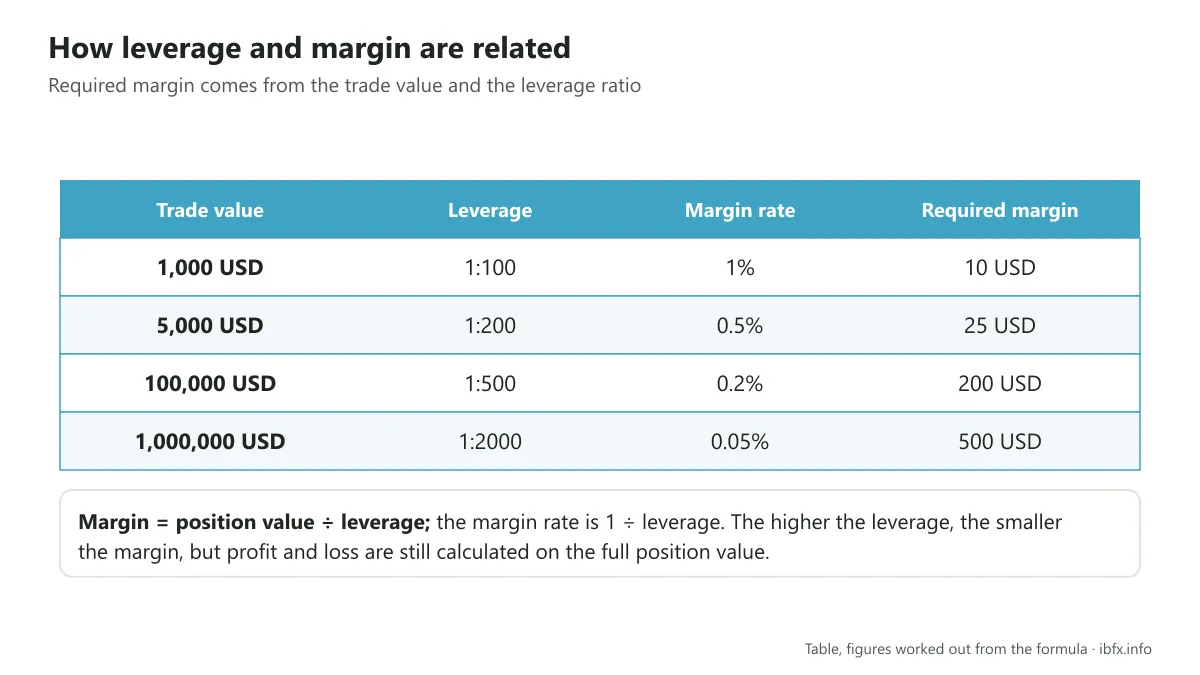
To use leverage in financial trades, an investor needs a minimum amount of money in the account, and that money is called margin. The formula: margin = position value / leverage ratio, so the higher the leverage, the lower the margin. How to calculate margin from the position size in lots, what margin level is, and when an account gets a margin call or a stop out are covered in What is margin?.
Example: to open a trade worth 1,000 USD, the minimum margin is 200 USD, so the remaining 800 USD is lent to you by the broker.
Leverage in financial investing is written as a ratio, such as 1:2, 1:5, 1:100, 1:500, 1:1000 and so on.
How the leverage ratio and margin are related
- Trading with leverage on the financial markets
On the stock market, trading with leverage means the investor borrows money from the securities firm to buy shares, and secures that loan with the very shares the investor holds.
Example: you have 100 million VND in your account at securities firm A, made up of 50 million VND in cash and a number of shares worth 50 million VND. Suppose firm A lends on margin at a ratio of 50% (that is leverage of 1:2, the common level in Vietnam), so you can borrow about another 100 million VND to buy shares and hold about 200 million VND in total. Your job is to pay the principal and the interest back to the securities firm, and margin interest in equities usually runs at about 10–15% a year (depending on the period and the firm), so an investor only uses leverage on this market when they see a good opportunity with a high chance of success.
In forex, a trader does not pay loan interest in that sense. When a position is held overnight, the account is charged or credited an overnight fee (swap), depending on the interest rate difference between the two currencies and on the markup the broker adds.
Another difference between trading with leverage in forex and in equities is that in forex the trader always uses leverage. The trade values on this market are very large, and without leverage you would have to have a very large amount of capital.
Position size in forex is measured in lots, and a trader is allowed to place an order with a minimum size of 0.01 lots.
Example: on USD/JPY, 1 lot = 100,000 USD. Suppose you only place a Buy of 0.01 lots; without leverage the margin you must have is 1,000 USD. That is far too much money for many individual traders. On top of that, profit in forex depends on how much price moves, measured in pips, and the value of a pip is very small, so if you only trade a small position size without leverage the profit will amount to very little against the capital you put up in the first place.
How leverage works in forex trading
We will look at how leverage works by comparing a trade with leverage and a trade without it.
Example: your account has a current balance of 2,000 USD.
- Case 1: no leverage
Suppose you buy 0.2 lots of USD/CAD. 0.2 lots = 20,000 USD, so the minimum margin for this trade is 20,000 USD, while your account only has 2,000 USD, and the order cannot be placed.
So you cut the position size to 0.01 lots = 1,000 USD, and the minimum margin is 1,000 USD.
If price rises and your trade wins 100 pips, the profit on the trade = position size x pips won x pip value = 1,000 x 100 x (0.0001/1.13200) = 8.83 USD, where 1.13200 is the USD/CAD rate when the trade is closed.
See also: What is a pip? How to calculate pips in forex trading.
If price falls and your trade loses 30 pips, the loss on the trade is 1,000 x 30 x (0.0001/1.11900) = 2.68 USD, where 1.11900 is the USD/CAD rate when the trade is closed.
- Case 2: with leverage
With the same 1,000 USD of margin but leverage of 1:100, the position size you can now trade is 1 lot.
If price rises and you win 100 pips, the profit on the trade is 100,000 x 100 x (0.0001/1.13200) = 883 USD.
The other way around, if price falls and you lose 30 pips, the loss on the trade is 100,000 x 30 x (0.0001/1.11900) = 268 USD.
Compared with trading without leverage, using leverage of 1:100 means that with the same 1,000 USD you trade a position worth 100 times as much, which multiplies the profit by 100 and at the same time, if the trade fails, multiplies the loss by 100 as well. Look at the figures: on a 2,000 USD account, a 1 lot trade losing 30 pips is already 268 USD gone, more than 13% of the account on a single trade; price running about 200 pips against you takes nearly the whole account.
The higher the leverage you use, the larger the profit, but the risk grows to match. That is exactly why leverage is always seen as a double-edged sword in financial investing.
Maximum leverage on the forex market
Trading on the forex market means you get to use leverage, but what ratio you use, and in which cases, depends on a number of different things.
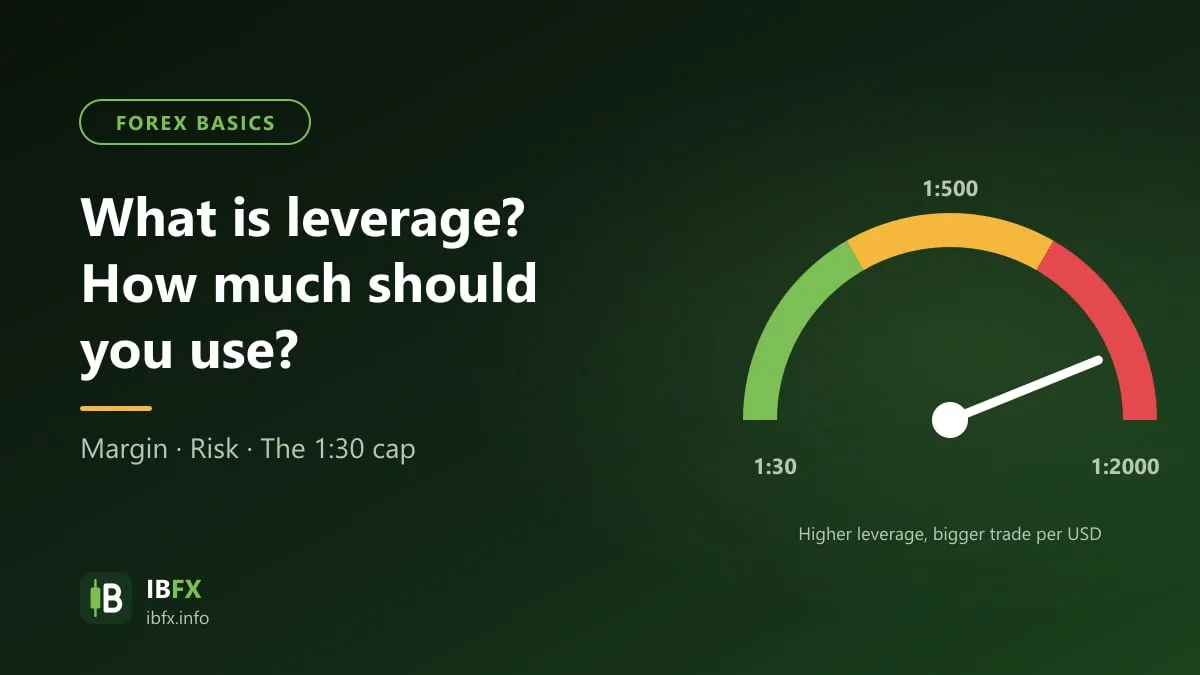
Every forex broker offers a certain maximum leverage, usually from 1:30 (for retail clients in the UK, the EU and Australia) up to 1:2000 or even “unlimited” at some offshore brokers. However, that ratio is not applied in every case: it depends on the account type, on the equity and on the product traded. You need to know each broker’s leverage policy well in order to choose the broker that fits what you need.
- The leverage ratio depends on the broker’s license
Brokers licensed by regulators such as the FCA (UK) or ASIC (Australia) are capped on the leverage they may offer to individual investors: both the FCA and ASIC allow a maximum of 1:30 on the major currency pairs (ASIC has applied this since March 2021), and lower on gold, indices, shares and cryptocurrencies.
CySEC (Cyprus) applies the EU-wide cap of 1:30 for retail clients. Ratios of 1:1000, 1:2000 or “unlimited” are only found at companies registered where regulation is loose, such as Seychelles, Saint Vincent and the Grenadines or Vanuatu. Higher leverage usually comes with weaker investor protection.
- The leverage ratio depends on the account type
Every forex broker offers different account types for different segments of customer, from new traders with little capital to experienced traders with a lot of it. Each account type has its own trading conditions, such as the spread, the commission, the minimum deposit, the minimum and maximum position size, and the leverage ratio too.
As a rule, standard accounts, or small accounts such as Micro, have a higher maximum leverage than Professional, Vip or Pro accounts. A professional account usually trades large sizes, so the broker caps the leverage to limit the risk to the broker itself. High leverage on small accounts, meanwhile, attracts new traders with little capital, but it also makes those accounts blow up faster; that is not a reason to use all the leverage you are given.
Example: one broker’s 2023 account table gave the Micro account a maximum leverage of 1:1000, the Premium account 1:500, and the PAMM and copy trading accounts only 1:300 to 1:400. These conditions change over time, so look at the account page of the broker you use.
- The leverage ratio depends on the product traded
Depending on the value of each type of asset on the market, the maximum leverage available on those assets also differs.
As a rule, forex, gold and indices are the products with the highest maximum leverage, and that is usually the maximum ratio applied to the trading account as well. Next come the other metals, commodities and energy. Last come shares, ETFs, cryptocurrencies and the like.
Example: an account with a maximum leverage of 1:500 may apply that 1:500 only to the major currency pairs, while gold and indices are 1:100, shares 1:20 and cryptocurrencies lower still.
- The leverage ratio depends on the equity
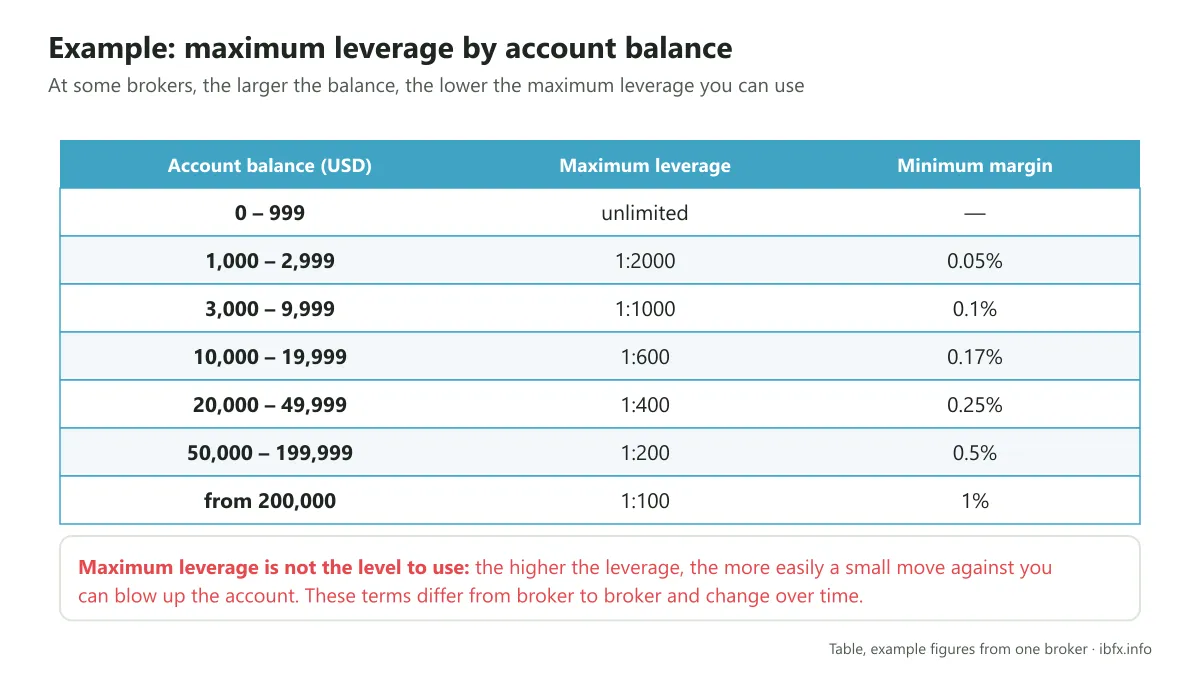
Every forex broker has its own rules on how leverage relates to equity: the larger the equity, the smaller the maximum leverage available, mainly so the broker limits its risk when a client’s positions are large.
Instead of equity, some brokers set the leverage ratio by the account Balance or by the Deposit paid into the account.
Example: a table of maximum leverage by account balance at one broker: the larger the balance, the lower the maximum leverage.
- The leverage ratio depends on the trading platform
This rule exists at only a few forex brokers and is not common.
Example: at some brokers, on the same account type, the maximum leverage on exotic currency pairs is 1:100 on the MT4 software and 1:200 on MT5.
- The leverage ratio depends on other trading conditions
This is another very unusual rule, found at only a few offshore brokers: the highest leverage is only opened up for accounts that have closed a certain number of trades or traded a certain volume.
The advantages and disadvantages of trading with leverage in forex
- Advantages
Getting the most profit out of a small amount of capital
This is the most obvious advantage of leverage. With a small amount of starting capital, an investor can trade positions worth many times more. It also means that instead of paying in full for a trade you only pay a small part of the trade’s value. So leverage is not only an advantage for the small trader with little capital: it is an extremely useful tool for professional traders too.
Low cost
Many traders think that to trade forex at all you need at least 1,000 USD. Thanks to leverage, many brokers let you open an account with just a few USD. But small capital does not mean small risk: with high leverage, a small account blows up very fast too.
- Disadvantages
The biggest disadvantage of leverage is the risk, the way it magnifies losses. However many times leverage multiplies your profit when a trade works out, it will multiply the loss by just as much when the trade fails. The higher the leverage ratio you use, the greater the risk.
How much leverage should you use in forex trading?
Given the nature of the foreign exchange market, the question is of course never “should I use leverage or not” but “how much leverage is sensible?”
First, if you cannot accept losing part or all of the money you have deposited, then whether the leverage is high or low, forex is not for you.
If you still want to take part, the leverage level should be based on your experience, your capital and the risk you can take, not on a profit target.
If you are a new trader with little capital and not much experience, you should use a low leverage ratio. That is how you get used to the market step by step and practice your methods and trading strategies at lower risk.
In forex trading there is no set standard for what counts as a high or a low leverage ratio. To someone with a low tolerance for risk, even 1:100 is far too high, while to someone with a high tolerance for risk 1:500 is still ordinary.
We class ratios of 1:500 and above as high leverage; a new trader should not set the account above 1:100. More important than the number set on the account is the effective leverage, that is the total value of the open positions divided by the capital: many risk management texts advise keeping that figure below 1:10.
Professional traders may use higher leverage on short-term trades, but they still cap the money at risk on each trade at a small percentage of capital, rather than using leverage to reach a profit target faster.
How to avoid blowing up an account when trading with leverage
- Always set a stop loss and a take profit
As you know, leverage multiplies the profit, but if the trade loses, the money lost goes up to match. Without a stop loss, will you close the trade in time when the market goes against your read, or will you hesitate and tell yourself it will soon come back?
If you are lucky you may turn the situation around; if not, you lose more money. A stop loss caps the loss at a fixed level, which limits the damage when price goes against your read and moves hard, leaving you no time to close the trade.
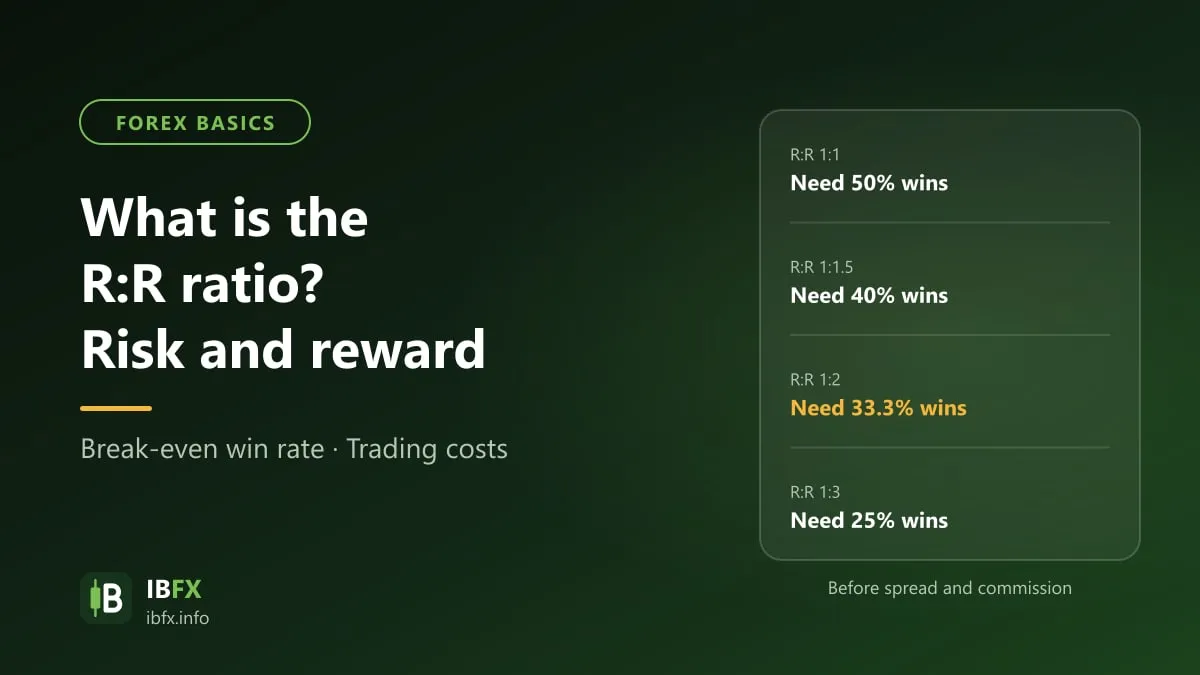
Set a profit target for each trade by placing a take profit. Be content with the profit you have made and do not try to “squeeze out a bit more”: the market will never satisfy anybody. Once the stop loss and the take profit are set, work out the R:R ratio to see what percentage of trades your way of trading needs to win just to break even.
- Use sensible leverage together with a suitable position size
Leverage lets you trade a position worth more than the capital in your account, but that does not mean you can happily place large orders. At a fixed leverage ratio, the larger the position size you trade, the larger the margin, the larger the profit, and the higher the risk too.
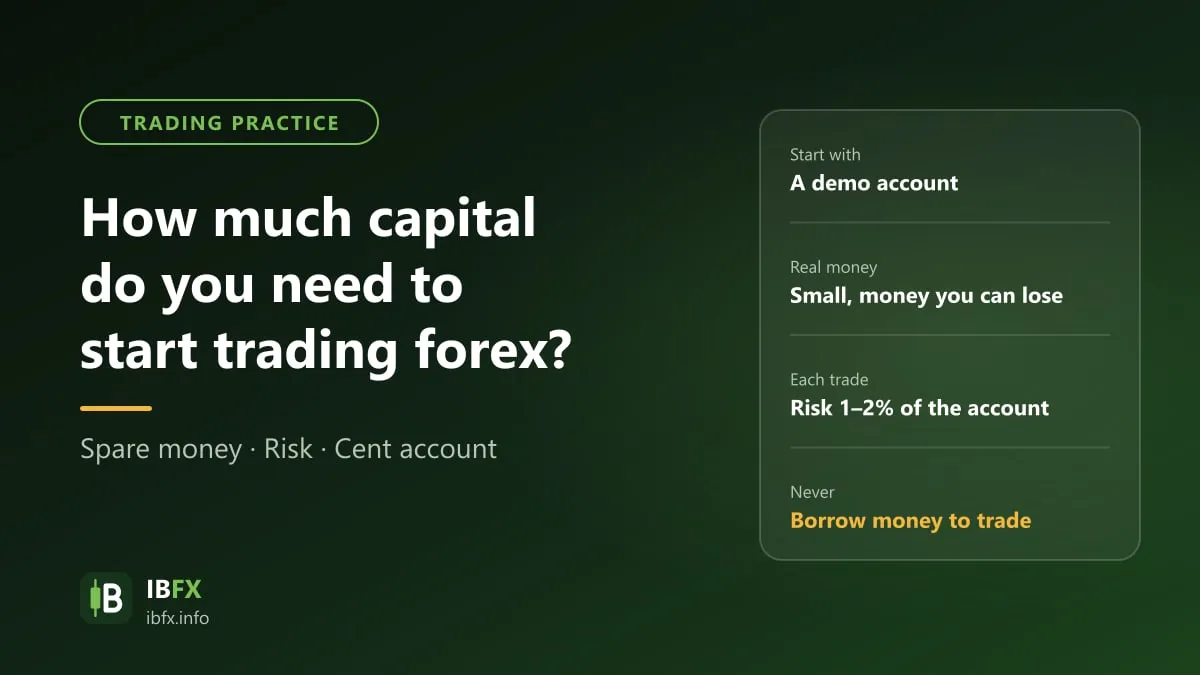
To work out the position size in this approach, you can apply the 2% money management rule: never lose more than 1-2% of the account on a single trade. The Kelly formula also comes up often, but it usually gives a level of risk that is too high for an individual trader; those who do use it often take only a small fraction of the result.
We hope that with what we have shared in this article you now understand leverage better, and how this tool works on the foreign exchange market.
To pick the leverage ratio that suits you best, work out clearly what you need, your profit target, the risk you can take, your trading experience and your capital. And do not forget to apply sound risk management strategies to keep the risk that leverage brings as small as possible.