On this page
Trading cost is one of the things a trader has to weigh carefully when choosing a broker and a trading account. On every trade that is opened and closed, the usual cost you pay is the spread and the commission. On top of those there is one more fee you pay the broker in particular cases, and that is swap, the overnight fee. Because it works so differently from the other costs, swap is usually studied on its own and put in a category of its own.
In earlier guides we went through spread and commission; this time it is everything to do with swap. If you are a medium- or long-term trader, or someone looking for a different kind of strategy, one that earns from swap, do not skip this article.
What is swap?
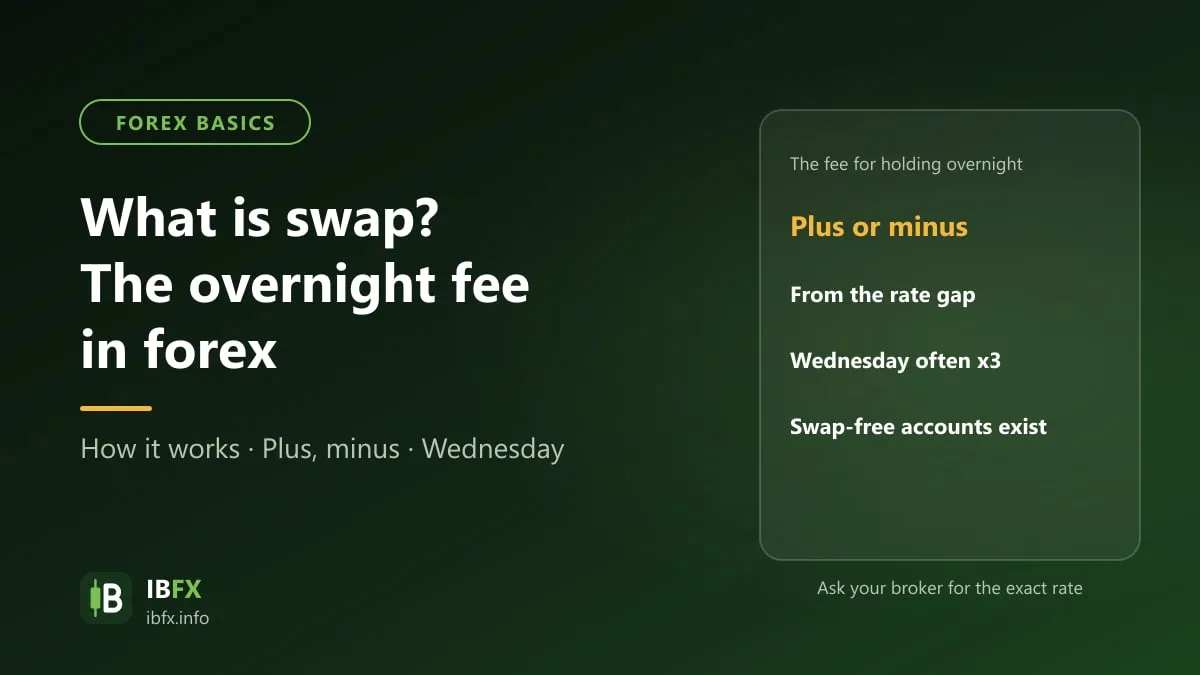
Swap, or the overnight fee, is interest that a trader receives (credited to the account) or pays (debited from the account) for holding a trade overnight.
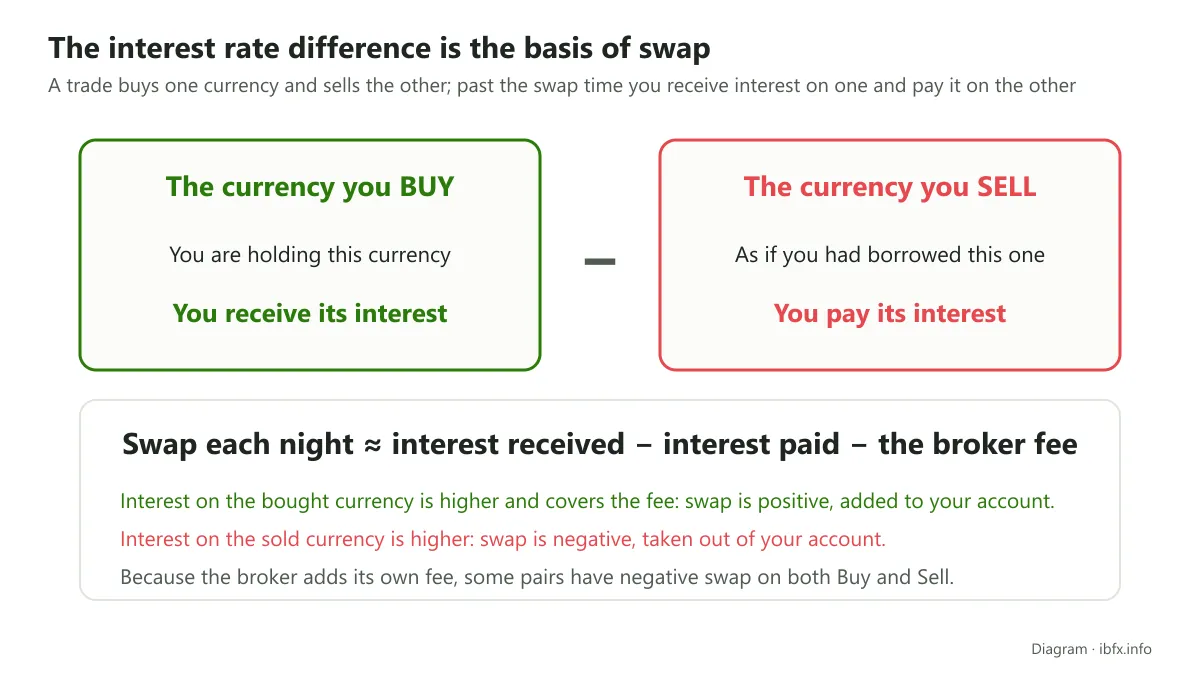
Swap is an unusual cost because a trader does not always pay it to the broker. Swap only becomes a trading cost when the trader holds a trade overnight and the interest rate on the currency bought is lower than the interest rate on the currency sold. On top of the interest rate difference, the broker adds its own fee, so some pairs carry a negative swap in both directions.
If you close the position within the day (before the swap time) you pay no swap fee, and if the interest rate on the currency you bought is higher than the rate on the one you sold, you receive the swap fee instead of paying it to the broker.
- How does swap relate to currency interest rates?
In practice every country runs its own interest rate policy, and the difference between the interest rates on the currencies of those countries is what the overnight swap fee is built on.
In the interbank market, foreign exchange trades settle on T+2, meaning the banks formally exchange the currencies with each other (settle) two days after the day the buy and sell arises. Suppose that on Monday bank A in Vietnam opens a trade buying USD from bank B in the United States. The trade settles two days later, that is on Wednesday, when bank A has to pay VND to bank B and receive USD from bank B, the amounts of VND and USD settled following the USD/VND rate at that point.
If the trade is rolled on one more day, the settlement date moves on one more day too, so both banks receive their currency on Thursday. The USD stays with bank B one more day, so it earns a day of interest, and the same goes for the VND that stays with bank A one more day, which earns a day of deposit interest.
On the settlement date, bank A receives the USD it bought together with the interest earned while the USD stayed a day longer at bank B, and pays the VND together with the VND interest to bank B. If the interest rate on VND is higher than the rate on USD, bank A pays more interest than it receives, and that is the cost to bank A of rolling the trade on. The other way round, if the VND rate is lower than the USD rate, bank A picks up an interest rate difference.
The overnight swap fee in the foreign exchange market was built on this idea from the spot market.
- An example of how swap arises in the foreign exchange market:
Suppose you open a buy of 1 lot on USD/CAD at a rate of 1.09123. Buying USD/CAD means using CAD to buy USD. On this trade you need 109,123 CAD to buy 100,000 USD. In concept you can read it as borrowing 109,123 CAD to buy 100,000 USD (in reality there is no loan and no deposit in your name). If you hold the trade past the swap time, it is as though you pay interest on the CAD you borrowed and receive interest on the USD you hold: if the interest rate on USD is higher than the rate on CAD, the difference (after the broker’s fee is taken off) is credited to your account, and the other way round it is debited. Swap is charged each night, not only when you close the trade.
How to see the swap rate in your trading platform
In the MT4 platform, go to the Market Watch area, right-click the pair whose swap you want to see, choose Specification, then scroll down to the swap section to read these values.
An example: the swap on USD/CHF
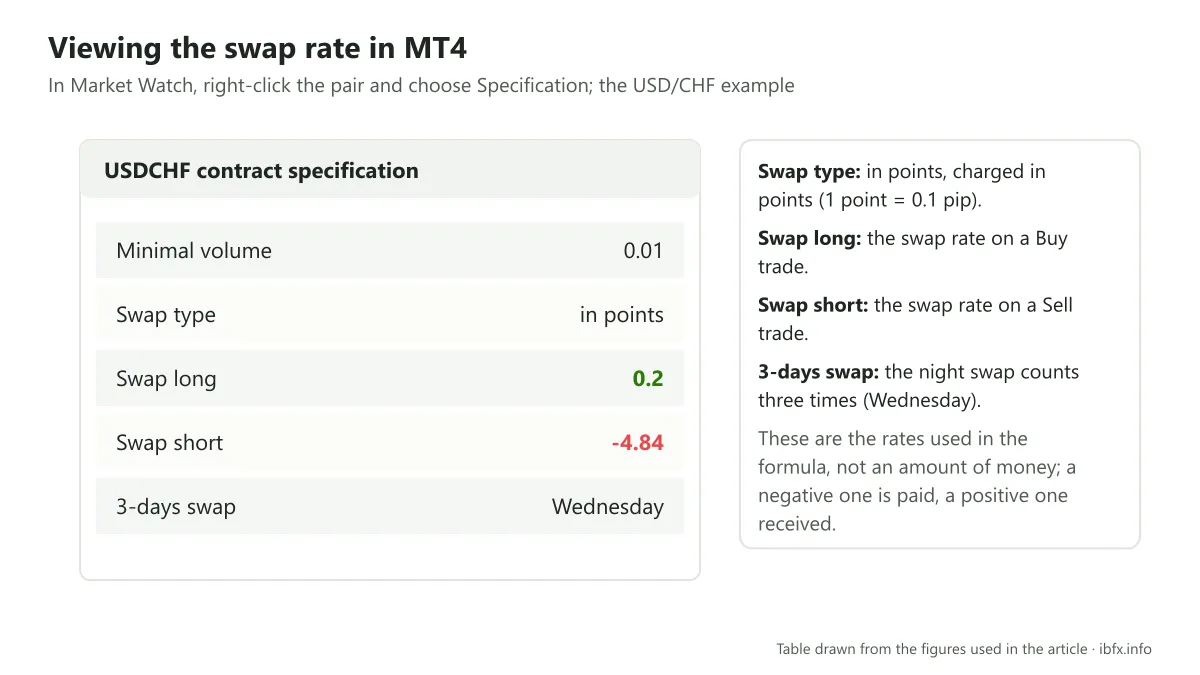
- Swap type: the type of swap. In Points means the swap is charged in points, where 1 point = 1 pipette = 0.1 pips.
- Swap long: the swap rate per point for a Buy trade
- Swap short: the swap rate per point for a Sell trade
- 3-days swap: the day on which the swap fee is multiplied by 3 (Wednesday)
From this table we can draw out a few features of swap:
- The values 0.2 (swap long) and -4.84 (swap short) are not the swap fee but only the swap rate, and those values go into the formula that works out the swap fee.
- A negative swap is an overnight fee you have to pay, a positive one is an overnight fee you receive
- A Forex pair can have a negative swap rate on both the Long and the Short side
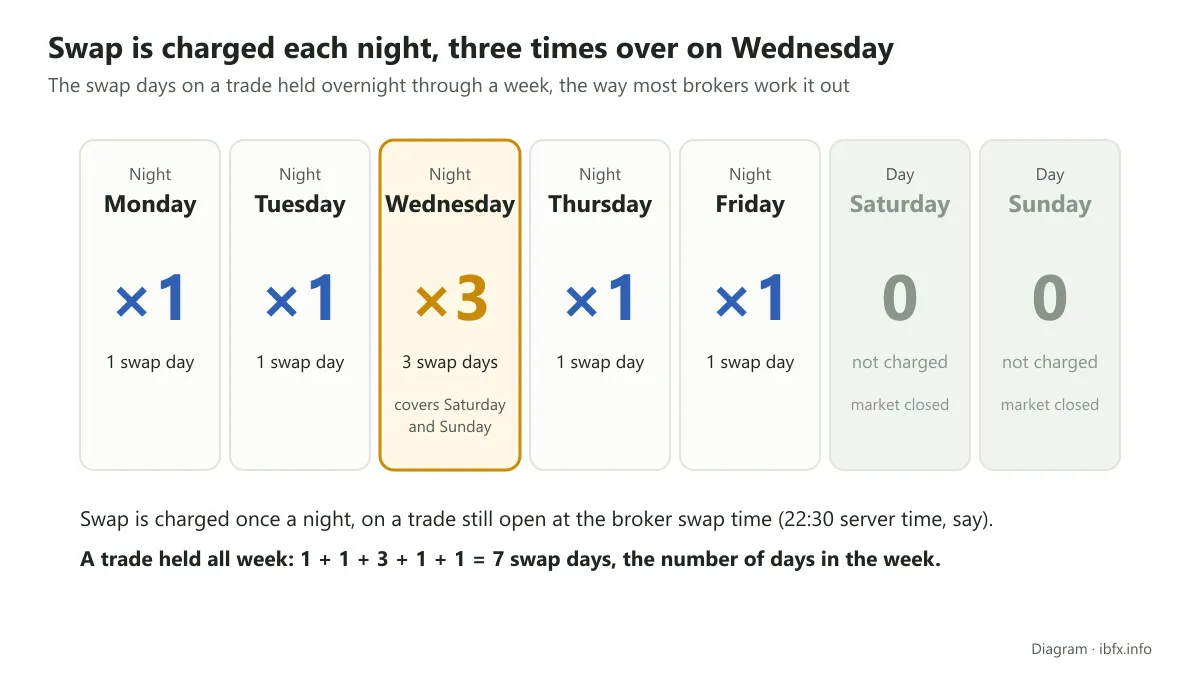
- Swap is multiplied by 3 on Wednesday night (at most brokers) because under T+2 settlement a Wednesday trade settles on Friday; hold the trade through Wednesday night and the settlement date moves to Saturday, but there is no settlement on Saturday or Sunday, so it moves on again to Monday, which is 3 days. In exchange, the market is closed on Saturday and Sunday, so there is no swap charge on those two days; hold a trade for a full week and it still comes to 7 swap days in total.
How the swap fee is worked out in Forex
Before we get to the formula itself, you need to work out when a trade counts as being held overnight. Opening a trade today and holding it until tomorrow morning does not always count as holding it overnight.
Every broker sets its own swap time; some charge swap from 22:00, 22:30, 23:00 or 23:30… by the clock in the trading platform.
Suppose your broker charges swap at 22:30: any trade open at 22:30 is charged the overnight fee. A trade opened after 22:30 is not charged that night, but if it is still open at 22:30 the next day it is charged as usual.
Many brokers also have a swap-free account for Muslim clients (the Islamic account), but they usually charge a fee in its place or cap the number of days a trade may be held swap-free.
- The formula for the swap fee
Swap fee = position size (in lots) * the standard size of a lot * the swap rate in pips * the value of a pip per unit of currency
The swap rate in pips = the swap rate in points / 10
An example: USD/CHF has these swap rates, Long/Short: 0.2/-4.84, and a current rate of Bid/Ask: 0.89851/0.89855
- Place a Buy of 2 lots.
Swap = 2 * 100,000 * (0.2/10) * (0.0001/0.89855) = 0.445 USD a night. Hold the trade for 3 nights and the total swap received is 1.335 USD.
- Place a Sell of 2 lots.
Swap = 2 * 100,000 * (-4.84/10) * (0.0001/0.89851) = -10.77 USD a night. Hold the trade for 3 nights and the total swap to pay is 32.31 USD.
When you trade in the platform, though, the system works the swap fee out for you and shows it in the swap column of your open trades. A positive value is swap credited to your account, a negative one is swap you pay the broker.
A strategy that uses swap to add to your return
Because swap is only charged on overnight, longer-held trades, using swap to add to your return is only for medium- and long-term traders who hold a position for more than a day.
The strategy makes use of two basic features of the swap fee:
- With a positive swap rate, you receive the overnight fee
- Trade on a Wednesday and the overnight swap fee is multiplied by 3
Here is how the strategy is run:
- First, pick Forex pairs with a high swap rate and a side that carries a positive swap, because a great many Forex pairs have a negative swap rate on both sides.
- Favor opening the trade on a Wednesday to get the swap multiplied by 3 (the multiple of 3 makes up for the two weekend days; hold the trade through the whole week and you get nothing extra)
Points to note:
- The Forex pairs with a high swap rate are usually the exotic pairs, because the interest rate difference between the currencies is very large. If you choose to trade them, though, you have to accept that they carry a wide spread, and that holding a trade overnight is when the spread commonly widens, so weigh this up and take care with it.
- Favor opening the trade on a Wednesday to get the swap multiplied by 3, but you cannot trade regardless when there is no strong, clear signal, or when the Forex signal points the other way from the side that carries the positive swap. That is, suppose USD/TRY has a positive swap rate on the Short (Sell) side, but the Forex signal points to the Long (Buy) side: at that point you cannot place the Sell regardless just to take the triple swap, because the swap you receive may well not cover the loss on the trade if the market does what the signal warned.
So a strategy that takes advantage of swap to add to your return only really works when you already have a specific trading strategy, when the direction of the trade matches the signal from the analysis tools you use, and when it falls on the side that carries the positive swap. Better still if you open the position on a Wednesday.
- Example 1: USD/TRY has the swap rates shown below:
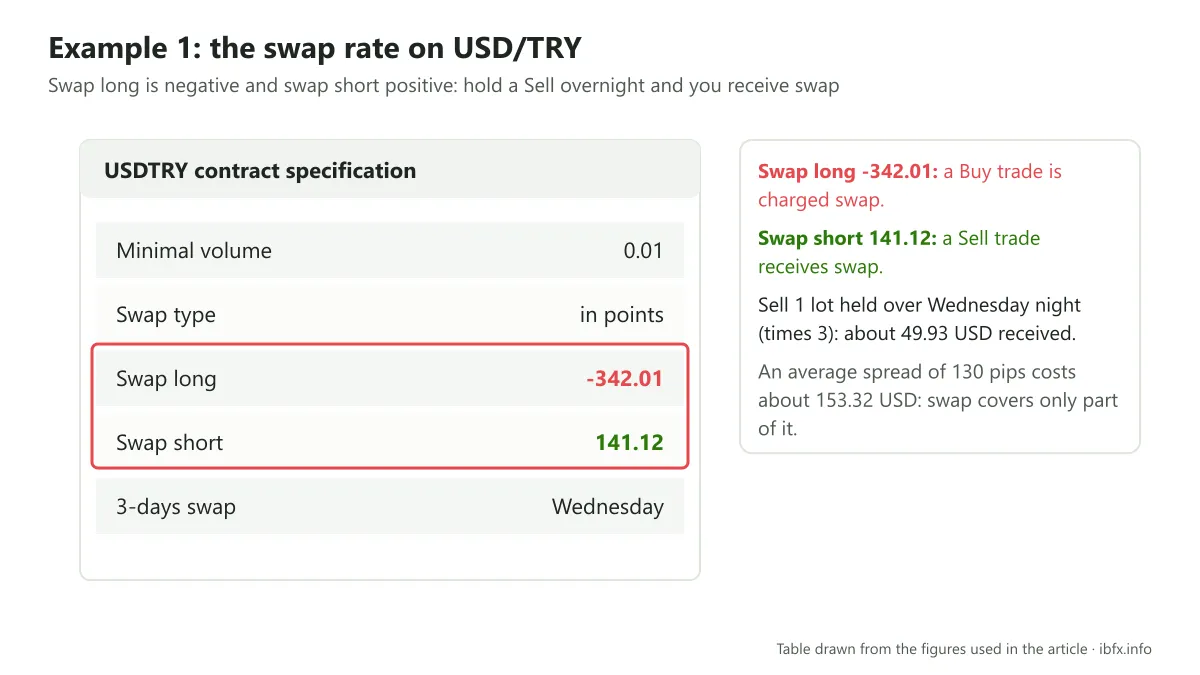
The average spread on this Forex pair is 130 pips.
Suppose you take every advantage swap offers and your strategy runs like this: place a Sell of 1 lot of USD/TRY. The current rate on this pair is Bid/Ask: 8.47894/8.49194
Holding the trade overnight, you get the swap multiplied by 3.
Swap received = 100,000 * (141.12/10) * (0.0001/8.47894) *3 = 49.93 USD
The broker charges no commission, so the cost you pay on this trade is the spread = 100,000 * 130 * (0.0001/8.47894) = 153.32 USD
In this case, if the trade works out, the swap fee you receive covers part of your trading cost.
- Example 2: EUR/ZAR has these swap rates:
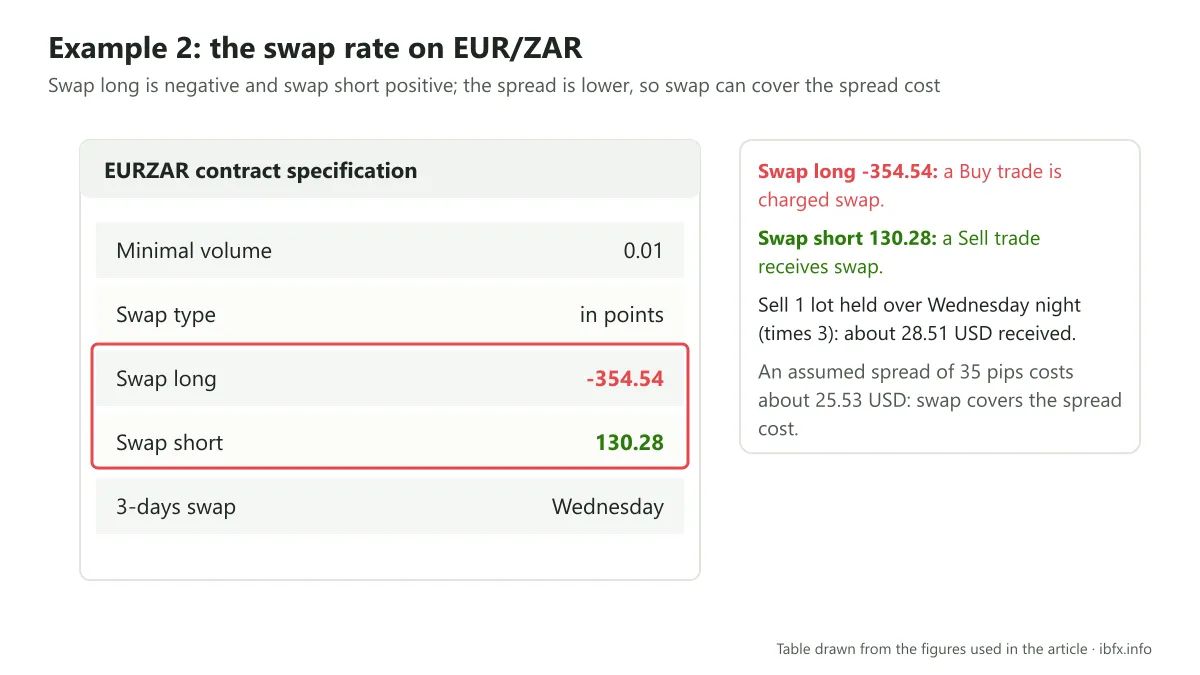
Assume the average spread on this pair is 35 pips
Suppose again that you take advantage of swap and your trading strategy runs like this: place a Sell of 1 lot of EUR/ZAR at a current rate of Bid/Ask: 16.76246/16.76596
Holding the trade overnight, you receive the swap multiplied by 3.
Swap received = 100,000 * (130.28/10) * [(0.0001/16.76246)*1.22288] * 3 = 28.51 USD, where 1.22288 is the EUR/USD rate.
See again: What is a pip? How to work out the value of a pip in Forex.
The cost you pay on the trade is the spread = 100,000 * 35 * [(0.0001/16.76246)*1.22288] = 25.53 USD
In this case the swap fee received is larger than the spread paid, so you not only save on trading cost but add to your return as well, though not by much, because exotic pairs carry a very wide spread by their nature.
You can easily compare the swap fee received with the spread paid, to decide whether to take the trade, in this way:
Work out the number of pips received from swap: it is the swap rate in pips * 3 (taking the Wednesday trade) = (the swap rate in points / 10) * 3, and compare that figure with the spread on the Forex pair you want to trade.
In example 1: the pips received from swap = (141.12/10)*3 = 42.336 pips < 130 pips, so swap only cuts part of the trading cost.
In example 2: the pips received from swap = (130.28/10)*3 = 39.084 pips > 35 pips, so swap covers the spread cost.
An important note: the comparison above leaves price movement out. Pairs with a high positive swap, such as USD/TRY or EUR/ZAR, usually involve the currency of a high-inflation economy, which can lose a great deal of value in a short time and wipe out the swap received. USD/TRY, for example, went from about 8.5 in mid-2021 to over 18 in December 2021: the Sell on USD/TRY in example 1 would have lost many times the swap it collected.
Conclusion
Getting to the bottom of swap will show you a good deal that is worth knowing. If you are a trader who often holds trades overnight in particular, this is one quantity you cannot afford to ignore.