On this page
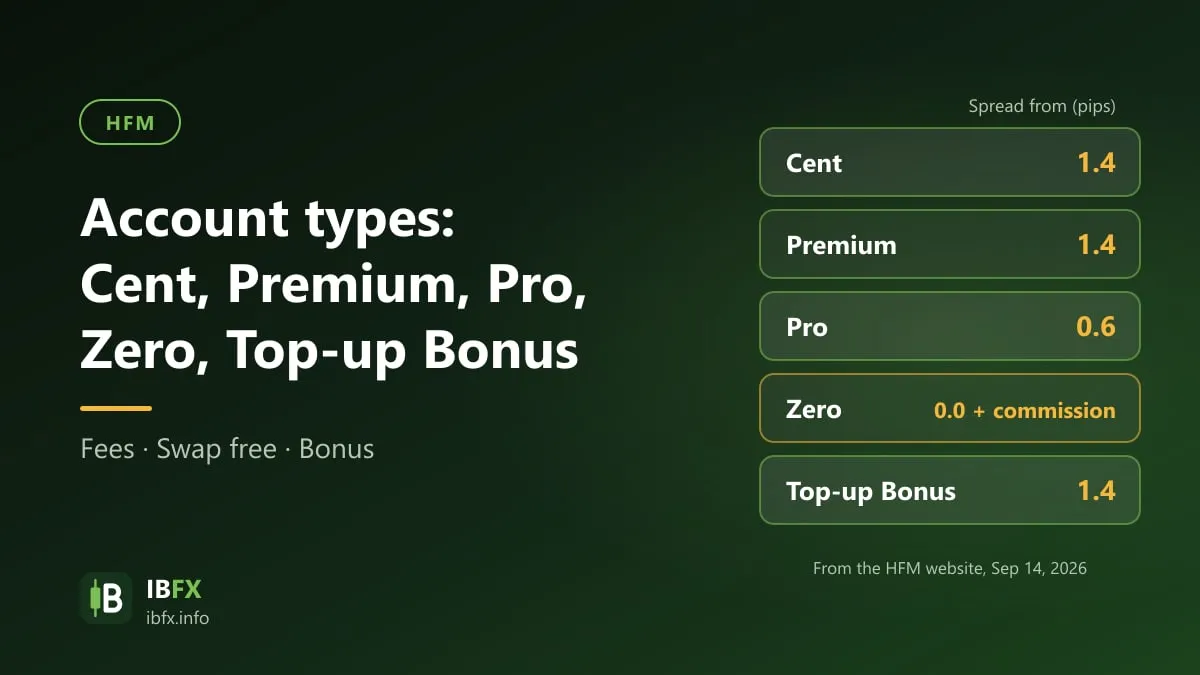
HFM (HF Markets, formerly HotForex) currently has five live trading account types: Cent, Premium, Pro, Zero and Top-up Bonus. The Micro, Auto and Zero Spread accounts of the HFM review written in 2022 are no longer in the current comparison table.
This article is drawn from the account comparison page, the page of each account, the Swap Policy, the Client Agreement (the July 2026 version) and the Top-up Bonus program terms (the March 2026 version) on the international HFM website, as of Sep 14, 2026. HFM states plainly that its leverage and its conditions may change, so check them again in the client area (myHF) before you open an account.
A quick comparison table
| Cent | Premium | Pro | Zero | Top-up Bonus | |
|---|---|---|---|---|---|
| Minimum deposit | 0 USD | 0 USD | 100 USD | 0 USD (the FAQ says 25 USD) | 0 USD |
| Spread from | 1.4 pips | 1.4 pips | 0.6 pips | 0 pips (Forex) | 1.4 pips |
| Commission | None | None (except on some products) | None (except on some products) | Yes | None (except on some products) |
| Maximum leverage | 1:2000 | 1:2000 | 1:2000 | 1:2000 | 1:1000 |
| Account currency | US cents (USC) | USD, EUR | USD, EUR | USD, EUR | USD, EUR |
| 1 lot | 1,000 units | 100,000 units | 100,000 units | 100,000 units | 100,000 units |
| Products | Forex, gold | All | All | All | All except DMA shares and ETFs |
| Open positions at a time | 300 | 500 | 500 | 500 | 500 |
Common to all five: a minimum position size of 0.01 lots; a maximum of 60 standard lots per position (the Cent account page gives a total of 6,000 cent lots for the whole account); market execution; MT4, MT5, HFM WebTrader and the HFM app; and a margin call at 50%, a stop out at 20%.
A minimum deposit of 0 USD is the minimum of the account. Each deposit method still has a minimum of its own, and HFM builds that table per country: the deposit page for Vietnam on Sep 14, 2026 gave bank transfer from 300,000 VND and credit or debit card from 120,000 VND.
The real cost of a trade
“Spread from” is the lowest figure, and you usually only see it when the market has good liquidity. The real cost of a trade is the spread at the moment you enter, plus the commission (if any), plus the swap (if you hold the position overnight and that symbol is charged swap).
The commission on the Zero account, from the table on the Zero page, counting both the opening and the closing of the trade:
| Product | Volume | Commission |
|---|---|---|
| All currency pairs | 1,000 / 10,000 / 100,000 units | 0.06 / 0.6 / 6 USD |
| Gold | 1 / 10 / 100 ounces | 0.10 / 1 / 10 USD |
The introduction on the same page says “commission from just 3 USD per lot”, which counts one side only; opening and closing together comes to 6 USD.
An example with 1 lot of EUR/USD (about 10 USD per pip), if the spread is exactly the lowest figure the broker publishes:
| Account | Spread | Commission | Total |
|---|---|---|---|
| Premium | 1.4 pips = 14 USD | 0 | 14 USD |
| Pro | 0.6 pips = 6 USD | 0 | 6 USD |
| Zero | 0 pips | 6 USD | 6 USD |
In practice the spread is usually wider than the “from” figure, above all when news comes out, at the open at the start of the week, and on pairs that are traded less. The surest way is to measure it yourself:
- Open a demo account of the same type in myHF (you can sign up with HFM here and create a demo account before you deposit anything).
- In MT4/MT5, open the Market Watch window, turn on the Spread column, and watch the pair you trade most at several times of day.
- Right-click the symbol and choose Specification to see the contract size, the margin rate and the swap.
Symbols in MT4/MT5 carry a suffix by account type: “c” on Cent (EURUSDc, XAUUSDc), “r” on Pro (EURUSDr), and no suffix on Premium (EURUSD). How the cost is worked out: “What is spread?”.
“Swap free” does not mean free however long you hold
The page of each account says “no overnight fee when you hold a position overnight”, but the footnote immediately below says the swap-free treatment applies only to certain instruments and comes with terms attached. Read the HFM documents closely:
- Only some symbols are swap free. The Swap Policy lists the swap-free symbols for clients who are not under Sharia law: the major currency pairs and some cross pairs (EURUSD, GBPUSD, USDJPY, AUDUSD, USDCAD, EURJPY, GBPJPY and others), gold (XAUUSD, XAUEUR), some indices (USA100, USA500, USA30, GER40, UK100, JPN225, HK50 and others), the US dollar index and the USOIL.S oil symbol. A symbol that is not on the list, silver XAGUSD for instance, is still charged swap. Share CFDs held overnight are charged an overnight financing fee.
- The broker monitors this and can take it away. HFM states that it will monitor trading history on the swap-free symbols and reserves the right to withdraw swap-free status if it considers that a client is misusing it.
- The Client Agreement (section 25) gives the broker several more rights. On a swap-free account, the broker may charge an additional commission on an open position without notice, charge an additional fee on a position held for more than a calendar month, recalculate the swap or the holding fee for the whole period already elapsed if it considers a position has been held “too long”, and withdraw swap-free status from the account or from an individual symbol at any time.
In short: swap-free treatment helps on a position held for a few days on a symbol that is on the list. Do not rely on it to hold a position for months. Read more: “What is swap?”.
The accounts one by one
The Cent account
The balance is denominated in US cents (USC); 1 cent lot is 1,000 units of currency, that is 1/100 of a standard lot. On 1 cent lot of EUR/USD, a pip is only about 0.1 USD. Only Forex (more than 50 currency pairs) and gold can be traded, up to 300 open positions at a time, the spread starts at 1.4 pips, and no commission is charged.
Suits: someone who has finished practicing on demo and wants to learn to trade with real money in very small amounts, to feel what it is like when the profit and loss is their own. For the conversion, see “What is a lot?”.
The Premium account
The everyday account: no minimum deposit, a spread from 1.4 pips, no commission on most products, and every product group available to trade (Forex, metals, energies, commodities, indices, shares, cryptocurrencies, ETFs, bonds).
Suits: someone who trades a few times a week, wants a simple cost structure and accepts a wider spread.
The Pro account
A minimum deposit of 100 USD (or 100 EUR), a spread from 0.6 pips, and no commission on most products. Against Premium, the lowest spread is 0.8 pips narrower, worth about 8 USD per lot of EUR/USD.
Suits: someone who trades more often, has capital from 100 USD, and wants a low cost without having to work out a commission separately.
The Zero account
A spread from 0 pips on Forex, with the commission in the table above. The page states that the raw spread applies only to certain products. On the minimum deposit, the specification table on the Zero page says 0 USD while the FAQ on the same page says 25 USD; check which one applies in myHF when you open the account.
Suits: a scalper, someone running an EA, or someone entering many trades a day, after comparing the real total cost of Zero against Pro on demo. See also What is scalping?.
The Top-up Bonus account
The website promotes a 10% bonus on a qualifying deposit, maximum leverage of 1:1000 and a spread from 1.4 pips. The program terms, issued by HF Markets (SV) Ltd, show that bonus money works very differently from real money:
- The rate and the cap are not fixed on the website. The bonus rate (from 10% to 100%), the cap and the conditions are stated in myHF. You have to verify your phone number before you receive a bonus.
- Bonus money cannot be withdrawn under any circumstances. Only the profit made is withdrawable.
- Bonus money is used as margin and takes losses. It lets the account absorb a further stretch of losses before a stop out, and it can be lost entirely.
- Every time you withdraw, the bonus is cut proportionally. Withdraw 30% of the amount you are allowed to withdraw and you lose 30% of the bonus. Under the Client Agreement, the broker takes no responsibility if removing the bonus causes a position to be stopped out.
- An account inactive for 60 days is terminated. With no deposit, no withdrawal and no trade for 60 days, the broker closes the bonus account without notice. If there is no qualifying profit, the bonus and the profit it generated go back to the company rather than into the wallet of the client; the account is archived and cannot be restored.
- No DMA shares or ETFs. Hedging positions between accounts inside the broker, or against another broker, to exploit the bonus can have the bonus removed straight away.
Bonus money does not reduce risk; it makes the balance look larger than the money that is really yours. If you take a bonus, work out your position size from the amount you deposited, not from a balance that includes the bonus.
Margin call 50%, stop out 20% and leverage
The margin level is worked out as: equity ÷ the margin currently in use × 100%. When the margin level falls below 50%, you get a margin call warning; when it reaches 20%, the system starts closing positions automatically.
An example: a 500 USD account, 1:500 leverage, buying 1 lot of EUR/USD
Say EUR/USD is at 1.1000. One lot is worth about 110,000 USD, the required margin is 220 USD, and the margin level starts at about 227%. A pip is about 10 USD.
- A loss of 39 pips (390 USD): equity is down to 110 USD, which is 50% of 220 USD, and you get a margin call.
- A loss of about 46 pips (456 USD): equity is down to 44 USD, which is 20% of 220 USD, and the position is closed.
Fewer than 50 pips has taken more than 90% of the account. A low stop out of 20% means positions are held until there is very little money left in the account; it does not mean you can “take losses for longer” in any safe sense.
On the same account, open 0.03 lots with a 30-pip stop loss: a pip is about 0.3 USD, so hitting the stop loses 9 USD, under 2% of the account. Your position size and your stop loss are what decide how much you lose; leverage only decides how large a position you are allowed to open.
On leverage, under the Client Agreement (section 18): you can change the leverage of each trading account yourself in myHF up to 30 times; there is no limit on increasing it, while reducing it is only possible when no margin is in use or the margin level is above 100%. So pick low leverage as soon as you open the account, rather than waiting until you are in a loss to reduce it.
Read more: “What is leverage? How much leverage should you use”, the 2% money management rule, “What is a stop loss?”.
The terms worth knowing before you open an account
- The legal entity that signs the agreement with you. The Client Agreement on the international HFM website governs the relationship between the client and HF Markets (SV) Ltd, an international business company registered in St. Vincent & the Grenadines (no. 22747 IBC 2015), under the law of St. Vincent & the Grenadines; any claim has to be brought before the courts there. The financial regulator of St. Vincent & the Grenadines has stated on several occasions that it does not license and does not supervise Forex brokerage, so this is company registration, not a brokerage license. The FCA (UK, no. 801701), FSCA (South Africa, no. 46632), FSA (Seychelles, no. SD015) and CMA (Kenya, no. 155) licenses on the Licenses & Regulation page belong to other companies in HF Markets Group.
- Negative balance protection comes with conditions. Under section 20.4, the total losses of a retail client do not exceed the total funds in their accounts at HFM, so a client will not lose more than the account balance, and the broker brings a negative balance back to zero “as soon as possible”. The broker may also combine a client’s accounts when one of them goes negative, so a negative amount on one account can be covered out of the money in another.
- The broker may be the counterparty to your trade. Under section 19, in some markets HFM may act as a market maker, may hold a position opposite to the client, and states plainly that this may lead to a conflict of interest. You have the right to ask in writing whether it is doing so on the product you trade.
- The dormant account fee. An account with no deposit, withdrawal or trade for 6 months running is charged a monthly fee against the balance until it reaches zero: 5 USD per month up to the one-year mark, 10 USD from one to two years, 20 USD from two to three years, and then 10 USD more each year. If you stop trading, withdraw everything.
- The myHF wallet and the trading accounts. myHF is the wallet you deposit into, withdraw from and transfer to your trading accounts. The broker limits how many wallets and how many accounts a client may open; opening more in breach of the rules can mean accounts terminated, profits canceled and bonuses canceled.
- Verification before you deposit. HFM requires a photo ID and a proof of address no more than 6 months old (a bank statement or a utility bill), with the same name on both; documents are approved in about 48 hours, and a deposit only reaches the account afterwards. For the steps in detail: the guide to opening an HFM account and the HFM deposit and withdrawal guide.
Which account to choose
| Your situation | Suggestion |
|---|---|
| You have never traded | A demo account, then Cent with a very small amount |
| A few trades a week, you want a simple cost | Premium, or Pro if you deposit from 100 USD |
| Many trades a day, scalping, running an EA | Pro or Zero, after comparing the total cost on demo |
| You often hold positions for several days | Check whether the symbol is on the swap-free list; a symbol outside the list is still charged swap |
| You have been offered a deposit bonus | Read the Top-up Bonus terms closely: the bonus is not withdrawable, it is cut when you withdraw, and it is lost if the account is inactive for 60 days |
Do not pick an account because of the high leverage or the bonus. The right account is the one with the lowest total cost for the way you trade, and one that lets you keep your position size small relative to your capital. Once you have chosen, you can open an HFM account through our referral link.
Legal status in Vietnam
Whichever country a broker is licensed in, trading Forex through a foreign broker is not among the foreign-currency transactions permitted under Vietnamese law. It risks being treated as a breach of foreign exchange control rules, and in a dispute Vietnamese law does not protect you. See Is Forex trading legal in Vietnam?.
Be wary of anyone who promises you a profit, offers to run a managed account, or asks you to transfer money into a personal account. See how to spot Forex scams.
Conclusion
HFM has five account types, all with the same margin call at 50% and stop out at 20%; what differs between them is mainly the spread, the commission and the product groups. Premium and Pro have a simple cost, Zero has a low spread with a commission, Cent suits practicing with a small amount, and Top-up Bonus comes with a lot of conditions to read closely. The two things most easily misunderstood are “swap free” (only some symbols, and the broker may charge a fee on a position held a long time) and the legal entity that signs the agreement (HF Markets (SV) Ltd in St. Vincent & the Grenadines, which holds no brokerage license).
If you have weighed all of that up and still want to try, start with a demo account, then deposit a small amount through the HFM sign-up link and try withdrawing part of it to find out the real timings and fees.