To become a successful forex trader, besides finding a good entry you also need to know when to cut a loss and when to take profit, which is how you hold on to a profit when you trade forex. And to be honest, none of this is simple! It rests mainly on the experience and the feel of each trader, and books cannot always teach it to you. Still, from our own trading experience, we would like to go through how we handle the money side of a trade, as well as how to exit sensibly in order to limit the risk you take.
How to find a good entry
A good entry lets you place the stop loss closer and gives you a better reward-to-risk ratio. That is why experienced traders do not rush into a trade for the sake of being in one; they wait patiently for price to come to the area they had planned. Finding an entry is like hunting: you have to be extremely patient and never hasty. So how do you find a good entry?
Before we talk about having a good entry, remember this mantra: “The Trend is Your Friend”, which means you should always trade in the direction of the trend. When the market is in a downtrend, instead of buying you should wait for a high price and sell; the other way round, when the market is in an uptrend, instead of selling you should wait for a low price and buy. Trading with the trend improves the chance that the trade goes your way, although it does not remove the risk.
Sadly, though, a lot of traders like to trade against the trend. When the market is falling, instead of waiting to sell with the trend, a great many traders take “pleasure” in trying to buy the bottom, no matter how fast price is dropping.
Another benefit of going with the trend is that you get to see the swings and can use them to set up a trade. Simply drawing the trendlines will show you price moving up and down along the trendline you drew, creating swing patterns that are easier for you to read.
Technical indicators such as the moving average (MA) also act as a support line for the trend, with price bouncing and staying above the MA in an uptrend, and below the MA in a downtrend. Just by watching, you can find a good entry right near the trend line that is acting as support, or in some of the ways we set out below.
Look for an entry in areas that give a signal, where trading patterns tend to appear.
This is a skill you have to practice every day. Once you are good at it you will find the picture of the market becomes clearer. You can also enter on reversal candlestick patterns or on Pin Bars, with the entry at about 50%–70% of the length of the candle.
Look for clear signals that appear within a strong trend
Typical examples are horizontal support and resistance levels, the 50% Fibonacci retracement level, or using a moving average to find the entry. At the 50% Fibonacci level, if price is still moving with the trend you can look for an entry right there. In particular, you should also watch for other signals, such as several reversal candles showing a rejection of higher prices (if you are looking to sell) or several candles showing a rejection of lower prices (if you are looking to buy).
Use a buy limit or sell limit pending order instead of buying or selling at the market price
This one is obvious: to get a good entry you have to wait until price reaches that area before you can buy or sell. And to do that you have to place a pending order in advance instead of buying straight away at the price the market is offering.
A great many traders new to the job enter at market (market execution) on MT4 as soon as they see a signal. That way you are certainly in a trade at once, but the entry price is usually worse and the stop loss further away, so you lose more when you are wrong and gain less when you are right than if you had entered at the price area you had planned. On the other hand, a pending order may never be filled if price does not come back, and you miss the opportunity. Each way has its advantages and drawbacks; what matters is being patient and consistent with your plan.
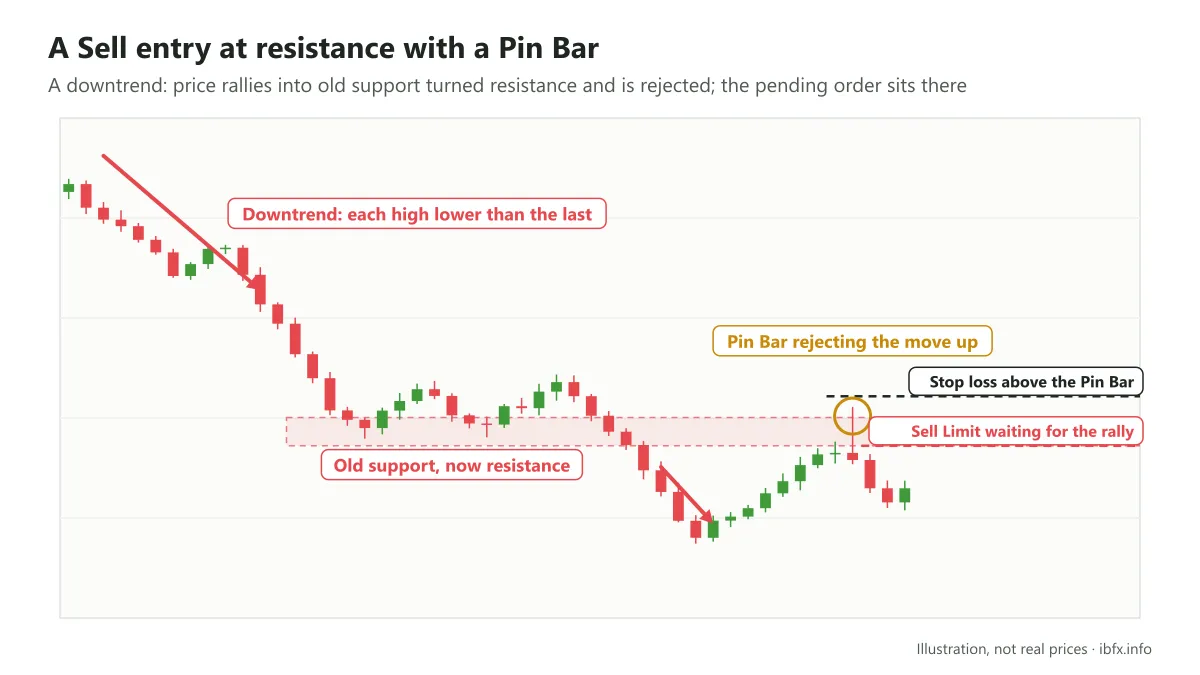
In the chart above the main trend is down: price keeps making lower highs and lower lows. The price area that used to be support turned into resistance once it was broken to the downside, and when price rallied back into that area a Pin Bar appeared, showing that price was rejecting the move up. When you see those facts, your job is to wait for price to rally back into the resistance area, and you can place a Sell Limit pending order there, with the stop loss a short distance above the high of the Pin Bar. So now that you have found a good entry, how should you take profit?
How to plan your take profit
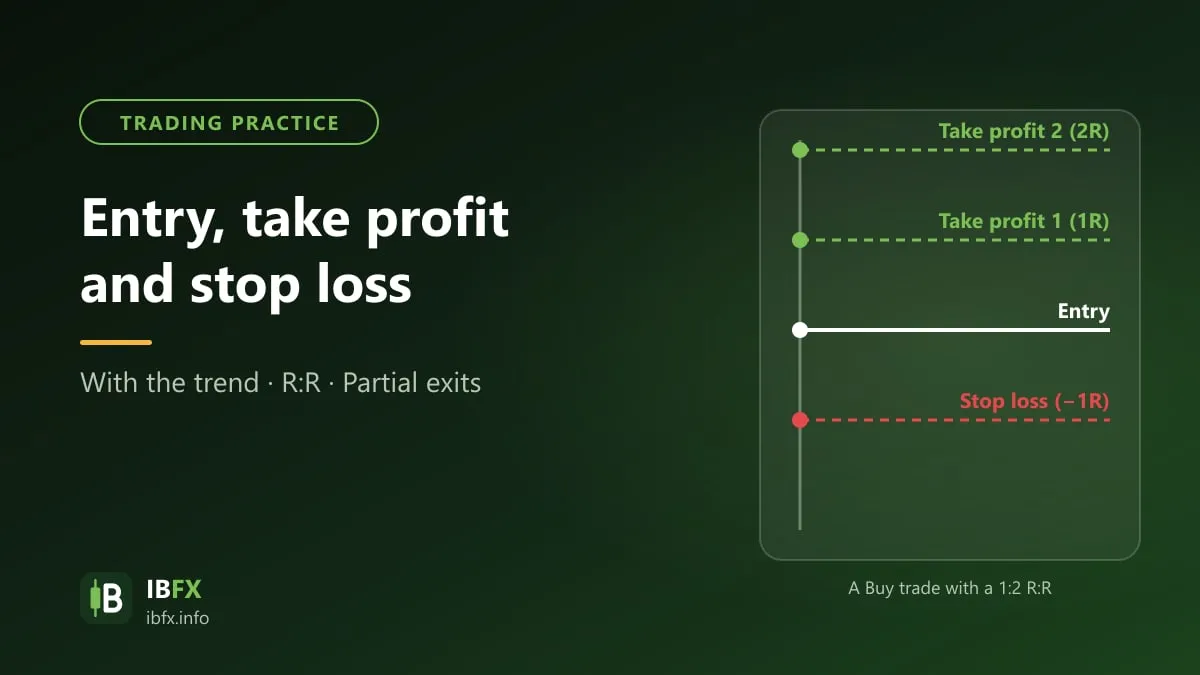
Staying with the same example, once you have found the entry and placed the stop loss, the take profit is worked out from a given R:R ratio. Instead of taking the whole profit at once, you can take profit in parts at each R level (1R is the distance from the entry to the stop loss): close part of the trade at the first level to hold on to some of the profit, and let the rest run with less risk.
Nobody can know in advance how price will move, so taking profit in parts lets you keep some of the profit if price then turns around and runs against your trade. For this to work, however, besides taking part of the profit once you are in the money you should move the stop loss back to the entry, so that the profit you have already made is always protected. There are plenty of cases where, once you drag the stop loss back to the entry, price starts playing up: it may shoot up or dive down to “bite” your stop loss and then move the right way again, which leaves many traders feeling they missed out. Even so, nobody knows what will happen next; taking profit in parts is a trade-off: you lock in part of the profit for certain, and in exchange the total profit will be smaller if price does keep running your way.
To work out where to take profit you can use tools such as Fibonacci, support and resistance areas and trendlines, combined with an R:R (risk-to-reward) ratio of at least about 1:2. At just 1:1 you need a win rate above 50% (before costs) to come out ahead, which is why we do not encourage taking that trade.
In the next example price is in a downtrend, pulls back up to a lower high and then turns down again. Although the downtrend may well go on to make a new low, the old low below can also be a place where price stops or forms a double bottom, meaning a reversal is possible too, so that is a sensible area to take profit.
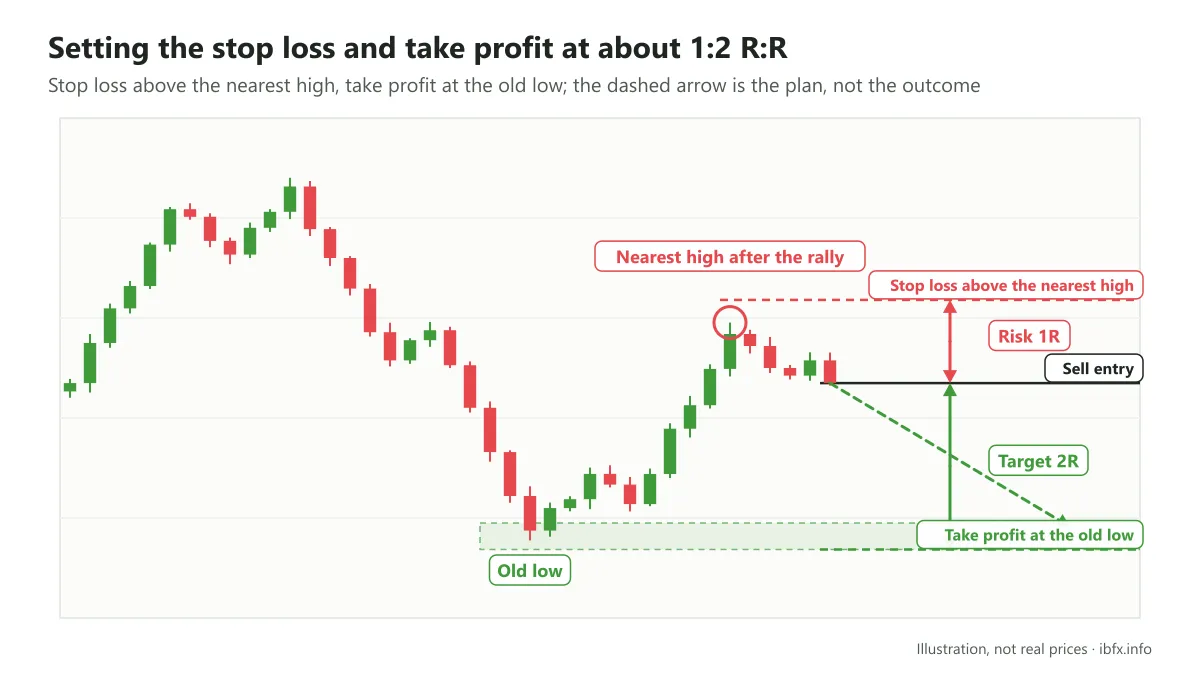
For that reason, if you choose to sell, the stop loss goes above the nearest high and the take profit at the old low. In the chart the distance to the take profit is about twice the distance to the stop loss, an R:R ratio of about 1:2, a level that is acceptable for taking the trade. On the daily timeframe a stop loss distance like this is often several hundred pips, so the position size has to be very small for the risk to be only about 1–2% of the account. If the distance to the take profit is shorter, or the stop loss further away, leaving a ratio of only 1:1, then this is not a trade we encourage.
So a trade with a plan needs a sensible entry, a stop loss and a take profit decided in advance, an R:R ratio of about 1:2 or better, and a position size worked out from the stop loss distance. This takes a certain amount of time spent trading, first of all on a demo account; that experience will give you a feel that no book can pass on in full. See also: What is a stop loss? How to set one.