On this page
The forex market runs around the clock, but it is not always a good moment to enter a trade. A professional trader, instead of trading all day, picks only the moments when the market is busiest, or waits patiently for the price to run to the point they want before opening suitable positions. A trader who has just stepped into the profession, on the other hand, usually pays no attention to this and all but eats and sleeps with the market, entering trades at any time and in any place in the hope of making more money. But however high the number of trades, the result that comes back is not much at all, and can even be a loss, because the timing of the trade was wrong.
So, to reduce risk, trade when the market is busy, or choose the trading hours that suit you best. In the article that follows we will look together at the trading sessions in forex, and at how to choose currency pairs to suit each particular window of time.
When the forex market is open during the week
The forex market is a decentralized market (OTC), open 24 hours a day and 5 days a week, stopping trading only on Saturday and Sunday.
As an economy runs, central banks need to steer monetary policy, commercial banks need to trade USD, JPY and so on to serve their business and their investments, and businesses need to buy and sell foreign currency for their production and trade. So the buying and selling of currency pairs happens across all the financial centers of the world, in many different sets of trading hours.
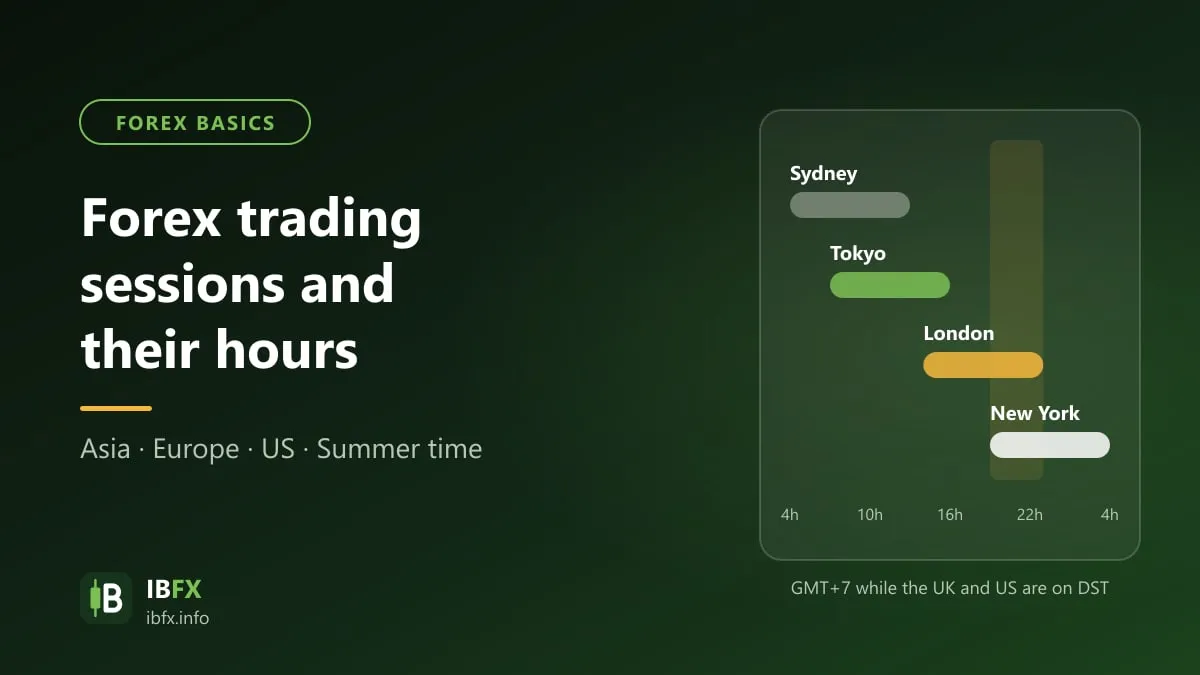
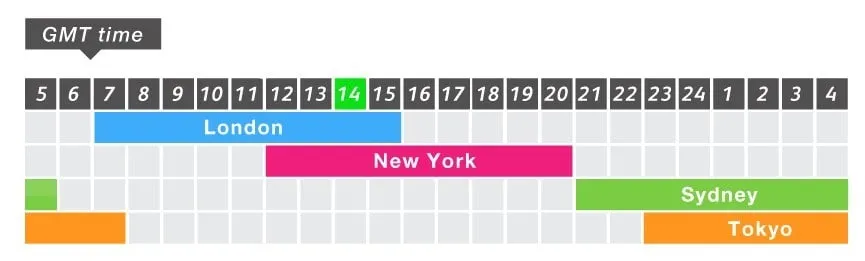
The four large trading centers are Sydney, Tokyo, London and New York. The working hours of these centers follow one after another with stretches that overlap, so from Monday morning to Saturday morning (GMT+7) there is always somewhere trading.
Each session has a different level of liquidity and a different level of volatility, set out in the sections below.
The trading sessions during the day, in GMT+7 and UTC
In one day there are 4 main trading sessions, based in the leading financial centers of the world: Sydney (Australia), Tokyo (Japan), London (England) and New York (the United States). Each trading session lasts about 9 hours; the sessions follow one another and have stretches that overlap, with the next session opening while the one before has not yet closed. The hours in this article are based on the normal working hours at each financial center; different sources can differ by about an hour.
The Australian session (Sydney)
This is the trading session that greets the dawn on a GMT+7 clock, and it is also the first main session on Monday, the start of a new week of forex trading.
Australia is on daylight saving time (DST) from October to April of the following year, the opposite of Europe and the United States. To make it easier to follow, this article uses “summer” and “winter” in the Northern Hemisphere sense: “summer” is roughly March to October, when Europe and the US are on summer time; “winter” is the rest of the year. Note that the US switches to summer time about 2-3 weeks earlier than Europe in March and switches back about a week later at the end of October or the start of November, so over those few weeks the hours of the US session and the European session differ from the ones below.
On that basis, in summer, trading hours in Sydney open at 5:00 and end at 14:00 GMT+7, which is 22:00 to 07:00 UTC. In winter, trading hours in Sydney open at 4:00 and end at 13:00 GMT+7, which is 21:00 to 06:00 UTC.
The forex market opens for the week at about 4:00 on Monday (summer) or 5:00 on Monday (winter) GMT+7, which is 21:00 UTC (summer) or 22:00 UTC (winter), that is 17:00 on Sunday New York time. The exact opening time can differ a little from broker to broker.
This trading session goes by another name too, the Pacific session, and the hours really are fairly pacific. The market is usually quiet and does not move too hard in the early morning on GMT+7. The session takes place in Australia, so the AUD (the Australian dollar) is bought and sold heavily, and if you want to trade in these hours you should pick AUDUSD or NZDUSD. Other pairs in this period usually have lower liquidity and move less.
The Asian session (Tokyo)
The trading session in Tokyo is also called the Asian session, and it opens after the Australian session. Here there is no difference between summer-autumn and winter-spring trading hours. This session opens at 6:00 and closes at 15:00 GMT+7, which is 23:00 to 08:00 UTC.
You can see that most of the trading time in Tokyo overlaps the hours of Sydney. So when the Tokyo session opens, the market becomes busier than it was before and the AUD is traded more heavily still. Alongside that, of course, the JPY (the Japanese yen) gets a lot of attention as well. That is your chance to look at trading pairs that contain JPY, such as USDJPY.
On the whole, in the morning on GMT+7, the forex market is fairly quiet. The ideal pairs you can choose to trade in these hours are the ones with AUD and JPY.
The European session (London)
The trading session in London opens an extremely busy stretch of trading in the day, because the flow of currency through Europe is very large.
Counted in GMT+7, the London session in winter is 1 hour later than in summer, the opposite of the Sydney session, because Australia changes its clocks with the seasons of the Southern Hemisphere. On that basis, the London session runs from 14:00 to 23:00 GMT+7 (07:00 to 16:00 UTC) in summer-autumn, and from 15:00 to 24:00 GMT+7 (08:00 to 17:00 UTC) in winter-spring.
When the London market is at work, the Tokyo market is going into its last minutes of trading. Intraday traders in Asia are getting out of trades while European traders are getting in, which makes the price move hard.
Unlike the morning, the trading volume in the afternoon on GMT+7 is very large. If you enter a trade, in only a short time you may find yourself with a fair profit or a fair loss. To trade in this period we can pick pairs that contain EUR (the Euro) or GBP (the British pound), such as EURUSD or GBPUSD.
The US session (New York)
The forex market bursts into life when the US session begins. What happens in these hours is usually fairly fierce. The US session runs from 19:00 to 4:00 the next morning in summer (12:00 to 21:00 UTC) and from 20:00 to 5:00 the next morning in winter (13:00 to 22:00 UTC), counted in GMT+7.
So the forex market closes on Saturday at 4:00 (summer) and 5:00 (winter) GMT+7, which is 21:00 UTC and 22:00 UTC on Friday.
Important economic news is also usually released at the start of the New York session, which makes the market move a great deal.
Many traders who have free time in the evening like this trading session a great deal.
The best hours to trade currency pairs during the day
From what has been shared above, you can also see that if you want to trade in a calm market you can pick the Sydney session and the Tokyo session, that is the morning through to about the start of the afternoon on GMT+7. Remember, though, that we cannot make a profit if the market simply stands still in one place. So you should trade pairs such as AUDUSD, NZDUSD and USDJPY in this window of time.
And if you want to make use of the market’s large moves, pick the European session and the US session. Pay particular attention to the stretch from 19:00 to 23:00 GMT+7 in summer (12:00 to 16:00 UTC) and from 20:00 to 24:00 GMT+7 in winter (13:00 to 17:00 UTC). This is the time when the London session and the New York session are both at work, which makes the trading volume there very high. As a result the market moves fast: the opportunity is larger, but the loss comes faster too. For example, in the morning on GMT+7 the AUDUSD pair may take 4 hours to move 20 pips, while in the evening on GMT+7 the EURUSD pair can go up 30 pips and then back down 50 pips within a single hour.
Below is a chart showing how far EURUSD moves in that window of time. You can see the pair moves more pips at around 8:00 to 12:00 New York time (ET), that is 19:00 to 23:00 GMT+7 (summer) or 20:00 to 24:00 GMT+7 (winter), which is 12:00 to 16:00 UTC (summer) or 13:00 to 17:00 UTC (winter).
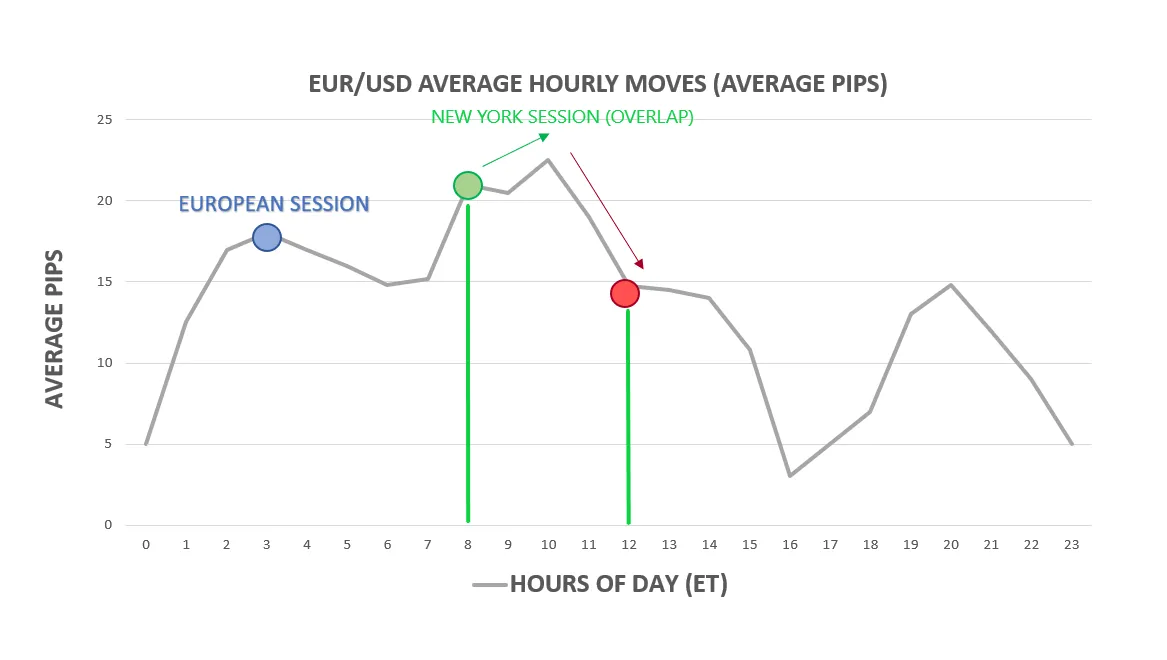
You need to pay attention to stretches where the trading sessions overlap like that. That is when the market has very high liquidity, trading is busy, and the market has enough buying and enough selling to make the price move fast and hard. Profit or loss can both arrive very fast, so when you trade in the hours where the European session and the US session are at work at the same time, you need to pay attention to your position size as well as to your leverage so that you can make sensible trades.
The best time to trade during the week
It is not only the trading windows within the day that make a difference; each day of the trading week has its own character too. Usually, if there is no particular news, the market on Monday is fairly flat compared with the other days. The market becomes busier on Tuesday, Wednesday and Thursday. By Friday the market is still busy, but only for the first half of the day, because traders usually get out of their trades and get ready for the weekend.
Summary
We hope that through this article you now understand clearly when the forex trading sessions run during the day, as well as the character of each day of the week. From this knowledge you can build yourself trading habits and strategies that make sense and suit you.