On this page
Fundamental analysis is one of the 2 major schools of analysis in investing and financial trading. Next to technical analysis it is the less popular of the two, because it is “harder to swallow”. Used sensibly, though, fundamental analysis lets an investor or a trader understand the root cause behind a price move, which is especially useful over a long horizon.
Fundamental analysis does not use nearly as many tools as technical analysis does, but applying each of those tools is hard: it asks the analyst for a good deal of background in economics and in micro and macro finance, which is why the methods of fundamental analysis tend to look more forbidding to new investors and new traders.
What is fundamental analysis? The theory it rests on
Fundamental analysis in financial markets generally is a technique, or a method, for working out the intrinsic value of a financial asset by assessing how factors inside and outside it affect the price of that asset — social, economic, micro and macro financial factors and so on — and from there forecasting which way the price is likely to move in the future.
The final purpose of fundamental analysis is to reach a conclusion about whether an asset is priced above or below its intrinsic value (its real value). On that view, an asset priced above it tends to correct downward over the long run, and an asset priced below it tends to correct upward. The process can take a very long time, though, and with currencies the “real value” is far harder to pin down than it is with stocks.
- The theory fundamental analysis rests on
Technical analysis works from how price has moved in the past and how it moves now to forecast where price is heading, through 3 main principles: price discounts everything, price moves in trends, and history tends to repeat itself. What all 3 principles mean is that the way price behaves on the chart already shows the effect of every other factor on price, so we do not need to analyze each factor one by one. And what technical analysis cares about is the market price of the asset.
With fundamental analysis the principle is the exact opposite: it sets out to find the cause behind unusual moves in price, because fundamental analysts hold that price never changes without a cause and that the effect of the various factors on price can be predicted.
Second, fundamental analysis focuses on the intrinsic value of the asset, and on the relationship between that value and the financial factors, which it holds can be measured. Their view is that whether an asset is priced high or low, at some point it comes back to its real value. Working from that principle, analysts look for the intrinsic value of the asset and then compare it with the market price to identify investment opportunities.
How fundamental analysis of stocks differs from fundamental analysis of forex
Fundamental analysis in stocks and in forex is alike in its purpose and its method, and different in what it looks at and which tools it uses.
Purpose: in these 2 markets, fundamental analysis aims in the end at finding the intrinsic value of a financial asset, and from there at identifying an investment or trading opportunity where there is a wide gap between the intrinsic value and the market price of the asset.
Method: whatever the market or the financial asset, the method of fundamental analysis is to identify the economic, financial and social factors, micro and macro, that affect the price 🡪 measure how strong the effect is and which way it runs 🡪 forecast which way price will move under those effects.
What is analyzed: in the stock market, what is analyzed is the stock. In forex, the range is wider and more varied: currency pairs, gold, indices, stocks, cryptocurrencies and so on.
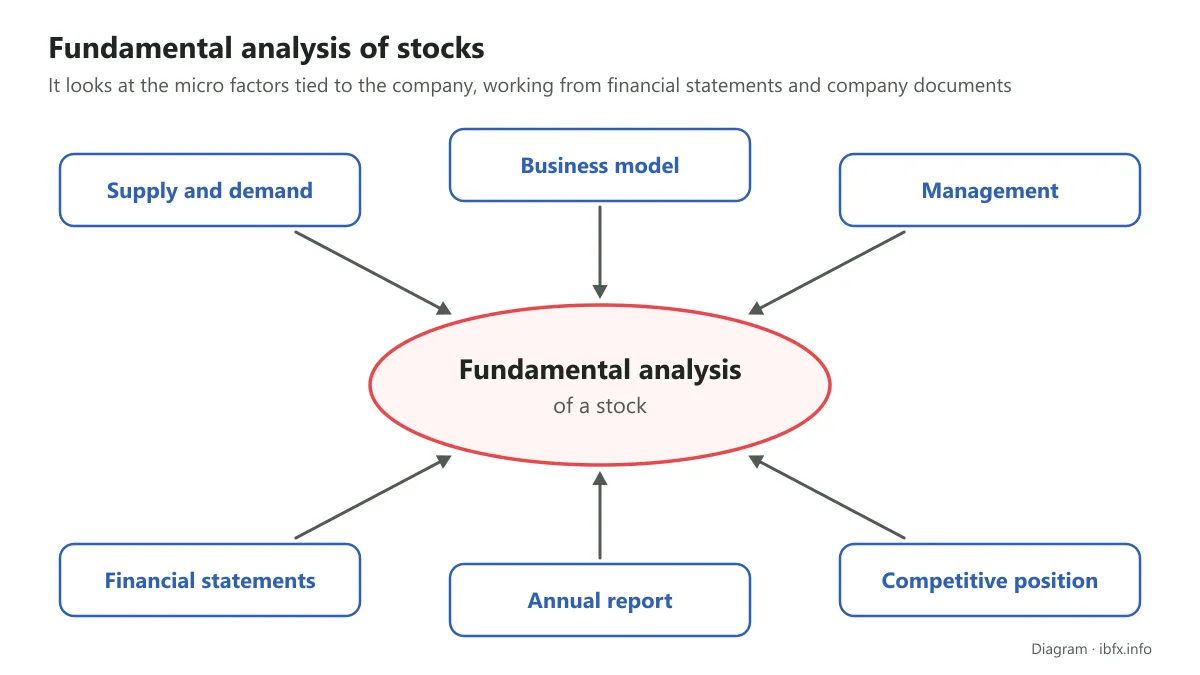
Tools of analysis: fundamental analysis of stocks uses micro tools tied directly to how a business performs, such as competitive position, pricing policy, quality of management, production, mission and objectives and earning power. Investors usually work from financial statements, annual reports and other documents about the company and the industry to assess those factors. Fundamental analysis in forex looks at more macro factors that bear directly on the currencies of countries, such as interest rates, inflation, the unemployment rate and GDP, along with political and social factors. A trader will use economic reports, published economic policy documents, speeches by leaders, central bank decisions and the like to follow and assess these factors.
How fundamental analysis works in forex trading
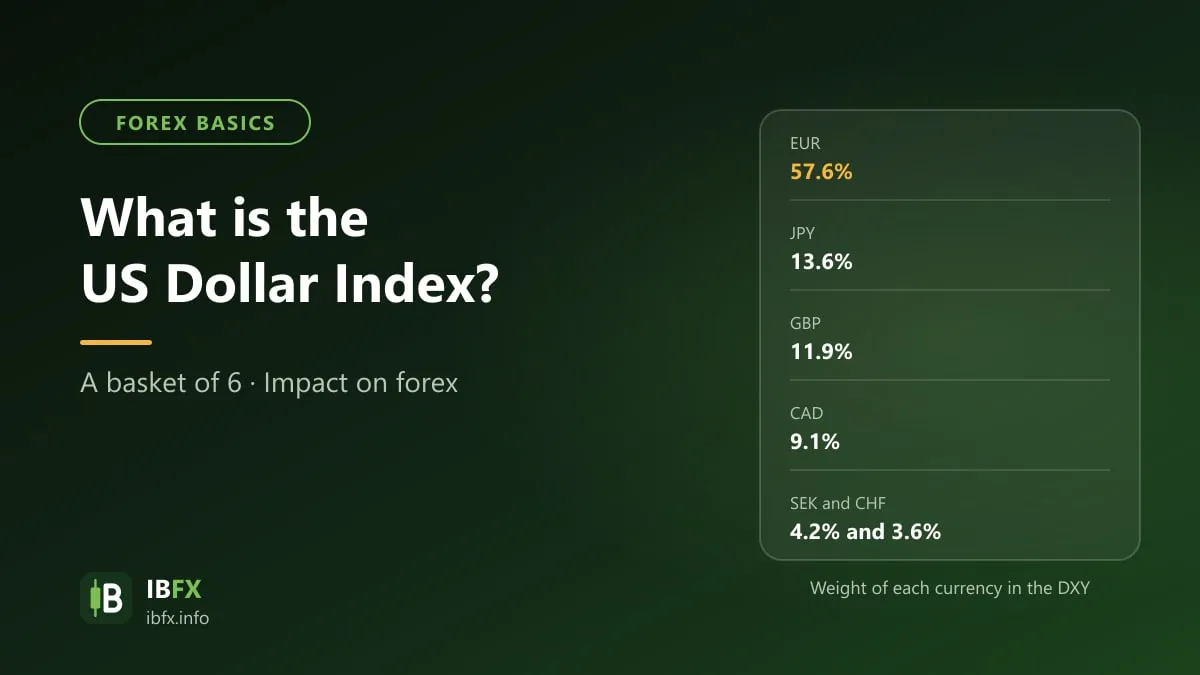
The range of products traded on the forex market is very wide, but most traders pay more attention to currency pairs, especially the major pairs, the ones that contain the US dollar. Fundamental analysis on these pairs means working out which factors affect their exchange rate, how strongly and in which direction. Because the US dollar is the main currency, and the most used one as well, with the largest influence on every other country’s currency, traders doing fundamental analysis on forex pairs usually concentrate on the factors that affect the US dollar.
Other kinds of product have their own particular drivers: metals and energy, for instance, are affected by policy on mining and resources, by the state of each country’s reserves, by natural disasters and so on. And among those factors, the price of the US dollar is an important one as well.
The factors that affect exchange rates in forex
There are 3 main factors that affect the value of a country’s currency:
- Economic factors
- Political and social factors
- Unexpected events
Of the three, the effect of unexpected events on the price of a currency is the hardest to see coming and to predict.
- Economic factors
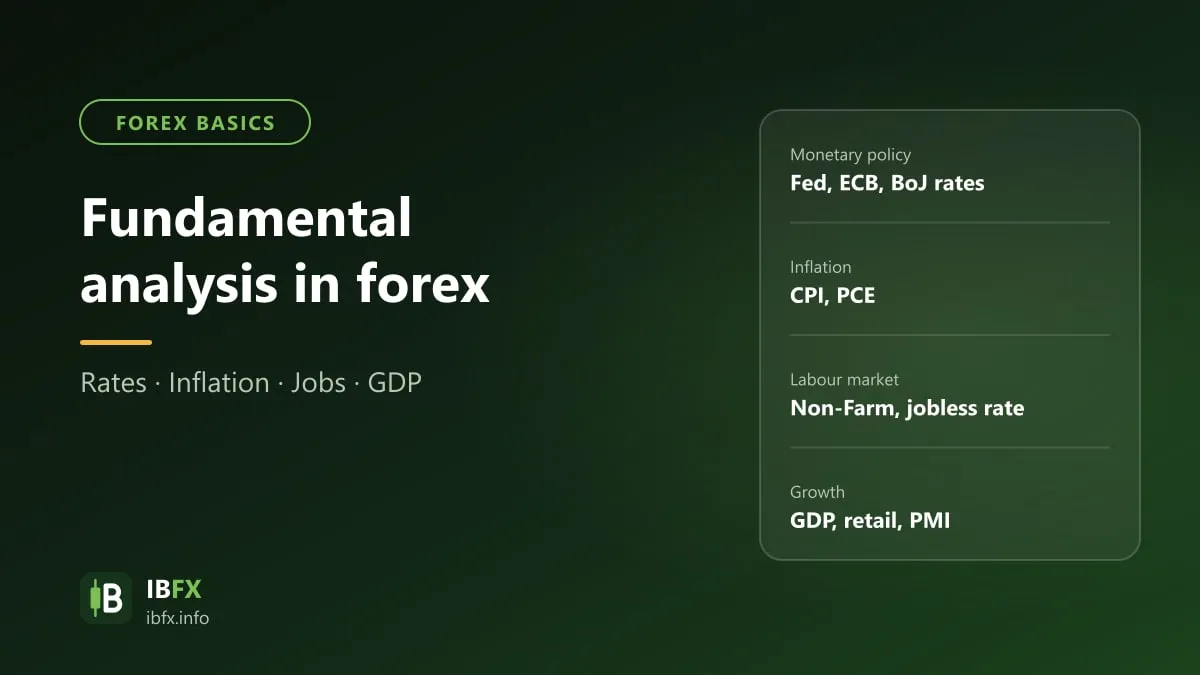
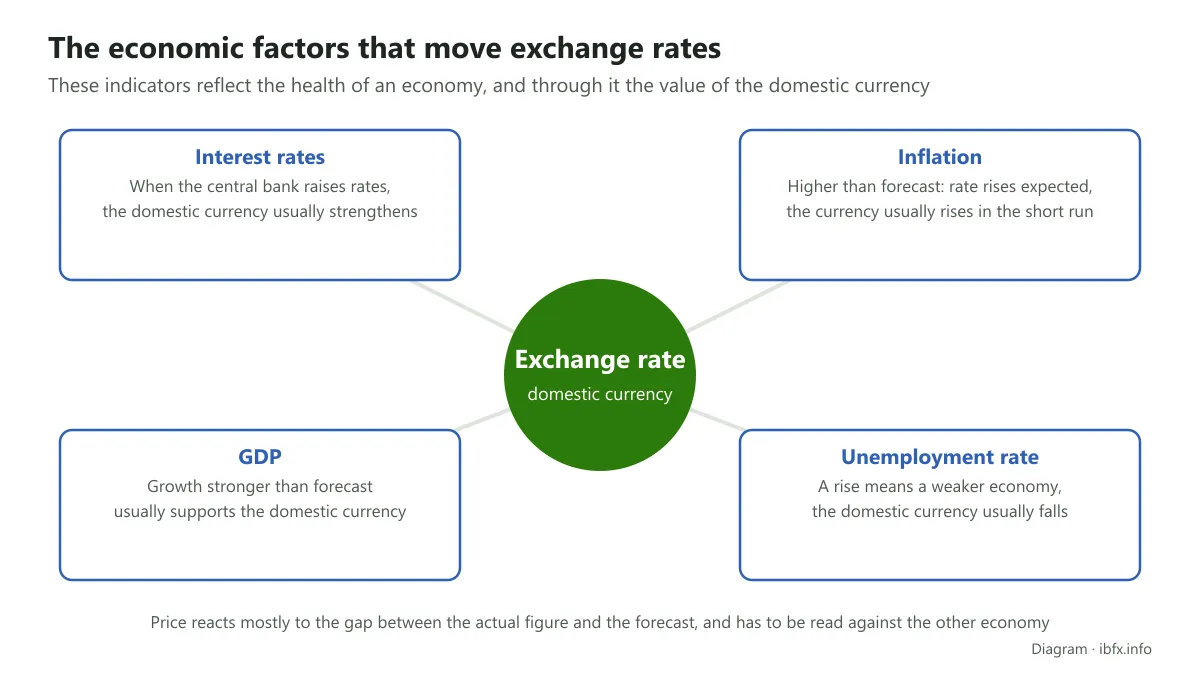
These are interest rates, inflation, GDP, the unemployment rate and so on. All of these indicators reflect the health of an economy, and whether a country’s currency holds its value depends in turn on whether that economy is strong. An economy in good health, with positive readings across the board, usually has a domestic currency that strengthens; a weak economy usually has a currency that loses value. Note: an exchange rate is a relative price between two currencies, so it has to be compared with the economy behind the other one, and price usually reacts to the gap between the actual figure and the forecast, not simply to whether the number is good or bad.
So how do these economic indicators affect the currencies of the countries concerned?
Interest rates
Interest rates usually move in the same direction as the price of a currency. You will come across a great many interest rate concepts: the base rate, the discount rate, the lending rate, the interbank rate, the treasury bill rate and so on. The one that matters most in forex fundamental analysis is the policy rate set by the central bank, such as the Fed’s federal funds target rate, the Bank of England’s Bank Rate or the ECB’s deposit rate.
The policy rate is the “anchor” for every other interest rate in the economy. When the central bank raises rates, deposits and assets held in that currency yield more, which draws capital in from abroad, so the domestic currency usually strengthens; at the same time borrowing gets more expensive, which helps hold inflation back. When the central bank cuts rates, the domestic currency usually weakens, while cheaper credit helps stimulate the economy in return. Over the long run, rates so low that too much money stays in circulation 🡪 inflation 🡪 the currency loses value.
Keep in mind that the market reacts to expectations. If a rate rise was forecast well in advance, the currency may not rise at all, and it can even fall when the news lands; what matters is whether the decision and the words of the central bank differ from what was expected.
Inflation
You can picture inflation like this: this year you buy a loaf of bread for 10 dollars, and next year you have to pay 11 dollars for that same loaf. What inflation looks like is the same basket of goods that now costs you more money than it did before. The cause may be too much money in circulation, or a rise in production costs (energy, raw materials). High inflation that goes on for a long time cuts the purchasing power of the currency and, over the long run, makes it lose value.
In the other direction, deflation (prices falling continuously) is not good either: people put off spending, firms cut production back, and the economy stalls. That is why central banks in developed countries usually set an inflation target of around 2% a year and use monetary policy to hold inflation near that level.
For a trader, what matters is how the central bank responds: when inflation comes in above forecast, the market expects the central bank to raise rates or to hold them high for longer, so in the short run the domestic currency usually rises; when inflation comes in below forecast, the currency usually weakens.
GDP – gross domestic product
This is an important economic indicator, measuring the total value of all the goods and services produced in a country over a given period. GDP growing faster than forecast usually supports the domestic currency, while GDP weaker than forecast, or a contraction (a sign of recession), usually leaves the currency weaker. GDP is a slow release, though (quarterly), so the market has usually priced part of it in already through indicators published earlier; analysts will also look at the makeup of that growth (consumption, investment, exports) before they draw a conclusion.
The unemployment rate
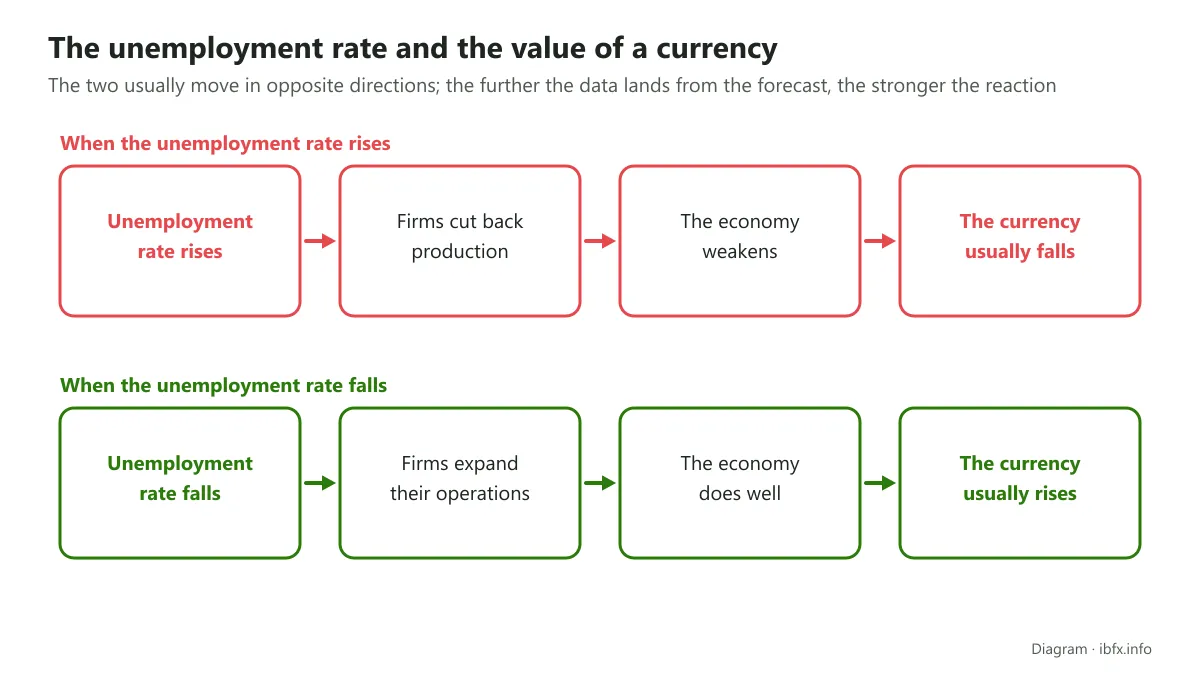
Clearly, the unemployment rate and the value of a country’s domestic currency move in opposite directions. When the unemployment rate rises, it means many workers have no job; the cause may be that firms are doing badly, that they are not expanding production, that they have stalled, and that leaves the economy weaker 🡪 the domestic currency falls in value. The other way round, a falling unemployment rate shows that more people are in work, that firms are producing well, growing in size and taking on more labor, so the economy is developing well 🡪 the domestic currency rises in value.
- Political and social factors
The political and social factors of a country include its laws, its machinery of government, ethnic conflict, military conflict, protests, strikes and so on. All of these have a certain effect on the value of the domestic currency.
A country whose machinery of government is weak certainly cannot develop well, and a country with constant protests, military conflict or violence will see a very heavy effect on its economy. In short, instability in the political machinery, or negative social events, will weaken the value of the domestic currency.
The one political event that investors and traders follow most closely, and one that bears directly on prices in the stock market and on the value of the domestic currency, is an election result. That event is especially important in the case of a US presidential election, which affects not only the United States but the whole world.
Candidates for the office argue constantly over the policies and strategies they would carry out if elected. Different policies (taxes, trade, public spending) can affect the value of the US dollar in different directions. When the result comes in, the market usually moves sharply as it adjusts its expectations for the new policies, even though the policy that actually arrives may differ from what was promised during the campaign.
Next to economic factors, political factors usually act slowly but over a long stretch, except for unexpected events. In the short run, analysts will concentrate more on the economic factors.
- Unexpected events
These are the things that cannot be forecast or seen coming, such as natural disasters, storms and floods, earthquakes and tsunamis. Usually, a negative unexpected event of that kind has a very heavy effect on the country’s economy, and can therefore lower the value of the domestic currency. It does not always work that way, though: after the earthquake and tsunami in Japan in March 2011, the JPY jumped instead, on the expectation that money would be repatriated to rebuild, to the point that the G7 had to intervene. Because the direction of the effect is so hard to forecast, many analysts only take stock of these events after they have happened.
The tools of fundamental analysis in forex
Once you have worked out which factors affect the exchange rate and which way they push it, the question is where you look at those factors, or in which documents and channels they appear so that a trader can follow and update them as quickly as possible.
For economic indicators such as interest rates, inflation, GDP and the unemployment rate, you can follow the monetary policy and the other policies and financial releases of the central bank and the finance ministry of each country. Those policies are published after the important meetings of the central bank, whether regular or unscheduled, and you can also follow them through mainstream media: television, electronic news channels and the reputable official online portals of the countries concerned.
On the forex market the major currencies are USD, EUR, GBP, JPY, AUD, CAD, CHF and NZD, so traders regularly follow the releases from the central banks of those countries: the Fed, the ECB, the BoE, the BoJ, the RBA, the BoC, the SNB and the RBNZ.
International economic and financial news sources you should follow regularly include Bloomberg, Reuters, CNBC, the Wall Street Journal and the Financial Times, along with the official websites of the central banks.
For political and social factors, you can follow the mass media, the press, social networks and so on, to pick up the news promptly and accurately.
- The economic calendar.
This is a tool no trader in the fundamental school can do without. See the guide to one widely used economic calendar: What is ForexFactory?
An economic calendar publishes every policy and every release on the economic indicators and economic factors of every country in the world, with a specific release time and the level of effect each one has on the domestic currency of that country. From past releases, you can note down the release times so that you can follow upcoming news in good time.
One useful feature the economic calendar gives a trader is the ability to filter the data. There is far too much news from far too many countries, while we only care about a few important pieces of data from a handful of countries with a large influence, so the filter helps you find the factors you need to analyze quickly, clearly and precisely.
How do you use an economic calendar in fundamental analysis?
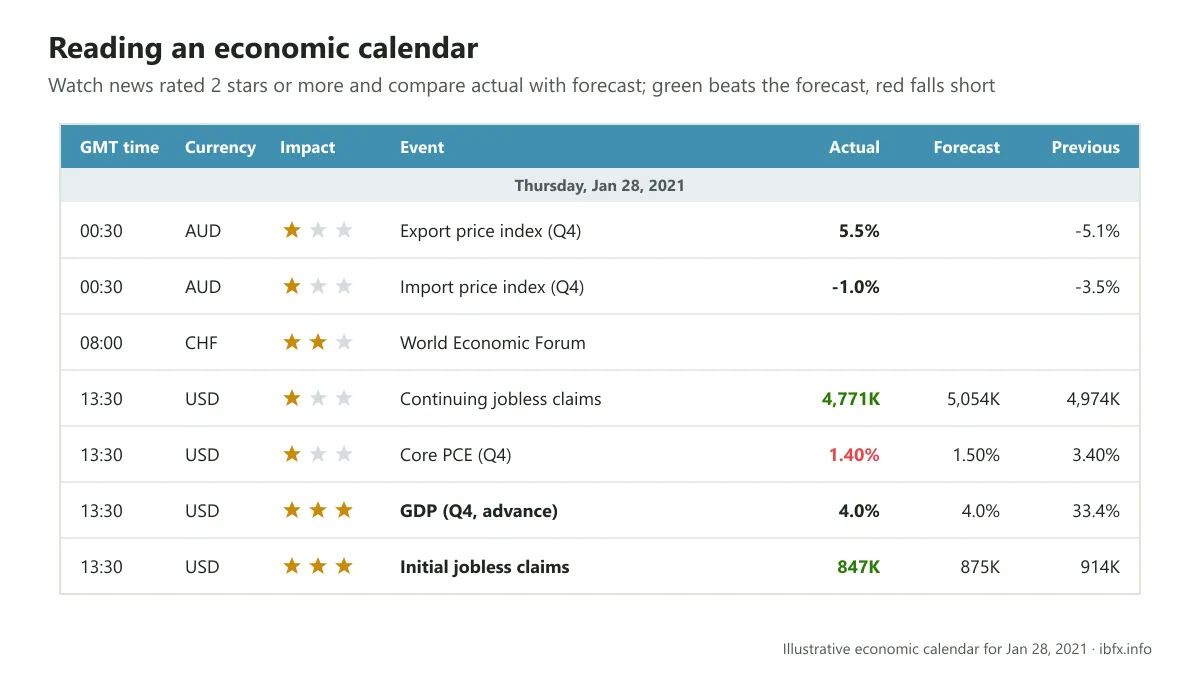
There are 2 things to pay attention to when you use an economic calendar: how important the event is, and the actual and forecast values.
One star, two stars, three stars show how strongly the news affects the currency of the country. In fundamental analysis you should only pay attention to news whose effect is medium to strong, which means 2 stars and above.
The moment the news is published is also the moment the actual value is published; you compare the actual value with the forecast value, analyze which way the news pushes the currency, and from there draw a conclusion about which way price will move.
For example: US CPI inflation is published with an actual value above the forecast, the market expects the Fed to hold rates high for longer or to raise them, so the US dollar usually rises right afterward.
If a piece of news has a strong effect on a currency but the actual and forecast values are not far apart, the large price move that was expected usually does not happen.
The important items on the economic calendar that you have to follow are the interest rate decision, the inflation release (the CPI), the Non-Farm payrolls report (which carries the unemployment rate), the speeches of central bank governors and the documents published by the Fed and the FOMC.
Should you use fundamental analysis in forex?
Unlike the forex market, fundamental analysis in stocks is enormously important and seems indispensable to every investor, partly because it bears directly on the share price and partly because the tools of analysis are easier to reach, since they have much to do with factors inside the company and with other micro factors. In the forex market, getting to grips with fundamental analysis is a great deal harder, because it involves many macroeconomic factors, and analyzing those thoroughly asks the investor or the trader for deeper knowledge and a much better understanding of the economies of different countries.
- So should a new trader pick fundamental analysis as their main method in forex trading?
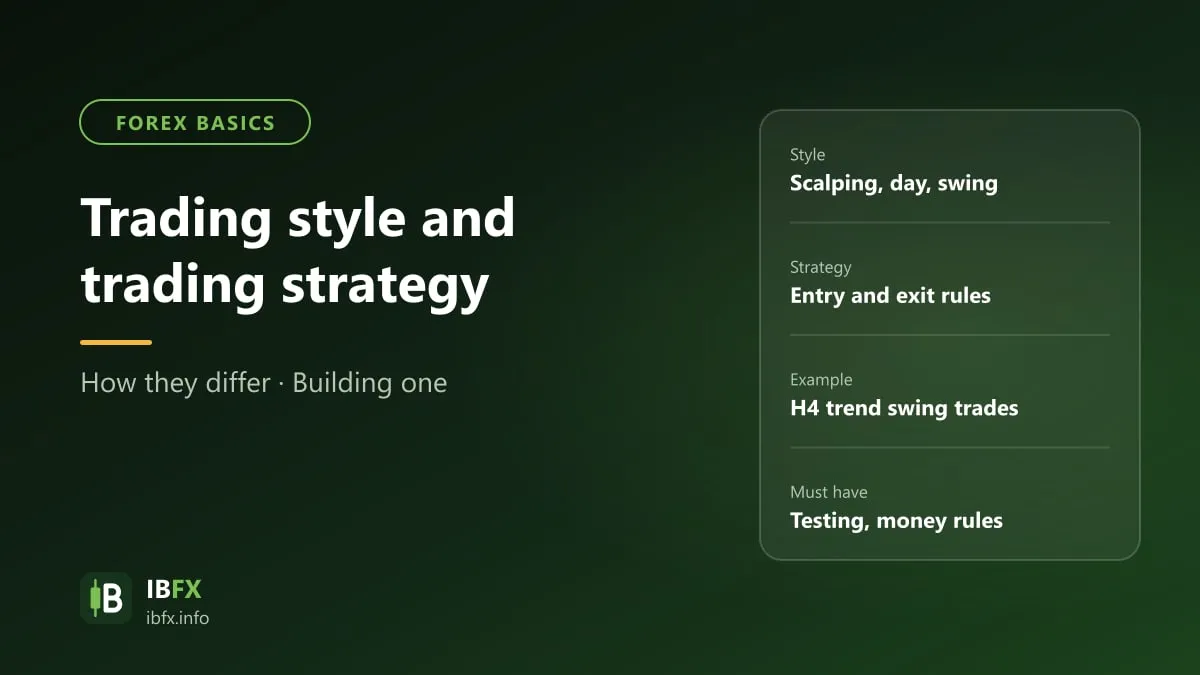
The most sensible answer is probably that it depends on your ability and your strategy, as well as on the trading style each trader chooses.
If you are confident in your knowledge of economics and finance, and the style you choose is a medium or long-term one such as swing trading or position trading, fundamental analysis is worth considering.
If you are not yet confident in your knowledge, on the other hand, and the style you are pursuing is a short-term one such as scalping or day trading, fundamental analysis on its own will not be very effective.
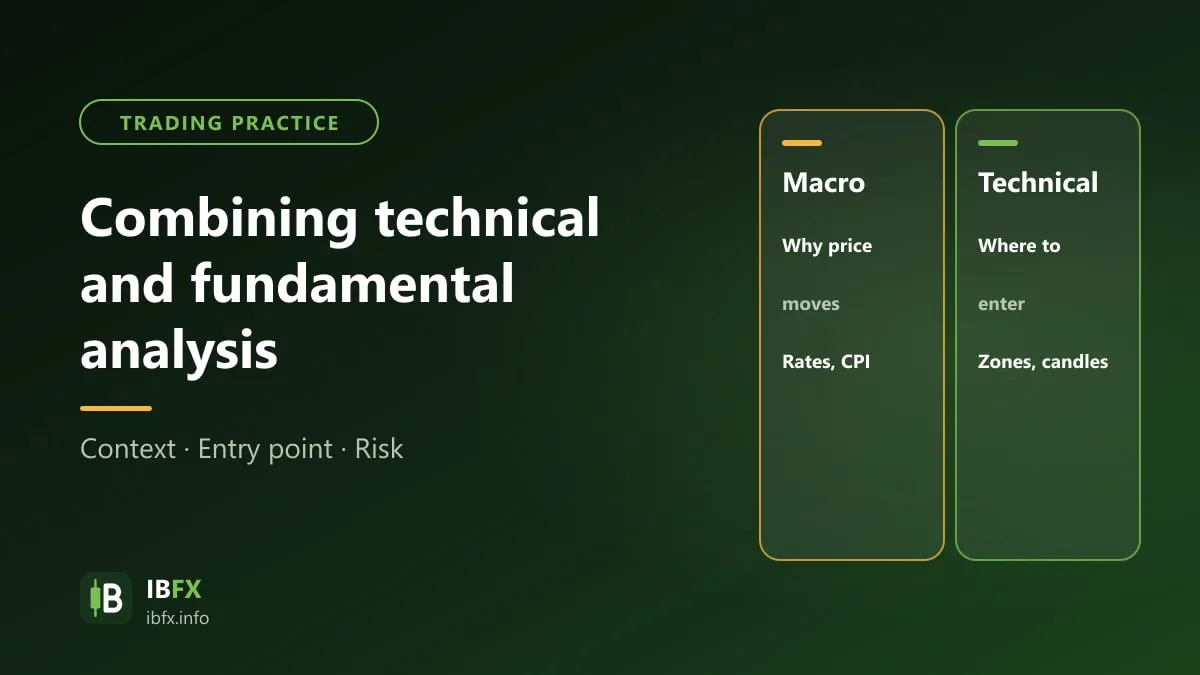
Forex traders, whether seasoned or new, usually combine fundamental analysis with technical analysis across all of their strategies. Fundamental analysis helps forecast the trend over the long run, while technical analysis helps you get a potential trading signal in the short run.
- How should a trader handle the time around a release?
When an important piece of news is about to be published, traders usually take one of 2 courses: either they simply watch and do not trade, waiting a while before they trade at all, or they work out which way price will move and trade the moment the news lands.
The first course tends to belong to traders who do not like risk, because when an important piece of news is published the move on the currency pair is very large: the gain is large if it works out, and the loss is just as large if it does not. On top of that, these traders are usually not confident in their own experience of fundamental analysis. A piece of news that has just been published demands that you react very fast; if you spend too long analyzing before you reach a conclusion, the effect of that news on price may already have changed, or the effect may only be momentary, lasting a few trading sessions around the release.
The second course belongs to traders who like risk and have plenty of experience of fundamental analysis in the market. They are looking for the large, immediate moves as the news lands. Trading around a release carries risks of its own, though: the spread widens a great deal, orders slip, and price can jolt hard in both directions within a few seconds and take out a stop loss before it goes the “right” way. A beginner should choose the first course: stand aside, or cut position size around the time of an important release.
What about you? Where do your risk tolerance and your experience stand?
In closing
Getting to grips with fundamental analysis in forex is far from easy, but you can still do it well if you are willing to build the knowledge methodically. Reading the economic press regularly, following the economic calendar and practicing your reading of how price responds to events will help you improve. See also: The factors that affect exchange rates.