On this page
How much money you need to trade forex is one of the first questions when you step into a market full of challenges but no less appealing and full of opportunity. Besides choosing the broker you will trade with, your entry strategy, your money management and so on, how much money you start trading with is also very important and decides whether your trading in the forex market succeeds or fails.
However, not all traders are alike or suited to the same method. Someone who trades in the Day Trading style (trading within the day) does not need as much money as a Swing Trader (trading medium-term trends). The amount you need to start trading forex is also set by your goal. Are you looking for a simple way to grow your capital through a broker with low fees, or are you looking for regular income from your forex investment?
Below we suggest reference capital levels for the different forex trading styles. This is not personal financial advice; only use money you can afford to lose.
How much money you need to trade forex – why does it matter?
Before we go deep into how much money you need to trade forex, we need to work out whether the question really matters. Are there big, important differences between trading a 100 USD account and a 3,000 USD account?
One of the problems many traders who are starting out in the forex market run into is that they are short of trading capital. Some forex brokers let a trader open a small account with only a few dollars, although the most common minimum deposit is 100 USD.
Face the facts if you want to start trading and bring cash flowing back to you. The reality is that many people do not have the patience to grow an account as small as 100 USD; they usually risk more, and one day they lose everything. Because they lack risk management skill.
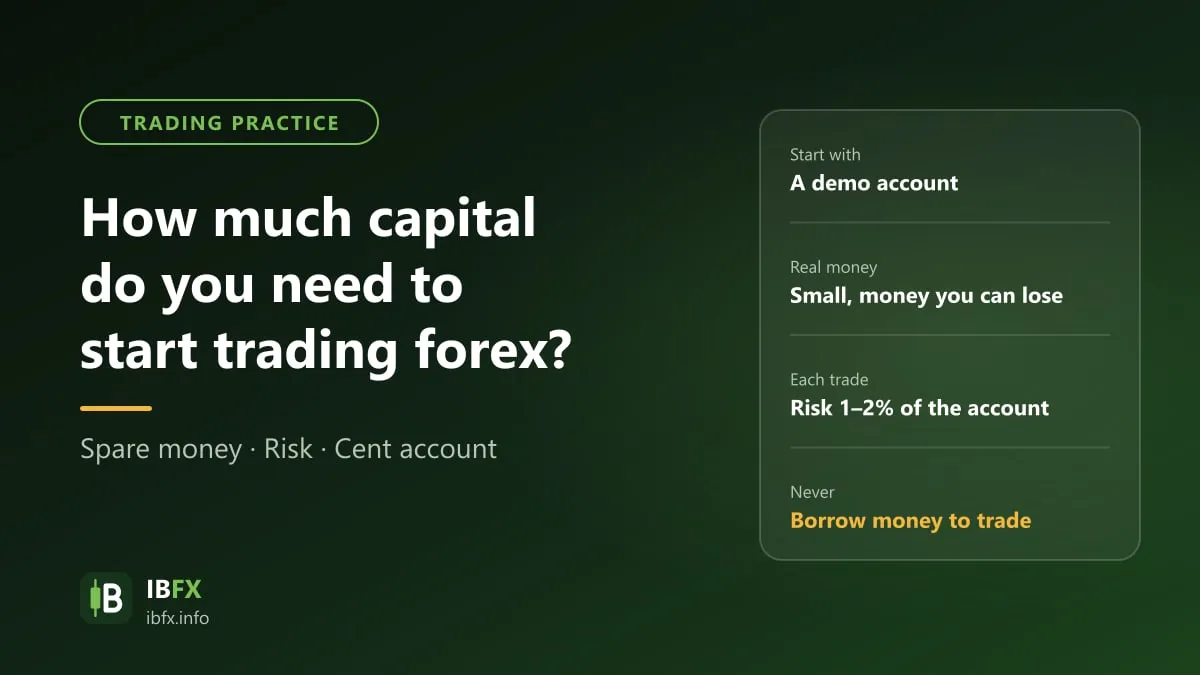
One piece of advice: if you want to survive in the forex market over the long run, you should risk only 1% (2% at most) per trade. If your account is 100 USD, you should risk only 1 USD per trade. With that amount you cannot open a 1 standard lot trade, but many brokers allow smaller position sizes such as a micro lot (0.01) or a cent account. Building an account this way is slow, but it keeps your account safer.
Another drawback of trading a small account is that you have little flexibility to adjust your position size. If you deposit 100 USD and follow the 1% risk rule, then with 1 micro lot (0.01 lot of EUR/USD, 0.1 USD per pip) you can only place a 10 pip stop loss. A 10 pip stop loss only suits very short-term trading, and even then price sweeps through it very easily; if you want to place the stop loss farther away and hold the trade longer, you need a bigger account.
When you are a new trader you should prepare enough money before you start trading forex; a more fully funded account helps you trade more properly.
How much money does a day trader need to start?
Technically, a day trader uses short stop losses and so can trade a small account. But if you want to day trade seriously with a flexible position size, many people suggest an account of 2,000–5,000 USD. Even so, skill matters more than the size of your capital, and a beginner should start small.
With a 3,000 USD account you should not risk more than 1% of your account per trade (that is 30 USD); likewise 1% of a 5,000 USD account is 50 USD.
With that as the amount you are willing to pay per trade, and 10 pips as the STOP LOSS point, a 5,000 USD account can open up to 5 mini lots (each mini lot is 1 USD per pip, 5 USD per pip in total). If you widen the STOP LOSS to 15 pips and keep the same 5 mini lots, each losing trade costs 75 USD, above the 1% level; at that point you have to cut the position size to about 3.3 mini lots. On the arithmetic, if you win 3 out of 5 trades at a RISK:REWARD of 1:1 with a 50 USD stop loss, you are 50 USD ahead. But this is only an illustrative calculation: holding a 60% win rate steadily is very hard, and the cost of the spread and commission has not been counted.
The above are only mathematical estimates, not an income you can count on; you can practice first on a DEMO account and follow your own trading results before risking real money on a live account.
You can also start with a smaller amount, say 500 USD, as long as you treat it as tuition money and keep the risk on each trade at 1%. Do not set yourself a target of making a fixed amount every day: with a small account that target will push you into increasing your position size and blowing up the account.
How much money does a swing trader need to start?
Swing trading is a style that holds a trade for a few days to a few weeks. This style suits people who do not like looking at charts constantly and who want to trade in the time they have free.
With swing trading you will have to try to catch the longer moves and therefore hold a position longer through the market’s swings, so placing the STOP LOSS too close is usually a poor fit for SWING trading. For SWING trading, traders usually place the STOP LOSS about 20 pips to 100 pips away on a trade, depending on your strategy and the currency pair you are trading (some pairs can be more volatile than others).
If you want to take a trade with a 50 PIP stop loss (STOP LOSS) and money management of 1% per trade, the minimum you can open an account with is 500 USD. That allows you to risk 5 USD per trade, which is 1% of 500 USD.
With a bigger account the profit or loss counted in dollars is correspondingly bigger, while the result still depends on your trading skill. Practice everything on a demo account before you decide to trade real money.
How much money does a long-term trader need?
The risk management ideas above apply in the same way to long-term traders; traders in this style usually do not trade often. But once they enter a trade they hold it for quite a long time, and the stop loss is also quite large in pips. For swing trading, 1% money management is good; for long-term trading, because the stop is so far away, some traders accept 2% at most. For long-term trading, a reference account is around 3,000–4,000 USD. This is because when we try to catch the big moves in the market we usually need to place the stop loss far from the entry. So sometimes an account that is too small will not be enough even if you enter with the minimum number of lots.
In this trading style, stop losses as large as 300 pips or 500 pips are normal; in exchange, when you catch a big trend the trade can run hundreds to more than a thousand pips, although trades like that are not frequent. Even if you enter with 0.01 standard lots, 300 pips already eats 30 USD of your money. So to keep money management at 1% with a 300 pip STOP LOSS you need a minimum account of 3,000 USD. If you are willing to risk 2% per trade you only need 1,500 USD of capital.
When you trade different currency pairs with different trading systems there will sometimes be differences, and the stop loss you need may be larger or smaller. This is why you should have a little capital to spare if you want really solid risk management at 1–2% per trade. For example: a trader thinks 1,500 USD is enough for him to trade long term. But trading in a highly volatile market, his trading system calls for a stop loss as wide as 500-600 pips. With 1,500 USD he will not be able to follow the 2% stop loss rule per trade; in that case he can choose not to trade, or risk more. From the example above we can see that preparing for cases like this is entirely necessary: you can choose not to trade, deposit more money, or take on a higher level of risk.
Your starting capital decides how much you profit or lose in dollars: at the same percentage, a bigger account gives a bigger number. But do not set expectations of a fixed monthly income; there will be stretches when you lose. So choose to go the long way with a low level of risk.
How much money you need to trade forex – in closing
What matters is that you are realistic about what you expect from your foreign exchange trading. How much money is in your account plays an important part in managing risk. If you do not have very much money, you can start with a 500 USD account. All the figures in this article come out of the same sum — the 1–2% you risk per trade divided by the stop loss distance of the style you pick — so they differ because the stop losses differ, not because there are four different recommendations: with a 50 pip stop loss, 500 USD is enough; with the wider stops of swing or long-term trading you need 3,000–4,000 USD; and a figure that leaves room in any style is around 1,000 USD. The article on the minimum capital to start trading works the same sum through with a different example. Choose the deposit that fits your finances and your purpose.
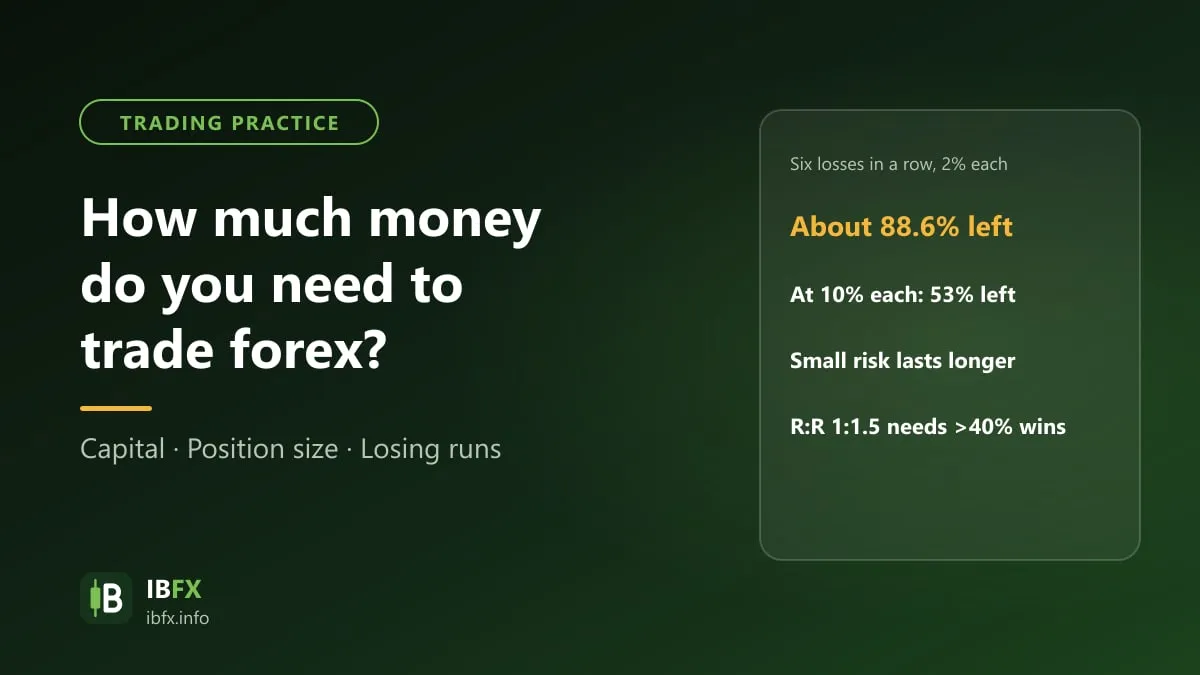
Many traders fail because they risk too much on each trade. Even traders with many years of experience go through stretches where they take a long run of losses, so if you risk too much on a single trade it is hard to go the long way in the forex market. You may make a great deal of money from the market in the future, but right now you have to make sure your trading account survives first. Suppose you risk 2% per trade and run into 6 losing trades in a row: the account falls about 11–12%. That drawdown is still small enough to make back; whereas if you risk 10% per trade, 6 losses in a row will cost you nearly half the account.
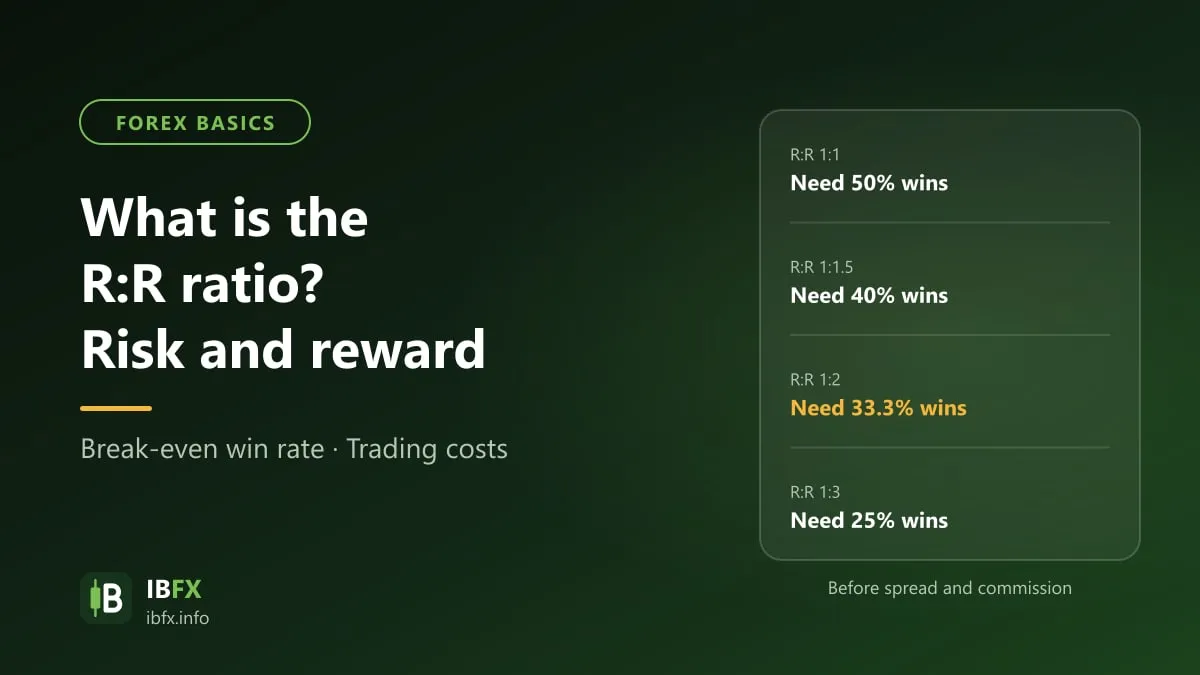
Another piece of advice is to set the take profit target farther away than the stop loss distance, for example 1.5 times as far. At a reward-to-risk ratio of 1.5:1, you only need to win more than 40% of your trades (before trading costs are counted) to be at break even. This is not always easy to do consistently, but following a trading system over the long run will help you more than trading on impulse. Combine a trading system, money management and mastery of your own psychology, and practice on a demo account before you trade for real.