On this page
- What are binary options?
- Why do people who trade binary options lose over the long run?
- Several countries have banned the sale of binary options to retail investors
- The common kinds of binary options
- The sales lines you will hear about binary options, and the facts
- If you have already put money into a binary options platform
- Conclusion
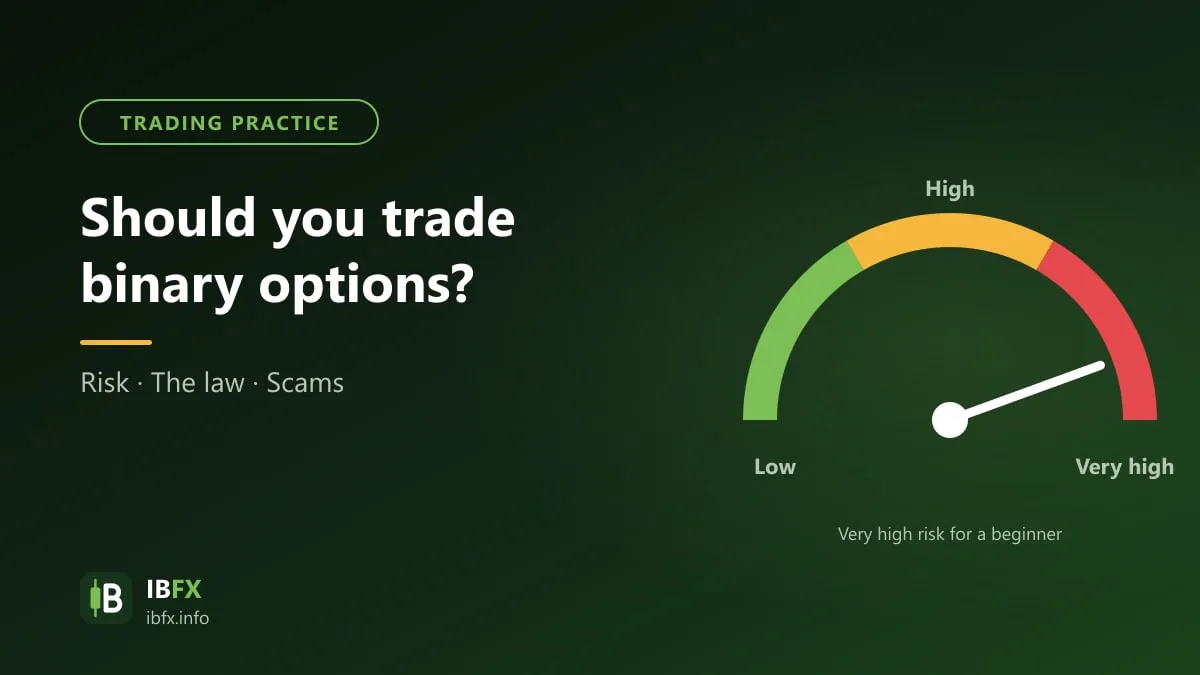
Binary options (BO) fill the advertising on social media: all you have to do is guess whether price goes up or down, and 30 seconds later you have the result. This article explains how binary options work, why the people who trade them lose over the long run almost without exception, and why the answer to the question “should you trade binary options?” is no.
What are binary options?
Binary options, often shortened to BO, are a way of betting on the direction price takes over a fixed period of time. When the time is up, which may be 30 seconds, 60 seconds or 15 minutes, you get your stake back plus a payout at a rate the platform sets, usually around 70–90% of the stake, if price went the way you picked. If price went the other way, you lose the whole stake.
Put another way, a binary option is not the purchase or sale of an asset. It is a bet on a yes-or-no outcome, much like a game of odds and evens.
Why do people who trade binary options lose over the long run?
The problem is built into the rules of the game. Say the platform pays out 80%: a win adds $0.80, a loss costs $1. To break even, you have to be right on at least 1 / (1 + 0.8) of your trades, which is about 55.6%. If the platform pays only 70%, that figure becomes about 58.8%.
Over 30 seconds or a minute, price movement is close to random. Being right 50% of the time is already hard, and staying above 55% across hundreds of trades is something almost nobody manages. That gap is the house edge, exactly as it is in a casino.
On top of that, on many binary options platforms the platform itself is the counterparty to every trade and supplies the prices as well. Whatever the customer loses, the platform wins, so the platform has no reason to want customers to win, and the customer has no way of checking whether the prices on the screen have been interfered with.
Several countries have banned the sale of binary options to retail investors
- The European Union: the European Securities and Markets Authority (ESMA) banned the marketing, distribution and sale of binary options to retail clients from July 2018; the member states, Cyprus among them (where CySEC issues licenses), then wrote the ban into their own rules.
- The United Kingdom: the FCA permanently banned the sale of binary options to retail consumers from April 2019.
- Australia: ASIC banned the distribution of binary options to retail clients from May 2021.
- Israel: a law banning the whole binary options industry was passed in 2017, after a number of companies based there were found to be defrauding customers abroad.
So a binary options platform that tells retail customers it “holds an FCA or CySEC license” is a warning sign: where retail customers are concerned, those authorities do not allow that product to be sold.
In Vietnam, binary options have no standing in law. A number of binary options platforms have been the subject of official warnings, and a number of related cases have been investigated. Someone who loses money on these platforms has almost no way of getting it back.
The common kinds of binary options
Up/Down (Call/Put, High/Low): you pick whether price will be higher or lower than the price at the time of the trade once the period you chose is over. This is the most common kind.
One Touch/No Touch: you pick whether price will touch a set level during the period you chose.
Range (In/Out): you pick whether price will be inside or outside a given range when the period is over.
Whatever the form, what is underneath is still a yes-or-no bet with a payout rate below 100%.
The sales lines you will hear about binary options, and the facts
| The sales line | The facts |
|---|---|
| “You are in profit in 30 seconds” | The shorter the period, the closer the result is to random; you can lose dozens of trades in the space of a few minutes. |
| “You know your risk in advance, so it is safe” | You know what each single trade can cost you, but because the payout rate is below 100%, the total you lose tends to grow with the number of trades. |
| “A private group, experts giving signals that win 80–90% of the time” | No signal service holds a rate like that; many of those groups make their money from commission when a newcomer funds an account. |
| “The platform has an international license” | The UK, the EU and Australia have banned the sale of binary options to retail customers; the “license” on display is usually nothing more than a company registration abroad or membership of a self-appointed association. |
| “Refer your friends and earn commission on several levels” | Commission on several levels is the mark of a multi-level scheme. |
If you have already put money into a binary options platform
- Stop sending more, including when the platform asks you to send money to “unlock withdrawals”, to “pay tax” or to cover a “withdrawal fee”: this is a standard trick.
- Try to withdraw what is left and keep all the evidence: the record of deposits and withdrawals, the messages with the person advising you, the transfer details.
- Be wary of “fund recovery” services that charge a fee up front: many of those services are a fraud in their own right.
- If your money has been taken, report it to the police where you live.
Read more: How to spot scams in the Forex market and The risks you need to know about when you invest in forex.
Conclusion
A binary option is, at bottom, a bet with a payout rate stacked against the person taking it, and several countries have banned its sale to retail investors. If what you want is to learn how to invest, stay away from binary options. If you want to understand the financial markets, start with the basics and practice on a demo account.