On this page
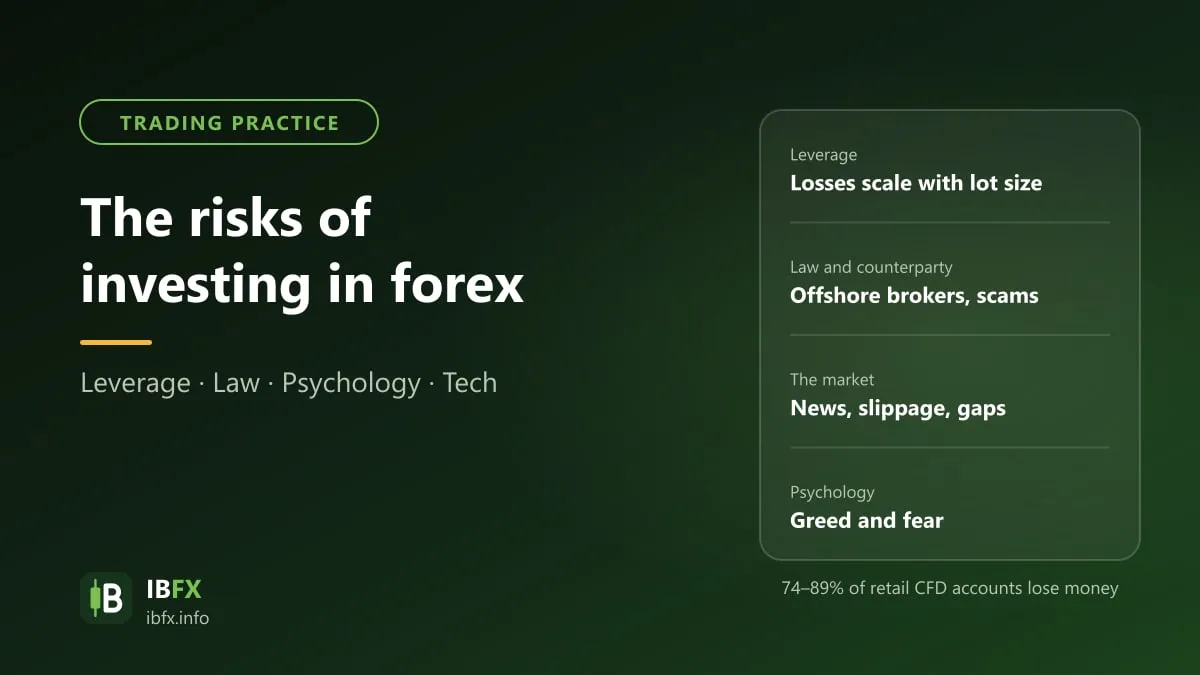
There are a great many risks in the foreign exchange market, in forex investing. If there were not, everybody would already be a billionaire. According to the disclosures ESMA has required brokers in Europe to publish since August 2018, somewhere around 74–89% of retail investors’ CFD accounts lose money; each broker publishes its own number, so read the figure on the site of the broker you actually use. Read carefully through the risks below before you join this market.
The risk of boredom and impatience
A great many new traders are drawn to forex because they think they can make a lot of money in a short time. But there are periods when the market moves sideways or barely moves at all, your trading system produces no signal, and of course no profit either.
Patience is essential. A bored trader easily abandons their own trading system, or takes positions with no basis simply to “have a position on”. If you cannot wait for a trading opportunity, the best thing is to step away from the charts for a while and rest until your spirits recover.
Psychological risk after a run of wins or losses
Everybody knows that a long run of losses is dangerous, but an investor also faces a large risk after a run of wins.
Once they have a number of successful trades behind them, many people become overconfident and make poor decisions: raising the position size too far, opening too many positions at once, and ignoring their own investment plan.
That is why investors always have to keep their psychology under control; otherwise it leads to trading on emotion. Always follow your investment plan and keep your emotions within bounds. See also: How to control your trading psychology.
Legal risk and counterparty risk
Trading forex through an overseas broker in Vietnam is not at present recognized or protected by law. When a dispute with the broker arises, or when the broker turns out to be a fraud, the investor has almost no way of getting the money back. See also: Is forex trading legal in Vietnam?
Counterparty risk is the chance that the broker itself runs into financial difficulty, goes bankrupt, commits fraud, or delays or refuses your withdrawal. Be careful of the “advisers” who keep phoning to talk you into depositing more money, into trading a large position size, or into handing your account over for them to “manage”, because that can leave you with nothing at all of the money you invested. See also: How to spot scams in the Forex market.
Political and social risk
Political and social instability - elections, conflict, war, strikes - or sudden policy decisions by governments and central banks can send exchange rates swinging very hard within a short space of time, well beyond anything that was predicted.
Technical risk
This is the risk of losses caused by faulty information, by the internet connection, by the trading software, or by the broker’s systems.
A system failure can mean that your order is not filled the way you placed it, or is not filled at all, and the one who suffers is usually you.
At times of overload - when important macroeconomic figures are released, for example - you may also find it hard to connect to the trading software at exactly the moment price is moving the most.
Market risk and liquidity risk
Price risk is the risk of losses from unfavorable price movements. Currency pairs, gold and oil can all move considerably during the day, so every position can end in a profit or in a loss.
News on interest rates, inflation and other important economic figures usually moves price sharply, and can sweep through your stop loss in a matter of seconds. See the IBFX guide on the things to watch out for when trading forex on the news.
Liquidity risk is when the market is short of buyers or sellers at a given moment - at the open at the start of the week, on a holiday, or when news comes out - so that the spread widens and orders are filled at a worse price. A wide spread can trigger a stop loss or a pending order early, or fill it at a worse price than you expected.
On top of that, if your trading account is denominated in USD, you carry exchange rate risk as well when you convert profit and loss back into your local currency.
The risk of using leverage
Both forex and CFD trading use leverage, so even small movements in the market can have a large effect on the trading account.
Leverage lets you open a position far larger than the margin you put up: if price goes your way, the profit measured against your capital is very large; but if price goes against you, the loss is correspondingly large, and can take most or all of the account.
Some products, such as gold, oil and the cross pairs, usually move within a wide range during the day, so an investor has to weigh them up carefully, because both the risk of loss and the potential profit are very large.
The prices of foreign exchange, gold, oil and the rest can swing very fast and very widely, reflecting events or changes that cannot be foreseen and that no individual or institution controls.
Worse still, under certain market conditions a trader’s order may not be executed at the price they wanted, which leads to a loss, because of slippage when the market is moving hard or liquidity is thin; and the higher the leverage, the larger the loss that slippage causes.
The prices of these assets are also affected by supply and demand, by trade policy, by domestic and international economic and political events, and by market sentiment. That is why setting a stop loss is always very important - more important even than looking for a profit.
Use low leverage relative to what you can afford to lose (many regulators cap leverage for retail clients at 1:30 on the major currency pairs: ESMA from August 2018, which the national regulators across the EU then wrote into their own rules, the UK FCA from August 2018, and ASIC in Australia from Mar 29, 2021), always put a stop loss in place, have a clear plan for taking profit, and choose a broker with a negative balance protection policy, so that your loss does not go beyond the amount you have deposited.