On this page
- 1. Global crises
- 2. Inflation
- 3. The value of the US dollar
- 4. Central bank policy
- 5. Interest rates
- 6. Quantitative easing (QE)
- 7. National gold reserves
- 8. Jewelry and industry
- 9. Gold supply and the cost of production
- 10. Overall supply and demand
- 11. Gold exchange-traded funds (ETFs)
- What should a trader follow when trading gold?
Gold is one of the most unusual commodities there is: it is not only made into jewelry, it was once the standard of value for currencies the world over. Like oil, gold is very sensitive to geopolitics and to the news, and the price can swing hard because of forces outside it. If you want to know which factors move the gold price on the market, read on.
1. Global crises
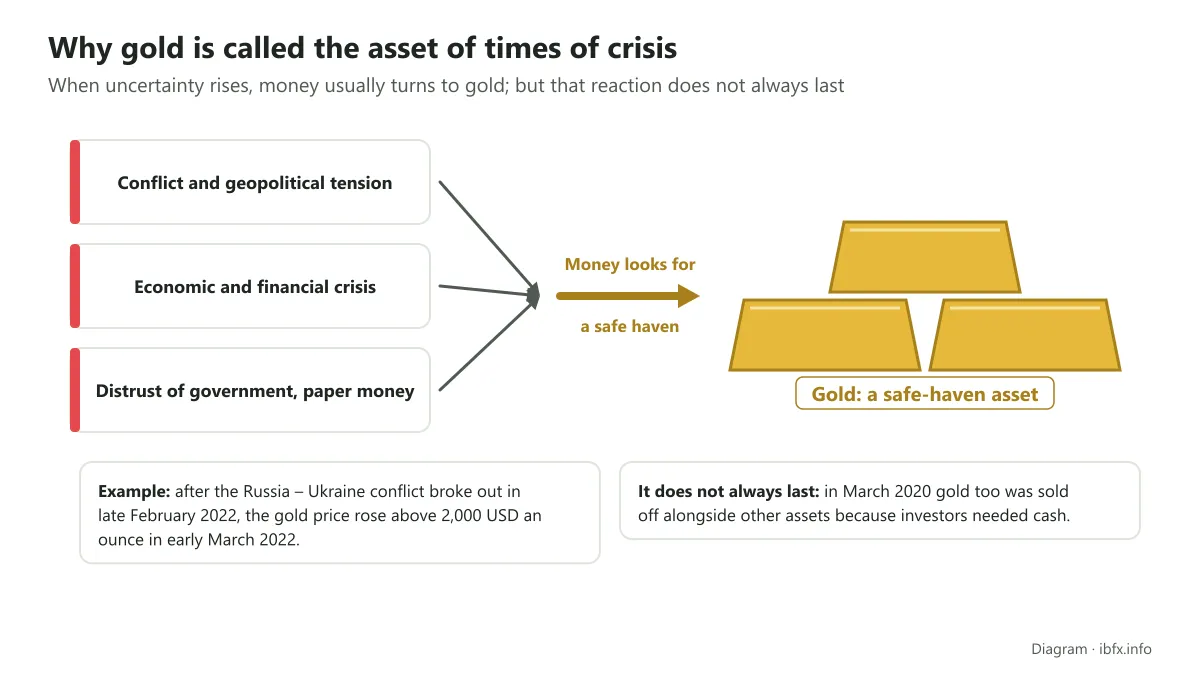
Gold usually rises when people lose confidence in governments or in the financial markets, which is why it is so often called the asset of times of crisis. Against a background of economic or geopolitical instability, money tends to look to gold as a safe haven. For example, after the Russia – Ukraine conflict broke out at the end of February 2022, the gold price rose above 2,000 USD an ounce in early March 2022.
Even so, that reaction does not always last: when the level of worry eases, the gold price can correct quickly, and in the most extreme panics, such as March 2020, gold too was sold off alongside other assets because investors needed cash.
2. Inflation
A great many people hold gold because they see it as a hedge against inflation and against the loss of value in paper money. Paper money can lose value over time, while over the long run gold holds its purchasing power rather well.
One example often brought up: measured in gold, the income of a soldier in ancient Rome and that of a modern soldier are not so far apart, while measured in paper money the difference is enormous. The exact figures differ from one source to another, but the point is that over a very long span gold holds its purchasing power better than paper money does.
Even so, over the short and medium term the gold price can still fall sharply and sit still for years, so gold is not always an effective tool against inflation.
3. The value of the US dollar
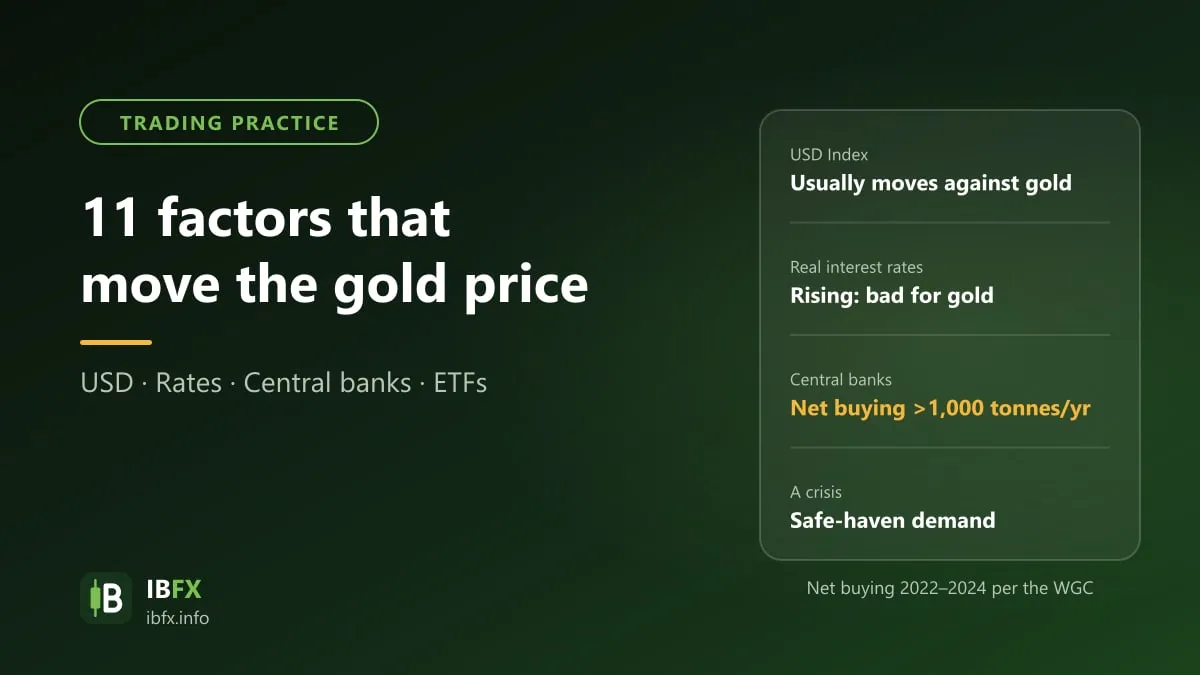
Thanks to the size of the US economy, the US dollar is the largest reserve currency in the world. The world gold price is quoted in USD, so gold and the dollar are usually inversely correlated: when the dollar strengthens, gold usually weakens, and the other way round. In 2022, for instance, the USD Index rose to its highest level in about 20 years (around 114 points at the end of September), while the gold price fell to around 1,620 USD an ounce. Read more: What is the US Dollar Index?
This relationship is not fixed: there are periods in which gold and the USD rise together, when other forces such as geopolitical tension or central bank demand weigh more heavily.
4. Central bank policy
Besides the US Federal Reserve (Fed), the large central banks such as the European Central Bank, the Bank of Japan and the Swiss National Bank all play an important part in setting monetary policy. When the market worries that policy is not working, or that money is being loosened too far, many people move into gold. In forex trading, every time the Fed announces a rate decision or signals a change of policy, gold is usually one of the products that moves most.
5. Interest rates
Gold pays no interest the way a bond or a savings deposit does, so interest rates bear directly on how attractive gold is. When rates rise, the opportunity cost of holding gold rises with them, many people move into things that do pay interest, and the gold price usually comes under pressure. When rates fall, the opportunity cost is lower and gold becomes more attractive.
More precisely, the market tends to follow real interest rates, that is bond yields minus inflation (for example the yield on 10-year US inflation-protected government bonds, TIPS). Rising real rates are usually bad for gold and falling real rates usually support it, although this relationship too breaks down at times.
6. Quantitative easing (QE)
Quantitative easing (QE) is a policy under which a central bank buys bonds and other financial assets on a large scale in order to pump money into the system, bring long-term rates down and encourage lending. Besides the Fed, the Bank of England, the Bank of Japan and the European Central Bank have all used this policy.
The large amount of money put into the system pulls rates down, which lowers the opportunity cost of holding gold, and at the same time it raises worries about inflation, so it usually supports the gold price. The other way round, when the Fed ended the QE3 program in October 2014 and the market began to expect the Fed to raise rates, the USD strengthened and the gold price came under downward pressure.
7. National gold reserves
Central banks and governments hold a large amount of gold in their national reserves. The United States, Germany, Italy and France have the largest gold reserves. In recent years many central banks, such as those of China, Poland, Turkey and India, have been steady net buyers of gold; according to the World Gold Council (WGC), central banks bought a net of more than 1,000 tonnes a year over 2022–2024. When central banks buy more than they sell, the amount of gold available on the market falls, which helps push the gold price up.
8. Jewelry and industry
Gold is not only a safe-haven asset, it is also used in jewelry and in industry. Close to half the annual demand for gold comes from jewelry, and China and India are the two largest consumer markets. In India gold is seen as a measure of wealth and as a valuable gift at weddings and festivals, so demand usually rises with the wedding season and with the large festivals such as Diwali. Jewelry demand is sensitive to price, though: when the gold price climbs too high, buyers usually buy less.
Besides jewelry, the electronics industry needs a certain amount of gold too, about 7–8% of total demand, to make electronic components, computers, phones and medical equipment.
9. Gold supply and the cost of production
According to World Gold Council figures for 2017, total demand for gold was 4,071.7 tonnes, of which 2,135.5 tonnes went into jewelry, 332.8 tonnes into technology and 1,029.2 tonnes into bars and coins, while ETFs bought a further 202.8 tonnes and central banks bought a net 371.4 tonnes. Compare that with 2001, when the gold price was at its lowest in about 20 years and jewelry demand was 3,009 tonnes, investment 357 tonnes and technology 363 tonnes. You can see that the share taken by investment demand and by central banks keeps growing.
On the supply side, mine output in recent years has been about 3,600 tonnes a year, plus recycled gold, while the total amount of gold ever mined is estimated at more than 210,000 tonnes. Because the amount newly mined each year is fairly small next to the total stock of gold, supply cannot rise quickly when demand jumps. The cost of mining also acts as a long-term reference point: if the gold price stays below the cost of production for a long time, the less efficient mines have to scale back and supply gradually falls.
10. Overall supply and demand
People have been mining and using gold for thousands of years, and gold still holds a special place in the financial system today. If you plan to buy gold, you need to understand that the gold price is the combined result of many factors: the cost of production, the money supply, financial or geopolitical instability, demand from jewelry, industry and investment, and what the central banks are doing.
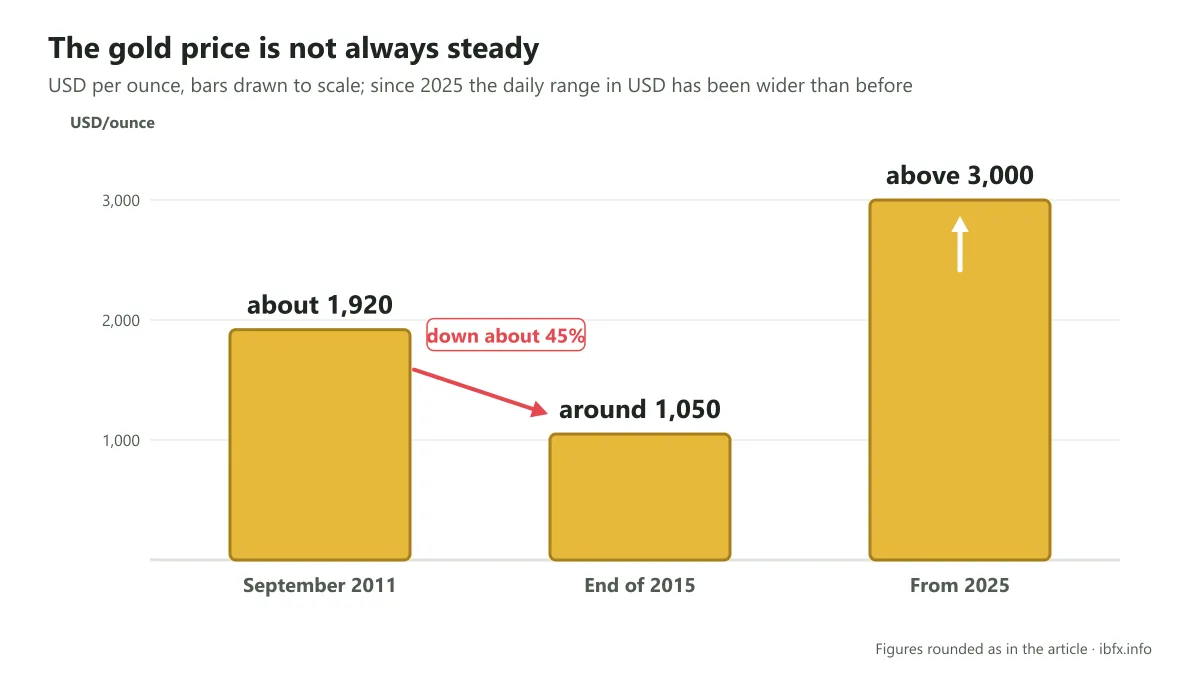
Gold is a finite resource, so when conditions in the world economy make gold attractive, rising demand pushes the price up. Even so, the gold price is not always steady: after it peaked at about 1,920 USD an ounce in September 2011, it fell by about 45% to around 1,050 USD an ounce at the end of 2015. Since 2025 the gold price has been above 3,000 USD an ounce, and the daily range measured in USD is far wider than it used to be.
11. Gold exchange-traded funds (ETFs)
Alongside the central banks, gold ETFs such as SPDR Gold Shares (GLD) and iShares Gold Trust (IAU) let investors buy gold through fund shares. These shares are listed on the US stock exchanges, and each one stands for a small quantity of gold (with GLD it was 1/10 of an ounce at the start) held in the vault of a custodian bank. These are two of the largest gold funds in the world; SPDR Gold Shares alone holds hundreds of tonnes of gold, and at times has held more than 1,000 tonnes.
Because they hold so much gold, when money is pulled out of these funds or poured into them in a rush, the gold they sell or buy can have a real effect on the gold price. Following the gold held by the large ETFs is one way to judge the flow of investment money into gold. Read more: “What is an ETF?”
What should a trader follow when trading gold?
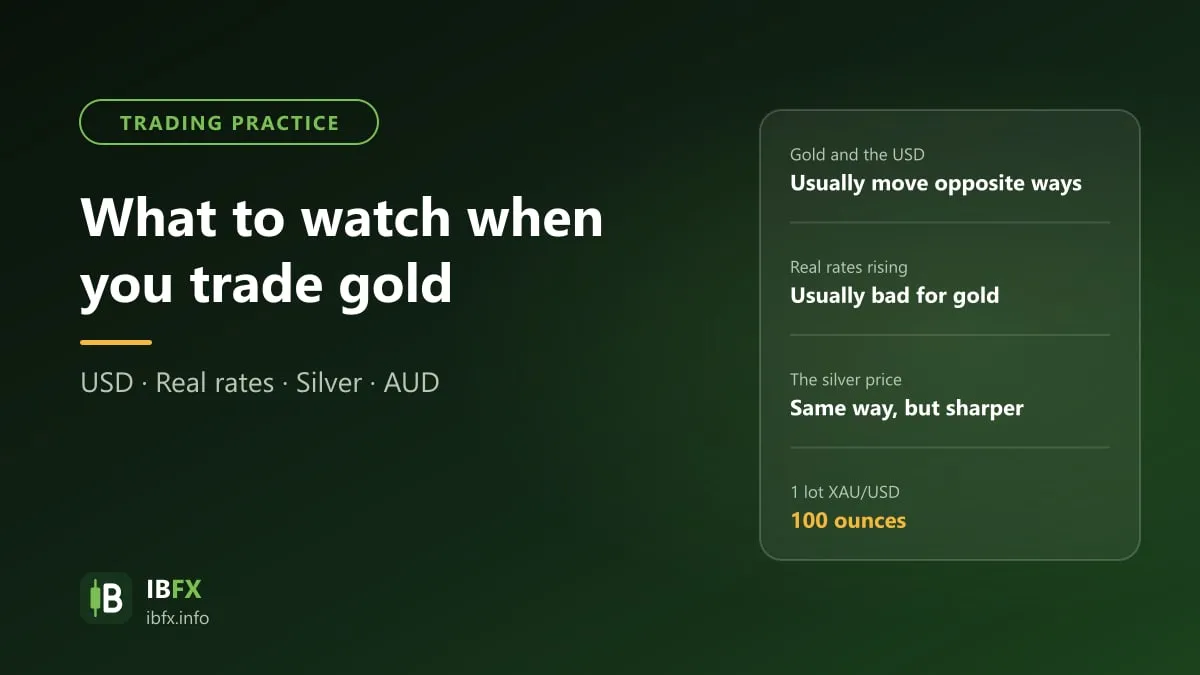
- The USD Index and US bond yields, real interest rates above all.
- Fed decisions and speeches, and the important US economic figures such as the CPI and Non-Farm Payrolls, on the economic calendar.
- Geopolitics and the risk appetite of the market.
- The quarterly WGC gold demand report and the gold held by the ETFs.
No single factor decides the gold price on its own, and the relationships above can change from one period to another. Gold moves very violently, so when you trade it always place a stop loss and use a small position size. Read more: Important points to watch when you buy and sell gold, What experience teaches about trading gold (XAU/USD)