On this page
Why do so many traders in the forex market lose as much as they do? Most individual traders end up losing money when they trade forex and CFDs: according to the disclosures ESMA has required brokers in Europe to publish since August 2018, about 74–89% of retail investors’ CFD accounts lose money. That range is the figure from that period, and each broker publishes its own number, so read the figure on the site of the broker you actually use. Is it because forex brokers “play dirty”? And have you ever asked yourself how you could get into the group of traders who end up with a profit?
In this article we will look together at how important the position size is in forex, and at an example of what position size a 500 USD forex account can trade safely. And so you want to become a forex trader and are asking yourself how much you should put into trading? Let’s find out.
To start trading forex
To get familiar with forex trading, you need to study the Forex guides as methodically as you possibly can, and find a trading method that suits you.
Once you have a trading method that suits you, do not rush to deposit money and trade for real at any forex broker at all; open yourself just a demo account, that is, a forex simulation account, because remember that there are forex demo accounts that let you practice trading without spending a cent, and a demo account will let you open and set up the kinds of position used in forex trading exactly as a live account does.
Preparing your knowledge and your mindset for a live account (Live Account)
Once you have prepared enough knowledge and worked carefully through your trading methods on a demo trading account, and if you are ready to trade a live account, you should know that the amount you need to start trading depends on the type of account you choose. This requires you to be certain how much money you can put into investing; you should not put all of your money into forex.
Take a simple example: if you have little money, only 100-200 USD, or you have plenty of money but only want to invest a small sum like that, you can open a micro account to trade with, or some brokers have cent accounts, mini accounts and so on for new investors.
For example, say you open a 100 USD mini forex account; then you should only open trades with a position size of 0.01 lot, and do not forget to use sensible leverage.
In the same way, if you can trade several positions at once and your money can be considerably larger, you can choose account types such as Standard or Professional, which are the types of account the forex brokers provide. There are a great many forex brokers today providing financial services such as currency trading, gold trading or stock trading, and choosing a broker with a full record of trust should also be considered carefully.
Pay attention to the money you have put up as margin when you trade
In forex trading, your margin deposit determines the size at which you trade.
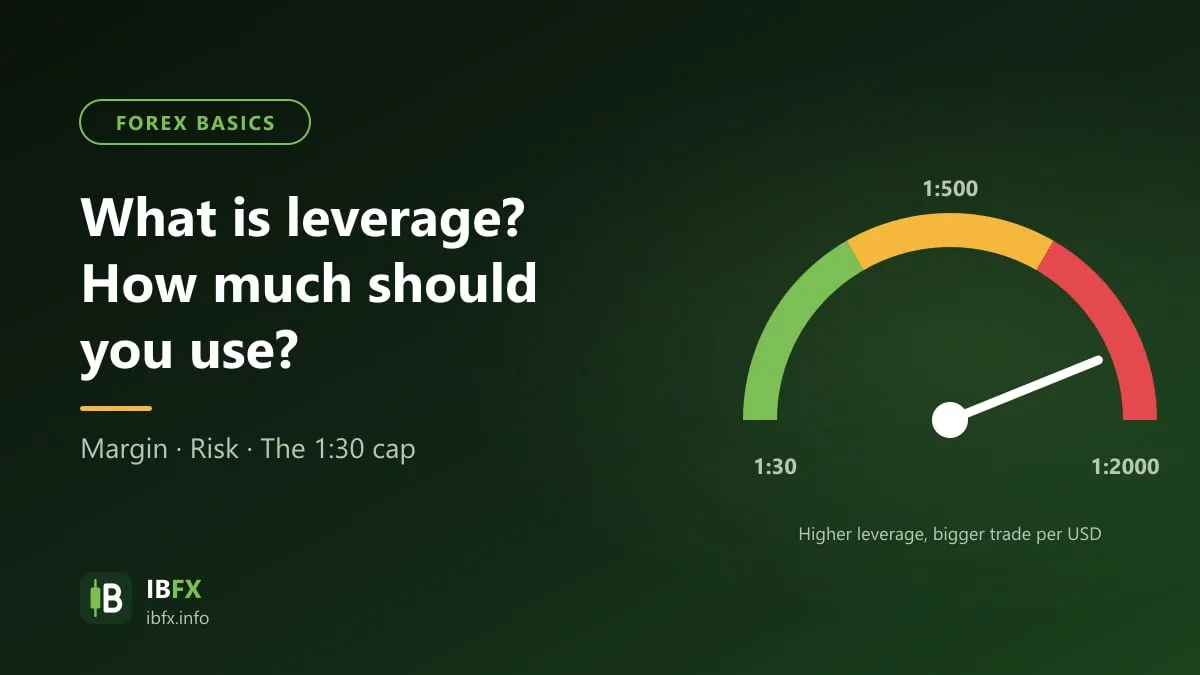
Consider an example where you open a micro account with a first deposit of 50 USD, and trade the minimum position size of 0.01 lot. Since 1 standard lot is 100,000 units of the base currency, 0.01 lot corresponds to 1,000 units; if you use leverage of 1:1000, you only need about 1 USD as the margin for the trade. (Leverage that high is usually only found at offshore entities; in the EU, retail investors are capped at 1:30 on the major currency pairs.) Low margin means you can open a trade far larger than your account can take in losses, and that is exactly the trap of high leverage.
Suppose you enter a 0.01 lot EUR/USD trade on a 50 USD account; the margin is only about 1 USD. In theory the balance left would let you open dozens more trades like that, but that is the fastest way to blow up an account: margin is only the deposit that lets you open the trade, while the amount you can lose depends on the position size and the stop loss distance.
And how does your money go up and down?
On a 0.01 lot trade, for each pip the EUR/USD price moves, your account gains or loses 0.1 USD. That is, if it goes the way you predicted, you gain 0.1 USD per pip; the other way round, if it goes against your prediction, you lose 0.1 USD.
Reference position sizes by account size
Below is how the position size is worked out from the level of risk for each size of account. The examples use the EUR/USD pair, where 1 pip on 0.01 lot is 0.1 USD. Many professional traders accept a risk of only 1–2% of the account on each trade; the higher risk figures below are only there to illustrate why they are dangerous.
+ If you open an account and deposit 50 USD.
At 2% risk per trade you may only lose 1 USD, which is 10 pips if you enter 0.01 lot, a stop loss distance far too narrow for most strategies. If you raise it to 10% (5 USD), 0.01 lot allows a 50 pip stop loss, but then it only takes 10 losing trades in a row to lose almost the whole account.
Put another way, a 50 USD account is barely enough to trade 0.01 lot at a safe level of risk. If the broker has a cent account (position sizes smaller than 0.01 standard lot), that is a more sensible choice for practicing trading with real money.
+ If you open an account and deposit 200 USD.
2% risk comes to 4 USD. With 0.01 lot (0.1 USD per pip), you can place a 40 pip stop loss. If you enter 0.1 lot (1 USD per pip), 4 USD only corresponds to a 4 pip stop loss, which ordinary volatility would almost certainly sweep through, so 0.1 lot is far too large for a 200 USD account.
A larger position size makes the profit grow faster, but the loss grows at exactly the same speed.
For example, entering 0.1 lot with a 40 pip stop loss means each losing trade costs 40 USD, that is 20% of the account: it only takes 5 losing trades in a row to lose it all. This is a level of risk you should not use.
+ If you open an account and deposit 500 USD.
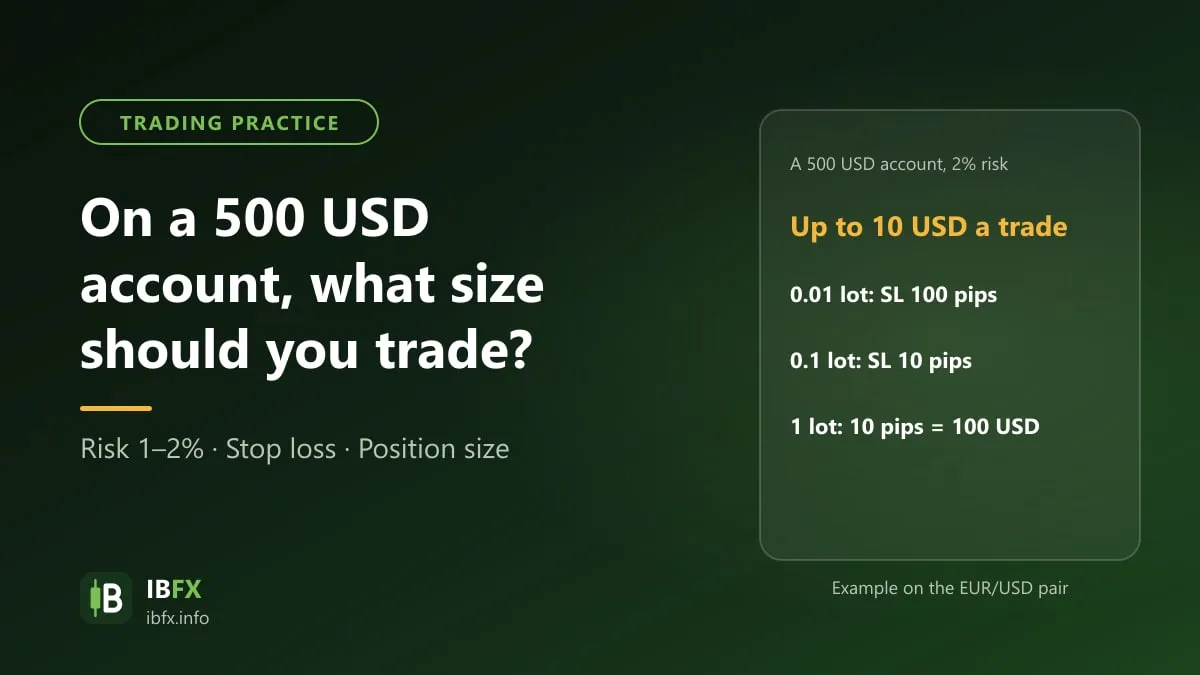
1% risk is 5 USD, 2% risk is 10 USD. With 10 USD of risk: entering 0.01 lot (0.1 USD per pip) allows a 100 pip stop loss, 0.02 lot (0.2 USD per pip) allows 50 pips, and 0.05 lot (0.5 USD per pip) allows 20 pips. So with a 500 USD account, a sensible position size usually falls in the 0.01–0.05 lot range depending on the stop loss distance, and it should be worked out again every time the balance changes.
The general formula: position size (lots) = the amount you accept losing ÷ (the stop loss in pips × the value of 1 pip of 1 lot). On EUR/USD, the value of 1 pip of 1 lot is 10 USD.
+ For opening an account and depositing 1,000 USD
If you open an account and deposit 1,000 USD, you can choose the position size more flexibly, but the risk principle stays exactly the same.
2% risk comes to 20 USD. With 0.1 lot (1 USD per pip), you can place a 20 pip stop loss; with 0.05 lot it is 40 pips. If the take profit target is 3 times the stop loss distance, one winning trade brings in about 60 USD. Leverage of 1:1000 or 1:100 does not change these profit and loss figures; it only decides how much margin is held back when the trade is opened.
One extremely important point is to keep an eye on the free margin you have left, so as to avoid a Margin Call and having trades closed automatically if the margin runs short. A margin call means the account no longer has enough margin to keep the open trades running; if the margin level falls to the stop out level, the broker will automatically close some of the trades (usually the one with the largest loss), unless you deposit more money. Do not let your account get into this state; the stop loss has to be placed beforehand.
Conclusion
Opening a forex account is not hard, and a few dozen dollars is enough to open one. But as the examples above show, an account that is too small is very hard to trade at a safe level of risk. Assess your own knowledge, experience and goals, and choose the position size from the amount you accept losing on each trade, not from the free margin you have left. Larger capital lets you choose the position size more flexibly, but it does not reduce the risk if your money management is poor.
Forex trading can bring a profit but it always carries the risk of a loss, even for people who have the knowledge. Practice on a demo account, always place a stop loss and only use money you can afford to lose. See also: the 2% money management rule