On this page
When hedging comes up in forex trading, many people think straight away of opening a position in the opposite direction to the one they already hold on the same asset. That is the nature of it, but hedging is far from simple, and a great many people misunderstand it, which leads them to apply hedging strategies wrongly or to no effect.
Professional traders usually do not hedge in that basic way. Their hedging is more involved, and the range of assets they use in their hedging strategies is wider.
In this article we will introduce the hedging strategies that are common in forex trading, along with the risks and the costs that come with them. Read on.
First, though, you need a clear understanding of what hedging in forex is. And why does a trader want to hedge in forex trading?
What is hedging?
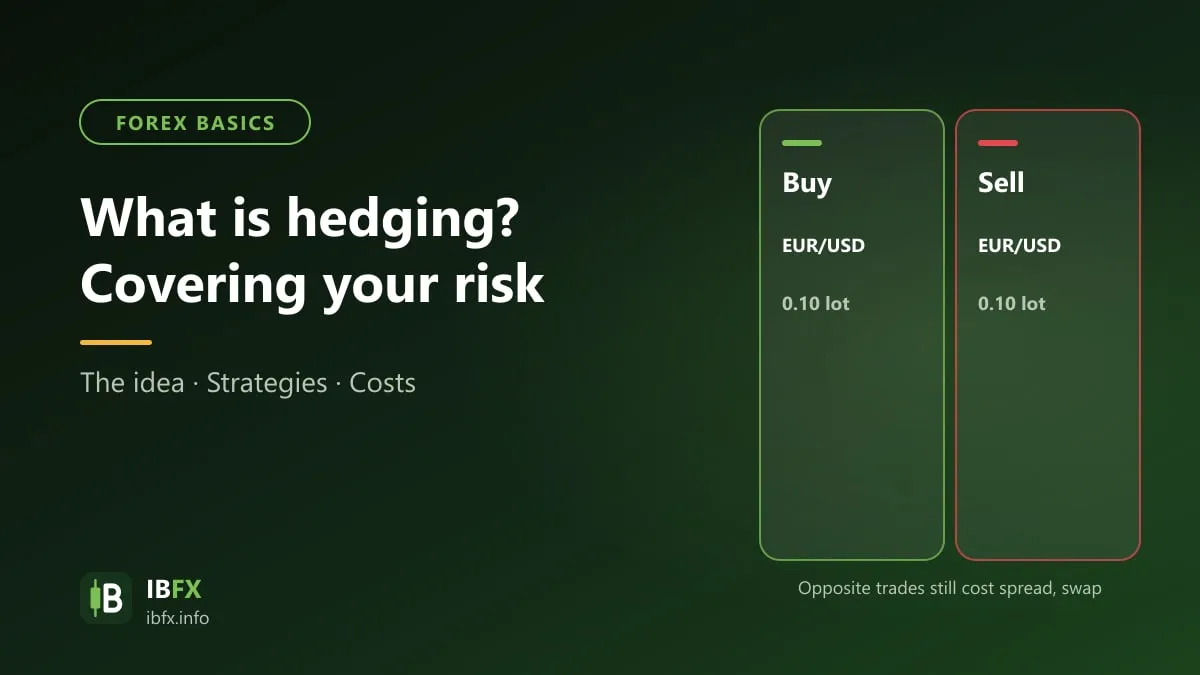
Hedging, put simply, is when you open a new position (the hedging position), a new trade, with the aim of offsetting the risk on your current position in case the market is moving in a direction that works against that current position (the main position).
In a typical trade, a trader uses a stop loss to cap the loss if the market does not move as expected. Hedging is another way of cutting the effect of an adverse move, but it does not replace the stop loss: without a plan for getting out, hedging only puts off the moment you accept the loss.
When the market moves hard in particular, price will move in a direction that works against the trade and the trade may well be stopped out early. So, by opening an opposing position, a trader can hold on to the current position (the main position) while waiting for price to come back to the larger trend. If price keeps going the wrong way, the profit on the hedging position offsets the loss on the main position. If price returns to the expected trend, the hedging position starts losing money, so the trader has to close it at the right moment: hedging does not make money in both directions, and each trade costs an extra spread and swap.
What is the principle of hedging in forex trading?
As said above, hedging strategies have the same aim as a stop loss: capping the damage. The difference is that a hedging position can be in profit while price moves the wrong way, offsetting part of the loss on the main position.
Most new traders, and even people who have been trading in the market for a while but have never used a hedging strategy, misunderstand the principle of hedging in forex trading. They usually place a trade of the same size and in the opposite direction to the main trade at the very same moment. For example, right after filling a Buy on GBP/USD of 1 lot, they immediately place a Sell of 1 lot on GBP/USD as well. Like the picture below:
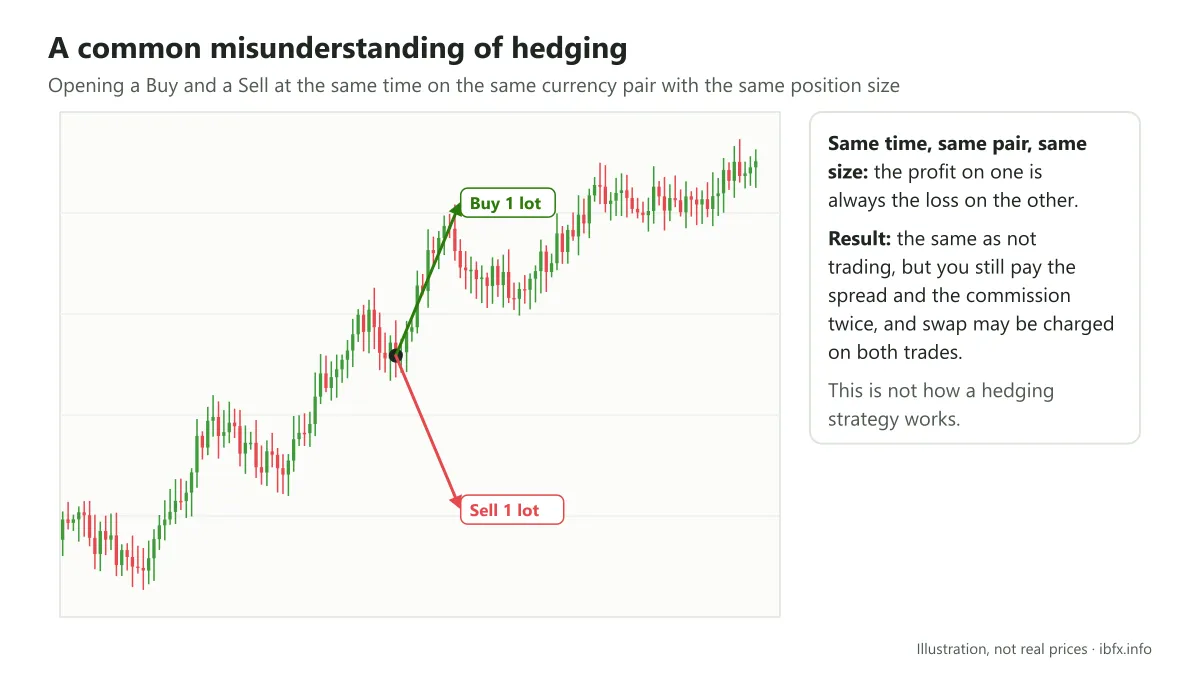
This, though, is not how a hedging strategy works. Opening a Buy and a Sell of the same size on the same currency pair at the same time means the profit on one is always the loss on the other: the result is the same as not trading, but you still pay the spread and the commission twice and may be charged swap on both trades.
One more thing to note: not every broker lets you open opposing trades on the same currency pair. Clients in the US, for example, are barred from doing so under the FIFO rule (the position opened first must be closed first).
With a broker that does allow it, hedging on the same currency pair means the trader holds a buy and a sell at the same time over a certain stretch. Hedging is usually used to pause the profit or loss on the main position while the market moves against the expected direction. Suppose the market is going up and you are short: to hedge, you can place a buy order to hold that short position for the time being until the market turns back in your favor. But that is only a small corner of hedging, given here so that you can picture it more easily.
Example:
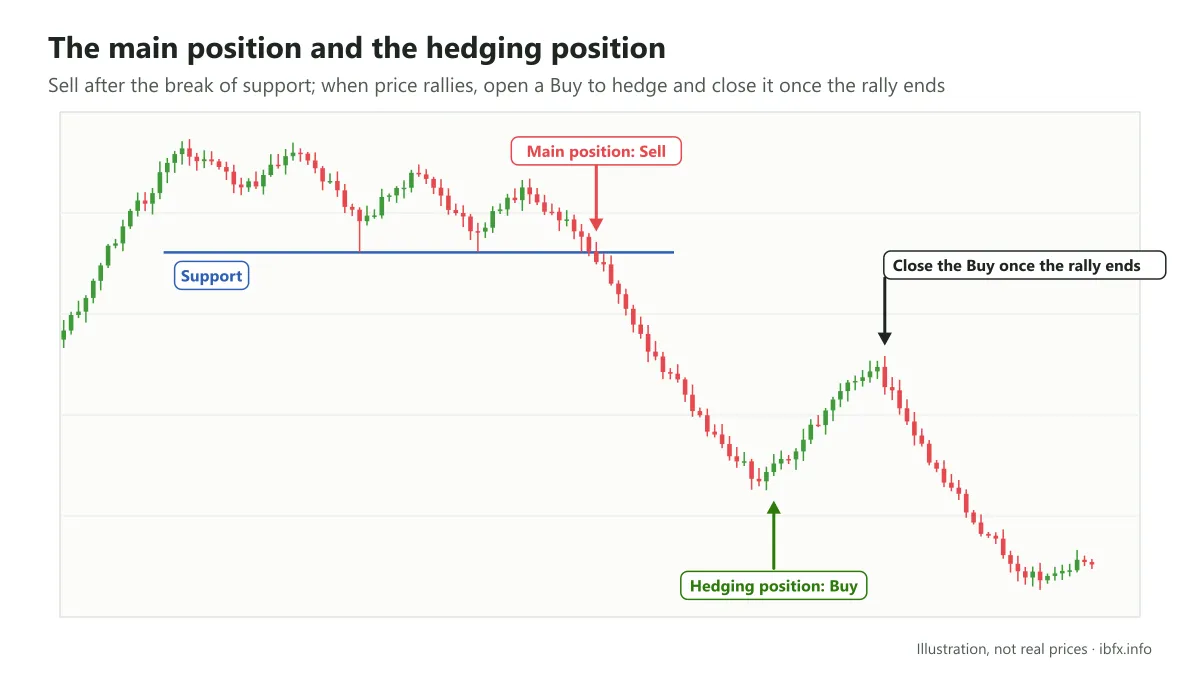
After price breaks out of support, the trader opens a Sell. After price has fallen for a while as expected, the market starts to rally. To hedge the sell position, the trader opens a buy position based on that upward pullback. The hedging position is closed once the pullback ends and the market carries on with the downtrend. In terms of the result, this is close to taking part of the Sell off and getting back in after the pullback, but it costs more; and if you get the end of the pullback wrong, both trades can lose money.
Another mistake people make with hedging strategies is to think that once they have hedged, the risk is gone, so a trader will often hold the hedging position for a very long time, which is not accurate at all. Holding a hedging trade too long brings in many other costs, swap among them, and sometimes these costs lead to a large loss, which makes the hedging strategy pointless.
Why does a trader want to hedge in forex trading?
Clearly, carried out well, a hedging strategy helps a trader cap the damage. That is the biggest reason traders use hedging in forex trading.
Although nothing guarantees that the risk will be removed, hedging done correctly can help cap the risk at a particular level over a particular stretch.
Professional traders mainly use this strategy when they expect the market to come back in favor of their positions after a move against them. Rather than having to close the trade completely when the market reverses, they take a trade in the opposite direction. Even so, this approach only makes sense when you have a clear plan: when to close the hedging position, and when to accept closing the main position too if you have read it wrong.
Besides that, there are many other reasons traders always want to use hedging strategies in foreign exchange trading.
First, the hedging tools are varied. Beyond opening an opposing position on the same currency pair, a trader can use other instruments to carry out a hedging strategy. Among them, derivatives such as options and futures are common hedging tools for institutions and professional traders. These derivatives are usually used in short-term strategies to cut the risk on long-term positions.
Second, some hedging tools can lock in a profit effectively for a trader’s position. In this case, hedging brings a benefit even over the long run.
Third, hedging strategies save a trader time watching their portfolio. Because once a hedging strategy is in place, the short-term adverse price moves have been dealt with. So the trader no longer has to worry much about the small daily swings on their long-term position.
What are the risks of hedging?
Of course, a hedging position is also a financial trade, so it carries risk in itself.
First, a hedging strategy that is to work well needs confidence and solid experience. So, carried out wrongly, hedging will cost a trader more than it cuts their risk.
An example: take the hedging strategy of opening an opposing position on the same currency pair. You have a Buy running because you expect the market to rise. But the moment there is a sign of a downward correction, you immediately open a Sell to hedge. When price corrects down with no sign of stopping, there is a good chance you will close the Buy because it is now in a loss. But right after you close the Buy, the market reverses upward, and because you regret not holding the Buy longer you decide to open a new Buy, which is now a hedging position against your current Sell. And this vicious circle may well repeat over and over, and you will lose even more.
Second, the profit may not cover the cost of hedging. Whichever hedging strategy you carry out, transaction costs go up a great deal, especially with strategies that use derivatives. A hedging strategy that fits will protect a trader from a large loss over a short stretch and will not cut too far into their long-term profit potential.
Third, hedging strategies usually do not work in a sideways market (price going up and down over and over makes opening and closing the hedging position lose money at both ends) and suit short-term trading such as day trading or scalping less well, because costs take up such a large share. Hedging is usually weighed up more for positions held longer, such as swing trading and position trading.
Fourth, hedging strategies call for a trader to have a large amount of capital. With a hedging strategy taken directly on the current currency pair or on a related pair, the account balance has to be large enough to trade a new position; with a hedging strategy using derivatives, the capital has to be large enough to pay the cost of holding that derivative.
The hedging strategies used in forex trading
Finally, let us look at the ways of hedging that come up most often. For a beginner, the simplest, cheapest and most manageable way to cut risk is still to set a stop loss and reduce position size; the strategies below should only be tried on a demo account.
Hedging with 2 currency pairs
This is the hedging strategy applied most widely in forex trading after the one on the same currency pair set out in the first part of this article.
This is a strategy that uses a currency pair with a high correlation to the currency pair on which the trader has an open position in the market. The correlation between the pairs may be positive or inverse. A positive correlation (a positive coefficient) is when one pair rises and the other pair rises too. An inverse correlation is when one pair rises and the other falls.
The strategy is carried out as follows:
- With 2 currency pairs that are positively correlated, when carrying out the hedging strategy the trader opens the hedging position in the opposite direction to the main position.
- With 2 currency pairs that are inversely correlated, when carrying out the hedging strategy the trader opens the hedging position in the same direction as the main position.
To carry out this strategy, you can look at the matrix of correlation coefficients between the currency pairs. This tool is usually provided on the broker’s website or on the trading platform.
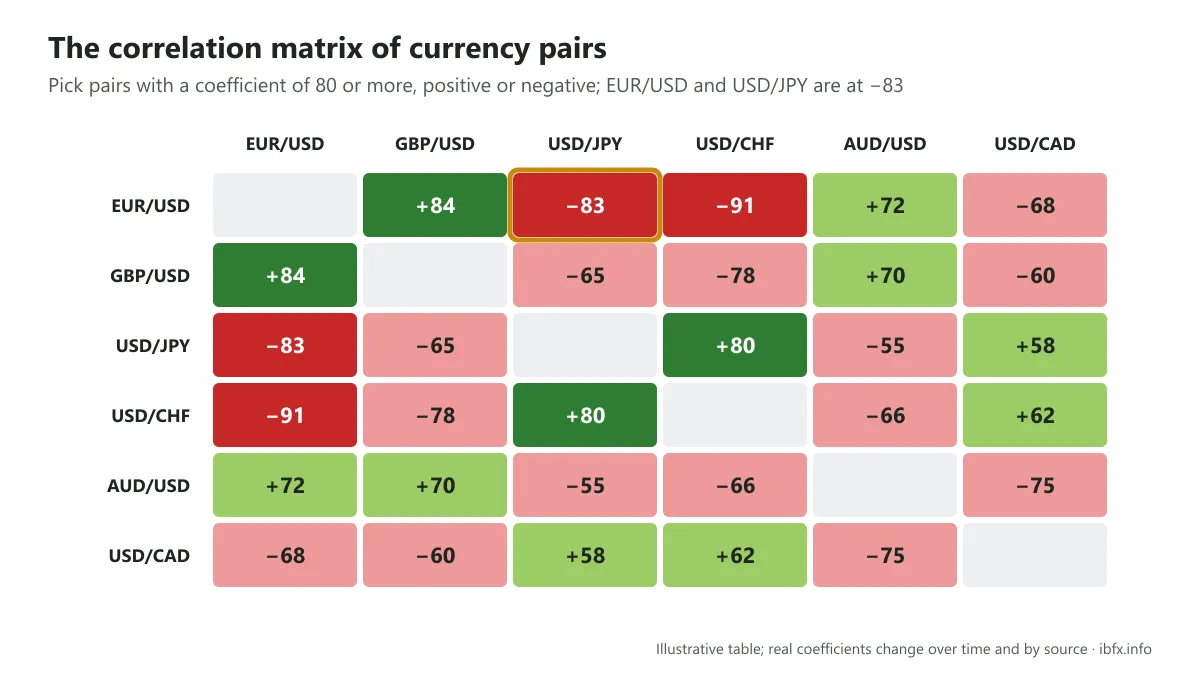
The correlation coefficients are never equal to +1 or -1, that is, a full 100% correlation; they are always below 100%. So, to carry out this hedging strategy, you only need to pick the currency pairs with a correlation coefficient of 80 or more, on either the negative or the positive side.
Example: you have a Buy on EUR/USD and the market is showing signs of a downward correction. To hedge this position, you will pick the currency pair with the highest correlation to EUR/USD. Going by the table above, you will pick USD/JPY, with an inverse correlation and a coefficient of -83, that is 83%. Because it is an inverse correlation, you will open a Buy on USD/JPY.
Note: the matrix of correlation coefficients is not fixed; it changes over time and may differ at each broker and on each platform you trade on.
Hedging with several currencies
In foreign exchange trading, when you buy a currency pair it means you are buying one currency (the one in front) and selling another currency (the one behind). The other way round, when you place a sell on a currency pair, you sell the currency in front and buy the currency behind.
Suppose you hold a buy position on USD/JPY, which means you are buying USD and selling JPY.
The several-currency hedging strategy is carried out as follows:
- You will open a position such that the USD cancels out, which means you have to sell USD. In this case, for example, you will place a Buy on EUR/USD, which means you are buying EUR and selling USD. The USD has now canceled out between the 2 positions.
- Your main positions at this point are only a sell of JPY and a buy of EUR, which is the same as a Buy on EUR/JPY. So, to hedge this trade, you need to place a sell on EUR/JPY.
- At this point you have both a buy and a sell on USD, a buy and a sell on EUR, and a buy and a sell on JPY.
Understand this properly: when the positions cancel each other out completely as above, you are almost no longer exposed to the exchange rate, which means the result is the same as closing the original USD/JPY trade, but you have to pay the spread and the costs of 3 trades and the swap on all 3 positions. On top of that, 1 lot of each pair has a different value (1 lot of EUR/USD is 100,000 EUR, 1 lot of USD/JPY is 100,000 USD), so to cancel out for real you have to work the position sizes out again. That is why this is not a “perfect hedge”, only a way of freezing the state for the time being, and a beginner should not use it.
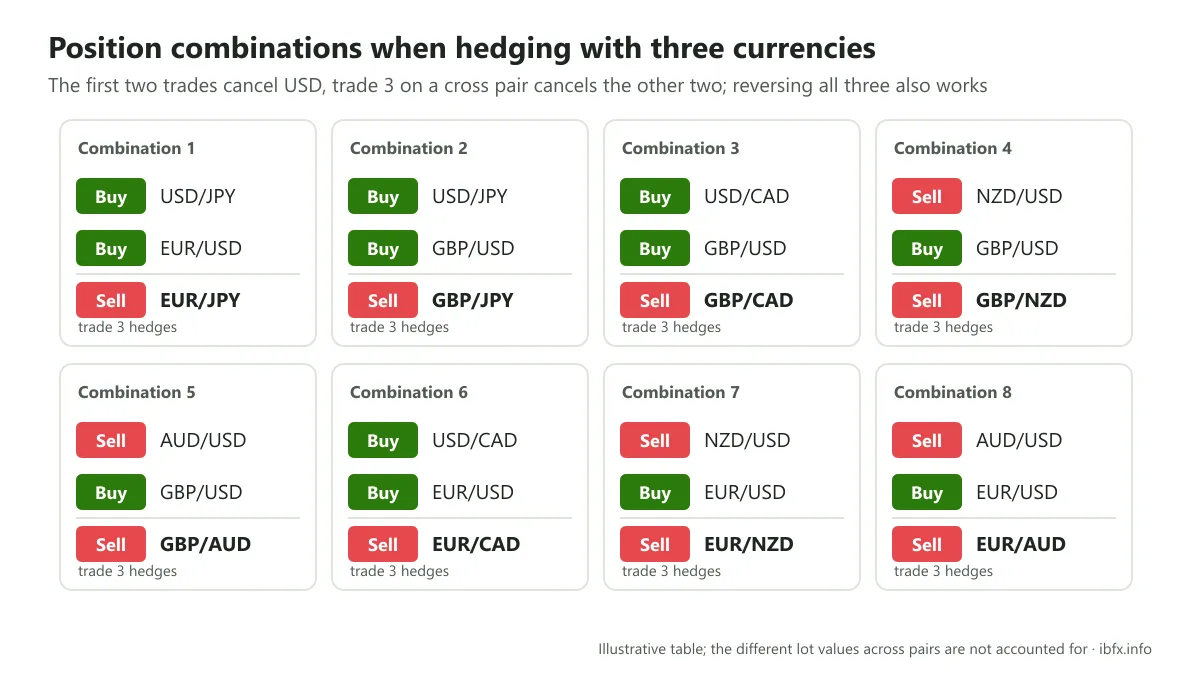
The principle of this hedging strategy is to open positions such that the buys and the sells on the currencies used cancel each other out, in full or in part.
Below is the set of currency combinations with the matching positions in a hedging strategy using 3 currencies. You can use it as a reference for carrying out your own hedging strategy.
Hedging with a position on spot gold (XAU/USD)
This hedging strategy rests on gold and the USD usually being inversely correlated. When the greenback loses value, gold (which is priced in USD) usually rises; when the USD strengthens, the gold price usually comes under downward pressure.
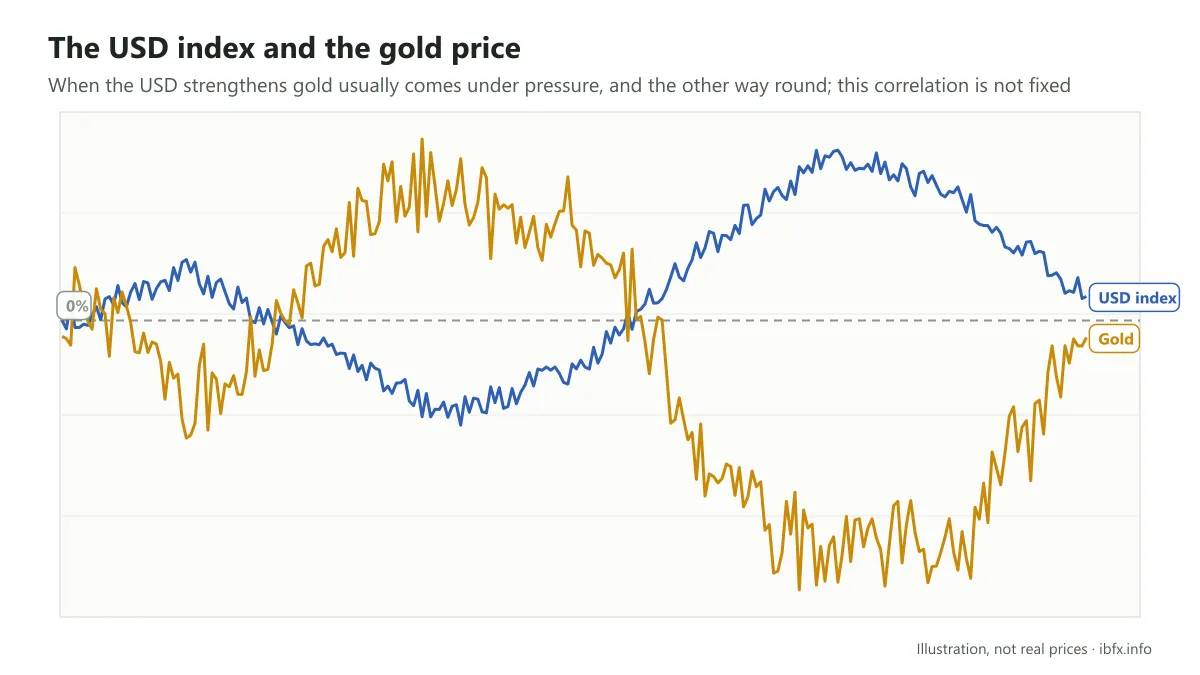
Gold is also often seen as a store of value when inflation is high, but it is not a perfect hedge. The gold to USD correlation is not fixed either: there are stretches in which both gold and the USD rise, for example when turmoil sends investors into both safe havens.
How to carry it out: if you hold a position that buys USD (a Sell on EUR/USD or a Buy on the USD Index, for example), that position loses money when the USD weakens, at which point gold usually rises, so the hedging position is Buy XAU/USD. The other way round, if you hold a position that sells USD, the hedging position is Sell XAU/USD.
Hedging with crude oil
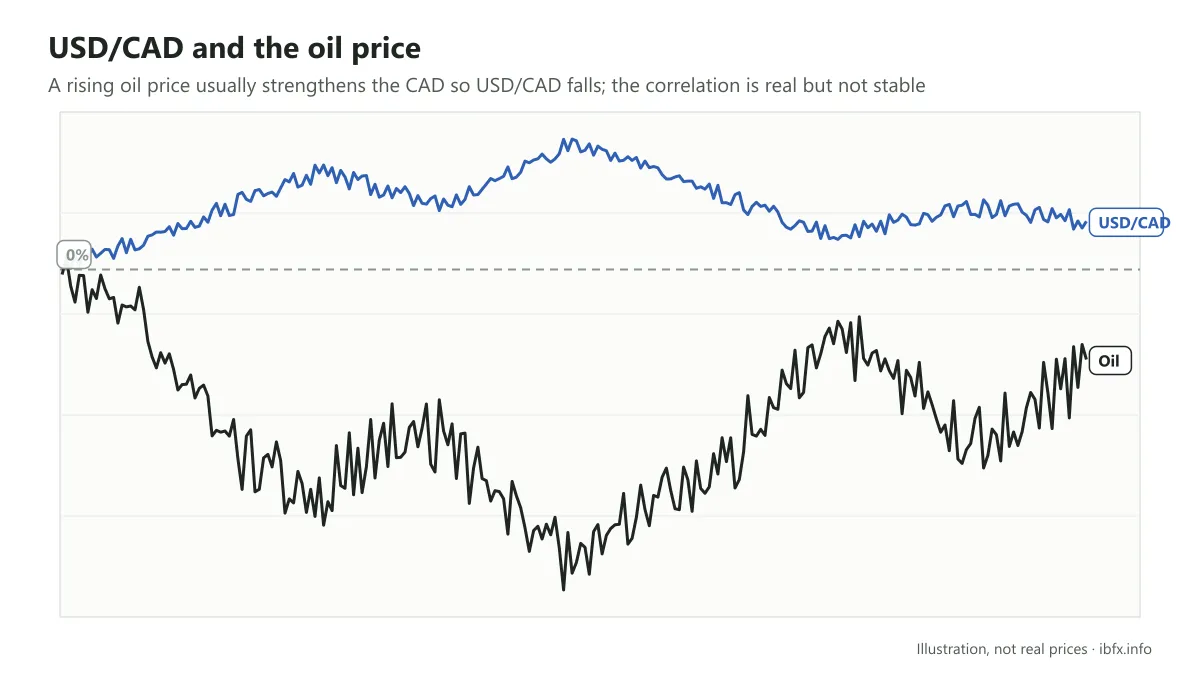
The oil price affects some of the currencies of the oil-exporting countries, and the Canadian dollar is the classic example. Canada is one of the largest oil producers in the world and the US is its main customer: Canada exports about 4 million barrels of crude oil a day to the US (2023 figures).
The oil price is set on the world market. When the oil price rises, Canada’s export earnings rise, demand to convert USD into CAD rises, so the CAD usually strengthens and USD/CAD usually falls.
The other way round, when the oil price falls, Canada’s earnings fall, the CAD usually weakens and USD/CAD usually rises. This correlation is real but not stable: there are stretches in which it weakens noticeably because of other factors such as the interest rates of the Fed and the Bank of Canada.
So, if a trader has an open position on USD/CAD, they can hedge it with a position on crude oil in the same direction as the position on USD/CAD: if you are Buy USD/CAD (which loses money when oil rises), then Buy oil; if you are Sell USD/CAD, then Sell oil.
Hedging with options
An options contract is a hedging tool used widely in the stock market. Of course, this strategy can be applied in the forex market as well, in the case where the broker offers this kind of derivative to its traders.
The number of forex brokers in the market today that offer options is very small, and where they do, it is only on a few underlying assets such as metals, indices and commodities. So you can only carry out this hedging strategy in the foreign exchange market if the position you want to hedge is on an asset for which your broker supports options trading.
This strategy is carried out as follows:
- A buy position on an asset is hedged with a buy position on a Put Option on that asset.
- A sell position on an asset is hedged with a buy position on a Call Option on that asset.
To apply this strategy, you need a grip on the features and the workings of an options contract: the buyer of an option has to pay a premium, and if price does not move in the direction you were hedging against, that premium is lost outright.
Note: whichever hedging strategy you choose, there are 2 extremely important things to keep in mind:
- When hedging with an opposing trade on the same currency pair, the hedging position usually has the same position size as the main position; when hedging with a correlated pair, the size has to be adjusted for the correlation coefficient and the pip value of each pair.
- When do you end the hedging position? The hedging position is closed once the market comes back in the direction expected on the main position. And working out exactly when price will come back to the expected trend depends entirely on the trader’s ability to read the market.
In closing
Hedging is not an easy thing to do, especially for new traders. Hedging done wrongly easily turns one losing trade into several losing trades, plus the costs.
So a beginner should give priority to the basic ways of managing risk: setting a stop loss, keeping position size small and managing your money. If you want to look into hedging, try it on a demo account and record the costs and the results before you weigh up using it for real.