On this page
A great many traders cannot work out what a lot comes to in money, or they can work it out but only vaguely and not accurately. In forex, exchange rate pairs are treated as goods that are bought and sold in the hope of a gain.
We always have to trade a specific quantity called a lot. Put another way, a lot is the position size you enter with. Lots come in 3 types: the standard lot, 100,000 units; the mini lot, 10,000 units; and the micro lot, 1,000 units.
Why is a lot unit needed at all, and why split it into several types? Exchange rates usually move only in very small steps, measured in ten-thousandths, so you have to trade a large enough amount of currency before the gain or loss is meaningful. Lots standardize trading volume, while the smaller lot types let people with little capital trade a position size that fits them.
Let’s get into the lesson.
What is a lot in forex?
First, to work out how much money you can make or lose, you need to know what a lot is. A lot is the specific number of currency units you will buy or sell on the foreign exchange market, also known as the forex market.
The standard size of 1 lot is 100,000 units of the base currency (the currency that comes first in the pair). However, there are now several lot sizes an investor can choose from: mini, micro and nano lots, at 10,000, 1,000 and 100 units respectively.
How much is 1 lot worth in USD?
1 lot is 100,000 units of the base currency, so the contract value in USD depends on the pair:
- Pairs with USD first (USD/JPY, USD/CHF, USD/CAD): 1 lot = 100,000 USD.
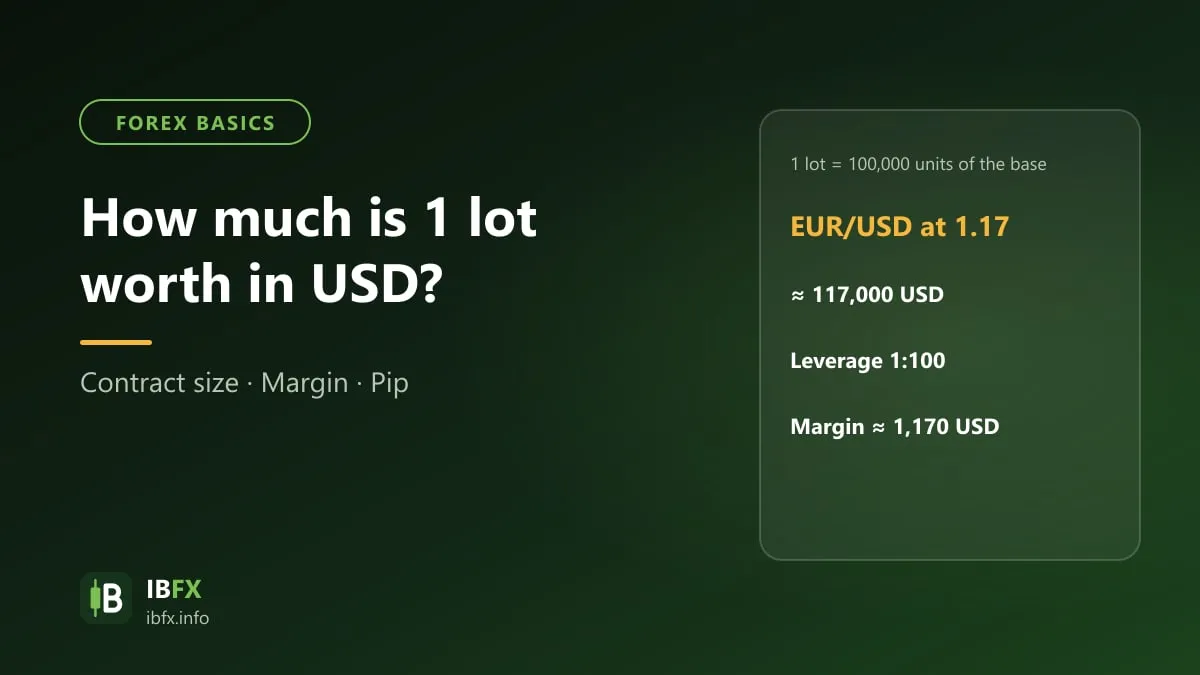
- Pairs with USD second (EUR/USD, GBP/USD, AUD/USD): 1 lot = 100,000 × the exchange rate. For example, with EUR/USD at 1.1700, 1 lot = 100,000 EUR, which is roughly 117,000 USD.
- Cross pairs (EUR/GBP, GBP/JPY…): convert the base currency into USD. For example, on GBP/JPY, 1 lot = 100,000 GBP; if GBP/USD is at 1.3500, that is roughly 135,000 USD.
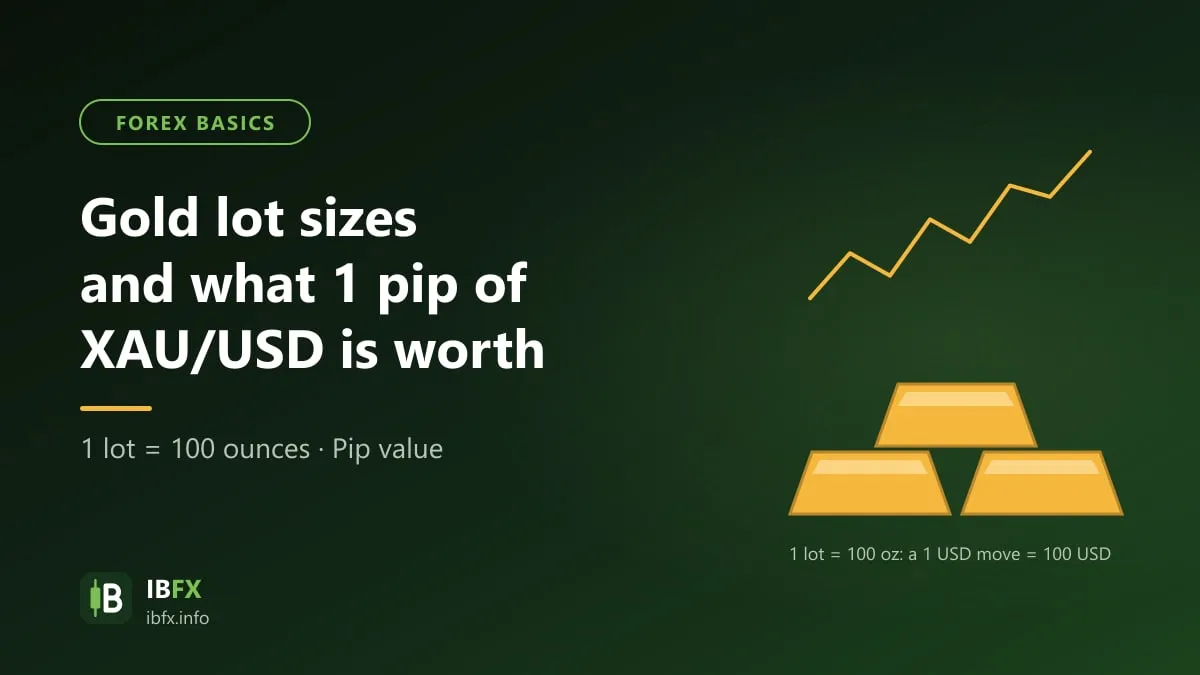
- Gold XAU/USD: at most brokers, 1 lot = 100 ounces; with gold at 3,500 USD an ounce, 1 lot is roughly 350,000 USD. See the IBFX guide on how to calculate gold lots.
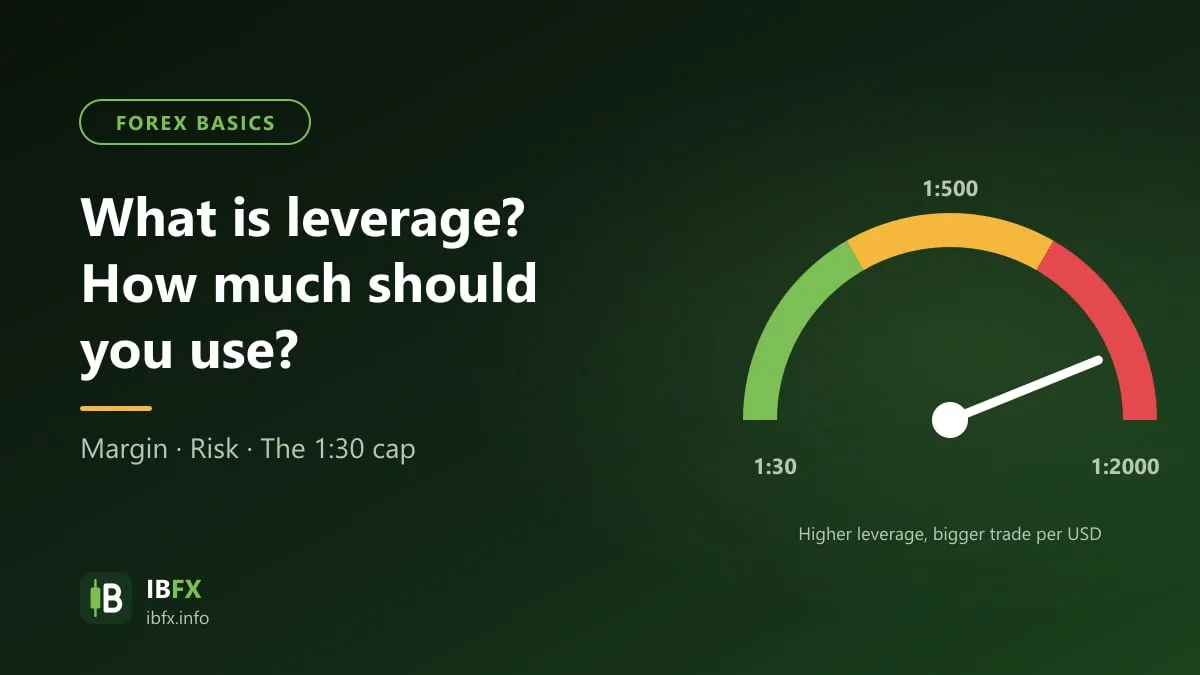
You do not need to have that whole amount, because forex trading uses margin: Required margin = Contract value ÷ Leverage. For example, 1 lot of EUR/USD is worth about 117,000 USD; at leverage of 1:100 that needs about 1,170 USD of margin, and at leverage of 1:30 about 3,900 USD. Profit and loss, however, are still calculated on the full contract value, so a large position size means large risk. See the IBFX guide on what leverage is.

The basic forex terms a trader needs to know.
In the forex market, the change in one currency’s value against another is measured in pips, a very small fraction of a currency unit. To take advantage of these changes in value, you need to trade a specific large amount of currency before any meaningful gain or loss shows up, and that is what gave rise to the lot.
Suppose we use the standard lot size of 100,000 units. Let’s now work through a few examples to see how that affects pip value.
When the US dollar comes first (the base currency), for example USD/JPY at a rate of 119.80: (0.01 / 119.80) x 100,000 = 8.35 USD per pip. Or USD/CHF at a rate of 1.4555: (0.0001 / 1.4555) x 100,000 = 6.87 USD per pip. Note that on pairs containing JPY, 1 pip is 0.01 and not 0.0001. The rates here are only for illustration; pip value changes with the exchange rate at the moment you trade.
When the US dollar comes second (the quote currency), for example EUR/USD, GBP/USD, AUD/USD or NZD/USD, no conversion is needed: 0.0001 x 100,000 = 10 USD per pip on 1 standard lot, whatever the rate happens to be.
On a cross pair with no USD in it, for example EUR/GBP, 1 pip on 1 standard lot is 0.0001 × 100,000 = 10 GBP, which you then convert into USD at the GBP/USD rate (with GBP/USD at 1.3500, about 13.5 USD per pip).
In practice you do not have to work this out yourself every time: your trading platform and the pip value calculator on your broker’s website will show the pip value at the rate current when you trade. The pip value of pairs that do not have USD second will change as the exchange rate changes. See the IBFX guide on what a pip is.
So, to make pip value by position size easy to remember, we can use the table below (it holds for pairs with USD second, such as EUR/USD; for other pairs, work it out from the rate as above):
| Lot type | Units of base currency | Volume on MT4 | Pip value (XXX/USD pairs) |
| Standard Lot | 100,000 | 1.00 | $10/pip |
| Mini Lot | 10,000 | 0.10 | $1/pip |
| Micro Lot | 1,000 | 0.01 | $0.1/pip |
How would you trade a 500 USD account?
On a 500 USD account you can trade from 0.01 lots. The examples below use a pair with USD second, such as EUR/USD.
If you apply the 2% money management rule to every trade on a 500 USD account, you are only allowed to lose 10 USD.
If you trade 0.01 lots, your stop loss can be at most 100 pips, which suits traders who follow medium-term trends.
If you trade 0.1 lots, your stop loss can be at most 10 pips, with 2% of the account at risk on each trade. Note that a 10-pip stop loss is very tight: the spread on its own plus a small move over a few minutes can reach it, so beginners are usually better off choosing a smaller position size to leave a sensible stop loss distance.

Money management always matters a great deal in forex trading.
What happens if you trade 1 lot? Price moving 10 pips against you costs you $100, which is 20% of a $500 account. On an account this size, trading 1 lot is far too risky.
And the returns? There is no fixed monthly figure. Setting a target such as “20% a month” (kept up, that would grow the account almost 9 times over in a year) is the shortest road to overtrading, while many professional investment funds treat 10–20% a year as a good result.
To stay in this market, the account first has to be able to hold out. To hold out, you have to keep losses small. I hope this article helps new traders with little experience sort out the money management problem.
So you can see that with 500 USD and the capital preservation rule I have given you, you have two options for shaping a trading style of your own: swing trading, or day trading/scalping. Whichever you choose, the money you make, if any, will also be small; that is the price of keeping risk low.
And life is not a dream. If you want a $500 account to trade a large position size so the returns build quickly, your money will leave just as quickly: high returns come with high risk.