On this page
A trader is a term for the people who buy and sell on the financial markets and take a profit from those trades. Are you trading on the foreign exchange market? Then you are already a trader.
So, how long have you been in this market? Do you really understand the work? Have you ever thought of trading as a kind of profession? And do you know what to do to reach a certain success in this line of work?
Let us look at the different sides of a trader.
An overview of the trader
What is a trader?
Trader means “the person who trades”, a term for the people who directly buy and sell financial assets in the market, in order to take a profit from the difference in price between buying those assets and selling them back.
The assets a trader trades on the financial markets can be stocks, bonds, currencies, gold, indices, commodities, crypto and so on.
A trader can work for themselves or for another person or organization. Working for themselves, a trader uses their own money to trade, manages the money and manages the trades with nothing holding them back, takes the whole of the profit or carries the whole of the loss from the result, and pays the trading costs (spread, commission, swap) to the broker.
Working for a person or an organization, a trader uses other people’s money to trade, but is kept under control. Of course, the trader will not carry the whole of the loss, and does not take the whole of the profit either, only a share of it or a fixed “salary”.
How are traders grouped?
Every line of work gets grouped somehow, and traders are no different.
For instance, doctors come as internists, surgeons, neurologists, obstetricians and so on; teachers come as primary school teachers, secondary school teachers and so on; singers come as rock singers, ballad singers, bolero singers and so on.
Traders too are grouped into many different kinds of trader, and in many different ways.
Traders grouped by the market they trade
- A trader on the foreign exchange market is called a forex trader
- A trader on the stock market is called a stock trader
- A trader on the crypto market is called a crypto trader
- A trader on the commodity market is called a commodity trader
Within each kind of market, a trader can also be grouped by the asset they mainly trade. For instance, a trader who only trades gold on the forex market may be called a gold trader, or a trader who only trades futures contracts on the derivatives market is called a futures trader, and so on.
Traders grouped by who manages them
- Traders working for themselves
- Traders working for another person or organization
Traders grouped by their school of analysis
- Traders of the technical analysis school: a trader who only uses tools such as indicators, trendlines, candlestick patterns, price patterns and so on to read the trend and decide on a trade.
See also: What is technical analysis?
- Traders of the fundamental analysis school: only uses news and economic, political and social events to read the market trend and decide on a trade.
See also: Fundamental analysis in forex trading
- Traders of the combined school: uses technical tools as well as news and events to analyze and decide on a trade.
Grouped by the form of trading
- Copy trader: traders who trade by copying someone else’s orders, usually paying a fee or sharing part of the profit. Note: the past results of the person being copied are no assurance for the future, and you still carry the whole of the loss.
- Auto trader: the trader does not trade directly; every trade is carried out automatically through algorithms, which are automated trading robots (EAs) or automated trading signals (Forex signals). When the market meets the conditions of the algorithm, the order is opened or closed automatically. Robots and signals that advertise a fixed profit every month are a common sign of a scam.
- Manual trader: the trader carries out the trade (opening and closing an order) by hand, without using any automated program or tool.
Grouped by how long they hold a position
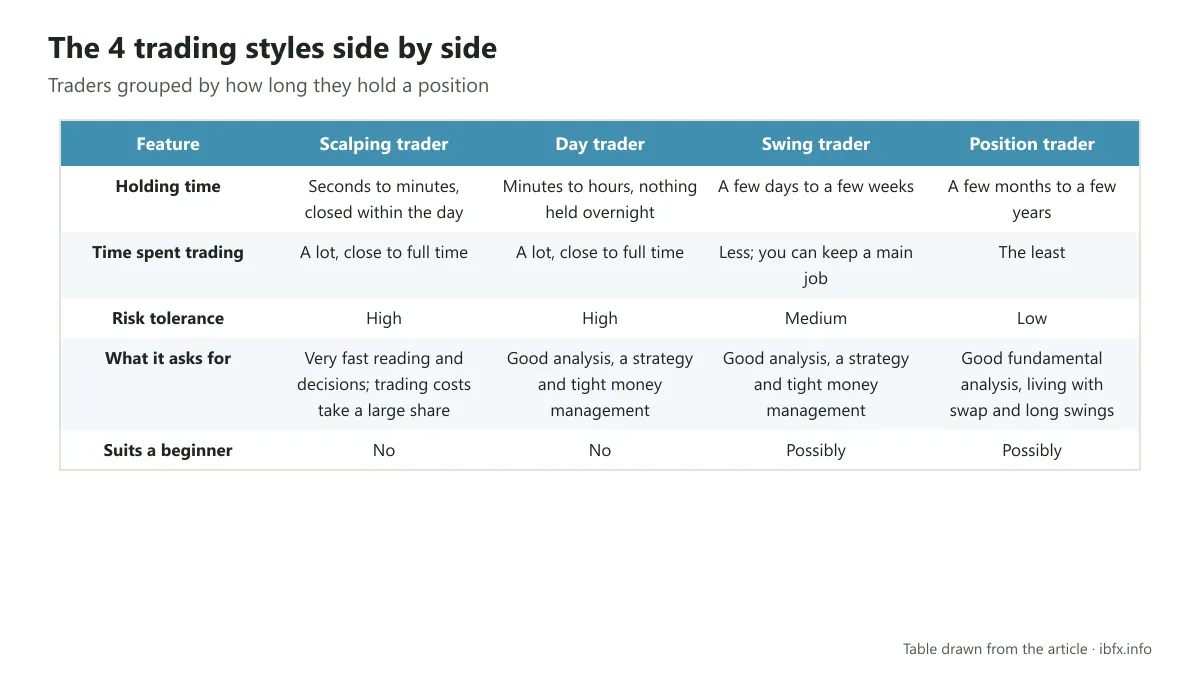
This is the most common way of grouping, and also the one that gives the 4 trading styles in forex.
- Scalping trader: a trader who scalps, holding a position for a short time, only a few seconds to a few minutes, and closing within the day.
- Day trader: a trader who trades within the day, holding an order from a few minutes to a few hours, and also not holding overnight.
- Swing trader: a medium-term trader, holding a position for longer, from a few days to a few weeks, and not worrying about short-term price moves.
- Position trader: a position or long-term trader, holding an order the longest, from a few months to a few years, close to the way investors work.
The 4 kinds of trader by trading style side by side
What does a trader actually do?
Broadly, the day-to-day work of a trader is the same from one to the next: the trader analyzes how the price of the asset they have traded, are trading or will trade is moving, and from that decides to take a new trade, to leave an open trade or to adjust it.
In general, day by day, traders buy and sell assets by opening and closing orders on their trading software.
Even so, depending on the kind of asset traded, the actual work of a trader differs.
Forex trader
A forex trader usually trades the common assets: currency pairs, indices, gold and so on.
Their work is to pick the currency pair or index that carries the most advantage to trade. Once that is done, they start analyzing how it is moving using technical tools and following the related news, for example central bank announcements that will move the exchange rate, interest rate policy and so on. When they spot a possible trading signal, the forex trader places the order, follows it, closes it or adjusts it if price signals a reversal or moves oddly.
Stock trader
Stocks are the main asset of stock traders. The work of a stock trader is somewhat more varied, from picking a favored stock, analyzing it and reading how it is moving with technical methods or through the financial reports of the company. Beyond that, the trader also follows the news of the economy as a whole, of the business sector of the stock they are trading and of the economy in large countries such as the USA, because all of it bears to some degree on how a domestic stock moves. Stock traders also look into the stocks about to be listed (IPO); the price of a newly listed stock usually moves very sharply both ways, so the risk is high as well.
Crypto trader
For a crypto trader, besides analyzing the trend in order to decide whether to buy or sell a coin, there is a great deal of attention on the crypto project itself. When news comes out about a new coin project, one about to list or one that has just listed, they start looking into the team, the product and how open the project is, in order to decide whether to take part. Keep in mind that a great many new coin projects are scams or lose almost all their value in a short time. As for the coins a trader already holds, news about the market and about the crypto policy of different countries and of large corporations is the kind of information crypto traders always follow.
Commodity trader
Traders on the commodity markets have to spend a good deal of time studying the nature of the commodity they have traded, are trading or will trade, and analyzing what moves the price of that commodity: the weather, the resources, the labor, economic and political factors and so on. Trading commodities also involves derivatives such as futures contracts, options contracts and forward contracts, and commodity traders have to learn how these instruments move as well as how the underlying asset (the commodity) moves. Broadly, the work of a trader dealing in commodities through derivatives is harder, and calls for more knowledge and more skill.
The opportunities and the challenges of a trader
Is a trader a profession or not?
Depending on the purpose and the time each person brings to the market, being a trader may or may not count as a profession.
For the people who come into financial markets such as stocks or forex and only give the spare hours of the day, after their main working hours, to trading, hoping for a small extra income or for the experience of a new kind of investing or business with a small amount saved up, and with a low tolerance for risk, trading is like a part-time job, a side job, not the work that will bring the main income for them and their family. In that case being a trader is not a profession.
The other way round, a person who gives the whole of the day to trading, who puts a large amount into knowledge and skill and treats trading as the work that brings in the main income, with no other work giving them a steady income, is in a different case. People like that usually lose a great deal of time at the start and fail many times over; later, the experience and the knowledge they have built up gradually make them a professional trader, and the income from trading gradually grows steadier. At that point, for them, being a trader really is a profession.
Whether being a trader is a profession for you or not, though, once you are a trader and once you are trading, alongside the opportunities trading brings, the work also has many challenges you have to accept.
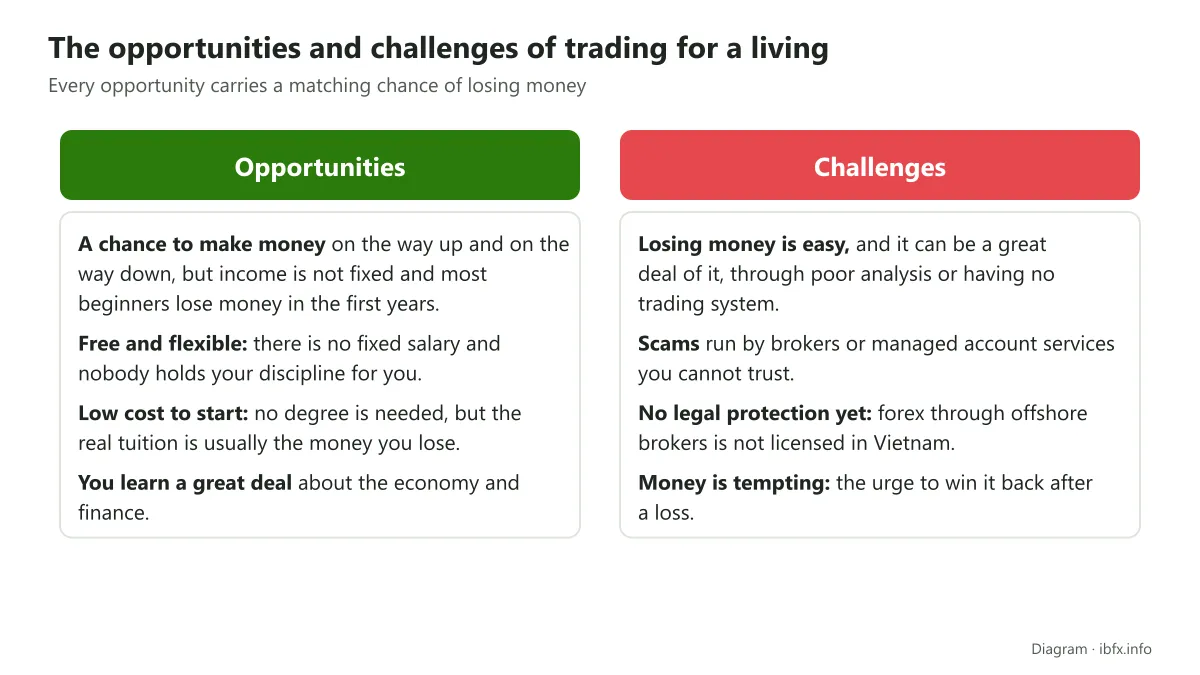
The opportunities and the challenges of trading “for a living”
The opportunities of trading for a living
- A chance to make a good deal of money
A trader’s income is not fixed the way an office salary is: some months show a profit, some a loss, and most beginners lose money in their first years. Only a small number of professional traders have a steady income higher than salaried work. What sets the financial markets apart is that price moves the whole time, so there is always a chance on both sides, up and down, but that chance comes with a matching chance of losing money.
- Trading is free and flexible work
You do not have to work for anyone, and you can pick the moment that suits you to trade. You can work at home or anywhere with a computer and the internet, with no boss to report to.
That freedom has another side, though: there is no fixed salary, nobody keeps your discipline for you, and trading while you are doing something else, without concentrating, usually leads to poor decisions. Plenty of people have left a steady job to trade full time and lost both their capital and their income.
- Low cost
The cost we mean here is not the trading cost, but the cost of becoming a trader.
Unlike a doctor, a teacher or an accountant, you need no degree and no certificate to be a trader. That does not mean it is cheap or easy, though: the real tuition is usually the money lost in the market in the first years. Be wary of courses that promise an income or a high win rate, or that come with an invitation to deposit at one particular broker.
Beyond that, you can teach yourself through material that is completely free, from the financial forums, the stock and forex websites and so on, and learn from the people who went before you.
The low cost also shows in the starting capital. Trading does not call for a large amount; many forex brokers even let you open an account from a few tens of dollars. But a small amount of capital means a small profit in money terms too; do not use an oversized position or too much leverage just because you want a large profit from a small amount.
- You build up knowledge
Trading calls on you to look into and study the market, finance, the economy, politics and society in different countries, the production and business of companies, the nature of each kind of market and each kind of asset, and so on. Over time a trader builds a certain understanding of all this that school or a course may not give you.
Even later on, when you are no longer a trader, this knowledge will help you a great deal in other work, and will build up your thinking, your judgment and your ability to react flexibly.
The challenges of trading for a living
The largest challenge of trading for a living is risk. Trading is not for anyone who likes safety; once you are a trader you have to accept risk, whether low or high. Low risk goes with low profit; high risk carries a higher potential profit, but a correspondingly larger chance of losing money.
We are not talking here about risk in the sense of the danger in certain jobs, such as an electrician, work involving contact with chemicals, or other dangerous work, but about financial risk, that is, the chance of losing money.
In work such as teaching or an office job, if you do it badly your pay is docked, but it does not make you lose your savings or any other capital. Trading is different: when you do it badly you lose the money you put in, possibly a great deal of it.
So where does the risk of trading for a living come from, or in other words, what makes a trader lose money when they trade?
- Reading the market trend wrongly, or having no effective trading system.
First, reading the market trend wrongly comes from 2 main causes: the trader’s own analysis skill is not good enough, they do not really understand the market or the tools of analysis, and the nature of the financial markets themselves, which are pulled by far too many different factors, move the whole time and often land outside what a trader expected.
Second, having no effective trading system also comes from a number of reasons: not settling on a trading style, not picking an effective trading strategy, having no skill in money management, risk management, managing emotion, managing time and so on.
With both of these causes, setting aside the risk that comes from the nature of the market, the risk that comes from the trader themselves is the most important one, and the main reason a trader loses money most easily.
To be a trader, putting money into knowledge is extremely important; you have to see how important it is before you will put in the effort, the time and the study. And this too is the largest challenge of trading for a living.
- Being defrauded by a broker or a managed account service
This problem is still with us today. Coming into trading for a living, if you are not clear-headed enough, it is very easy to be defrauded by a sham broker or a sham managed account service, and to lose money.
- Trading for a living is not protected by law yet
At present, trading forex through offshore brokers is not licensed in Vietnam, so it is not protected by Vietnamese law. For crypto assets, Vietnam only began a licensed pilot market in 2025; trading on unlicensed offshore exchanges is still not protected. That in itself is a risk. In a dispute between a trader and a broker or a managed trading organization, the trader will not be protected by Vietnamese law and may have to carry the loss themselves.
- The temptation of money
In truth this is not only about traders; money tempts people in any line of work. A trader is all the more open to it, though, because money can be made or lost very quickly. The temptation shows in a trader being unable to stop at the right moment, especially after losing too much, when the urge to win it back, much like gambling, takes hold and pushes the trader into trading more with no control over their own state of mind, which makes losing more money all the easier.
Trader and investor: the difference
Both take part in the financial markets and both buy and sell assets, but a trader and an investor are entirely different.
A trader holds a position for a shorter time than an investor, apart from the position trader, who holds for quite a long time. A trader looks for a profit from the difference in the price of an asset between opening and closing a trade, while an investor concentrates more on the growth of the intrinsic value of the asset. A trader can make money even when the market goes down, but an investor only looks for the market to grow.
A few of the differences between a trader and an investor
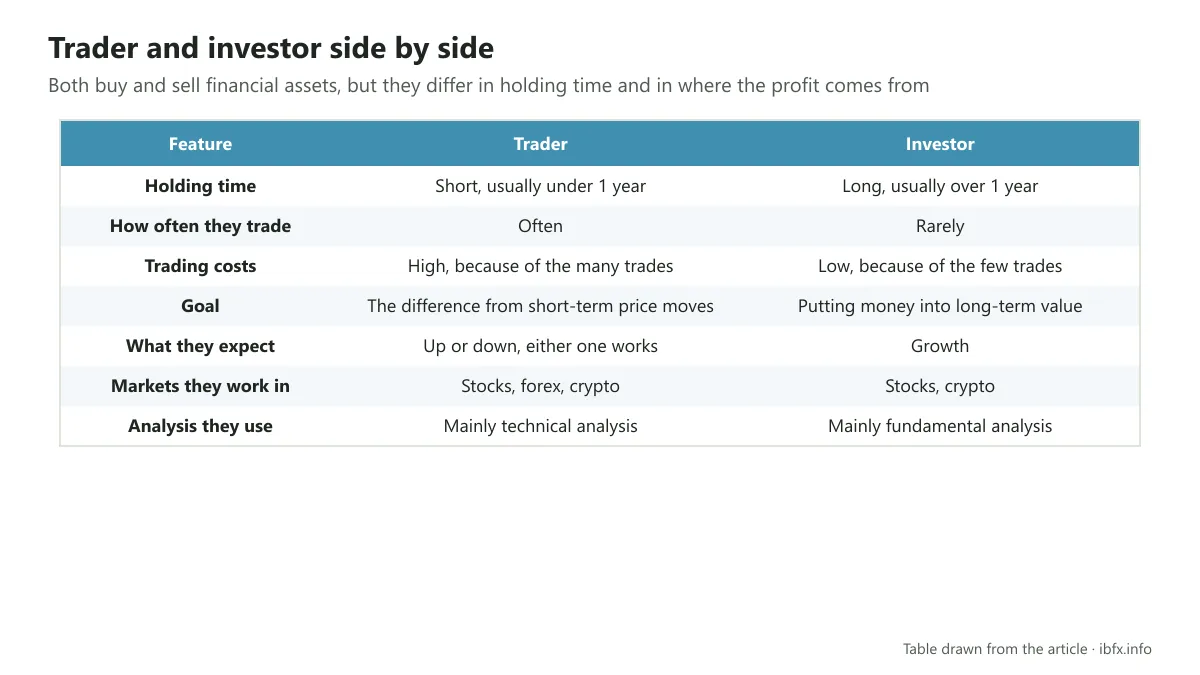
From the features above, can you now say whether you are a trader or an investor?
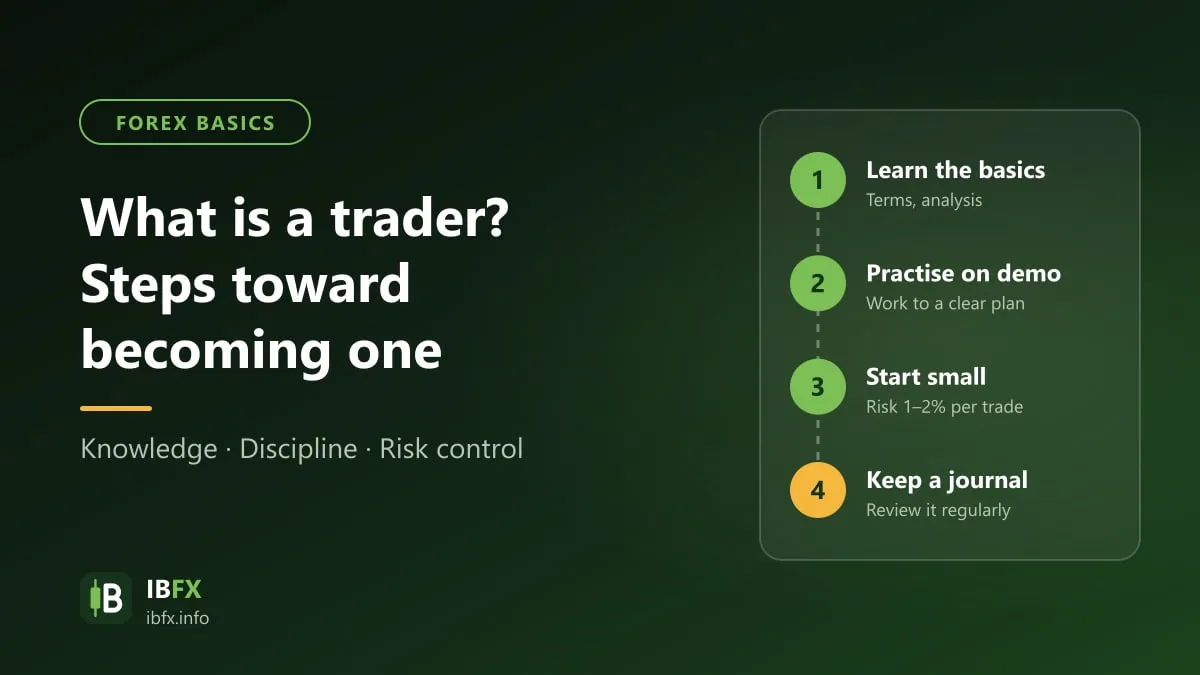
How do you become a professional trader?
This is what a great many traders want when they first come into the market, and above all the ones who see trading as a profession and as their main source of income. Being professional and experienced in trading gives them the chance to last a long time in the market.
So, how does a new trader become a professional trader, and what rules keep that process at its least risky?
The 5 “core” rules of a professional trader
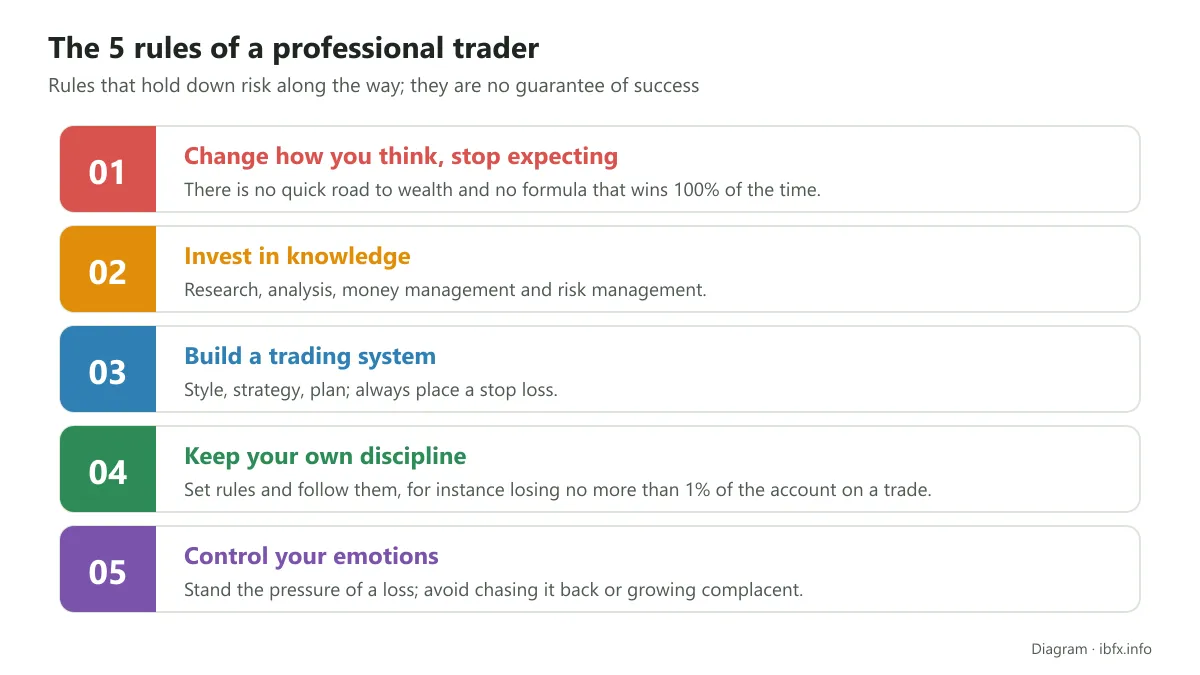
Change how you think and stop expecting
This is the first rule a trader has to have. Trading for a living is not simple at all, and risk is a part of it that cannot be avoided. Before anything else, stop expecting a profit and learn instead how to hold risk as low as you can. After that, change a few ways of thinking about the work of trading:
- Trading will not make you wealthy quickly and easily
- There is no formula that makes a trade succeed 100% of the time
- Giving time, effort and money to study is simply part of it
- Keep at it and never stop learning and building knowledge.
Putting money into knowledge is the wise investment
You know by now how risky the work of trading is, and the only way to hold those risks down is to be good at it, to understand it and to have experience. Putting money into knowledge is the rule a trader never moves away from, whatever level you are at.
What knowledge should a trader put money into?
- Research skill
You have to grow used to studying the economy and finance, because those factors all bear on prices in the market. Research does not stop at reading financial reports, documents, figures or economic statistics and political and social news; you have to go deeper into each detail: the nature of the asset traded, the kind of market, a strategy, a tool of analysis, a pattern and so on, and the trading systems of professional traders as well.
- Analysis skill
This is your ability to read where price is going after studying the factors that bear on price, or to read the trend from the way price itself shows on the chart. The result of your analysis is the ground on which you decide to trade. Even so, nobody analyzes correctly forever; the long-run result depends a great deal on how you manage risk when your analysis is wrong.
- Money management and risk management skill
Holding money or spending it is simple enough, but how to hold it and how to spend it so as to make the most of the profit and hold down the risk is the hard part. Without an effective money management strategy and good risk management, your money will evaporate after only a few trades, or you will feel that most of your trades are profitable yet end up losing in the long run.
Here are a few money management and risk management strategies to look at:
- Money management mistakes
- The 2% money management rule used by professional investors
- Effective money management in forex trading
Alongside putting money into knowledge, you have to practice regularly to turn what you have learned into something of your own. And always remember: putting money into knowledge only makes you better, nothing more.
Build an effective trading system
Why do pro traders always have a clear and detailed trading system, while new traders trade with no plan and no rule, trading when they feel like it and stopping when they do not, trading a large size when they are happy and a small one when they are down? That is also why most traders fail when they first set foot in the market.
An effective trading system will keep a trader on the right road, going the right way, neither lost nor bewildered, and able to react in time to sudden moves.
To have an effective trading system, a trader first has to settle on a trading style and keep to it. You have to work out what your financial goal is, whether you have much time or little for trading and whether your tolerance for risk is high or low, and from there which trading style suits you. Once the style is settled, pick a trading strategy that fits and draw up a trading plan. The clearer and more detailed the trading plan, the better the trading that comes of it. And last of all, you have to have an effective money management and risk management strategy.
And there is one rule that no professional trader’s system is without: “NEVER FORGET TO PLACE A STOP LOSS”.
Always keep your own discipline
You have to set a few rules for your own trading and always follow them, such as always placing a stop loss, never letting the amount you can lose on a single trade go beyond 1% of the account balance, stopping trading and looking over the system again after 3 losing trades in a row, and so on. Discipline will make you stronger and get you to your goal sooner.
Control your state of mind and stand the pressure of a loss
Emotion is the leading cause of failure for a trader. Emotion very easily makes you break the rules you set yourself. Traders usually fall into 2 states: the urge to win it back and to go all in after losing too much, or over-confidence and complacency after a run of profit, and both states are to be avoided and both bear on the work of trading.
Faced with a loss, traders very easily come under pressure and make poor decisions. To avoid this, keep the loss at a level you can accept and never stake everything on a single trade.
Professional traders always know how to control their emotions well, and you can practice this by starting with a small amount of capital, watching how you feel each time you win or lose, and adjusting as needed.
Patience and persistence
These are 2 rules, 2 qualities, that you cannot do without if you want to become a professional trader.
Patience is needed most in analyzing and in trading. When you analyze and some trading signal appears but that signal does not carry a high chance of success, you need the patience to wait for another signal instead of rushing into the order. And while an order is running, traders usually lose patience when price goes against what they expected; they grow restless and hesitate over whether to close the order, and in truth they do not trust their own trading system, so most of them lose patience and close it. Patience here means letting the order run to plan with the stop loss you placed, not moving the stop loss further away or holding a losing trade.
Persistence, on the other hand, is needed at every stage; without it a trader will not stand firm in this market, and you will quickly grow discouraged and give up after a few early failures. For trading as a living, persistence shows in many different ways: persistence in studying, learning and practicing, persistence in following your trading system (though not too rigidly — if you find the system no longer works, you should look at changing or adjusting it) and persistence even when you fail.
Conclusion
With what we have shared above, we hope you now understand something of this line of work, and can weigh how well it suits you, between what you gain and what you lose, in deciding whether to become a trader or not. And if you have decided to be a trader, then start on the road to becoming a professional trader, in which the most important things are seriousness and persistence. The rules we shared in the last part cannot make you succeed 100% of the time, but they will go some way toward keeping the road to being a pro trader less risky.