On this page
Trading the news is a style that a lot of traders are drawn to, because when an important figure is published the price can run several tens of pips in a matter of minutes, more than the range of many ordinary trading hours. At the moment of the release, though, the price usually jerks violently in both directions, the spread widens and orders slip easily, so trading the news carries a great deal of risk. Even when the market eventually goes the way your analysis said it would, those first jerks against you can still take out a stop loss, or blow up an account if the position size is large. Trading the news is a double-edged sword and calls for an experienced trader. So how do you limit the risk?
What is news trading in forex?
News trading means opening a position on the back of economic figures, of interest rate decisions or of central bank speeches, making use of the sharp movement around the moment of publication.
Each event on the economic calendar usually carries a previous figure, a forecast figure and an actual figure. The price reacts mainly to the gap between the actual figure and the forecast (that is, what the market expected), not simply to whether the news is “good” or “bad”. There are times when the figure is good and the price falls anyway, because the market had expected something even better.
At the moment of a release the market becomes very lively: some traders make money, but plenty of traders blow up an account in the space of a few minutes as well.
The hidden dangers of trading the news
High potential profit comes with large risks that you have to treat with great care:
A widening spread
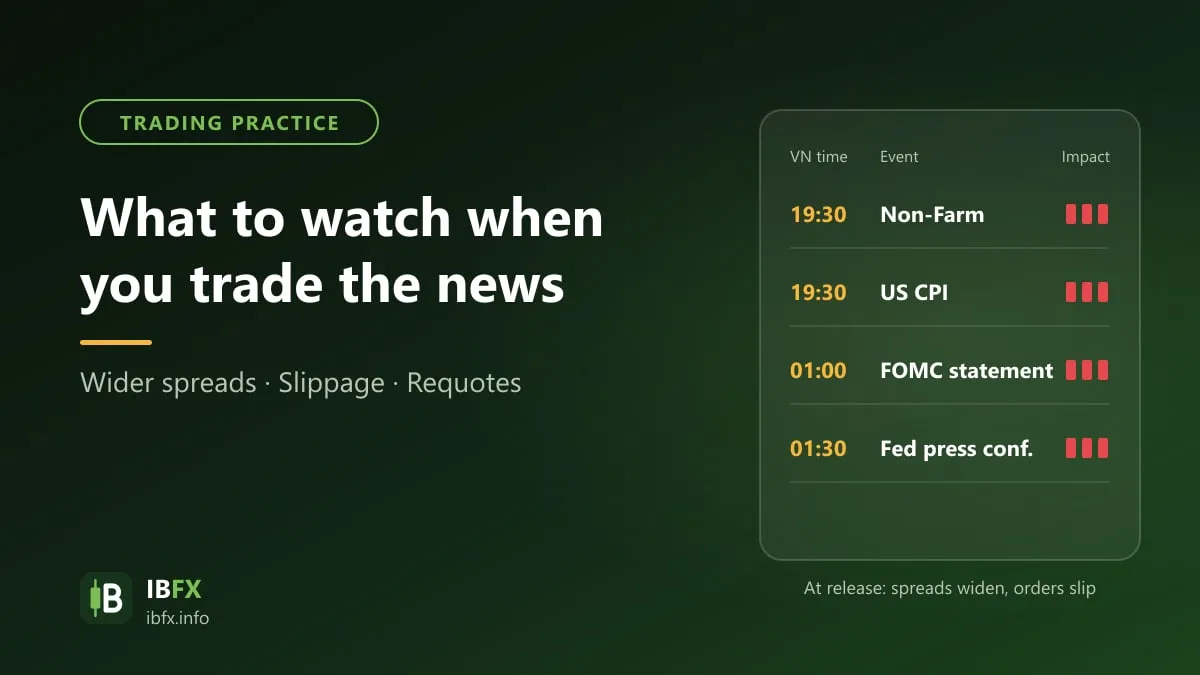
This happens at almost every broker, reputable ones included. When the figure comes out, the market moves sharply, liquidity from the price providers thins, and so the spread widens, sometimes to several times its normal size. Trading at that point costs you more, and a widened spread can also trigger your stop loss or your pending orders even though the price on the chart has not reached them.
Requotes
A requote happens on accounts that fill orders by instant execution: when you place the order, the price has already changed, so the broker does not fill it and sends you a new price to accept or reject instead. At the moment of a release, requotes can come one after another and leave you unable to enter at the right time. On top of that, when the connection or the server is overloaded, an order can be slow to appear; if you lose patience and click to place the order several times, it is quite possible that several orders will be filled at once, multiplying the risk on the account.
Slippage
Slippage is when an order is filled at a price different from the one you placed it at, because the price moved too fast. At the moment of a release, slippage usually goes against you. You need to be clear about this:
- Market orders and Stop orders (Buy Stop, Sell Stop, and the stop loss too) become market orders once they are triggered, so they can be filled at a worse price than the one placed, sometimes very much worse.
- Limit orders (Buy Limit, Sell Limit, and the take profit) are filled only at the price you placed or better, but they may not be filled at all if the price runs straight past.
There is therefore no order type that is both certain to be filled and safe from slippage. Some brokers offer a guaranteed stop loss service for a separate fee. Read more: “Buy Stop and Sell Stop pending orders”, “What is a Buy Limit?”
How should you trade the news to limit the risk?
If you do not have much experience yet, the best thing to do during the hours when an important figure is due is to stand aside. All you need to do is follow the economic calendar on sites such as Investing or Forex Factory to know when a heavy release is coming and when the market is calmer to trade in.
If you already have a position open before the release, consider taking some of it off, cutting the size, or accepting that the stop loss may slip well past the level you placed it at.
You can also wait around 10–15 minutes after the release, once the spread has settled back and the price is starting to show a clearer direction, and only then consider an entry. Even so, after a big release the market can still move sharply for several hours.
If you do still want to trade around the news, the most important thing is to analyze the currency pair carefully beforehand: the current trend, the important support and resistance zones, the forecast figure, and to prepare your scenarios in advance. For instance, wait for the price to break clearly out of an important price zone, confirm that it is following your scenario, and only then enter, with a smaller position size than usual.
One thing to note: before a release the market often moves sideways while it waits, and then bursts out when the figure lands, and that first burst is very often a false break. Analyze it carefully so that you do not get caught out.
The releases most likely to cause a sharp move are: the Non-Farm Payrolls employment report (usually published on the first Friday of the month, at 19:30 GMT+7 or 12:30 UTC, or at 20:30 GMT+7 or 13:30 UTC when the United States is not on summer time), the consumer price index (CPI), the interest rate decisions of the large central banks, and the US Federal Reserve above all (the FOMC statement is published at 14:00 New York time, which is 01:00 or 02:00 GMT+7 the following morning, that is 18:00 or 19:00 UTC), along with the speeches of the Fed chair. Keep up with the economic calendar daily so that you can avoid these moments, or prepare for them, of your own accord.