On this page
Gold has been a precious metal since ancient times, used not only for jewelry but also as an asset that is actively traded on the financial markets. Trading gold, however, is far from easy: the gold price moves violently and is driven by a great many forces, from the USD and interest rates through to political tension around the world. Technical analysis on its own is probably not enough; you need to understand what makes gold particular in order to avoid the mistakes you would regret.
How does gold differ from other commodities?
Gold behaves more like a financial asset than like an ordinary commodity. About half of the annual demand for gold goes into jewelry and a small share into technology such as electronics; the rest is mostly investment demand (bullion, gold ETFs) and buying by central banks.
Most of the large central banks hold gold in their national reserves. Part of the reason is historical: banknotes and coins were once backed by gold and could be exchanged for it. The United States ended the conversion of USD into gold in 1971, and from the early 1970s the gold price has floated with market supply and demand.
Today, central banks hold gold mainly to diversify their reserves: the gold price tends to move differently from foreign currencies, so a portfolio that holds both gold and foreign currency is steadier than one that holds only a single kind. Gold also does not depend on the ability of any government to repay its debts, and it can be used when liquidity is needed urgently. According to the World Gold Council (WGC), central banks bought a net of more than 1,000 tonnes of gold a year over 2022–2024, which has been one of the important supports under the gold price.
Seasonality in gold through the year
Some statistics suggest that the gold price has a seasonal element through the year, but that is only a tendency from the past, not a rule, and there have been a great many years in which the gold price went the other way entirely. This is set out at greater length, along with the times at which the LBMA reference price is set, in the guide on how to trade gold.
The thing to hold on to here: do not rush along with the euphoria of the market, chasing the price when it runs hot and then dumping when it corrects.
The relationship between gold and the USD
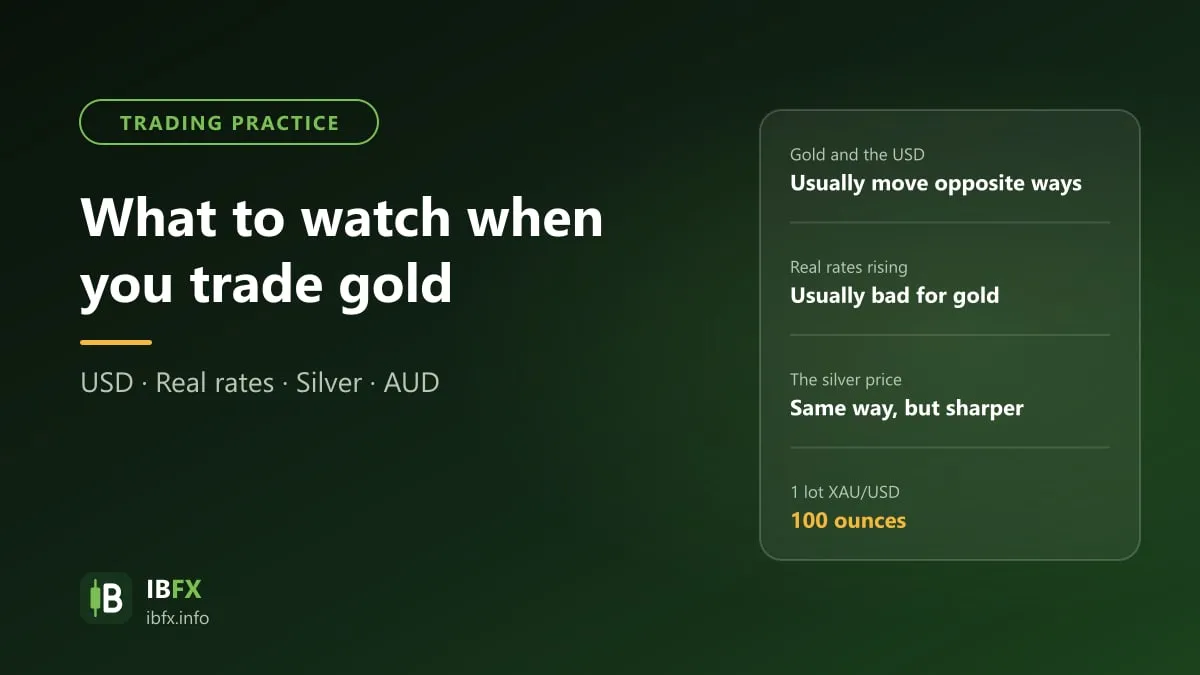
The world gold price is quoted in USD, so gold and the USD are usually inversely correlated:
- When the USD weakens, more USD are needed to buy 1 ounce of gold, and at the same time gold becomes cheaper for buyers who use other currencies, so the gold price in USD usually rises.
- When the USD strengthens, the opposite happens, and the gold price usually comes under downward pressure.
You can follow the US Dollar Index (DXY) to gauge the overall strength of the USD.
These correlations are not fixed; there are periods in which gold and the USD rise together, for instance when markets panic and money flows into both safe havens at once. How gold relates to US real interest rates and to the Fed is covered in the guide on how to trade gold.
Gold, the news and the stock market
Gold is strongly affected by political events, conflicts, disasters and crises, because it is treated as a safe-haven asset; and when stocks fall sharply, safe-haven money usually turns to gold — though not always, as in March 2020, when gold too was sold off alongside stocks because investors needed cash.
How to handle an entry around a release, and why you should not open a position at the instant news lands, is covered in the guide on how to trade gold. For a fuller list, read “11 factors that move the world gold price”, and follow the economic calendar so that you know about important events in advance.
How gold relates to other metals and currencies
Silver is a precious metal too, but it is used in industry far more than gold is: electronic components, solar cells, medical equipment and antibacterial dressings, X-ray film and so on. Because it is both a precious metal and an industrial raw material, the silver price usually moves in the same direction as gold but with a wider range, and it sometimes breaks away from gold when the industrial outlook changes. Following the silver price and the gold/silver ratio can give you an extra point of view when you trade gold.
How gold relates to the AUD is covered in the guide on how to trade gold.
Correlations give you extra information with which to test a view, but you should not use them as a certain entry signal, because they can change or reverse from one period to another.
Managing risk when you trade gold
- Understand the contract size: at most brokers 1 lot of XAU/USD stands for 100 ounces, so a 1 USD move in the gold price is a gain or a loss of 100 USD on a 1 lot position. Read more: “How to work out gold lots”
- Always place a stop loss and use a small position size: gold can move by several tens of USD inside one day, so work out a position size at which each trade risks only about 1–2% of the account.
- Be careful around sensitive moments: Non-Farm Payrolls, the CPI, Fed rate decisions and the opening hour at the start of the week (where there can be a gap) tend to widen the spread and cause heavy slippage.
- Watch the overnight swap if you hold a position for several days.
- The law: trading forex and gold through a foreign broker is not currently recognized or protected by the law in Vietnam. Read more: Is Forex trading legal in Vietnam?
Practice on a demo account before you trade gold with real money, and see also: What experience teaches about trading gold (XAU/USD).