On this page
A bull market and a bear market are two concepts every investor and trader on the financial markets knows well, and both name a kind of market trend. A bull market means a rising market, while a bear market means a falling market. For every investor and every trader, the direction of the market is the main force acting on the value of their portfolio. That is why it matters to understand the direction, or the condition, of the market, so that you can adjust the portfolio or plan your trading to work well, to aim at a higher profit or to cut risk.
In this article we will introduce the two terms bull market and bear market side by side, to show the most basic differences in the features and the signs of each kind of market. We will also suggest ways of investing and trading that work for each kind of market. Read on.
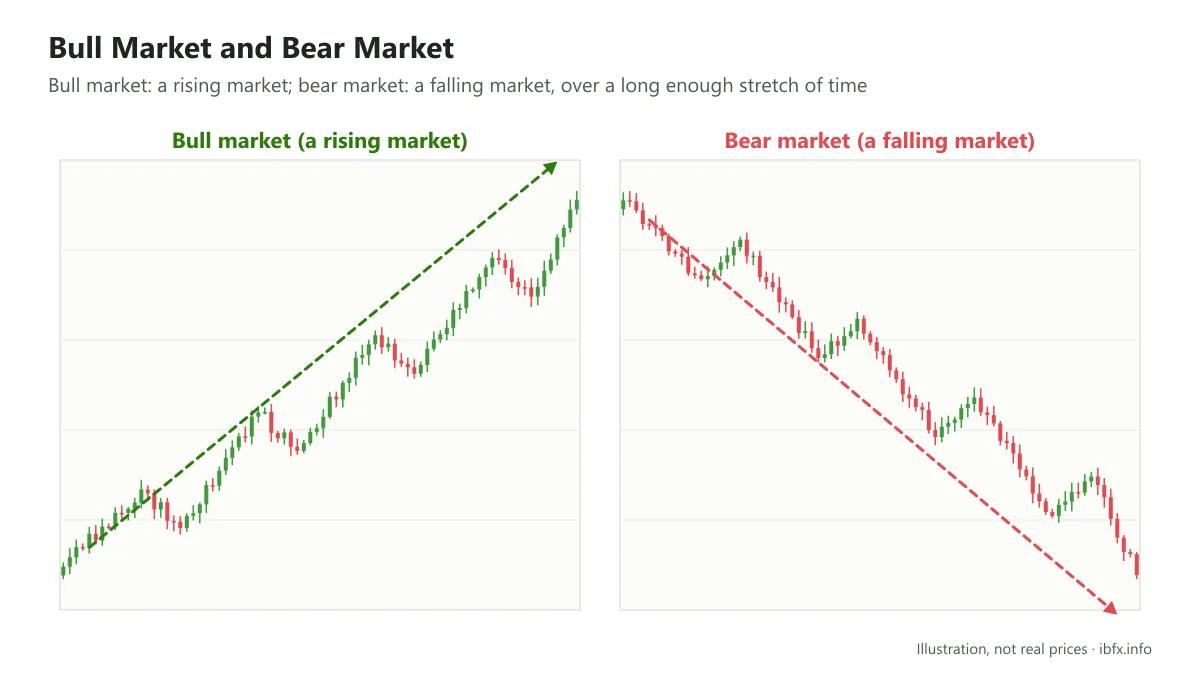
What a bull market and a bear market are, and the different sides of each
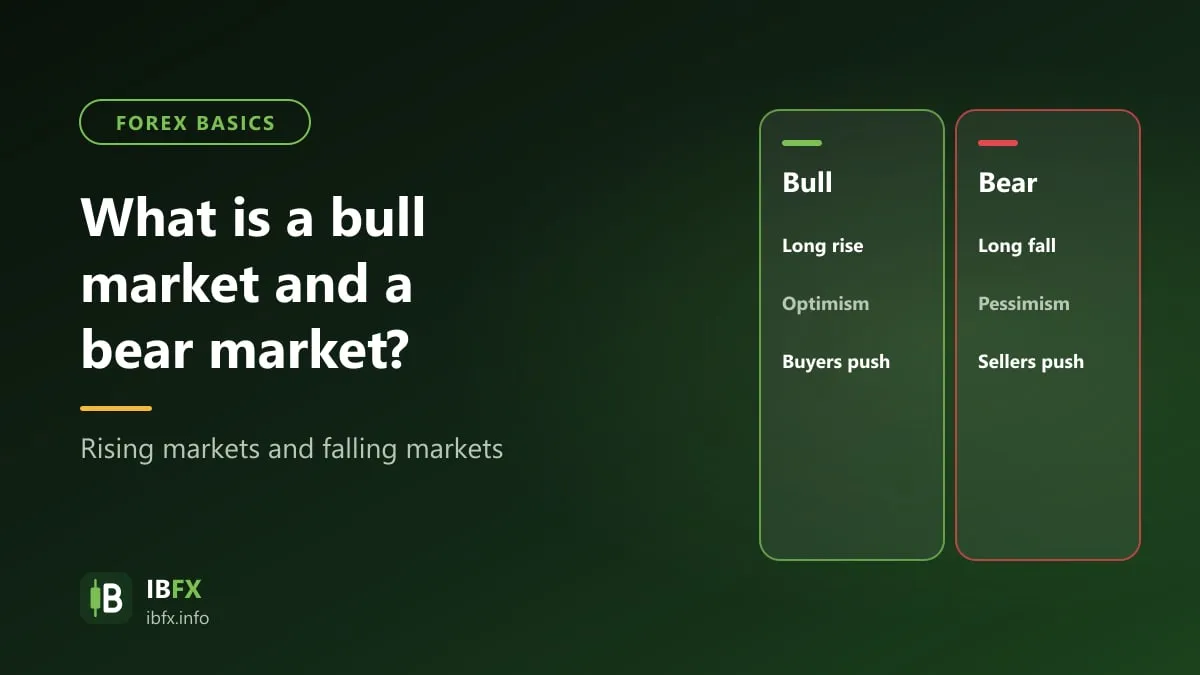
What is a bull market and what is a bear market?
A bull market is the term for a rising market, in which the prices of assets are climbing above their average level, usually along with heavy trading volume and over a long enough stretch of time. With the stock market, people often use the convention that the index rises by 20% or more from its most recent low.
A bear market is the term for a falling market, in which the prices of assets are dropping below their average level, along with heavy trading volume and over a long enough stretch of time. By the common convention in the stock market, a market counts as a bear market once price falls at least 20% from its most recent high. The 20% mark is only a convention so that everyone names things the same way, not a law of the market.
Where the two terms bull and bear come from
“Bull” is used for a rising market because it resembles the way a bull attacks, driving into its opponent from below with its horns. The other way round, “bear” is used for a falling market because a bear tends to land heavy blows from above.
Where a bull market and a bear market apply
A bull market and a bear market are used not only for the rise or fall of a whole given market (the stock market, the gold market, the property market, the foreign exchange market and so on) but also for the trend of one particular financial asset (a share, a currency, a metal, an index, a bond, a cryptocurrency and so on), of an industry (heavy industry, services, manufacturing, health care and so on), and even of the economy of a country.
For an economy, it is a bull market when the economy is growing strongly, which shows up in positive moves in economic figures such as strong GDP growth, a falling unemployment rate and more IPO activity on the stock exchanges. The other way round, it is a bear market when the economy is sliding into recession and growing slowly, under the negative readings of the economic figures.
Where a bull market and a bear market apply also has a time side to it, which means that on different time frames, or in the short run and the long run, the signs of a bull market and a bear market look different.
In the short run, a bull market or a bear market shows that an asset is rising or falling over a short stretch of time, from a few days to a few weeks. Those rising or falling legs may run with a general medium or long-term trend that is up or down, or they may be the pullbacks or rallies against a general medium or long-term trend that is up or down.
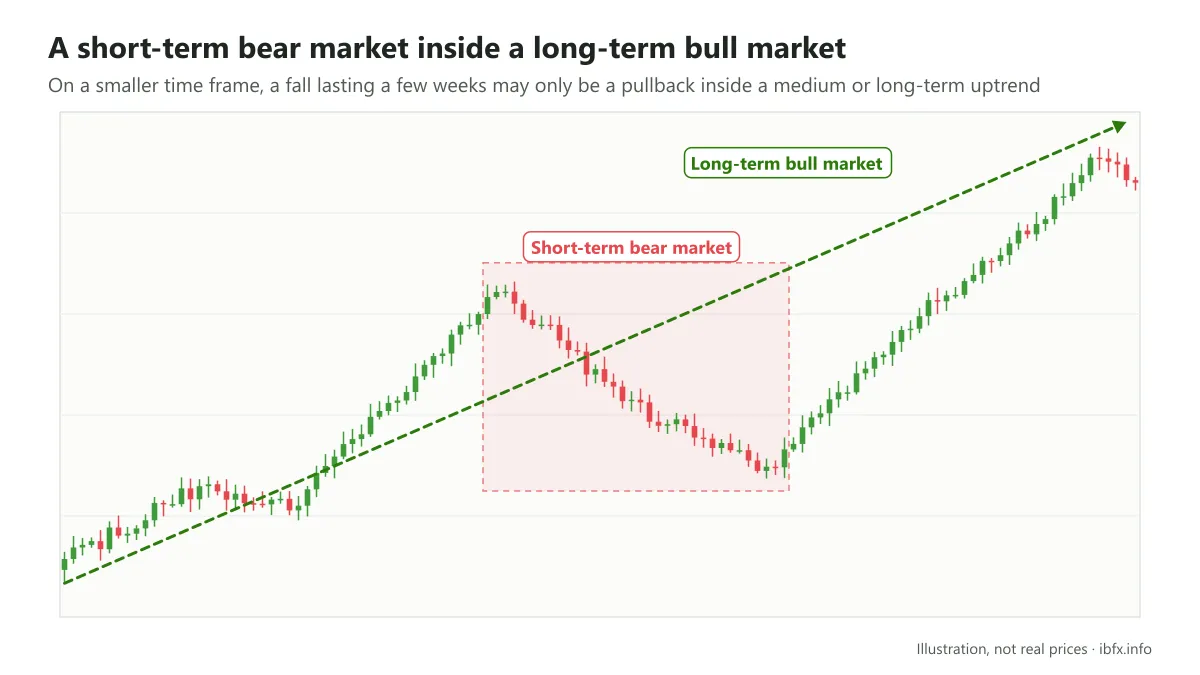
In the picture, the bear market stretch only lasts a few weeks and is a pullback inside a bull market over the medium run.
In the same way, a bull market or a bear market over the medium run shows up as runs of rising or falling prices over longer stretches of time, from a few months to under a year. In the long run, the stretches of rising or falling prices last longest, over 2 years, which is also the average length of a bull market or a bear market across a whole market.
How long do a bull market and a bear market last?
Taking a given market as a whole, the stock market for example (the two concepts of a bull market and a bear market came out of that market), a rising market tends to last longer than a falling market.
A bull market can last from a few months to a few years and tends to happen more often than a bear market. A bull market usually lasts close to 3 years on average, while a bear market lasts under a year. This depends on the stock market of each different economy; the figures above are for the US stock market.
The measure that stands for a stock market is the stock index. The VN-Index, for example, stands for the Ho Chi Minh City Stock Exchange, which holds most of the market capitalization of the Vietnamese stock market, so it can be taken to stand for the Vietnamese stock market.
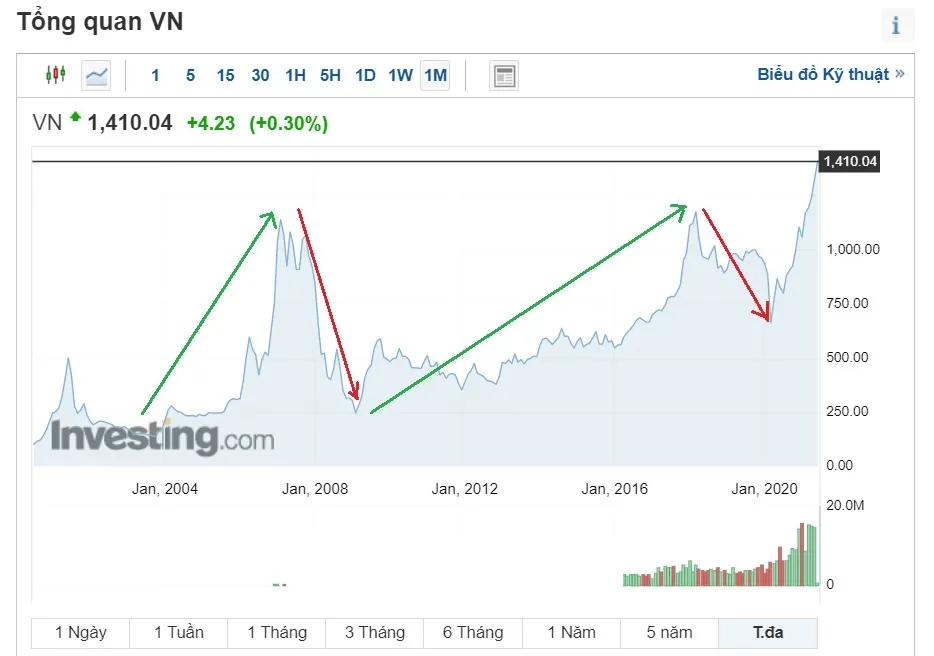
The screenshot shows the Vietnamese-language interface; the buttons and labels sit in the same places in the English one.
On the VN-Index chart, the stretch from October 2003 to March 2007 was a bull market that ran for over 3 years, while the fall from March 2007 to February 2009 (the VN-Index lost about 80%) was a bear market that ran for close to 2 years. Over 2009 to 2018 the index rose strongly, but there was a fall of more than 40% in the middle of it (2010 to 2011), so in truth that stretch holds several cycles of rising and falling rather than one unbroken bull market.
The concepts related to the two terms “bull” and “bear”
On financial markets such as stocks, forex and cryptocurrencies, next to bull market and bear market you will come across many other concepts related to the two terms “bull” and “bear”, but all of them carry one base meaning: bull means price rising, bear means price falling.
- Bullish and bearish: the general terms for a rise or a fall in the price of an asset or of a market. Bullish and bearish are sometimes used in place of bull market and bear market.
- A bullish or bearish strategy: the trading strategies used when the market is rising or falling.
- Bullish or bearish plus the name of a candlestick pattern or a price pattern plus “pattern”: these are the bullish and bearish patterns. When one appears, it hints that price may carry on rising or falling, but it is no guarantee and it can still fail.
- Bullish or bearish reversal plus the name of a candlestick pattern: the bullish or bearish reversal candlestick patterns, which hint that the market may turn around; you need a further signal to confirm before you enter a trade.
- and so on.
The differences between a bull market and a bear market
The definitions already show the basic difference between the two kinds of market: one is rising, the other is falling. The differences between a bull market and a bear market, though, also show up in the features and the signs of each kind of market.
The differences in the structure of a bull market and a bear market
A bull market and a bear market have the same structure and both have 3 stages: the start, the climax and the fading. The features of each stage, though, are different.
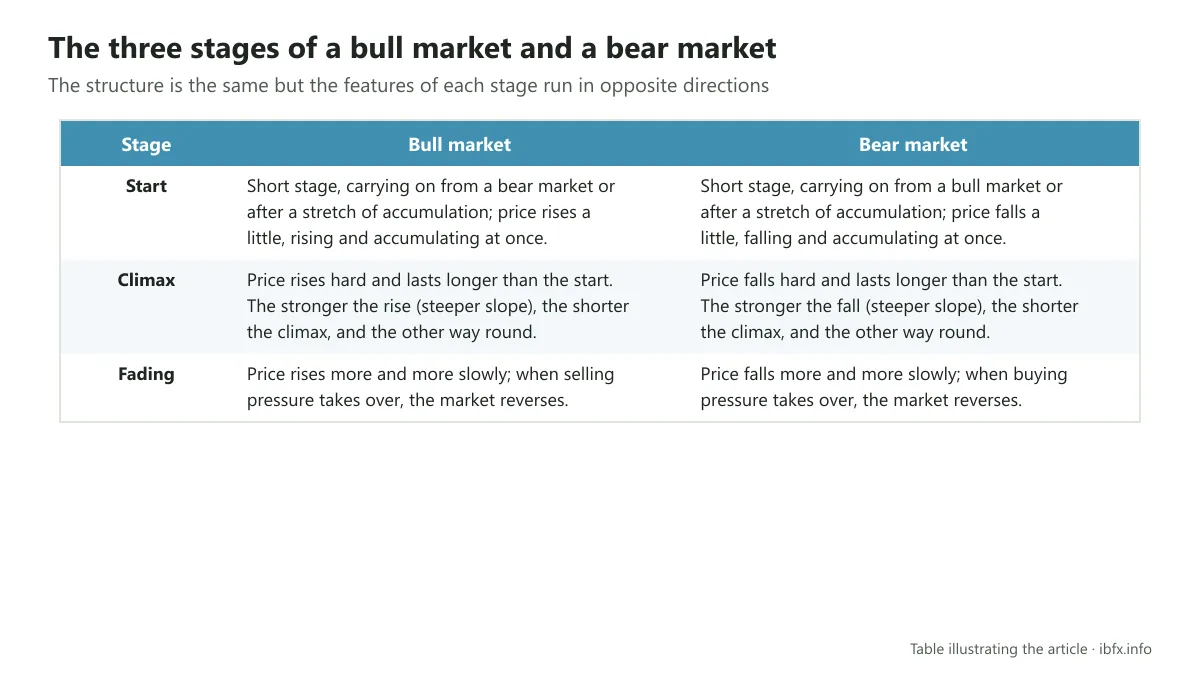
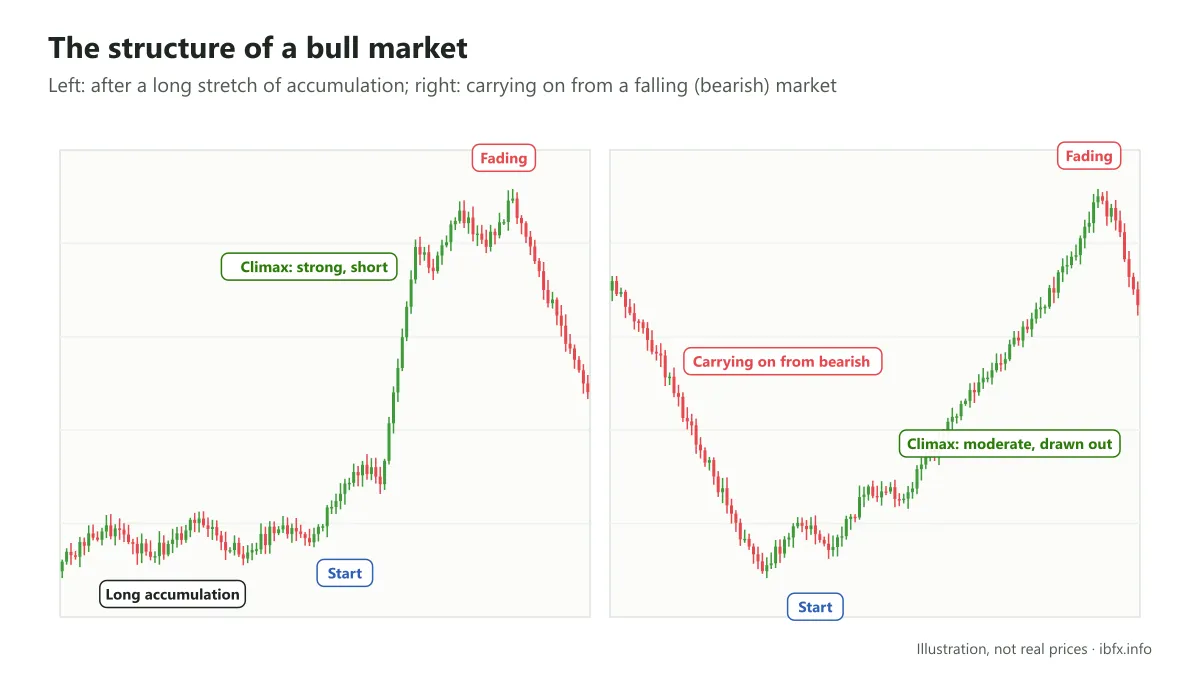
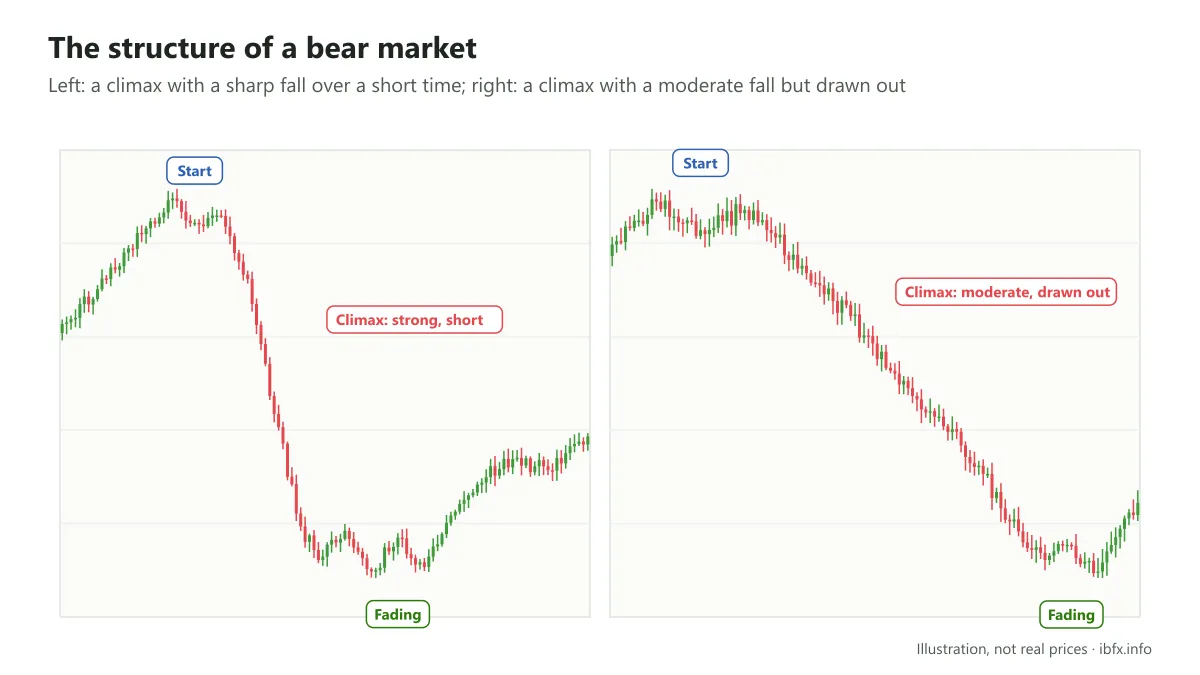
The 3 stages of the trend structure in a bull market and a bear market can usually be spotted by eye, or with other technical tools, through the behavior of price on the chart. Besides that, the structure of a bull market and a bear market also differ in the following features:
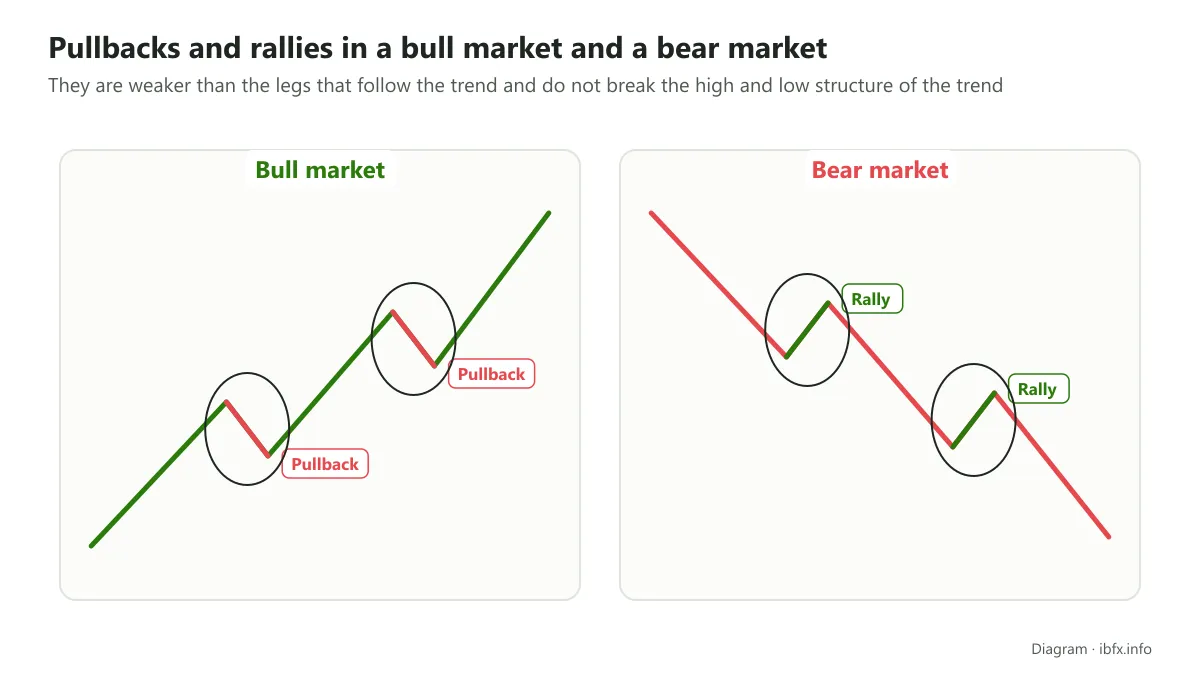
- A bull market: price makes each high above the one before and each low above the one before. In between the rising legs come pullbacks whose size is smaller than that of the rising legs, and those pullbacks do not break the structure of a bull market.
- A bear market: price makes each high below the one before and each low below the one before. In between the falling legs come rallies whose size is smaller than that of the falling legs, and those rallies do not break the structure of a bear market.
The differences in the signs of a bull market and a bear market
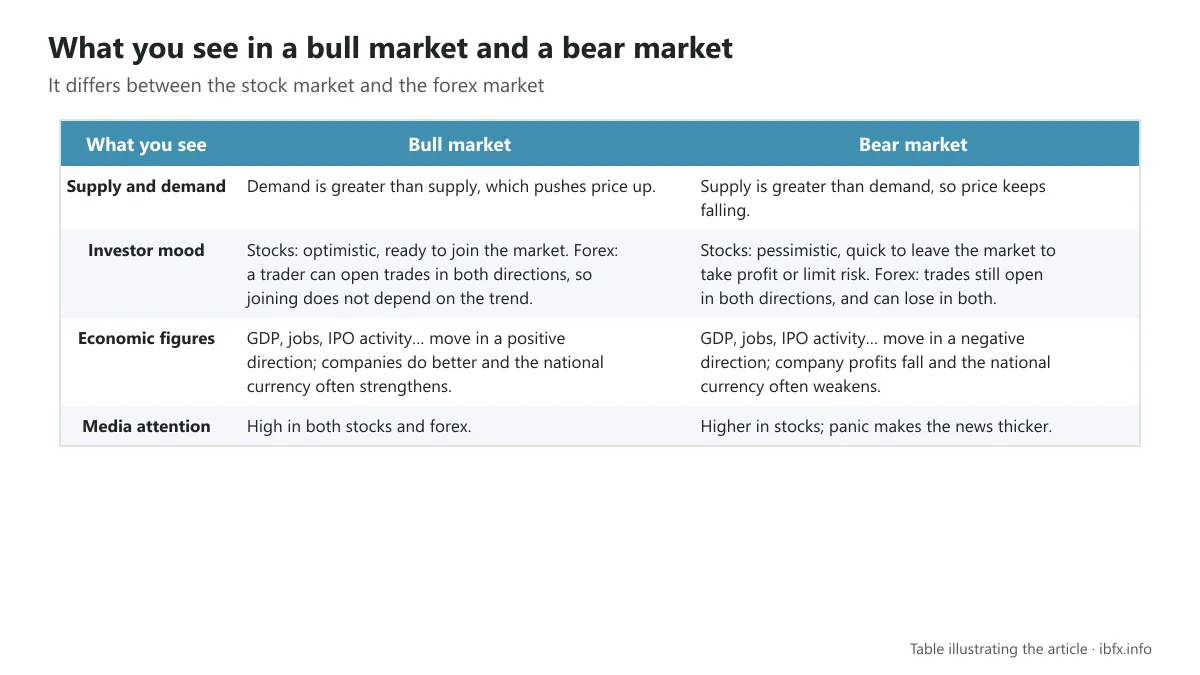
When a market rises or falls, it comes with certain signs from the forces inside the market itself, such as the balance of supply and demand or the attitude of investors, as well as from outside forces. Those signs differ between a bull market and a bear market, and they also differ between the stock market and the foreign exchange market.
What should an investor or a trader do in a bull market and in a bear market?
In the stock market
What should an investor do in a bull market?
In a rising market, the ideal thing for an investor to do is to take advantage of rising share prices by buying early with the trend and then selling out when the market is at the top of the rising trend. Buying early with the trend or selling at the top, though, is very hard and risky, and “timing” matters enormously in this market. A familiar saying among investors is “buy at the knee, sell at the shoulder”: do not try to buy the exact bottom and sell the exact top, because almost nobody manages that on a regular basis.
Keep this in mind: even inside a bull market, an individual share can still fall hard and never recover, and the market as a whole can turn down at any time. So do not put more money in simply because the market is going up; keep your weighting and your level of risk in line with how much of a loss you can take.
Should you buy shares in a bear market?
In a falling market, buy positions usually carry higher risk. Even if you decide to buy in the hope that the market will rise again, there is a chance you will be in a loss before anything changes. That is why, in a bear market, investors usually cut their weighting in shares, hold cash or switch into fixed-income assets such as bonds. In the developed markets, professional investors can also sell short or use options (option contracts) to hedge; in Vietnam, individual investors are currently not allowed to sell shares short.
There are also long-term investors who deliberately go against the crowd: when the market panics, they buy shares of good businesses at low prices, a little at a time. This approach calls for careful analysis of the business, for money you do not need, and for the stomach to watch price keep falling for a long time.
What an investor in the stock market does depends on time and on their financial goals.
- You still have a lot of time to give to the stock market and your financial goals are still at the starting line.
Whether it is a bull market or a bear market, you should still try to hold your shares and make sure you have cut your risk by diversifying your portfolio. Even though in a falling market you may be tempted to sell some shares to limit the damage, you will find it very hard to pick the right moment to get back into the market.
Because you have plenty of time, if you are young and your financial goals are still far off, you can wait for the market as a whole to recover. This holds more true for a diversified portfolio or an index fund; an individual share may never come back to its old price.
- Your financial goals are nearly met.
And if the time you have left to give to the stock market is short, you have less time to wait for the market to recover after the falls. At this point you should look over your portfolio again. You may carry on holding shares in a bull market and weigh up selling in a bear market, while mixing different kinds of asset (shares, cash, bonds and so on) and holding them in sensible proportions so that your financial goals are met and match how much risk you accept.
- You have met your financial goals and are no longer young enough to keep “fighting” the market.
Whether it is a bull market or a bear market, once you have met your financial goals and start planning for retirement, many people move gradually out of shares and into safer assets. The priority then is usually preservation rather than growth, and you can choose instruments that are safer and pay a fixed income, such as bonds or a bank deposit.
In the forex market
In forex, a currency pair is always one currency rising against the other, and a trader can open trades in both directions (Buy or Sell) thanks to the nature of the CFD, the contract for difference. But that also means you can lose in both directions, and leverage magnifies the loss exactly as it magnifies the gain.
Many traders wait until the trend is clear before entering, rather than trying to guess where it starts, so as to strip out some of the noise. In exchange, they accept missing part of the first leg of the move.
The strategy usually suggested for beginners is trading with the trend: opening a Long position (a Buy) in a bull market and a Short position (a Sell) in a bear market. Trading with the trend is usually easier to carry out than trading reversals, but you can still lose money when the trend ends, so you always need a stop loss.
You can read the detail on how to identify the trend and trade with it in these articles: bullish markets and how to trade them, what a trend is and how to identify the market trend and what a pullback is
In closing
Whether it is a bull market or a bear market, it affects your portfolio, and each kind of market carries its own opportunities and its own risks. That is why it matters to work out whether the market is rising or falling, so that you can make the adjustments or the investing and trading decisions that make sense. And to do that you need time to research, to learn and to build up experience from your own real investing and trading.