On this page
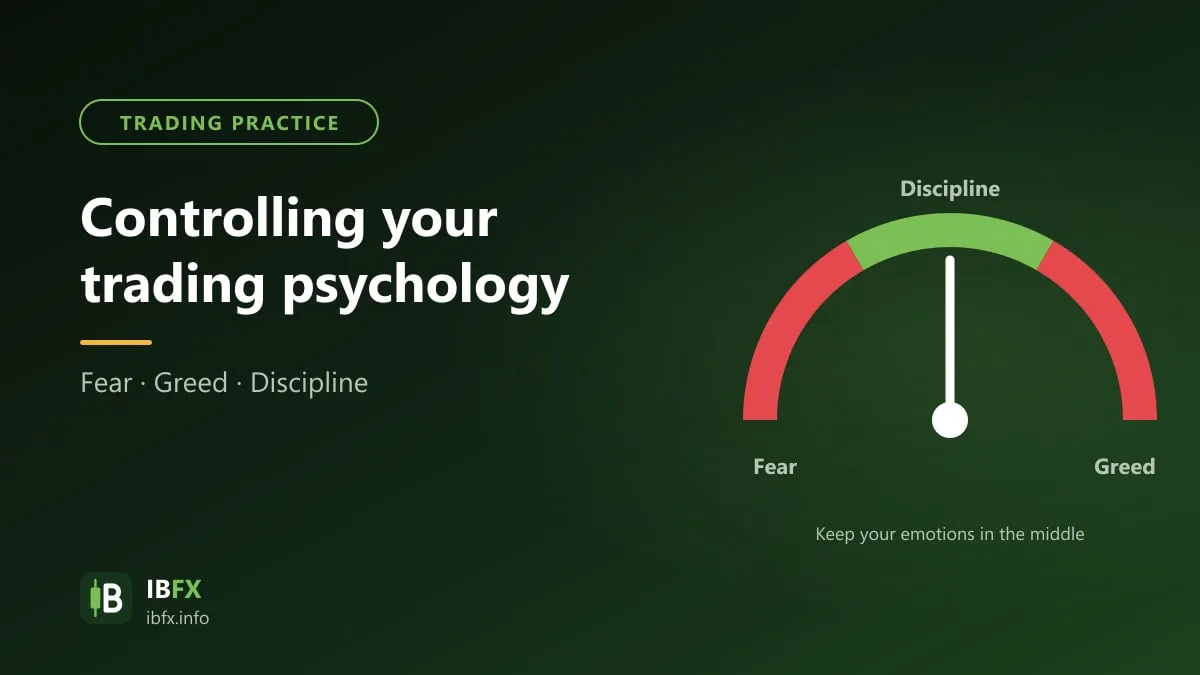
Psychology is one of the most important factors in trading, alongside your trading method and your money management. With the same trading system, two traders can end up with very different results purely because of the way they react to a profit or a loss. The forex market is full of temptations, and it can take you through the whole range of emotions: euphoria, fear, greed, regret, and the urge to “take revenge” on the market.
What is trading psychology?
Trading psychology is your own emotional state and way of thinking when you decide to buy, sell, hold or close a position. It is a different thing from market sentiment, which is the mood of the crowd as a whole - whether the market is optimistic or fearful, for instance.
Many traders carry the emotions of earlier trades into the next one: after a painful loss they are afraid and do not dare enter even when there is a signal; after a run of wins they are overconfident and raise their position size. What matters is separating emotion from each individual trade, treating every position as no more than one execution of the plan among a great many.
Controlling your psychology is a skill that takes time to practice. It not only helps you trade with more discipline, it also spares you the harm that prolonged stress does to your health and your life.
The emotions and biases you meet most often
- Fear: not daring to enter when there is a signal, or closing a position too early when price has only moved slightly against you.
- Greed: holding a position too long hoping for a bigger profit, raising your position size too far, not taking profit according to the plan.
- Fear of missing out (FOMO): seeing price run hard and rushing to chase the buy or the sell without a clear entry point.
- Reluctance to cut a loss: people usually feel the pain of losing money more strongly than the pleasure of making a comparable amount, so they tend to sit on a loss while taking profit in a great hurry.
- Revenge trading: after a loss, wanting to win it back at once by entering position after position or by raising the position size.
- Overconfidence: after a run of wins, thinking you have “figured out” the market and ignoring your risk management rules.
How to be at ease while you trade
Have a clear trading plan and trust it
In the forex market the two emotions that hold the most sway are fear and greed. An effective way to reduce them is to have a trading plan written down beforehand: the conditions for entering, where the stop loss goes, where the take profit goes, the position size. Once the plan exists, the decisions are made while you are still calm, and while the position is running all you have to do is carry them out.
To trust the plan you need to know that it has been tested: whether the method has a statistical edge, roughly what the win rate is, and roughly what the maximum drawdown on the account is. Once you understand those numbers, a losing streak becomes less frightening, because you know it was allowed for.
Test and adjust your trading system
Nobody can arrive at a trading method they can rely on in a short space of time. Before you use real money, you should test the method on past data, then practice on a demo account for long enough. A demo account lets you practice without putting real capital at risk, get used to how the market moves, and build the habit of following your plan. When you move to a live account, start with a small amount of capital and a small position size, because your psychology when real money is involved is nothing like it is on demo.
How to separate emotion from your trades
Trade a small position size
When you stake too much on a single trade you will not be able to sit still, and your mind stays under constant strain. If, on the other hand, each trade risks only a small part of the account, losing one is no longer a big deal, and it becomes much easier to decide according to the plan.
Many experienced traders limit the risk to no more than 1–2% of the account on each trade. See also: the 2% money management rule
Keep a trading journal
Write down every trade: the reason for entering, the entry price, the stop loss, the take profit, the result, and how you felt at the time. After a while you will see clearly which mistakes you keep making and in which emotional state, so that you can deal with them deliberately instead of worrying vaguely. See also: Why should you write a forex journal every day?
Set rules for stopping
Set a limit for yourself in advance: 3 losing trades in a row, for instance, or a loss of 3–5% of the account in one day, means you stop trading for the rest of the day. A rule like this keeps you out of the revenge trading spiral. See also: Risk management rules in trading you need to know
Keep learning and look after yourself
The best way to worry less is to understand properly what you are doing: learn more, review your old trades, work out which skill needs more practice. Alongside that, do not trade when you are tired, short of sleep, stressed about something else, or after you have been drinking, because your ability to make decisions is far worse at those times.
A few lessons for a sound state of mind
Accept that a losing streak is normal
No trader wins forever; everyone who has traded for years has been through runs of consecutive losses, simply because trading is a game of probability.
Suppose your system has a win rate of 50% and has been tested over a long period. Across a few hundred trades you are almost certain to run into stretches of 5 losing trades in a row, and even longer ones. The market also goes through periods that do not suit your system.
We are human, so we lose our temper easily and want to claim back at once what we have lost. That is the moment psychology slips out of control: you enter even though the conditions are not met, and multiply your position size several times over to win it back. Once you have made this mistake, the next losses usually arrive very fast, and by the time you come to your senses the account may already have taken heavy damage. Instead, turn the computer off, go outside and walk a few laps to get your calm back, and come back only when you are genuinely all right.
When the market is not in your favor, when the trend is hard to read, or when it is moving erratically because of economic or political events, standing aside is a trading decision too.
Do not keep your eyes glued to the screen
Many traders are in the habit of watching a position from the moment they enter it to the moment it closes. While the position is in profit that feels pleasant, and while it is in loss they are restless and sleep badly, especially the ones who are new to this.
Watching a position constantly usually does not help you handle the trade any better; it makes you impatient at every small move, and more likely to interfere with the position outside the plan or to pile on more positions. If you have already set a sensible stop loss and take profit, you can use the price alert feature on your trading platform instead of sitting there watching.
Is taking profit too early a good thing?
When price is moving your way and a specific signal in your plan warns of a reversal, closing early to keep the profit you have is reasonable.
If, however, you regularly close positions early simply out of fear of losing the profit, with no signal at all, you need to look again at your system or at your trading psychology. Cutting your profits short over and over makes the average gain per trade smaller while the losses stay the same size, and over the long run that can turn a method with an edge into a losing one. Then again, do not blame yourself every time price carries on after you have closed, because looking back after the event everything seems easy.
Money management and psychology always go together: trading an appropriate position size makes your state of mind steadier, and a steady state of mind helps you keep to the discipline of money management. See also: The risks you need to know about when you invest in forex