On this page
Blowing up an account is a short phrase, but one that haunts a great many traders who take part in forex trading. According to the disclosures brokers in Europe are required to publish (under the ESMA rules), about 74–89% of retail CFD accounts lose money. Traders even joke that “you are not a trader until you have blown up an account”, but blowing up an account is not something you have to go through: most cases come from mistakes that can be avoided. If you have been through this, or are going through it now, what you need to do is calm down, find the cause and change the way you trade, rather than angrily depositing more money to win it back. The article below will help you understand clearly what blowing up an account means and how to limit it.
What does blowing up an account mean?
Blowing up an account (often called a blown account in English) is when a trading account has lost nearly all, or all, of its money, and the trades are closed automatically by the broker because there is no longer enough margin. It usually happens when you trade a position far too large for your capital, price goes against you and you do not cut the loss, and the loss grows until the account no longer has enough money to hold the trade.
To understand it clearly, you need a grip on the terms people often confuse with blowing up an account:
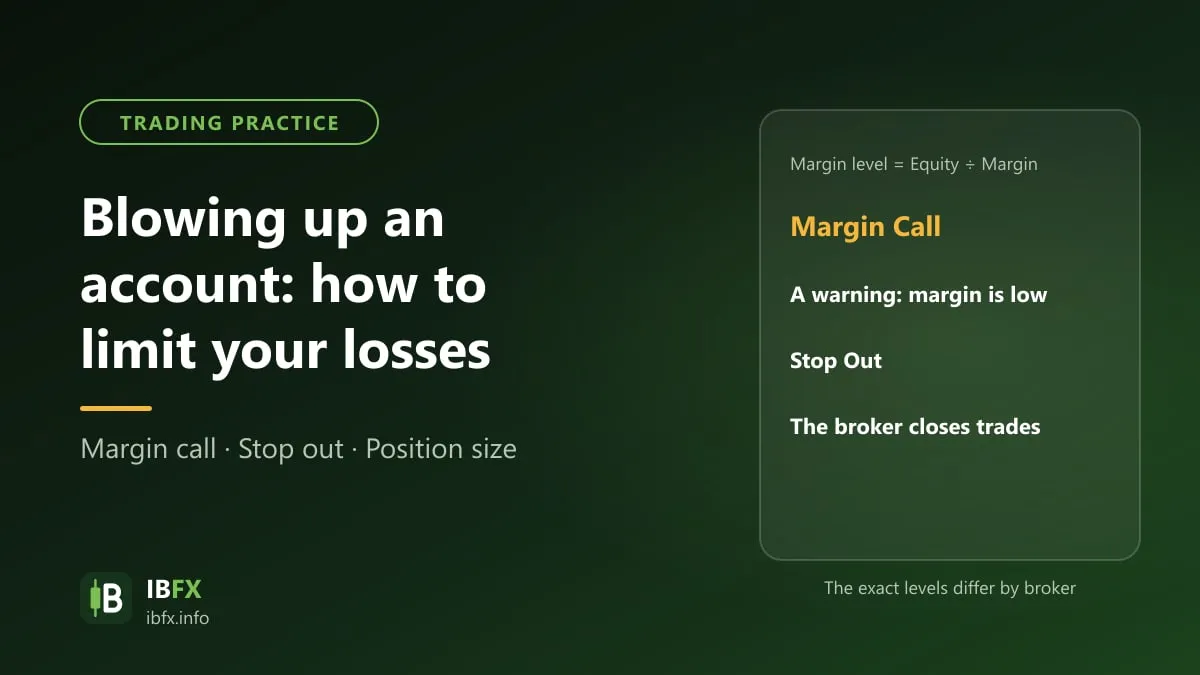
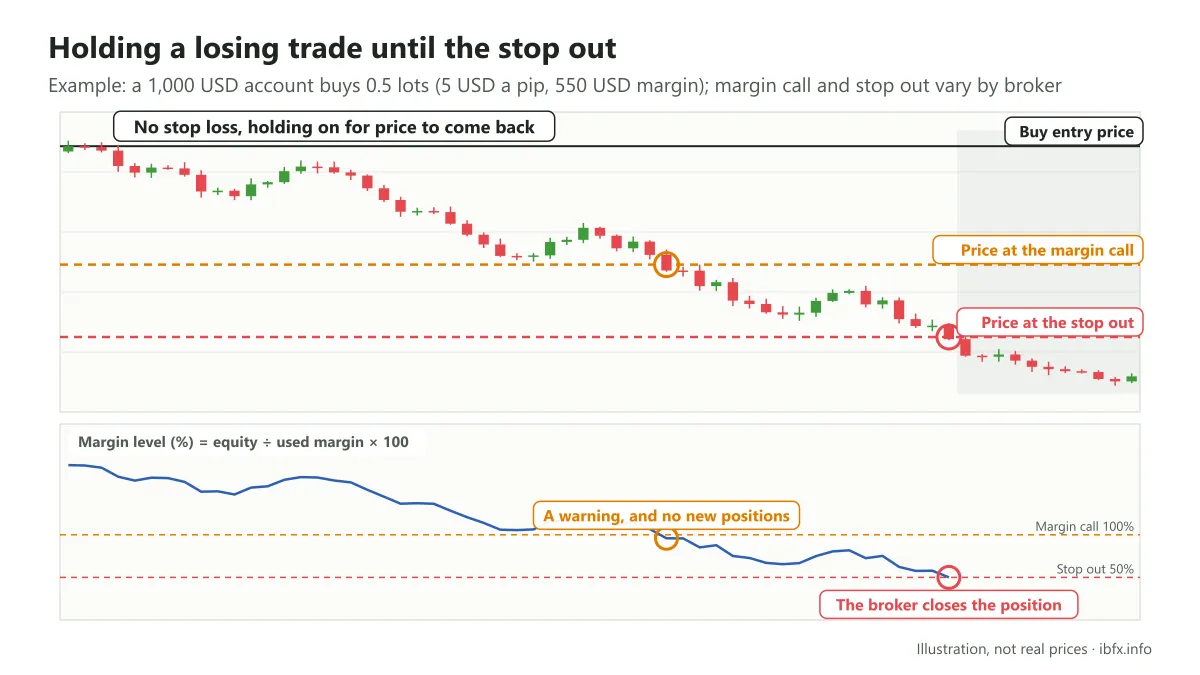
- Margin level = equity ÷ used margin × 100%. Equity is the balance plus or minus the profit and loss of the trades you have open.
- A margin call is a warning when the margin level drops to the threshold the broker sets (100% or 50%, for instance). At that point you usually cannot open any new trades and you need to deposit more money or close some of your trades.
- A stop out is when the margin level keeps falling to a lower threshold (50% or 20%, for instance, depending on the broker) and the broker closes trades automatically, usually starting with the one showing the largest loss, until the margin level is back above the threshold. This is the moment traders usually call “blowing up the account”.
After a stop out the account usually has only a very small part of it left. When price moves too fast or there is a gap, trades can be closed at a far worse price and the balance can even go negative; brokers with a negative balance protection policy will bring the balance back to 0 so that the loss does not go beyond the money you deposited. Margin call and stop out thresholds differ from broker to broker, so check them carefully before you trade. See also: What is leverage?
What causes an account to blow up
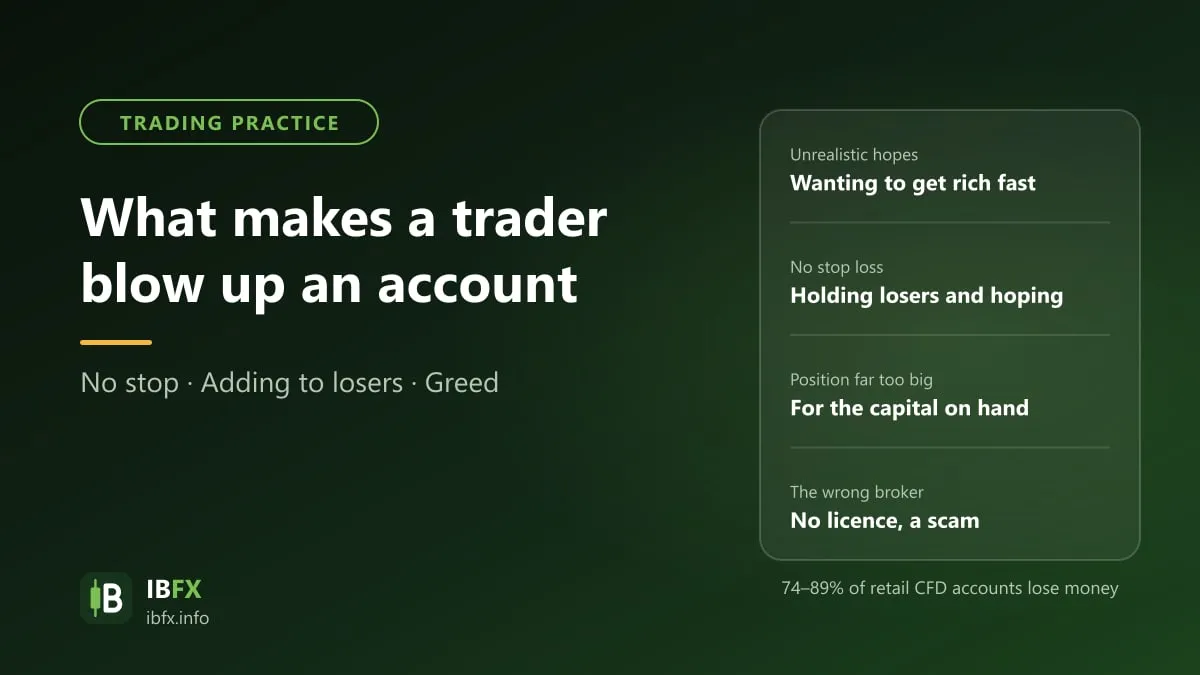
The road to blowing up an account is different for everyone, but in the end it usually starts with greed, with not being able to accept a loss, and with one of the causes below:
Trading far too large a position
Entering with a lot size far too large for your capital is the mistake most traders make. Say your account has only 100 USD and you enter 0.1 lots of EUR/USD on one trade. At that size each pip is worth about 1 USD, so price only has to run about 80–90 pips against you (depending on the leverage and the broker’s stop out threshold) for the account to be stopped out. With gold, 0.1 lots is 10 ounces, and a move of less than 10 USD against you in the gold price is enough to cost nearly all of that 100 USD, something that can happen in a few minutes when news comes out. In many cases price runs so fast that by the time you notice, the account has already “blown up”. See also: What is a pip? How to work out the value of a pip
Holding a losing trade
The second cause is also very common. After entering, price goes against you, but instead of cutting the loss many traders hold the trade and are determined to “nurse” it until it turns green again. Sometimes price really does come back, you get out of the trade, perhaps even at a profit, and those very escapes make the habit of holding losing trades harder and harder to break.
But the market is under no obligation to come back to the price you want. It only takes one occasion when price runs straight on in the opposite direction for the loss to grow until the account is stopped out. Many traders only accept the truth once the account has almost nothing left to lose.
Stacking up trades against the trend
This is another “secret manual of kung fu” that many traders take up, but sadly it is more like the Evil-Repressing Sword Manual than the Nine Yang Manual: practice it carelessly and it is very easy to go mad from the training.
Human nature does not want to admit being wrong. So when the market goes against the trade, besides holding the loss many traders go on stacking up more trades to average the price down (DCA). If price is moving in a clear trend and you keep trading against it, it is like standing in front of a moving train in the hope it will stop. Each extra trade adds to your total position size, so it only takes a short further move against you for the loss to grow very fast, which blows the account up sooner. See also: What is DCA?
Using high leverage and holding trades through strong news
High leverage lets you open a large position with a small amount of capital, so the loss is correspondingly large. Regulators such as ESMA (Europe), the FCA (the UK) and ASIC (Australia) cap leverage for individual clients at 1:30 on the major currency pairs, but many brokers in other regions still allow 1:500, 1:1000 or more. Combining high leverage with holding trades through strong news such as Non-Farm Payrolls or an interest rate decision, or over the weekend (when there can be a gap at the start of the week), is a very fast road to blowing up an account. See also: What to watch out for when trading forex on the news
How to avoid blowing up an account
Work out your position size from the risk on each trade
Before you enter, decide where your stop loss goes, then work out a position size such that if the trade hits the stop loss you only lose about 1–2% of the account:
Position size (lots) = amount at risk ÷ (stop loss in pips × the pip value of 1 lot)
For example: a 1,000 USD account, 1% risk is 10 USD, a 25 pip stop loss on EUR/USD (1 pip on 1 standard lot is about 10 USD), position size = 10 ÷ (25 × 10) = 0.04 lots. Working it out this way, even if you lose 10 trades in a row you still have about 90% of the account. See also: the 2% money management rule
Always place a stop loss as soon as you enter
Set the stop loss and the take profit from the start, so that when the market goes against you the trade is closed automatically and you never end up sitting on a loss. Note that a stop loss order, once triggered, is filled at the market price, so when news comes out or there is a gap it can still slip well beyond the level you set. See also: What is a stop loss?
Use low leverage and choose a broker with negative balance protection
Keep the total value of your open trades moderate compared with your capital, rather than using up all the leverage the broker allows, and favor a broker with a license you can trust and a negative balance protection policy. See also: How to choose a forex broker to trade with
What should you do after blowing up an account?
Accept the loss
The first thing, and an extremely important one, is that you have to learn to accept losing and to accept being wrong. Only then will you learn how to cut a loss. A great many people regret the money they have lost and look for ways to hold the loss in the hope of getting it back. When that happens you easily fall into a negative, bewildered, fearful state, and those feelings make you take the next set of wrong decisions.
Practice cutting losses until it is a reflex. Do not regret the money you have lost too much; think of it positively: while you still have money, however much or little, you still have the chance to put things right. Once you have held a loss to the point of blowing up the account, you have no chance left, unless you deposit more money.
Find out what caused the mistake
Rather than being bitter and looking for ways to “take revenge” on the market, take a deep breath and look back over the mistakes that blew up the account: was it too large a position, no stop loss, stacking up trades, or trading as news came out? Write down all of those causes in your trading journal and set yourself rules so that they do not happen again. See also: What makes a trader blow up an account?
“While you have money you can trade; when the money is gone, go back to demo”
Going back to a demo account after blowing up an account is nothing to be ashamed of. It is a chance to correct the mistakes you made without losing any more money.
Treat the demo account like a real one. Instead of opening a demo account with 100,000 USD, open one with the same capital you really intend to deposit later on. Trade the method you set out, at the position size your rules allow, with discipline, with a clear stop loss and take profit, over enough trades (several dozen to several hundred) and over several months, to be sure you have corrected the old mistakes. Only then should you think about going back to a real account with a small amount of capital.
Note that results on a demo do not guarantee results on a real account, because the psychology of using real money is very different, quite apart from slippage and trading costs. Correcting your old mistakes is a necessary condition for coming back to the market, but there is nothing to guarantee that you will make money.
Do not borrow money to trade after blowing up an account
A great many traders who blow up an account fall into a state of regret and bitterness, and look for ways to borrow money from friends and family, or even take out a high-interest loan, in order to go on trading and win it back. Do not correct this mistake with a bigger one: trade only with spare money you are prepared to lose, and never borrow money to trade forex. The forex market will still be there, and you can come back when you are really ready in yourself.
On top of that, trading forex through a foreign broker in Vietnam is not at present recognized or protected by law, so if a dispute arises you have almost no way of getting your money back. See also: Is forex trading legal in Vietnam?