Risk management means settling in advance, and capping, the loss that can happen when you trade on the forex market. Risk here is the chance of losing part or all of the capital you invest, and it comes from many causes: a lack of knowledge, a lack of experience, having no suitable risk management method, a sudden move in the market… Nobody avoids losses, but you are perfectly able to control how large each loss is.
Why you need risk management when you trade forex
Risk management lets you know in advance the most you can lose on each trade, each day and each month, and from there decide your position size, when to enter and when to stop.
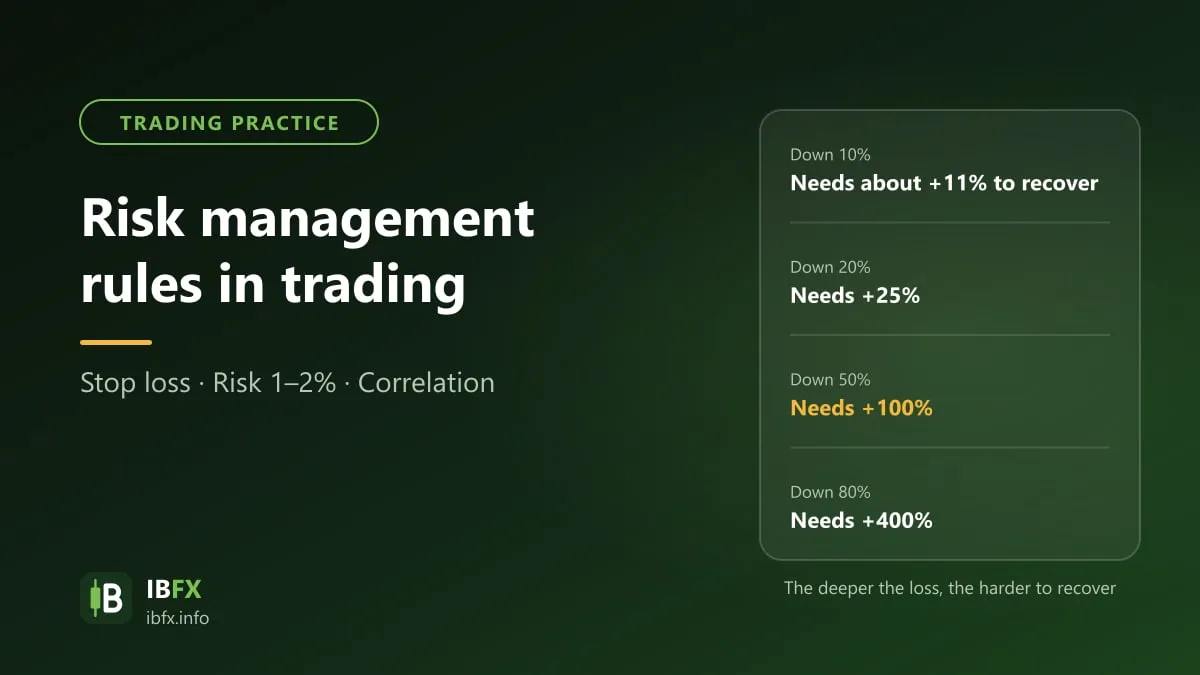
One important reason is that the arithmetic of losses is not symmetrical: the deeper the account is down, the harder it is to win back.
- A 10% loss needs a gain of about 11% to break even.
- A 20% loss needs a gain of 25%.
- A 50% loss needs a gain of 100%.
- An 80% loss needs a gain of 400%.
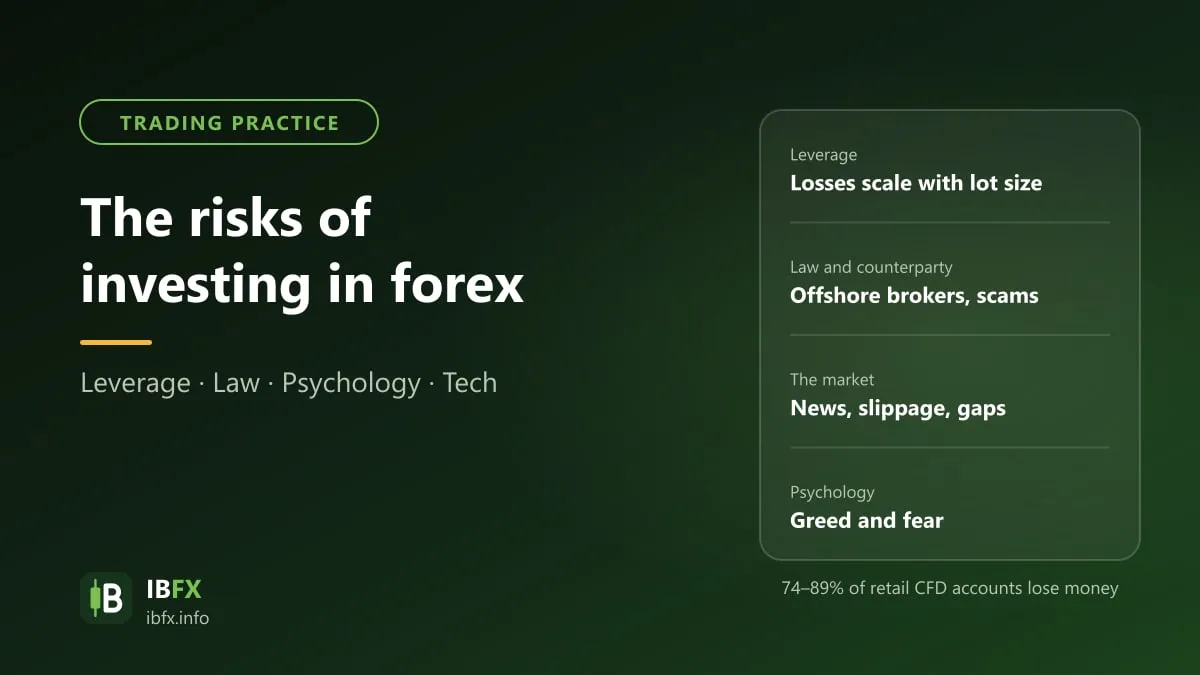
See also: The risks you need to know about when you invest in forex
Risk management is not only about capital. It also covers other risks such as a computer fault, the internet connection, a problem at the broker, legal risk… See also: “The risks you need to know about when you invest in forex”.
So what do you need to do to limit your risk?
Always set a stop loss on every trade
Every trade has a different stop loss distance, and the more volatile the market, the wider the stop loss usually is. The stop loss is one of the most basic tools of risk management, because it caps your loss when the market goes against your forecast.
If a trade has no stop loss, a single wrong trade with a large position size can blow up the account. Whether the stop loss is far or near depends on each person’s method, but it should sit at a level where, if price reaches it, your original read is no longer correct (below the support area when you are buying, for instance), rather than being placed arbitrarily. Bear in mind that when news comes out or there is a gap, a stop loss order can still suffer slippage.
Alongside the stop loss comes the risk/reward ratio (R:R). If you trade at a ratio of 1:2 or 1:3, meaning the potential profit is 2 or 3 times the maximum loss, then the break-even point sits at exactly 33.33% or 25% of trades (before trading costs) — to come out ahead you have to win more than that. However, the further away the profit target, the lower the probability of reaching it, so it has to be balanced against what your method actually does.
Keep the risk on each trade moderate
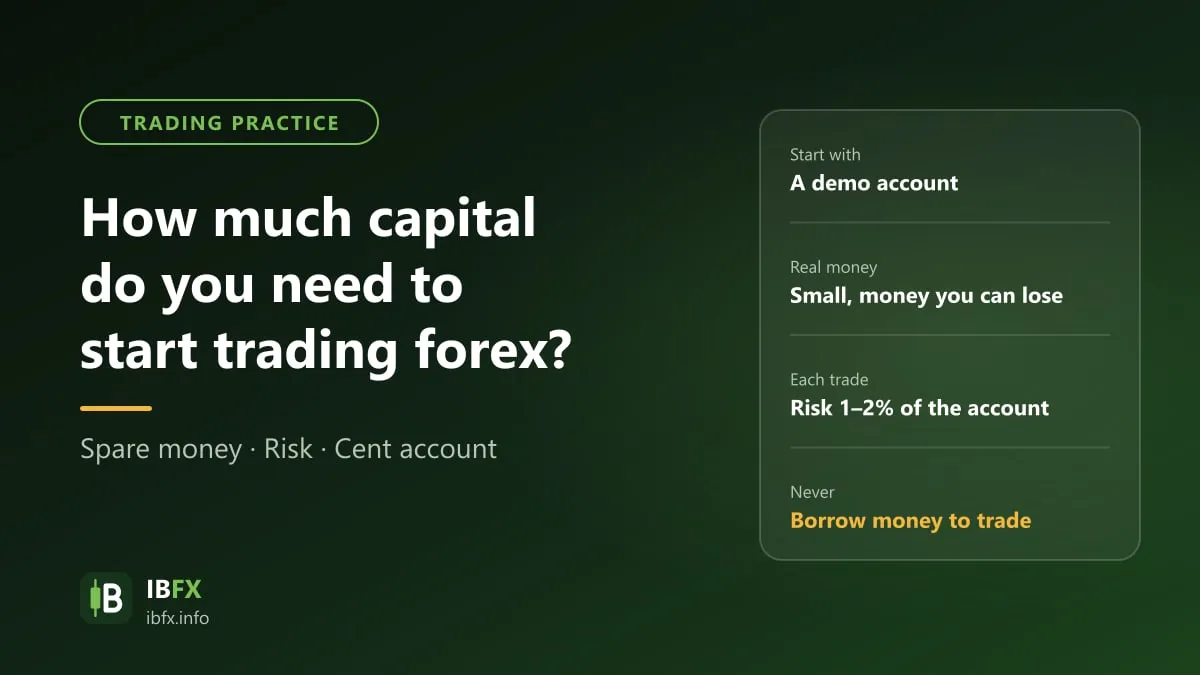
Before each trade, settle your entry and your stop loss, then work out a position size such that if you lose, you only lose a small percentage of your account balance. The figure many traders use is 1-2% per trade.
Position size (lots) = amount at risk ÷ (stop loss in pips × the pip value of 1 lot)
An example: a 2,000 USD account, 1% risk is 20 USD, a 40 pip stop loss on EUR/USD (1 pip of 1 standard lot is about 10 USD), position size = 20 ÷ (40 × 10) = 0.05 lots. See also: the 2% money management rule, “What is a lot?”
Each trader can pick a figure of their own that suits how much risk they can carry, but should also set a total risk limit: the combined risk of the positions open at the same time, and the maximum loss allowed in one day.
Cap your losses by day, by week and across the whole account
- By number of trades: if you trade intraday, you can make it a rule that 3 losing trades in a row means stopping for the rest of the day, to keep revenge trading at bay. The market at that moment may be chaotic, or simply unsuited to your method; a break helps your head clear again.
- By week: if you lose 2 or 3 days in a row, consider stopping for the rest of the week.
- Across the whole account: set a maximum drawdown threshold from the account’s peak — many traders pick something around 15-20%, but this is a figure you set for yourself, according to what you can bear; there is no standard number. When you reach it, stop trading live, reassess the system, and practice on a demo account again before you come back.
Watch the correlation between currency pairs
When you open positions on several currency pairs, you have to weigh the correlation between them. Positive correlation means the two pairs usually move in the same direction; negative correlation means the two pairs usually move in opposite directions.
EUR/USD and GBP/USD, for instance, are usually positively correlated, because they share USD as the quote currency. If you buy both pairs and risk 2% on each, you are in effect betting about 4% on USD weakening. EUR/USD and USD/CHF, on the other hand, are usually negatively correlated, so buying both pairs at the same time is close to two positions canceling each other out.
Should you add to a winning position?
One thing experienced traders do is not enter the whole position size on the first trade, but split it up.
For instance, if you allow a maximum risk of 2% on one trade idea, you can split it into 2 entries of 1% each: enter 1% first, and only add the second 1% if price moves the right way. Each time they enter again, they move the stop loss on the earlier position so that the total risk does not go past the level they set.
This has two benefits: if you run into a false breakout (price turns straight back after the break), you only lose on the small part you entered; and if price runs a long way in the right direction, the added positions make the profit larger while total risk stays inside the limit. Only add when the earlier position is already in profit and the stop loss has been moved; never add to a position while it is losing. If you are new, keep your entries simple before you take this technique up.
Cut your position size during a losing streak
In a losing streak, what matters is not how to win it back quickly but how to cap the losses, like plugging the hole in a water barrel before you think about pouring more water in.
One approach is to cut position size sharply when the account draws down. For example, a 5,000 USD account falls 20% to 4,000 USD; you can trade as though the account only had 3,000 USD in it, risking about 1-2% of 3,000 USD per trade, until your results settle down again. Do not be in a hurry to win it back.
Be careful with news, leverage and your choice of broker
- Avoid opening a large position right before strong news such as Non-Farm, CPI or an interest rate decision, because the spread can widen and price can slip heavily. See also: “Important points to watch when you trade forex on the news”
- Use low leverage; many regulators cap leverage for retail clients at 1:30 on the major currency pairs: ESMA brought in a temporary measure in August 2018 which the national regulators across the EU then wrote into their own rules, the UK FCA did so from August 2018, and ASIC in Australia applied it from Mar 29, 2021. See also: “What is leverage?”
- Choose a broker that holds a reputable license and has a negative balance protection policy. Bear in mind that in Vietnam, trading forex through a foreign broker is not currently recognized or protected by law. See also: Is forex trading legal in Vietnam?
Know when to stand aside
When the market is highly unstable because of geopolitical or economic factors, or you can see that your own method is in trouble, pause your trading for a while.
Stepping back is not a failure. It is a pause to deal with the emotional side, to get more time for research, and to wait for the right moment to come back.
When you trade on the forex market, the first thing a trader has to care about is keeping their own capital safe: think about keeping money before making money.