On this page
We all know that to take part in the forex market the first thing to do is open a trading account at some forex broker. Few people, though, look deeply into forex brokers; they focus only on how to read the direction of price correctly. That matters, of course, but learning about forex brokers is not wasted effort either.
Once you understand what a genuine forex broker is and how it works, you will find it easier to recognize the tricks of the “fake” brokers, and easier to pick a broker you can trust, one that does the job well — which matters a great deal, because it affects whether you succeed or fail on the market.
What is a forex broker?
A broker, or intermediary, is an organization or a person acting as a middleman, connecting people who want to buy with people who want to sell some asset or product on a given market.
An example of a broker: on the real estate market, a broker’s job is to find people who want to buy a house or a plot of land for people who want to sell, or the other way round — to find people who want to sell and introduce them to people who plan to buy — and then advise them on price and on the paperwork. The reward, or the pay, they get for this brokering is the commission that the buyer and the seller pay them once the deal goes through.
A forex broker works in much the same way. A forex broker’s job is to help investors reach the foreign exchange market and to connect them with people all over the world who want to buy or to sell as they do. The forex broker provides the trading environment, the place where an investor who wants to buy meets another who wants to sell, and the other way round.
The main assets and products traded on this market are forex pairs, along with gold, indices, shares and a great many other assets, depending on the broker.
How a genuine forex broker works
At a broker that passes orders out to the market, the broker receives quotes from liquidity providers, passes those quotes on to the investor, and when the investor places an order, sends the order to a liquidity provider to be filled. At a broker that takes the other side, the broker itself is the counterparty to the order (see the classification below). The better a broker’s liquidity, the more easily an order is filled near the price you see. But no broker can promise a fill at exactly that price 100% of the time: when the market moves sharply or news comes out, an order can still be filled at a different price (slippage).
Once the investor closes the position (closes it by hand, is stopped out at the stop loss, or reaches the take profit), the broker calculates the profit or the loss on that trade and transfers it straight to the investor’s account.
Receiving quotes, publishing quotes, taking orders, routing orders, filling them and transferring the profit or the loss are all done automatically and instantly in the trading software.
The trading software displays everything to do with your trading account, the products on offer, the quotes, the order entry areas, position management and so on; it is the platform that connects you to the global trading network.
- The steps for a trader to connect to a broker and to the market
There are four main steps:
- Choose a forex broker that you can trust, that does the job well and that suits your capital and your needs. This step is extremely important, and we set it out in detail later in this guide.
- Open a trading account and deposit money into it. The trading account is what identifies you on the market; only with an account can you log in to the trading software and place buy and sell orders. And you can only place an order with money in the account, just as you have to take money with you when you go shopping. Before you deposit real money, practice on the broker’s free demo account.
- Download the trading software: use the account you created to log in to the trading software and start placing your trades.
- Trade: choose a product and place a buy or a sell order.
Types of forex broker
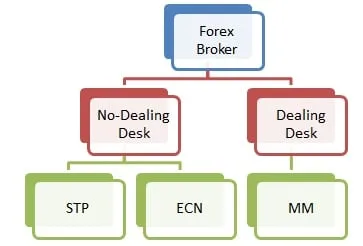
Forex brokers are currently split into two types according to how they quote prices: No-Dealing Desk brokers and Dealing Desk brokers.
-
Dealing Desk brokers are market makers, or MMs. They set their own quotes for traders (based on the market price) instead of passing a liquidity provider’s quotes straight through. These brokers do not send a trader’s orders out; they keep them, which means you are trading directly with the broker rather than with the market. Because the broker is the direct counterparty to your order, its interests and the trader’s can conflict; the spread is usually fixed and can be higher than at a broker that passes orders out to the market.
-
No-Dealing Desk brokers come in two different kinds: STP (Straight Through Processing) and ECN (Electronic Communication Network). The two work fairly similarly — both send the trader’s order straight out to the market instead of taking the other side — but there are some differences.
- An STP broker may offer a fixed or a floating spread. Either way, an STP broker “adds a little” to the spread to make its money.
- An ECN broker is usually connected to several large liquidity providers, takes quotes from them, and usually does not add to the spread but charges a separate commission.
It is this difference that makes many traders, professionals especially, want to trade on an ECN account. That said, the name “ECN” is one the broker gives itself; not every broker that advertises ECN really does send orders out to the market.
How do forex brokers make money?
A forex broker’s income comes mainly from the spread and from commission, plus the amount added on top of the swap. At a broker that takes the other side, its clients’ losses are income too.
The spread: the difference between the Bid price and the Ask price. Every broker quotes each product at two different prices: the Bid (which fills Sell orders) and the Ask (which fills Buy orders), and the Ask is always greater than or equal to the Bid. For example, when you open a Sell you are filled at the Bid, but when you close it you are filled at the Ask; being filled at the Ask (which is higher than the Bid) when you close a Sell reduces the profit or increases the loss. And that is the fee you pay the broker.
The spread is measured in pips. For example, EUR/USD is quoted like this:
- Ask price: 1.20000
- Bid price: 1.19980
The spread here is 2 pips. One pip on EUR/USD is worth 0.0001 USD, so a spread of 2 pips comes to 0.0002 USD. If you trade 1 lot, the spread you pay the broker is 20 USD.
Commission: the fee a trader pays the forex broker for trading; it is charged on every position, both on opening and on closing. Commission is worked out from the volume traded — for example 3 USD/lot/per side, meaning it is counted on one side only, opening or closing, so a complete trade (open and close) comes to 6 USD/lot/round turn.
Typically, MM brokers set a high fixed spread and charge no commission. STP brokers float the spread, but it is high as well, and they charge no commission either. ECN brokers float a very low spread and do charge commission.
Compared with a “no commission” policy paired with a fairly high spread, a competitive commission paired with a low spread works out better for the investor. That is also why traders who deal in size tend to prefer the commission-plus-low-spread model to the no-commission model.
The criteria for choosing a forex broker
A broker that meets all three standards — “trustworthy”, “good at the job” and “a fit for you” — is the best choice, and the one every trader is after. Below are the basic criteria a forex broker has to meet for those three standards, as we would suggest them to you:
A solid legal record: a broker earns a trader’s confidence by being licensed by one or more of the world’s leading forex regulators. The three most often named are the FCA (UK), ASIC (Australia) and CySEC (Cyprus). Their requirements on capital, on segregating client money and on compensation funds are not the same, so do not treat every license as equivalent — read the specific terms of the entity your account actually sits with.
A broker licensed by these regulators has to keep client money separate from the company’s own accounts and is supervised regularly. But a license belongs to one particular subsidiary: clients outside the UK, the EU and Australia are usually given an account at a subsidiary registered somewhere else, where those protections do not apply. So check the name of the company on your agreement. This is still the most important criterion, but it does not mean that a licensed broker leaves you nothing to worry about. And wherever a broker is licensed, trading through a foreign broker is not protected by Vietnamese law when a dispute arises; see Is forex trading legal in Vietnam?.
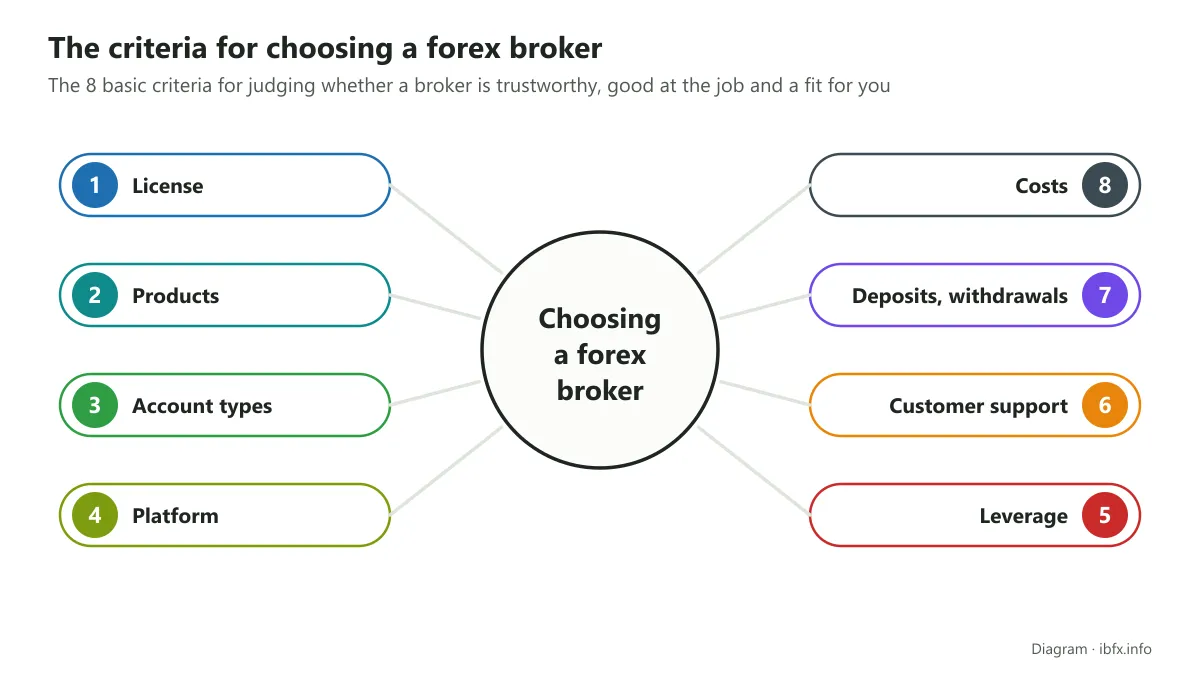
A wide range of products: this one depends on what each person wants to trade. If you only care about currency pairs, you do not need a broker with a broad product list; but if you are interested in other, more advanced financial assets, you should favor a broker that offers many different products.
Several types of trading account: each account type comes with different trading conditions and a different deposit requirement. Traders have different amounts of capital and different levels of experience, so each needs the account type that suits them.
A broker offering several account types can serve several segments of investor. A new trader with little capital needs a standard account, while experienced traders with large capital want an ECN account to benefit from the spread or from the broker’s more advanced services.
Good trading software with plenty of advanced analysis tools: software that is good and stable, with no stutter and no lag, gets a trader’s orders filled faster. Advanced analysis tools make the analysis more convenient, but they do not by themselves make your forecasts more accurate if you do not yet have a clear trading method.
Low trading costs: a broker with a low spread and competitive commission saves a trader a great deal. On top of that, at a broker whose spread is high to begin with, the spread widens sharply when the market moves hard, and the cost climbs much further.
Several deposit and withdrawal channels, and fast withdrawals: each trader uses one or a few particular online payment methods, so choosing a broker that supports many deposit and withdrawal channels makes it more likely that the method you use is covered. Besides that, a broker you can trust processes deposits and withdrawals quickly, does not sit on a trader’s money and does not make withdrawing unduly difficult.
Good customer service: forex is a field of investment that demands a lot of knowledge, so there will be times when a trader needs the broker’s help, especially on technical matters, on opening an account and on deposits and withdrawals. For that reason you should also choose a forex broker whose support staff work in the language you use.
Beyond these, depending on what each trader wants from their investing, there are further criteria: the leverage ratio, the minimum deposit into the account, promotions, forex contests and so on. Bonuses in particular usually come with a condition that you trade a certain volume before you can withdraw, so read the terms carefully before you accept one.
Alongside the brokers you can trust and that do the job well, the share of fraudulent forex brokers keeps growing. These brokers use all kinds of tricks to pull investors into opening an account with them, and the tricks keep getting more sophisticated and harder to spot — above all, they play on an investor’s greed for profit so that they fall into the trap more easily.
We have put together a number of the tricks used by the “fake” forex brokers in How to spot forex scams, so that if you meet one you know to stay well away.
We hope that what we have shared in this guide gives you a grip on what a genuine forex broker is and how it works, and helps you pick the forex broker that you can trust, that does the job well and that fits you best.